
Forcibly Displaced People 2022
Forcibly displaced people include refugees, asylum seekers, and internally displaced persons worldwide.
Newer data is available: Forcibly Displaced People by country 2025 →
 Syrian Arab Republic
 Vietnam
Where does your country rank? Pick it to see its position.
Related Transnational Issues statistics
More ↓Interactive Map
Complete Data Rankings
Rank | Actions | ||
|---|---|---|---|
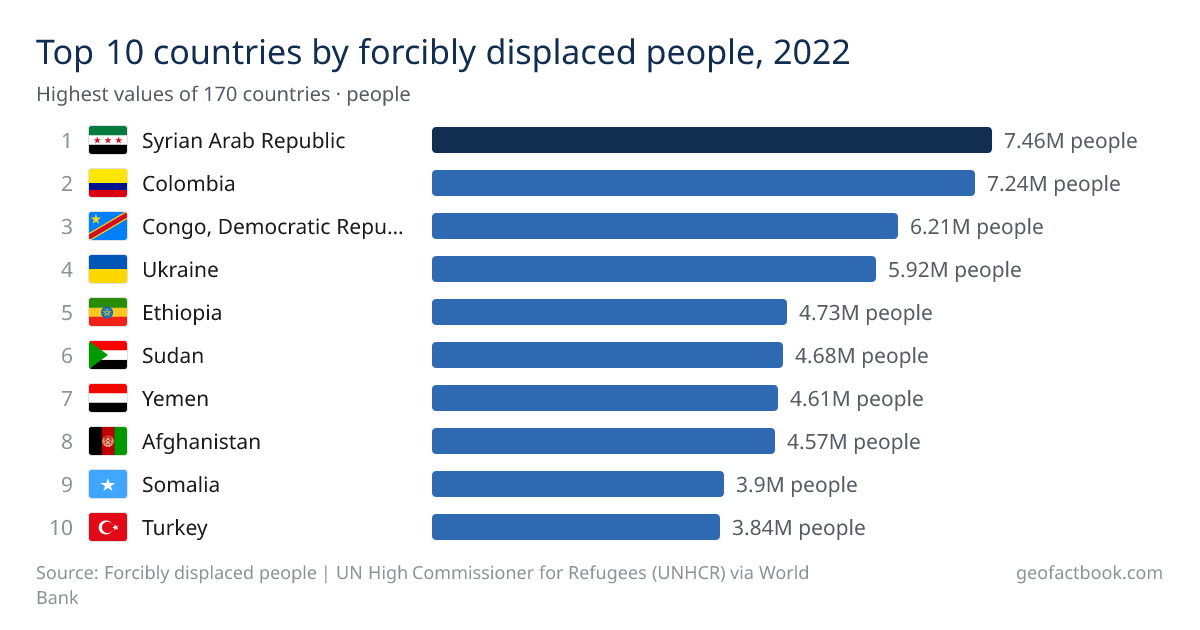
1 | Syrian Arab Republic | 7,464,382 people | |
2 |  Colombia | 7,244,144 people | |
3 |  Congo, Democratic Republic of the | 6,208,691 people | |
4 |  Ukraine | 5,917,022 people | |
5 |  Ethiopia | 4,733,812 people | |
6 |  Sudan | 4,681,958 people | |
7 |  Yemen | 4,613,683 people | |
8 |  Afghanistan | 4,565,377 people | |
9 |  Somalia | 3,898,601 people | |
10 |  Turkey | 3,840,595 people | |
11 |  Nigeria | 3,738,898 people | |
12 |  Iran | 3,425,125 people | |
13 |  Jordan | 3,108,028 people | |
14 |  State of Palestine | 2,466,258 people | |
15 |  Germany | 2,336,464 people | |
16 |  United States | 2,161,849 people | |
17 |  Burkina Faso | 1,916,926 people | |
18 |  Pakistan | 1,798,062 people | |
19 |  South Sudan | 1,785,506 people | |
20 |  Peru | 1,586,821 people | |
21 |  Uganda | 1,500,189 people | |
22 |  Myanmar | 1,498,000 people | |
23 |  Cameroon | 1,470,134 people | |
24 |  Iraq | 1,453,337 people | |
25 |  Bangladesh | 1,378,408 people | |
26 |  Lebanon | 1,314,138 people | |
27 |  Russia | 1,285,938 people | |
28 |  Mozambique | 1,060,911 people | |
29 |  Poland | 974,149 people | |
30 |  Chad | 897,717 people | |
31 |  India | 756,629 people | |
32 |  Mexico | 745,215 people | |
33 |  France | 687,981 people | |
34 |  Niger | 674,012 people | |
35 |  Azerbaijan | 665,566 people | |
36 |  Kenya | 603,484 people | |
37 |  Ecuador | 565,183 people | |
38 |  Brazil | 543,926 people | |
39 |  Central African Republic | 527,683 people | |
40 |  United Kingdom | 496,278 people | |
41 |  Chile | 450,874 people | |
42 |  Spain | 449,070 people | |
43 |  Mali | 441,517 people | |
44 |  Czech Republic | 436,198 people | |
45 |  Italy | 376,160 people | |
46 |  Egypt | 358,513 people | |
47 |  Georgia | 321,869 people | |
48 |  Cyprus | 311,777 people | |
49 |  Austria | 311,700 people | |
50 |  Côte d'Ivoire | 307,812 people | |
51 |  Sweden | 292,195 people | |
52 |  Costa Rica | 270,326 people | |
53 |  Netherlands | 268,962 people | |
54 |  Canada | 253,687 people | |
55 |  Honduras | 247,272 people | |
56 |  Guatemala | 244,220 people | |
57 |  Serbia | 237,712 people | |
58 |  Tanzania | 234,974 people | |
59 |  Switzerland | 197,378 people | |
60 |  Belgium | 192,523 people | |
61 |  Bulgaria | 187,462 people | |
62 |  Greece | 182,900 people | |
63 |  Malaysia | 181,987 people | |
64 |  Argentina | 180,368 people | |
65 |  Libya | 179,717 people | |
66 |  Panama | 157,747 people | |
67 |  South Africa | 150,912 people | |
68 |  Australia | 144,979 people | |
69 |  Rwanda | 121,231 people | |
70 |  Dominican Republic | 116,443 people | |
71 |  Republic of Moldova | 108,994 people | |
72 |  Romania | 106,793 people | |
73 |  Mauritania | 106,370 people | |
74 |  Algeria | 102,753 people | |
75 |  Philippines | 99,636 people | |
76 |  Burundi | 97,086 people | |
77 |  Papua New Guinea | 96,827 people | |
78 |  Slovakia | 96,667 people | |
79 |  Ireland | 96,364 people | |
80 |  Thailand | 95,398 people | |
81 |  Bosnia and Herzegovina | 91,340 people | |
82 |  Congo | 86,913 people | |
83 |  Norway | 78,624 people | |
84 |  Finland | 75,599 people | |
85 |  Denmark | 70,548 people | |
86 |  Lithuania | 68,129 people | |
87 |  Zambia | 63,933 people | |
88 |  Portugal | 60,745 people | |
89 |  Malawi | 56,425 people | |
90 |  Angola | 55,782 people | |
91 |  Indonesia | 45,674 people | |
92 |  Armenia | 42,814 people | |
93 |  Estonia | 41,437 people | |
94 |  Uruguay | 40,617 people | |
95 |  Latvia | 39,304 people | |
96 |  Trinidad and Tobago | 37,971 people | |
97 |  Hungary | 35,390 people | |
98 |  Montenegro | 32,605 people | |
99 |  Venezuela | 30,386 people | |
100 |  Djibouti | 29,557 people | |
101 |  Japan | 27,924 people | |
102 |  Israel | 26,373 people | |
103 |  Zimbabwe | 22,145 people | |
104 |  Croatia | 21,838 people | |
105 |  Senegal | 20,462 people | |
106 |  Belarus | 20,354 people | |
107 |  South Korea | 19,777 people | |
108 |  Nepal | 19,714 people | |
109 |  Morocco | 18,066 people | |
110 |  Aruba | 17,000 people | |
111 |  Bolivia | 14,708 people | |
112 |  Luxembourg | 14,567 people | |
113 |  Curaçao | 14,000 people | |
114 |  Malta | 13,168 people | |
115 |  Uzbekistan | 13,026 people | |
116 |  Togo | 12,176 people | |
117 |  Sri Lanka | 11,725 people | |
118 |  Ghana | 11,048 people | |
119 |  Tajikistan | 9,721 people | |
120 |  Gambia | 9,483 people | |
121 |  Slovenia | 9,200 people | |
122 |  Tunisia | 8,929 people | |
123 |  United Arab Emirates | 8,509 people | |
124 |  Paraguay | 7,624 people | |
125 |  Namibia | 7,197 people | |
126 |  North Macedonia | 7,194 people | |
127 |  Iceland | 6,221 people | |
128 |  Kyrgyzstan | 4,943 people | |
129 |  Benin | 4,439 people | |
130 |  Saudi Arabia | 4,395 people | |
131 |  Albania | 2,681 people | |
132 |  Suriname | 2,571 people | |
133 |  New Zealand | 2,364 people | |
134 |  Guinea | 2,252 people | |
135 |  Eswatini | 2,149 people | |
136 |  Belize | 2,127 people | |
137 |  Kuwait | 1,644 people | |
138 |  Nicaragua | 1,536 people | |
139 |  Liberia | 1,441 people | |
140 |  Kazakhstan | 1,268 people | |
141 |  China | 1,105 people | |
142 |  Solomon Islands | 1,000 people | |
143 |  Botswana | 830 people | |
144 |  Oman | 716 people | |
145 |  Lesotho | 539 people | |
146 |  Liechtenstein | 530 people | |
147 |  Bahrain | 377 people | |
148 |  Qatar | 337 people | |
149 |  Cayman Islands | 289 people | |
150 |  China, Hong Kong SAR | 285 people | |
151 |  Gabon | 280 people | |
152 |  Madagascar | 233 people | |
153 |  Cuba | 182 people | |
154 |  New Caledonia | 150 people | |
155 |  Sint Maarten (Dutch part) | 122 people | |
156 |  Eritrea | 119 people | |
157 |  Nauru | 67 people | |
158 |  Guinea-Bissau | 54 people | |
159 |  Bahamas | 41 people | |
160 |  Cambodia | 36 people | |
161 |  Jamaica | 31 people | |
162 |  Fiji | 18 people | |
163 |  Comoros | 17 people | |
164 |  Monaco | 17 people | |
165 |  Turkmenistan | 14 people | |
166 |  Mongolia | 10 people | |
167 |  Turks and Caicos Islands | 7 people | |
168 |  Cabo Verde | 0 people | |
169 |  Singapore | 0 people | |
170 | Vietnam | 0 people |
- #1Syrian Arab Republic
- #2Colombia
- #3Congo, Democratic Republic of the
- #4Ukraine
- #5Ethiopia
- #6Sudan
- #7Yemen
- #8Afghanistan
- #9Somalia
- #10Turkey
Analysis: These countries represent the highest values in this dataset, showcasing significant scale and impact on global statistics.
- #170Vietnam
- #169Singapore
- #168Cabo Verde
- #167Turks and Caicos Islands
- #166Mongolia
- #165Turkmenistan
- #164Monaco
- #163Comoros
- #162Fiji
- #161Jamaica
Context: These countries or territories have the lowest values, often due to geographic size, administrative status, or specific characteristics.
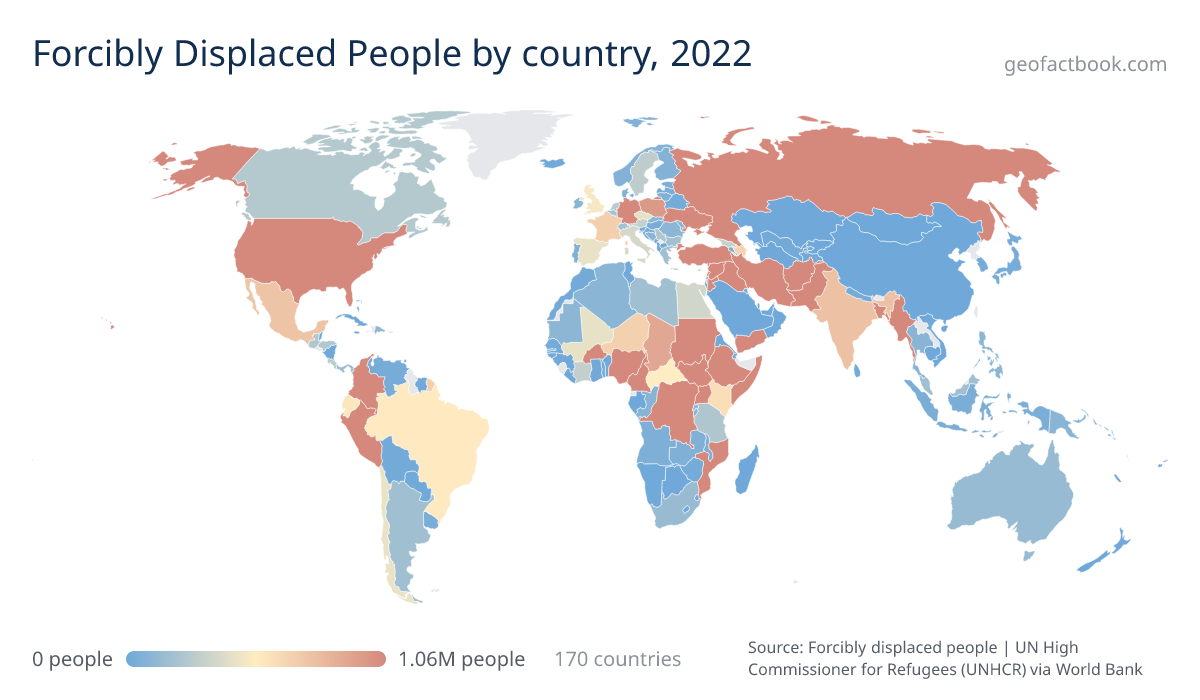
Forcibly Displaced People by country, 2022: map image
Top 10 countries by forcibly displaced people, 2022: chart
Insights by country
Austria
In 2022, Austria had 311700 forcibly displaced people, ranking #49 out of 170 countries. This figure is significant compared to neighboring countries like Germany, which has a much higher number of displaced individuals due to its larger population and more extensive immigration policies. Austria's status as a transit country for migrants, combined with its commitment to international asylum agreements, has contributed to this notable statistic.
South Sudan
In 2022, South Sudan ranked #19 globally with 1,785,506 Forcibly Displaced People. This figure highlights a significant humanitarian crisis, particularly when compared to neighboring countries that have lower displacement figures. The ongoing conflict, economic instability, and lack of effective governance have driven large segments of the population from their homes, exacerbating the displacement situation in the region.
Bangladesh
In 2022, Bangladesh ranked #25 globally with 1,378,408 Forcibly Displaced People. This figure places Bangladesh significantly above many of its regional neighbors, reflecting ongoing challenges in managing displacement. Key drivers include the country’s geographic vulnerability to natural disasters, such as cyclones and flooding, alongside the inflow of Rohingya refugees from Myanmar, which has strained resources and infrastructure.
Croatia
In 2022, Croatia had 21838 forcibly displaced people, ranking #104 out of 170 countries. This figure is notably higher than some neighboring countries, indicating a regional challenge. Key drivers include Croatia's geographic position as a transit country for migrants and its ongoing efforts to integrate those fleeing conflict and persecution, particularly from regions affected by instability.
Czech Republic
In 2022, the Czech Republic ranked #44 globally with 436,198 forcibly displaced people. This figure is notable compared to the global average, reflecting the country's significant role in providing refuge amidst regional conflicts. Key drivers include its geographic location in Central Europe, which makes it a transit point for those fleeing crises, as well as a robust asylum policy that encourages displaced individuals to seek safety within its borders.
Iraq
Iraq ranked #24 globally with 1,453,337 people classified as Forcibly Displaced People in 2022. This figure is significant within the region, reflecting ongoing instability in comparison to neighboring countries like Syria, which has a higher number of displaced individuals. The primary drivers of this displacement include years of conflict, the rise of extremist groups, and economic challenges that have hindered effective governance and stability.
Lithuania
In 2022, Lithuania ranked #86 globally with 68,129 Forcibly Displaced People. This figure is notable as it reflects a significant increase compared to some neighboring countries, highlighting regional challenges in managing displacement. Key drivers include Lithuania's geographic proximity to conflict zones and its evolving immigration policies, which have been influenced by the ongoing crisis in Ukraine and the need to accommodate refugees.
Cyprus
In 2022, Cyprus had 311,777 forcibly displaced people, ranking #48 out of 170 countries. This figure is notably higher than many of its regional neighbors, reflecting the island's strategic location as a gateway between Europe and the Middle East.
The ongoing geopolitical tensions in the region, particularly related to the situation in Syria, have led to increased migration flows towards Cyprus. Additionally, the island's policies and resources aimed at managing these populations play a significant role in shaping its displacement statistics.
Bosnia and Herzegovina
In 2022, Bosnia and Herzegovina ranked #81 globally with 91,340 Forcibly Displaced People. This figure is notable, especially when compared to neighboring countries that have faced similar conflicts but show varying displacement numbers. Key drivers of this situation include the aftermath of the 1990s conflict, ongoing ethnic tensions, and economic challenges that hinder the integration of displaced populations.
Curaçao
Curaçao ranked #113 globally with 14,000 forcibly displaced people in 2022. This figure is relatively high compared to other Caribbean nations, reflecting regional challenges in migration and displacement. The primary drivers include economic instability and the island's geographic position as a transit point for migrants from South America seeking refuge or better opportunities elsewhere.
Analysis & Context
In 2022, the country with the highest number of Forcibly Displaced People was the Syrian Arab Republic, with a staggering 7,464,382 individuals. The global range for forcibly displaced people spanned from 0 to this maximum figure. The average number of forcibly displaced people across the 170 countries with available data was approximately 628,962.42, with a median of 70,548, indicating significant disparities among nations.
Conflict and Forcible Displacement
The extreme figures for forcibly displaced people are primarily driven by ongoing conflicts and instability within certain regions. Syria, leading the list, continues to suffer from a protracted civil war that has led to mass displacement both internally and across borders. Similarly, the Democratic Republic of the Congo (6,208,691) and Yemen (4,613,683) also feature prominently among the top ten, reflecting the severe humanitarian crises triggered by prolonged conflict and violence in these regions.
Other countries like Afghanistan (4,565,377) and Sudan (4,681,958) highlight how political instability and conflict can exacerbate displacement. The situation in these countries underscores the complex relationship between governance, security, and population movements.
Economic and Environmental Factors
Beyond conflict, economic hardship and environmental challenges also contribute to the displacement of people. Colombia, with 7,244,144 displaced people, faces issues related to both internal conflict and economic instability. The large number of internally displaced persons in Colombia is partly a legacy of decades of armed conflict, but also due to economic pressures and environmental degradation.
Ethiopia (4,733,812), affected by both conflict and droughts, illustrates how environmental factors can compound the challenges of displacement. Environmental degradation and climate change are increasingly recognized as drivers of forced migration, as communities face unsustainable living conditions.
Year-over-Year Dynamics
The year 2022 saw significant changes in the number of forcibly displaced people in several countries. Notably, Ukraine experienced a dramatic increase of 5,057,921 displaced individuals, a direct consequence of the ongoing conflict following the Russian invasion. This surge highlights the acute impact of new conflicts on displacement statistics.
Iran and Russia also saw substantial increases, with 2,626,748 and 1,274,043 more displaced people respectively, reflecting regional instability and the ripple effects of geopolitical tensions. Conversely, China experienced the most significant decrease, with 303,116 fewer displaced individuals, suggesting improved conditions or changes in reporting or policy.
Global Distribution and Policy Implications
The distribution of forcibly displaced people is uneven, with some countries like Cabo Verde, Singapore, and Vietnam recording 0 displaced individuals, while others face overwhelming numbers. This disparity often reflects differences in national policies, geographic location, and international support systems.
Countries with low numbers of displaced people often have strong border controls, limited conflict exposure, or are less appealing destinations for asylum seekers due to economic or geographic factors. Meanwhile, countries like Turkey (3,840,595), which despite a decrease of 224,192, remains a major host nation due to its proximity to conflict zones and its policy of accepting refugees.
The data on forcibly displaced people in 2022 underscores the urgent need for comprehensive international strategies to address the root causes of displacement, improve humanitarian responses, and support host countries in managing large populations of displaced individuals. As conflicts, economic challenges, and environmental changes continue to drive displacement, coordinated global efforts remain essential to mitigate these impacts.
Frequently Asked Questions About Forcibly Displaced People in 2022
Which country had the highest number of forcibly displaced people in 2022?
The Syrian Arab Republic had the highest number of forcibly displaced people in 2022, with 7,464,382 people.
Which country had the lowest number of forcibly displaced people in 2022?
Cabo Verde had the lowest number of forcibly displaced people in 2022, with 0 people.
What was the average number of forcibly displaced people per country in 2022?
The average number of forcibly displaced people per country in 2022 was 628,962 people.
What was the median number of forcibly displaced people per country in 2022?
The median number of forcibly displaced people per country in 2022 was 69,339 people.
How many countries had zero forcibly displaced people in 2022?
Three countries had zero forcibly displaced people in 2022: Cabo Verde, Singapore, and Vietnam.
Which country had the second-highest number of forcibly displaced people in 2022?
Colombia had the second-highest number of forcibly displaced people in 2022, with 7,244,144 people.
Data Source
Forcibly displaced people | UN High Commissioner for Refugees (UNHCR) via World Bank
Data produced by Refugee Population Statistics Database, UN High Commissioner for Refugees (UNHCR), compiled and published by World Bank as "Forcibly displaced people".
Visit Data SourceCite this page
Geo Factbook. (n.d.). Forcibly Displaced People by Country, 2022. Retrieved November 27, 2026, from https://geofactbook.com/fact/forcibly-displaced-people/2022
The figures on this page come from Forcibly displaced people | UN High Commissioner for Refugees (UNHCR) via World Bank. For academic work, cite the original source as well.
›Embed this ranking on your site
Free to embed with attribution. Shows the top 10 countries and links back to the full ranking.
Historical Data by Year
Explore Forcibly Displaced People data across different years. Compare trends and see how statistics have changed over time.
You might also like
Rule of Law Index by Country
FeaturedCompare countries by Rule of Law percentile rank, reflecting confidence in laws, courts, police, property rights, and protection from crime and violence.
Highest: Finland100%Human Capital Index
FeaturedThe Human Capital Index measures a country's investment in education and health, reflecting its potential for economic growth and productivity. This vital statistic highlights the importance of nurturing human resources for sustainable development.
Highest: Singapore0.91Total population
FeaturedDiscover the latest total population statistics for every country and region worldwide. Explore accurate, up-to-date data on global population growth, density, and demographic trends — sourced from trusted international databases like the UN and World Bank. Perfect for researchers, students, and data enthusiasts looking to understand how the world’s population is changing.
Highest: India1.48B persons