
Forcibly Displaced People 2025
Forcibly displaced people include refugees, asylum seekers, and internally displaced persons worldwide.
 Colombia
 Singapore
Where does your country rank? Pick it to see its position.
Related Transnational Issues statistics
More ↓Interactive Map
Complete Data Rankings
Rank | Actions | ||
|---|---|---|---|
1 | Colombia | 10,040,663 people | |
2 |  Sudan | 9,976,963 people | |
3 |  Syrian Arab Republic | 6,336,014 people | |
4 |  Congo, Democratic Republic of the | 4,879,844 people | |
5 |  Yemen | 4,859,749 people | |
6 |  Afghanistan | 4,376,251 people | |
7 |  United States | 4,176,592 people | |
8 |  Ukraine | 3,714,813 people | |
9 |  Myanmar | 3,639,000 people | |
10 |  Nigeria | 3,638,040 people | |
11 |  Ethiopia | 3,501,453 people | |
12 |  Somalia | 3,393,669 people | |
13 |  State of Palestine | 3,095,080 people | |
14 |  Germany | 2,952,694 people | |
15 |  Jordan | 2,842,473 people | |
16 |  Turkey | 2,492,911 people | |
17 |  Burkina Faso | 2,105,953 people | |
18 |  Chad | 2,104,634 people | |
19 |  Uganda | 1,973,968 people | |
20 |  Bangladesh | 1,761,105 people | |
21 |  Peru | 1,743,572 people | |
22 |  Pakistan | 1,688,098 people | |
23 |  Iran | 1,650,014 people | |
24 |  South Sudan | 1,550,064 people | |
25 |  Cameroon | 1,381,166 people | |
26 |  Iraq | 1,342,711 people | |
27 |  Egypt | 1,098,301 people | |
28 |  Poland | 1,004,317 people | |
29 |  Brazil | 967,151 people | |
30 |  France | 873,646 people | |
31 |  Kenya | 845,771 people | |
32 |  Lebanon | 835,059 people | |
33 |  Niger | 827,990 people | |
34 |  Ecuador | 783,887 people | |
35 |  India | 783,718 people | |
36 |  Mexico | 779,694 people | |
37 |  Spain | 759,794 people | |
38 |  Libya | 743,477 people | |
39 |  Canada | 730,497 people | |
40 |  United Kingdom | 725,819 people | |
41 |  Mali | 696,037 people | |
42 |  Chile | 674,696 people | |
43 |  Azerbaijan | 663,588 people | |
44 |  Guatemala | 578,674 people | |
45 |  Central African Republic | 490,761 people | |
46 |  Mozambique | 489,077 people | |
47 |  Italy | 427,058 people | |
48 |  Czech Republic | 396,552 people | |
49 |  Thailand | 359,897 people | |
50 |  Netherlands | 333,597 people | |
51 |  Georgia | 327,810 people | |
52 |  Cyprus | 318,369 people | |
53 |  Mauritania | 308,868 people | |
54 |  Austria | 308,665 people | |
55 |  Serbia | 250,997 people | |
56 |  Belgium | 245,118 people | |
57 |  Costa Rica | 233,727 people | |
58 |  Switzerland | 225,326 people | |
59 |  Tanzania | 214,404 people | |
60 |  Malaysia | 213,175 people | |
61 |  Romania | 206,987 people | |
62 |  Algeria | 184,265 people | |
63 |  Argentina | 183,098 people | |
64 |  Ireland | 171,597 people | |
65 |  Greece | 166,491 people | |
66 |  Republic of Moldova | 149,918 people | |
67 |  Sweden | 148,777 people | |
68 |  Slovakia | 140,901 people | |
69 |  South Africa | 137,535 people | |
70 |  Rwanda | 131,045 people | |
71 |  Norway | 130,286 people | |
72 |  Armenia | 124,085 people | |
73 |  Burundi | 119,066 people | |
74 |  Australia | 116,340 people | |
75 |  Bulgaria | 106,913 people | |
76 |  Finland | 104,423 people | |
77 |  Honduras | 101,711 people | |
78 |  Dominican Republic | 100,533 people | |
79 |  Denmark | 97,745 people | |
80 |  Zambia | 96,131 people | |
81 |  Bosnia and Herzegovina | 95,750 people | |
82 |  Côte d'Ivoire | 82,807 people | |
83 |  Papua New Guinea | 80,848 people | |
84 |  Portugal | 78,944 people | |
85 |  Hungary | 71,374 people | |
86 |  Congo | 70,609 people | |
87 |  Japan | 65,097 people | |
88 |  Panama | 64,109 people | |
89 |  Israel | 61,956 people | |
90 |  Malawi | 60,492 people | |
91 |  Togo | 58,449 people | |
92 |  Kyrgyzstan | 56,999 people | |
93 |  Angola | 55,657 people | |
94 |  Benin | 54,921 people | |
95 |  Lithuania | 54,537 people | |
96 |  Kazakhstan | 52,931 people | |
97 |  Uruguay | 51,316 people | |
98 |  Indonesia | 48,071 people | |
99 |  South Korea | 43,513 people | |
100 |  Belarus | 42,264 people | |
101 |  Estonia | 41,620 people | |
102 |  Djibouti | 35,040 people | |
103 |  Latvia | 32,941 people | |
104 |  Croatia | 30,182 people | |
105 |  Philippines | 29,974 people | |
106 |  Trinidad and Tobago | 29,102 people | |
107 |  Ghana | 25,425 people | |
108 |  Morocco | 22,337 people | |
109 |  North Macedonia | 20,860 people | |
110 |  Nepal | 19,915 people | |
111 |  Senegal | 18,797 people | |
112 |  Zimbabwe | 18,065 people | |
113 |  Venezuela | 15,910 people | |
114 |  Tajikistan | 13,408 people | |
115 |  Russia | 13,367 people | |
116 |  Luxembourg | 13,334 people | |
117 |  Slovenia | 13,235 people | |
118 |  Montenegro | 12,444 people | |
119 |  Aruba | 11,470 people | |
120 |  Malta | 9,696 people | |
121 |  Bolivia | 9,406 people | |
122 |  Iceland | 9,119 people | |
123 |  Tunisia | 7,909 people | |
124 |  Uzbekistan | 7,705 people | |
125 |  United Arab Emirates | 7,634 people | |
126 |  Curaçao | 6,903 people | |
127 |  Namibia | 6,796 people | |
128 |  New Zealand | 6,732 people | |
129 |  Paraguay | 6,280 people | |
130 |  Sri Lanka | 5,284 people | |
131 |  Eswatini | 4,925 people | |
132 |  Albania | 4,684 people | |
133 |  Gambia | 4,617 people | |
134 |  Saudi Arabia | 4,355 people | |
135 |  Suriname | 3,215 people | |
136 |  Turkmenistan | 3,209 people | |
137 |  Guinea | 2,326 people | |
138 |  Belize | 2,183 people | |
139 |  Liberia | 1,897 people | |
140 |  Madagascar | 1,366 people | |
141 |  Liechtenstein | 1,024 people | |
142 |  Kuwait | 997 people | |
143 |  Botswana | 868 people | |
144 |  China | 712 people | |
145 |  Oman | 703 people | |
146 |  Lesotho | 680 people | |
147 |  Bahrain | 362 people | |
148 |  Qatar | 348 people | |
149 |  Mauritius | 257 people | |
150 |  Gabon | 252 people | |
151 |  China, Hong Kong SAR | 236 people | |
152 |  Sint Maarten (Dutch part) | 158 people | |
153 |  Cuba | 155 people | |
154 |  Eritrea | 119 people | |
155 |  Nauru | 97 people | |
156 |  Cayman Islands | 68 people | |
157 |  Guinea-Bissau | 54 people | |
158 |  Fiji | 46 people | |
159 |  British Virgin Islands | 32 people | |
160 |  Mongolia | 26 people | |
161 |  Comoros | 19 people | |
162 |  Monaco | 17 people | |
163 |  Barbados | 13 people | |
164 |  Vietnam | 13 people | |
165 |  Bahamas | 10 people | |
166 |  Turks and Caicos Islands | 8 people | |
167 |  Vanuatu | 7 people | |
168 |  Dominica | 5 people | |
169 |  Saint Kitts and Nevis | 5 people | |
170 |  Saint Lucia | 5 people | |
171 |  Brunei Darussalam | 0 people | |
172 |  Cabo Verde | 0 people | |
173 | Singapore | 0 people |
- #1Colombia
- #2Sudan
- #3Syrian Arab Republic
- #4Congo, Democratic Republic of the
- #5Yemen
- #6Afghanistan
- #7United States
- #8Ukraine
- #9Myanmar
- #10Nigeria
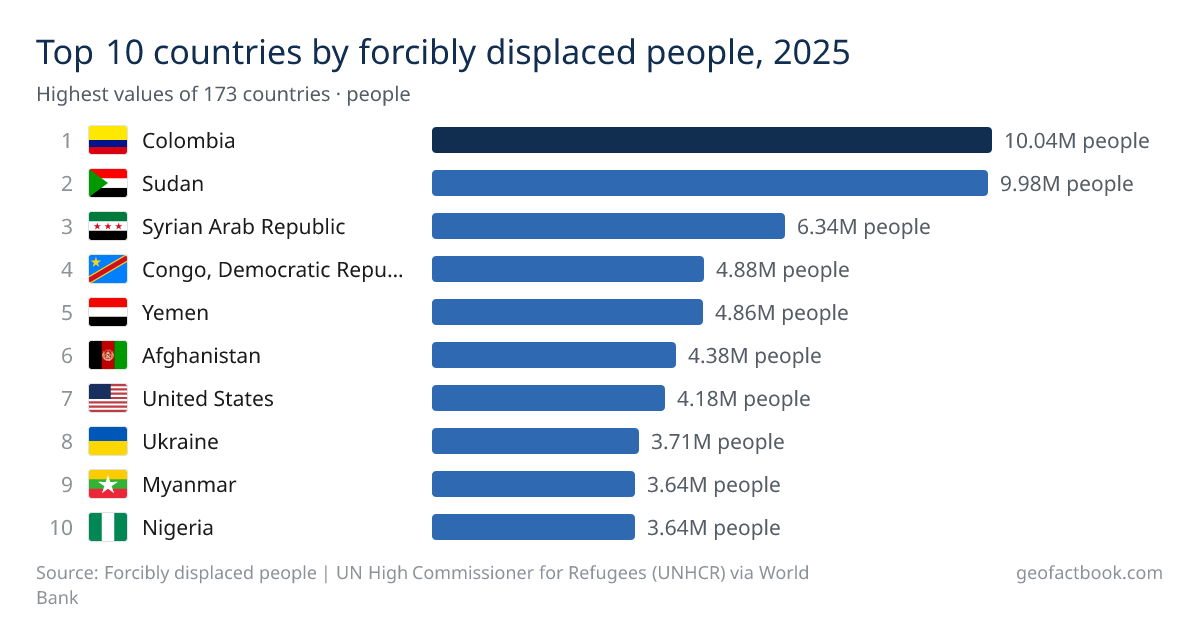
Analysis: These countries represent the highest values in this dataset, showcasing significant scale and impact on global statistics.
- #173Singapore
- #172Cabo Verde
- #171Brunei Darussalam
- #170Saint Lucia
- #169Saint Kitts and Nevis
- #168Dominica
- #167Vanuatu
- #166Turks and Caicos Islands
- #165Bahamas
- #164Vietnam
Context: These countries or territories have the lowest values, often due to geographic size, administrative status, or specific characteristics.
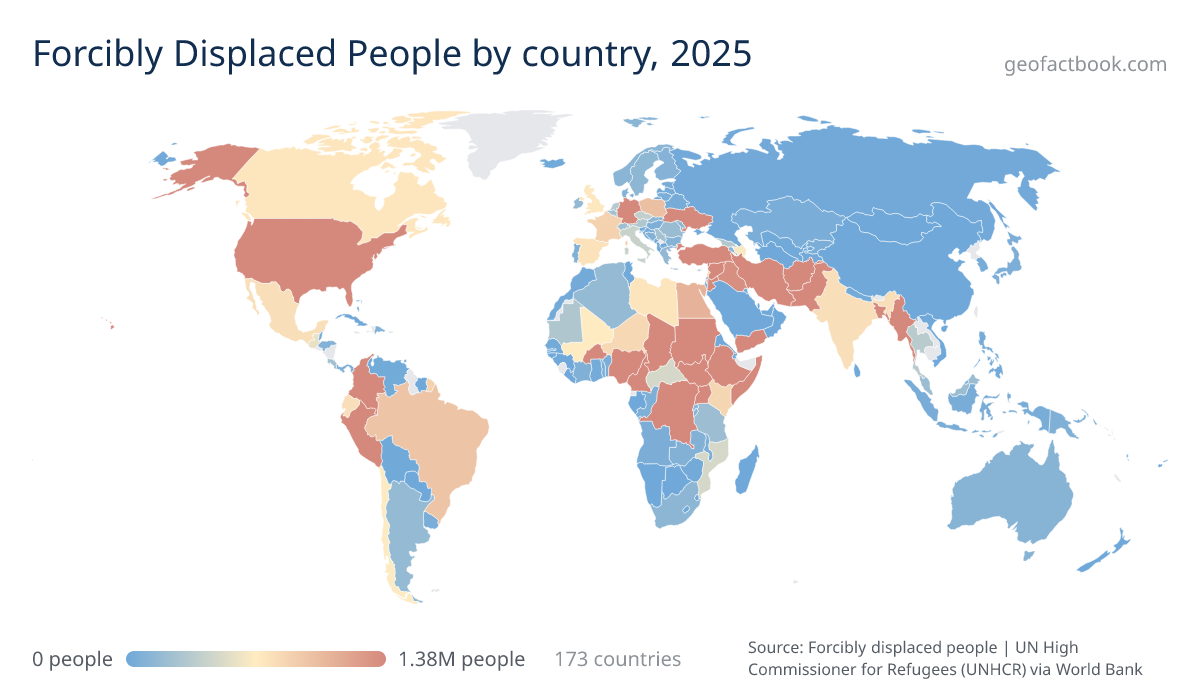
Forcibly Displaced People by country, 2025: map image
Top 10 countries by forcibly displaced people, 2025: chart
Insights by country
Burkina Faso
In 2025, Burkina Faso ranks #17 globally with 2,105,953 forcibly displaced people. This figure is significantly higher than the global average, highlighting the country's critical humanitarian situation. The primary drivers include ongoing conflict in the Sahel region, particularly from militant groups, and widespread poverty that exacerbates displacement. Additionally, Burkina Faso's geographic location makes it vulnerable to spillover effects from instability in neighboring countries.
Mauritania
In 2025, Mauritania ranks #53 globally with 308,868 forcibly displaced people. This figure is significant when compared to regional neighbors, indicating a considerable humanitarian challenge. The primary drivers of displacement in Mauritania include ongoing conflicts in the Sahel region, economic instability, and environmental factors such as drought, which exacerbate the vulnerabilities of the population.
Mexico
In 2025, Mexico ranks #36 globally with 779,694 Forcibly Displaced People. This figure is significant compared to the global average, reflecting ongoing challenges in the region. Key drivers include violence from organized crime, economic instability, and inadequate governmental policies addressing migration and displacement. These factors contribute to Mexico's complex humanitarian landscape, necessitating urgent attention and action.
Montenegro
In 2025, Montenegro has **12444** forcibly displaced people, ranking **#118** out of 173 countries. This figure is notably higher than many of its regional neighbors, reflecting ongoing challenges in managing displacement. Key drivers include Montenegro's geographic position in the Balkans, which has made it a transit country for migrants, and its socio-economic conditions that have limited effective integration policies.
Saudi Arabia
In 2025, Saudi Arabia has 4355 forcibly displaced people, ranking #134 out of 173 countries. This figure is relatively low compared to regional neighbors, indicating a more stable situation in terms of forced displacement. Key drivers include Saudi Arabia's substantial economic resources and its policies aimed at providing humanitarian assistance, which have contributed to maintaining lower levels of displacement within its borders.
Luxembourg
In 2025, Luxembourg ranks #116 globally with 13,334 forcibly displaced people. This figure is relatively low compared to neighboring countries, reflecting Luxembourg's stable economic environment and strong social policies. The country's robust welfare system and commitment to human rights contribute to its approach in managing displacement, although its small size limits its capacity to host larger populations of displaced individuals.
Niger
Niger ranks #33 globally with 827,990 Forcibly Displaced People in 2025. This figure is significant given that it places Niger above many neighboring countries in the Sahel region, which faces similar challenges. The displacement is primarily driven by ongoing conflicts, particularly from militant groups, and environmental factors such as desertification that exacerbate food insecurity and force communities to flee. Additionally, Niger's geographic location as a transit country for migrants further complicates its humanitarian situation.
Namibia
In 2025, Namibia ranks #127 globally with 6,796 forcibly displaced people. This figure is notably higher than that of several neighboring countries, reflecting regional challenges in managing displacement. Key drivers include Namibia's geographic vulnerability to climate change, which exacerbates resource scarcity, and economic factors that limit the government's capacity to address the needs of displaced populations effectively.
Aruba
In 2025, Aruba ranks #119 globally with 11,470 Forcibly Displaced People. This figure is significantly higher than many Caribbean neighbors, reflecting regional challenges related to migration and displacement. Factors contributing to this situation in Aruba include its geographic location, which makes it a transit point for migrants, and economic conditions that may limit local resources for integration and support.
Saint Lucia
In 2025, Saint Lucia ranks #170 globally with 5 forcibly displaced people. This figure is notably low compared to many countries in the Caribbean and reflects a stable internal environment. The limited number of forcibly displaced individuals can be attributed to Saint Lucia's relatively low levels of conflict and its focus on maintaining social cohesion and safety within its communities.
Analysis & Context
In 2025, Colombia leads the world in the number of Forcibly Displaced People, with a staggering 10,040,663. The global range for forcibly displaced people spans from 0 to 10,040,663 across 173 countries. The average number of forcibly displaced people globally is approximately 666,141, while the median stands at 65,097.
Concentration of Displacement: Key Drivers in Top Countries
The phenomenon of forced displacement is predominantly concentrated in certain regions due to ongoing conflicts, political instability, and humanitarian crises. Colombia leads with the highest number of forcibly displaced people, largely due to prolonged internal conflict and issues related to drug trafficking and violence. Similarly, Sudan follows closely with 9,976,963 displaced individuals, a consequence of political instability and ethnic conflicts.
In the Syrian Arab Republic, with 6,336,014 forcibly displaced people, the ongoing civil war continues to drive mass displacement. The Democratic Republic of the Congo and Yemen also experience significant displacement figures, with 4,879,844 and 4,859,749 respectively, due to armed conflicts and humanitarian crises.
Minimal Displacement: Stability and Policy Success
At the opposite end of the spectrum, countries like Cabo Verde, Singapore, and Brunei Darussalam report 0 forcibly displaced people. These nations benefit from stable political environments, robust economies, and effective governance, which contribute to the absence of significant displacement. Additionally, small island nations such as Saint Kitts and Nevis and Saint Lucia report minimal displacement figures, each with just 5 displaced individuals, indicating a stable socio-political climate.
Year-Over-Year Trends: Significant Movers
The past year has seen notable shifts in displacement figures. The United States experienced the largest increase, with an additional 557,097 individuals, representing a 15.4% rise. This uptick is attributed to increased asylum applications and migration pressures at its borders. Chad and Libya also saw significant increases of 434,989 (26.1%) and 359,467 (93.6%) respectively, driven by regional conflicts and instability.
Conversely, Sudan experienced the most significant decrease, with 2,421,025 fewer displaced people, a 19.5% reduction, possibly due to peace agreements and stabilization efforts. The Democratic Republic of the Congo and Iran also saw reductions of 1,853,601 (27.5%) and 1,839,243 (52.7%) respectively, likely due to improved security conditions and repatriation initiatives.
Global Implications: Policy and Humanitarian Challenges
The data on forcibly displaced people in 2025 highlights significant challenges and opportunities for international policy and humanitarian efforts. Countries with high displacement figures, such as Colombia and Sudan, underscore the urgent need for conflict resolution and development aid. Meanwhile, the increases in countries like the United States and Libya point to the necessity for robust asylum policies and international cooperation to manage migration flows effectively.
On the other hand, countries with minimal displacement figures offer models of stability and effective governance. These examples can guide international efforts to create environments that prevent forced displacement through sustainable development and conflict prevention strategies.
Frequently Asked Questions About Forcibly Displaced People in 2025
Which country has the highest number of forcibly displaced people in 2025?
Colombia has the highest number of forcibly displaced people in 2025, with 10,040,663 people.
Which country has the lowest number of forcibly displaced people in 2025?
Cabo Verde has the lowest number of forcibly displaced people in 2025, with 0 people.
What is the average number of forcibly displaced people per country in 2025?
The average number of forcibly displaced people per country in 2025 is 666,141 people.
What is the median number of forcibly displaced people per country in 2025?
The median number of forcibly displaced people per country in 2025 is 65,097 people.
Which countries are in the top 3 for the highest number of forcibly displaced people in 2025?
The top 3 countries with the highest number of forcibly displaced people in 2025 are Colombia, Sudan, and the Syrian Arab Republic.
How many countries have zero forcibly displaced people in 2025?
Three countries have zero forcibly displaced people in 2025: Cabo Verde, Singapore, and Brunei Darussalam.
Data Source
Forcibly displaced people | UN High Commissioner for Refugees (UNHCR) via World Bank
Data produced by Refugee Population Statistics Database, UN High Commissioner for Refugees (UNHCR), compiled and published by World Bank as "Forcibly displaced people".
Visit Data SourceCite this page
Geo Factbook. (n.d.). Forcibly Displaced People by Country, 2025. Retrieved November 27, 2026, from https://geofactbook.com/fact/forcibly-displaced-people/2025
The figures on this page come from Forcibly displaced people | UN High Commissioner for Refugees (UNHCR) via World Bank. For academic work, cite the original source as well.
›Embed this ranking on your site
Free to embed with attribution. Shows the top 10 countries and links back to the full ranking.
Historical Data by Year
Explore Forcibly Displaced People data across different years. Compare trends and see how statistics have changed over time.
You might also like
Rule of Law Index by Country
FeaturedCompare countries by Rule of Law percentile rank, reflecting confidence in laws, courts, police, property rights, and protection from crime and violence.
Highest: Finland100%Human Capital Index
FeaturedThe Human Capital Index measures a country's investment in education and health, reflecting its potential for economic growth and productivity. This vital statistic highlights the importance of nurturing human resources for sustainable development.
Highest: Singapore0.91Total population
FeaturedDiscover the latest total population statistics for every country and region worldwide. Explore accurate, up-to-date data on global population growth, density, and demographic trends — sourced from trusted international databases like the UN and World Bank. Perfect for researchers, students, and data enthusiasts looking to understand how the world’s population is changing.
Highest: India1.48B persons