
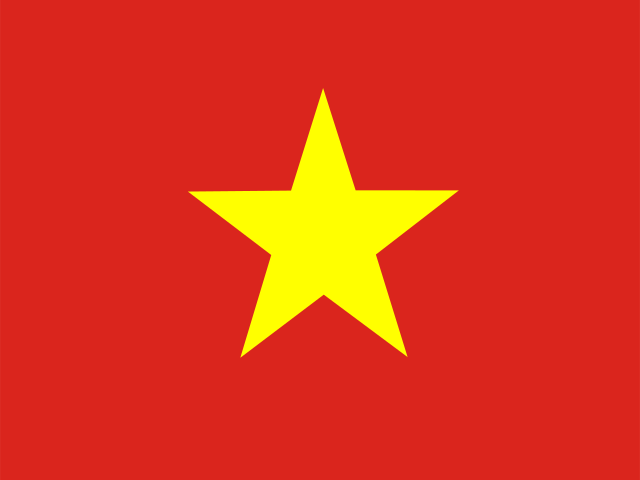
Location
Vietnam is in Southeastern Asia, bordering the Gulf of Thailand, Gulf of Tonkin, and South China Sea, as well as China, Laos, and Cambodia. It shares land borders with Laos (2,161 km), China (1,297 km) and Cambodia (1,158 km) and has 3,444 km of coastline. The capital is Hanoi.
Vietnam population 2026: 102.21 Million — growth, rank & history →Key Statistics for 2026
Total population
Population Change
Median age of population
Population density
Life expectancy at birth
Agricultural land
Average Female Breast Size by Country: Worldwide Data & Rankings
Current Bank Rate
Dam capacity per capita
Female population of reproductive age
Health Care Spending per Capita
History
Vietnam's history is marked by its rich cultural heritage and significant historical milestones, tracing back thousands of years. The earliest known civilization in Vietnam emerged around 3,000 BCE with the Đông Sơn culture, renowned for its sophisticated bronze casting and the famous Đông Sơn drums. The region saw the establishment of the first Vietnamese state, Văn Lang, in the 3rd century BCE, led by the Hùng kings. By the 1st century CE, Vietnam experienced Chinese domination, which lasted for over a millennium. This period profoundly influenced Vietnamese culture, language, and governance, as Confucianism, Taoism, and Buddhism were introduced and integrated into local traditions.
During the medieval period, Vietnam witnessed significant developments under various dynasties. The Lý dynasty (1009-1225) and the Trần dynasty (1225-1400) were notable for their advancements in governance, culture, and military prowess. The Trần dynasty is particularly remembered for its successful defense against Mongol invasions, with the famous victories at the battles of Bạch Đằng River in 1258 and 1288. The establishment of the Đại Việt state during this time marked a consolidation of national identity and autonomy, further resisting Chinese influence and asserting Vietnamese sovereignty. The emergence of a distinct Vietnamese culture, characterized by its folk traditions, literature, and the development of the Vietnamese script, also took shape during these centuries.
The modern history of Vietnam is dominated by colonialism and conflict. The French colonized Vietnam in the mid-19th century, leading to widespread social and economic changes. Resistance against French rule culminated in the August Revolution of 1945, which led to the declaration of independence by Ho Chi Minh and the Viet Minh. However, this period was swiftly followed by the First Indochina War (1946-1954), resulting in the division of Vietnam into North and South at the Geneva Conference. The subsequent Vietnam War (1955-1975) was a pivotal conflict, involving significant U.S. military intervention aimed at preventing the spread of communism. The war concluded with the fall of Saigon on April 30, 1975, leading to the reunification of Vietnam under communist governance.
In recent history, Vietnam has emerged as a significant player on the global stage. The Doi Moi reforms initiated in 1986 transitioned the country from a centrally planned economy to a socialist-oriented market economy, resulting in rapid economic growth and development. Today, Vietnam is recognized for its dynamic economy, rich cultural heritage, and strategic geopolitical position in Southeast Asia. The country's historical significance lies not only in its turbulent past but also in its resilience and capability to adapt and thrive in a rapidly changing world, making it a focal point for studies in post-colonial development and international relations.
Geography
Vietnam is located in Southeast Asia, bordered by China to the north, Laos to the northwest, and Cambodia to the southwest. To the east, it has a long coastline along the South China Sea, stretching approximately 3,444 kilometers (2,140 miles). This strategic location has made Vietnam a significant player in regional trade and cultural exchange throughout history. The country’s total land area is approximately 331,210 square kilometers (127,881 square miles), making it the 66th largest country in the world.
The physical features of Vietnam are incredibly diverse, characterized by a complex topography that includes mountains, plateaus, and extensive river systems. The Annamite Range runs parallel to the coast and is home to several peaks, with Fansipan being the highest at 3,147 meters (10,326 feet). The Red River Delta in the north and the Mekong Delta in the south are two of the most significant river systems, providing fertile agricultural land and supporting a rich biodiversity. The terrain varies from the mountainous regions in the north to the flat coastal plains and fertile deltas in the south, contributing to the country’s agricultural output and natural beauty.
Vietnam experiences a tropical monsoon climate, which is characterized by high humidity and significant seasonal variations in rainfall. The climate is generally divided into two distinct regions: the northern region has four seasons, including a cool winter from November to March, while the southern region enjoys a more consistent tropical climate with a wet and dry season. The average temperature ranges from 15°C (59°F) in the winter months in the north to over 30°C (86°F) in the south during the summer. This climatic diversity supports a wide variety of flora and fauna, making Vietnam one of the most biodiverse countries in the world.
The natural resources of Vietnam are abundant and varied, including significant reserves of coal, oil, and natural gas, which are crucial for the country's energy needs and economic growth. Additionally, the country's forests are rich in timber and non-timber products, while its agricultural lands produce rice, coffee, tea, and other crops that are vital for both domestic consumption and export. However, rapid industrialization and urbanization pose environmental challenges, including deforestation and pollution. Conservation efforts are becoming increasingly important to preserve Vietnam's unique ecosystems and natural heritage, which play a crucial role in sustaining the livelihoods of millions of people.
Government
Vietnam is a socialist republic governed by a one-party system led by the Communist Party of Vietnam (CPV). This political framework is characterized by the centralization of power, where the CPV holds a preeminent position in all state and societal affairs, effectively limiting political pluralism. The Constitution of Vietnam establishes the country as a socialist state under the leadership of the CPV, emphasizing the principles of Marxism-Leninism and Hồ Chí Minh's ideology. The political system is designed to foster collective leadership, with a focus on maintaining stability and continuity in governance.
The structure of the Vietnamese government consists of three branches: the executive, legislative, and judicial. The executive branch is headed by the President, who serves as both the head of state and the commander-in-chief of the armed forces. The Prime Minister, appointed by the President, is responsible for the day-to-day administration of the government. The National Assembly, which serves as the legislative branch, is a unicameral body that consists of representatives elected by the populace. The judicial system is intended to operate independently but is influenced by the CPV, with the Supreme People's Court at its apex, overseeing the judiciary's functions and ensuring adherence to party policies.
Key institutions in Vietnam's political landscape include the National Assembly, the President, the Prime Minister, and the CPV. The National Assembly, comprising approximately 500 deputies, is responsible for enacting laws, approving the budget, and supervising the executive branch. The President, currently elected by the National Assembly, represents the state and symbolizes national unity. The Prime Minister leads the government and implements policies outlined by the Assembly, while the CPV's Central Committee and Politburo make critical decisions regarding national governance and policy direction.
Vietnam's electoral system is structured to reflect the principles of democratic centralism, where candidates for the National Assembly are typically nominated by the CPV, limiting competition. Elections are held every five years, with the last parliamentary election taking place in March 2021. The political landscape is marked by the absence of opposition parties, as the CPV maintains a monopoly on political power. Although there have been recent calls for reforms and increased political freedoms, the government's stance remains focused on preserving its authority and promoting economic development while maintaining social order.
Economy
Vietnam operates as a socialist-oriented market economy, characterized by rapid growth and substantial transformation since the implementation of the Đổi Mới reforms in 1986. As of 2023, the country's nominal GDP stands at approximately $409 billion, positioning it as one of the largest economies in Southeast Asia. The GDP per capita has seen significant improvement, reaching around $4,200, reflecting the rising living standards and economic development. Vietnam's economy is classified as a lower-middle-income economy by the World Bank, showcasing its transition from an agrarian society to an increasingly industrialized and service-oriented economy.
The major industries driving Vietnam's economic growth include manufacturing, agriculture, and services. Manufacturing, particularly textiles, electronics, and furniture, has become a cornerstone of the economy, contributing significantly to exports. Agriculture remains vital, with rice, coffee, and seafood as key products, while the services sector, encompassing tourism and retail, is rapidly expanding. The government has actively encouraged foreign investment, particularly in technology and high-value sectors, bolstering economic diversification and resilience.
Vietnam's trade relationships are expansive, with the country being a member of various international trade agreements, such as the Comprehensive and Progressive Agreement for Trans-Pacific Partnership (CPTPP) and the Regional Comprehensive Economic Partnership (RCEP). Exports are a major component of its economy, with key export goods including textiles, electronics, and agricultural products totaling over $340 billion in 2022. Conversely, imports predominantly consist of machinery, petroleum, and raw materials, with total imports approximating $300 billion. The United States, China, and the European Union are among Vietnam's largest trading partners, creating a dynamic trade environment.
Despite its economic successes, Vietnam faces challenges such as infrastructure deficits, environmental degradation, and reliance on foreign investment. The need for sustainable development is pressing as the country grapples with climate change impacts and urbanization pressures. However, opportunities abound, particularly in digital transformation and renewable energy sectors, which the government is strategically promoting. Continued investment in education and skills development will be crucial for maintaining growth and enhancing the competitiveness of its workforce, positioning Vietnam as a viable player in the global economy.
Culture
Vietnam is a nation characterized by its rich tapestry of languages, religions, and ethnic groups. The official language is Vietnamese, a tonal language belonging to the Austroasiatic language family, which serves as a vital component of national identity. In addition to Vietnamese, there are numerous regional languages and dialects, reflecting the country's diverse ethnic landscape. Around 54 ethnic groups are recognized in Vietnam, with the Kinh (Viet) people making up the majority at approximately 86% of the population. Significant minority groups include the Tay, Thai, Muong, Hmong, and Khmer, each contributing to the cultural mosaic and enriching the nation’s cultural heritage through their unique traditions and customs. Religiously, Vietnam is predominantly influenced by Buddhism, Confucianism, and Taoism, with a growing presence of Catholicism and indigenous belief systems, which coexist harmoniously and shape daily life.
The cultural traditions and customs of Vietnam are deeply rooted in its history and are evidenced through various ceremonies and festivals. One of the most significant cultural events is the Tet Nguyen Dan, or Lunar New Year, which is celebrated with family reunions, special foods, and ancestral worship, marking a time for renewal and reflection. Vietnamese culture places a strong emphasis on family values, respect for elders, and community cohesion. Traditional customs such as wedding ceremonies, ancestor worship, and the practice of giving "li xi" (red envelopes) during Tet reflect the importance of familial bonds and social harmony in Vietnamese society.
Vietnamese arts, music, and literature showcase a rich heritage influenced by various historical epochs. Traditional art forms, including silk painting and lacquerware, often depict themes of nature and daily life, while folklore and storytelling play a crucial role in preserving cultural narratives. Music in Vietnam is diverse, featuring genres such as Quan Ho (folk singing) and Ca Tru (ceremonial singing) that have been recognized by UNESCO as part of the intangible cultural heritage of humanity. Vietnamese literature, with its roots in oral traditions, has evolved to include both classical and contemporary works, reflecting societal changes and the quest for identity.
The cuisine of Vietnam is a vital aspect of its culture, celebrated for its fresh ingredients, vibrant flavors, and balance of taste. Dishes such as Pho (noodle soup), Banh Mi (sandwich), and Goi Cuon (spring rolls) showcase the country's culinary diversity and regional specialties. Daily life in Vietnam is often centered around communal meals and street food culture, where families and friends gather to enjoy food together, reinforcing social ties. The practice of sharing meals is deeply ingrained in Vietnamese customs, illustrating the importance of community and hospitality in everyday interactions. This cultural emphasis on food and social gatherings not only fosters connection but also reflects the enduring spirit of Vietnamese identity.
About This Data
This page displays comprehensive statistical data for Vietnam for the year 2026. All data points are sourced from authoritative international organizations and are regularly updated to ensure accuracy and reliability.
Click on any statistic to explore more detailed information, see how Vietnam compares with other countries, and view historical trends.
Primary Data Sources
CIA World Factbook
Comprehensive country profiles and demographic statistics from the Central Intelligence Agency
Learn moreUnited Nations Statistics
Global demographic data and population projections from UN agencies and research divisions
Learn moreWorld Bank Open Data
Development indicators and comprehensive population metrics from the World Bank database
Learn moreCompare Vietnam with other countries
Side-by-side comparisons across population, GDP, geography, and more.
Frequently Asked Questions About Vietnam
Which continent is Vietnam in?▾
Vietnam is in Asia, in the South-eastern Asia subregion according to the UN geoscheme.