
Forcibly Displaced People 2011
Forcibly displaced people include refugees, asylum seekers, and internally displaced persons worldwide.
Newer data is available: Forcibly Displaced People by country 2025 →
 Colombia
 Saint Lucia
Where does your country rank? Pick it to see its position.
Related Transnational Issues statistics
More ↓Interactive Map
Complete Data Rankings
Rank | Actions | ||
|---|---|---|---|
1 | Colombia | 5,281,323 people | |
2 |  Iraq | 2,639,379 people | |
3 |  Pakistan | 2,604,315 people | |
4 |  Jordan | 2,435,548 people | |
5 |  Sudan | 2,346,303 people | |
6 |  State of Palestine | 2,055,043 people | |
7 |  Congo, Democratic Republic of the | 1,863,879 people | |
8 |  Syrian Arab Republic | 1,844,194 people | |
9 |  Somalia | 1,467,118 people | |
10 |  Turkey | 1,025,393 people | |
11 |  Iran | 886,907 people | |
12 |  Kenya | 851,750 people | |
13 |  India | 838,626 people | |
14 |  Yemen | 684,606 people | |
15 |  Bangladesh | 655,669 people | |
16 |  Ethiopia | 640,179 people | |
17 |  Germany | 634,326 people | |
18 |  Azerbaijan | 600,769 people | |
19 |  Lebanon | 493,850 people | |
20 |  Chad | 492,653 people | |
21 |  South Sudan | 455,113 people | |
22 |  Afghanistan | 453,063 people | |
23 |  Myanmar | 450,000 people | |
24 |  Serbia | 314,094 people | |
25 |  China | 301,042 people | |
26 |  South Africa | 277,240 people | |
27 |  United States | 276,452 people | |
28 |  Côte d'Ivoire | 271,871 people | |
29 |  Georgia | 270,497 people | |
30 |  France | 259,447 people | |
31 |  Venezuela | 219,369 people | |
32 |  Cyprus | 214,540 people | |
33 |  United Kingdom | 210,355 people | |
34 |  Canada | 206,714 people | |
35 |  Uganda | 192,891 people | |
36 |  Indonesia | 184,230 people | |
37 |  Libya | 167,012 people | |
38 |  Mexico | 164,258 people | |
39 |  Congo | 152,032 people | |
40 |  Liberia | 151,852 people | |
41 |  Peru | 151,614 people | |
42 |  Ecuador | 144,941 people | |
43 |  Thailand | 137,576 people | |
44 |  Tanzania | 131,950 people | |
45 |  Sri Lanka | 125,385 people | |
46 |  Burundi | 124,712 people | |
47 |  Central African Republic | 124,184 people | |
48 |  Nepal | 123,580 people | |
49 |  Bosnia and Herzegovina | 119,964 people | |
50 |  Egypt | 113,993 people | |
51 |  Sweden | 104,709 people | |
52 |  Cameroon | 103,657 people | |
53 |  Malaysia | 97,594 people | |
54 |  Algeria | 94,950 people | |
55 |  Netherlands | 84,993 people | |
56 |  Kyrgyzstan | 73,501 people | |
57 |  Italy | 71,591 people | |
58 |  Austria | 71,519 people | |
59 |  Switzerland | 67,294 people | |
60 |  Rwanda | 55,616 people | |
61 |  Norway | 51,785 people | |
62 |  Israel | 47,665 people | |
63 |  Senegal | 46,901 people | |
64 |  Zambia | 46,645 people | |
65 |  Philippines | 46,164 people | |
66 |  Greece | 45,508 people | |
67 |  Belgium | 41,402 people | |
68 |  Togo | 29,646 people | |
69 |  Australia | 28,633 people | |
70 |  Mauritania | 26,804 people | |
71 |  Ghana | 26,225 people | |
72 |  Djibouti | 22,240 people | |
73 |  Costa Rica | 20,495 people | |
74 |  Angola | 19,366 people | |
75 |  Poland | 18,707 people | |
76 |  Mali | 18,115 people | |
77 |  Panama | 18,031 people | |
78 |  Guinea | 17,210 people | |
79 |  Malawi | 16,848 people | |
80 |  Denmark | 14,801 people | |
81 |  Eritrea | 14,726 people | |
82 |  Mozambique | 13,666 people | |
83 |  Ireland | 13,614 people | |
84 |  Montenegro | 12,905 people | |
85 |  Finland | 11,432 people | |
86 |  Niger | 11,414 people | |
87 |  Armenia | 11,330 people | |
88 |  Nigeria | 10,329 people | |
89 |  Gambia | 9,548 people | |
90 |  Papua New Guinea | 9,378 people | |
91 |  Brazil | 9,110 people | |
92 |  Malta | 8,396 people | |
93 |  Sierra Leone | 8,152 people | |
94 |  Guinea-Bissau | 7,884 people | |
95 |  Benin | 7,567 people | |
96 |  Bulgaria | 7,057 people | |
97 |  Namibia | 6,975 people | |
98 |  Spain | 6,890 people | |
99 |  Ukraine | 6,757 people | |
100 |  Japan | 6,325 people | |
101 |  Hungary | 5,445 people | |
102 |  Tajikistan | 5,348 people | |
103 |  Zimbabwe | 5,333 people | |
104 |  Russia | 4,856 people | |
105 |  Tunisia | 4,629 people | |
106 |  Luxembourg | 4,549 people | |
107 |  Argentina | 4,537 people | |
108 |  Gabon | 4,126 people | |
109 |  Turkmenistan | 4,059 people | |
110 |  Uzbekistan | 3,616 people | |
111 |  Botswana | 3,556 people | |
112 |  Czech Republic | 3,333 people | |
113 |  Croatia | 3,137 people | |
114 |  Dominican Republic | 2,378 people | |
115 |  North Macedonia | 2,153 people | |
116 |  New Zealand | 2,117 people | |
117 |  Chile | 2,025 people | |
118 |  Romania | 1,754 people | |
119 |  South Korea | 1,548 people | |
120 |  Kuwait | 1,450 people | |
121 |  Morocco | 1,338 people | |
122 |  Burkina Faso | 1,216 people | |
123 |  Vietnam | 990 people | |
124 |  Timor-Leste | 900 people | |
125 |  Lithuania | 897 people | |
126 |  Eswatini | 757 people | |
127 |  China, Hong Kong SAR | 720 people | |
128 |  Slovakia | 720 people | |
129 |  Bolivia | 718 people | |
130 |  United Arab Emirates | 716 people | |
131 |  Kazakhstan | 676 people | |
132 |  Saudi Arabia | 675 people | |
133 |  Belarus | 640 people | |
134 |  Portugal | 611 people | |
135 |  Cuba | 381 people | |
136 |  Bahrain | 355 people | |
137 |  Latvia | 304 people | |
138 |  Slovenia | 227 people | |
139 |  Uruguay | 214 people | |
140 |  Republic of Moldova | 173 people | |
141 |  Liechtenstein | 136 people | |
142 |  Belize | 134 people | |
143 |  Oman | 128 people | |
144 |  Qatar | 128 people | |
145 |  Paraguay | 125 people | |
146 |  Iceland | 111 people | |
147 |  Cambodia | 106 people | |
148 |  Albania | 105 people | |
149 |  Nicaragua | 90 people | |
150 |  El Salvador | 44 people | |
151 |  Bahamas | 40 people | |
152 |  Estonia | 39 people | |
153 |  Lesotho | 38 people | |
154 |  Monaco | 37 people | |
155 |  Jamaica | 19 people | |
156 |  Curaçao | 11 people | |
157 |  China, Macao SAR | 10 people | |
158 |  Haiti | 6 people | |
159 |  Fiji | 5 people | |
160 |  Grenada | 5 people | |
161 |  Madagascar | 5 people | |
162 |  Mongolia | 5 people | |
163 |  Sint Maarten (Dutch part) | 5 people | |
164 | Saint Lucia | 5 people |
- #1Colombia
- #2Iraq
- #3Pakistan
- #4Jordan
- #5Sudan
- #6State of Palestine
- #7Congo, Democratic Republic of the
- #8Syrian Arab Republic
- #9Somalia
- #10Turkey
Analysis: These countries represent the highest values in this dataset, showcasing significant scale and impact on global statistics.
- #164Saint Lucia
- #163Sint Maarten (Dutch part)
- #162Mongolia
- #161Madagascar
- #160Grenada
- #159Fiji
- #158Haiti
- #157China, Macao SAR
- #156Curaçao
- #155Jamaica
Context: These countries or territories have the lowest values, often due to geographic size, administrative status, or specific characteristics.
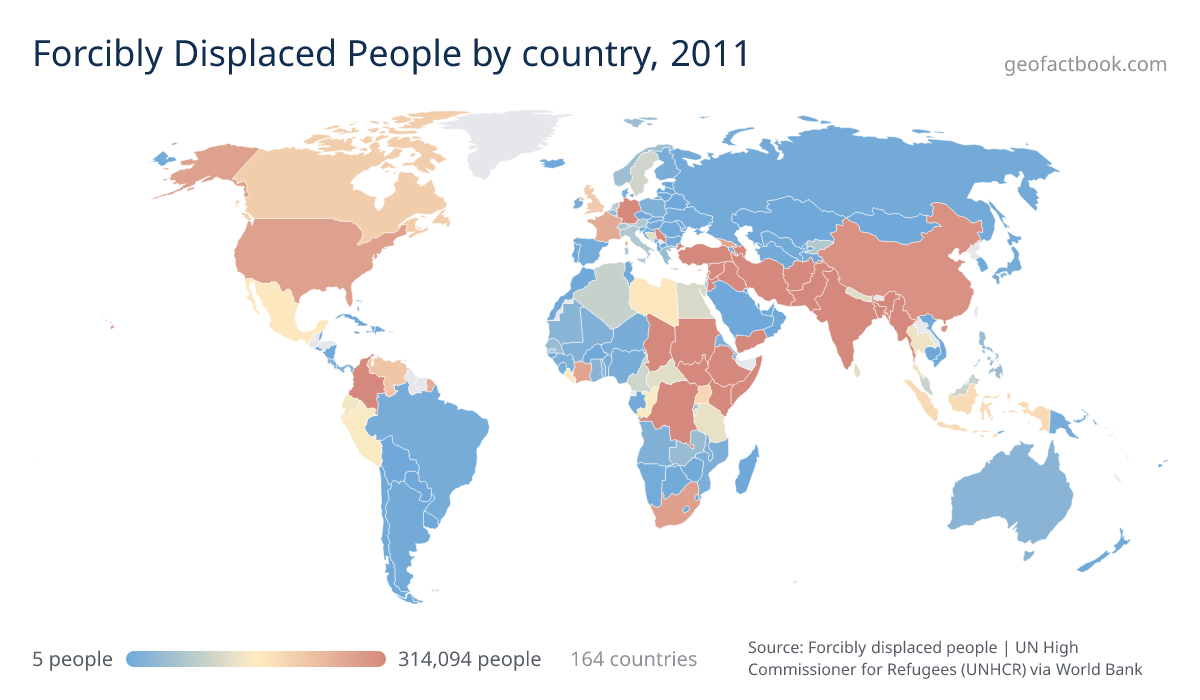
Forcibly Displaced People by country, 2011: map image
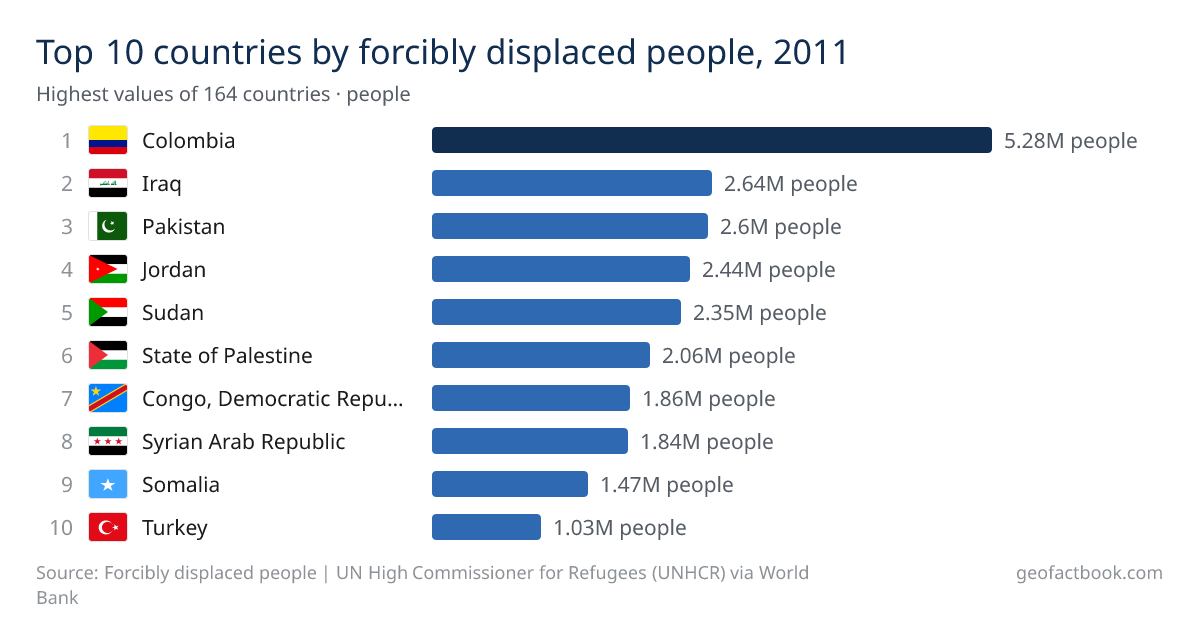
Top 10 countries by forcibly displaced people, 2011: chart
Insights by country
Senegal
In 2011, Senegal had 63 rank globally for Forcibly Displaced People with a total of 46,901 people. This figure is notable when compared to the regional average in West Africa, where displacement figures are often higher due to ongoing conflicts. The primary drivers of displacement in Senegal include economic challenges and the impacts of climate change, which have led to internal migration and pressures on resources.
El Salvador
In 2011, El Salvador had 44 Forcibly Displaced People, ranking #150 out of 164 countries. This figure is notably low compared to other Central American nations, where displacement often stems from violence and poverty. In El Salvador, factors such as gang violence and economic instability contribute to the limited number of forcibly displaced individuals, reflecting a complex interplay of social issues and government response.
Ecuador
In 2011, Ecuador had 42 global rank for Forcibly Displaced People with a total of 144,941 people. This figure is significant compared to other countries in the region, illustrating a notable challenge in displacement issues. Key drivers for this situation include ongoing internal conflicts, economic instability, and a high rate of violence that has compelled many Ecuadorians to flee their homes.
Azerbaijan
Azerbaijan ranked #18 globally with 600,769 Forcibly Displaced People in 2011. This figure is significant, reflecting ongoing regional tensions, particularly due to the Nagorno-Karabakh conflict, which has historically displaced many individuals. The country’s geopolitical position and unresolved territorial disputes contribute to a high number of displaced persons, impacting its social and economic landscape.
Liechtenstein
In 2011, Liechtenstein had 136 forcibly displaced people, ranking #141 out of 164 countries for this metric. This figure is notably low compared to larger countries in Europe, reflecting Liechtenstein's small size and stable political environment. The principality's robust economy and strong social policies contribute to its ability to maintain low levels of forced displacement, as it has not been a significant destination for refugees or internally displaced persons.
Ukraine
In 2011, Ukraine had 6757 Forcibly Displaced People, ranking #99 out of 164 countries. This figure is notably lower than many of its Eastern European neighbors, reflecting a relatively stable internal situation at that time. The primary drivers for this statistic include Ukraine's geographic position, which has historically offered some degree of stability, and its policies aimed at maintaining social cohesion amidst regional tensions.
Malaysia
In 2011, Malaysia ranked #53 globally with 97,594 people categorized as Forcibly Displaced People. This figure is notably higher than many of its Southeast Asian neighbors, reflecting regional challenges in addressing displacement. Contributing factors include Malaysia's geographic position as a transit country for refugees and its relatively open immigration policies, which attract individuals fleeing conflict and persecution in neighboring nations.
Switzerland
In 2011, Switzerland ranked #59 globally with 67,294 people classified as Forcibly Displaced People. This figure is notably lower than many European neighbors, reflecting Switzerland's robust asylum policies and economic stability. Key drivers include the country's commitment to humanitarian principles and its geographic location, which attracts individuals seeking refuge from conflict and persecution.
France
In 2011, France had 30th rank globally with 259,447 Forcibly Displaced People. This figure is significant when compared to neighboring countries like Germany, which faced similar challenges but had a higher number of displaced individuals. The influx of forcibly displaced people in France can be attributed to its geographic location as a gateway to Europe, as well as its historical role in international humanitarian efforts, which has influenced its immigration policies.
Sudan
In 2011, Sudan ranked #5 globally with 2,346,303 people classified as Forcibly Displaced People. This figure highlights Sudan's severe displacement crisis, exacerbated by ongoing conflicts and instability, particularly in regions like Darfur. The combination of civil unrest, economic challenges, and humanitarian issues has driven millions from their homes, contributing significantly to the country's high displacement numbers.
Analysis & Context
In 2011, the country with the highest number of Forcibly Displaced People was Colombia, with a staggering 5,281,323 individuals. The global range for forcibly displaced populations spanned from as few as 5 people in several countries to Colombia's maximum, highlighting significant disparities. The average number of forcibly displaced people across the 164 countries with available data was 234,990.15, while the median stood at 13,666.
Conflict and Displacement: Key Drivers in Top Countries
The prevalence of high numbers of Forcibly Displaced People in 2011 was prominently linked to ongoing conflicts and instability. Colombia, with its internal conflict involving armed groups, topped the list. Similarly, Iraq and Pakistan reported figures of 2,639,379 and 2,604,315 displaced individuals, respectively, due to prolonged warfare and internal strife. In Syria, the early stages of civil war contributed to 1,844,194 forcibly displaced people. These numbers underscore the direct impact of conflict on displacement, where security concerns and violence force populations to flee their homes.
Geopolitical and Economic Influences on Displacement
In several countries, geopolitical factors played a significant role in the displacement figures. Jordan, with 2,435,548 displaced persons, was heavily influenced by regional instability, particularly the spillover from neighboring conflicts. Similarly, the State of Palestine experienced high displacement levels, with 2,055,043 individuals affected, largely due to protracted geopolitical tensions. In contrast, countries such as Turkey housed 1,025,393 displaced persons, partly due to its status as a regional hub for refugees and asylum seekers, influenced by its geographical position and economic opportunities.
Year-over-Year Trends: Significant Shifts in Displacement
Analyzing year-over-year changes reveals significant shifts in displacement patterns. Yemen experienced the largest increase, with 265,971 more displaced individuals, a 63.5% rise, driven by escalating conflict. Libya also saw a dramatic increase of 155,905 displaced people, marking a 1403.7% surge, primarily due to the civil unrest following the Arab Spring. Conversely, Sudan witnessed a massive reduction of 2,638,040, a 52.9% decrease, possibly reflecting changes in the methods of counting or resettlement of displaced populations. Sri Lanka saw a substantial decrease of 201,973, as the country moved towards post-conflict stabilization.
Minimal Displacement: A Reflection of Stability and Policy
At the other end of the spectrum, countries with minimal displacement figures, such as Sint Maarten, Saint Lucia, and Mongolia, each reported only 5 displaced individuals. These low numbers can often be attributed to stable political environments and effective governance, reducing the likelihood of internal displacement. Additionally, geographic isolation and limited international borders may contribute to lower displacement rates, as seen in island nations like Grenada and Fiji, which also reported minimal displacement.
In summary, the 2011 data on Forcibly Displaced People reflect a complex interplay of conflict, geopolitical dynamics, and economic factors. Countries with high displacement figures often grapple with internal conflicts and regional instability, while those with lower figures benefit from political stability and strategic geographic positioning. Understanding these patterns is crucial for developing targeted interventions to address and mitigate the causes of displacement globally.
Frequently Asked Questions About Forcibly Displaced People in 2011
Which country had the highest number of forcibly displaced people in 2011?
Colombia had the highest number of forcibly displaced people in 2011, with 5,281,323 people.
What was the average number of forcibly displaced people per country in 2011?
The average number of forcibly displaced people per country in 2011 was 234,990 people.
Which country had the lowest number of forcibly displaced people in 2011?
Sint Maarten (Dutch part) had the lowest number of forcibly displaced people in 2011, with 5 people.
What was the median number of forcibly displaced people per country in 2011?
The median number of forcibly displaced people per country in 2011 was 13,640 people.
How many countries had fewer than 20 forcibly displaced people in 2011?
In 2011, ten countries had fewer than 20 forcibly displaced people.
Which countries were in the top three for forcibly displaced people in 2011?
The top three countries for forcibly displaced people in 2011 were Colombia, Iraq, and Pakistan.
Data Source
Forcibly displaced people | UN High Commissioner for Refugees (UNHCR) via World Bank
Data produced by Refugee Population Statistics Database, UN High Commissioner for Refugees (UNHCR), compiled and published by World Bank as "Forcibly displaced people".
Visit Data SourceCite this page
Geo Factbook. (n.d.). Forcibly Displaced People by Country, 2011. Retrieved November 27, 2026, from https://geofactbook.com/fact/forcibly-displaced-people/2011
The figures on this page come from Forcibly displaced people | UN High Commissioner for Refugees (UNHCR) via World Bank. For academic work, cite the original source as well.
›Embed this ranking on your site
Free to embed with attribution. Shows the top 10 countries and links back to the full ranking.
Historical Data by Year
Explore Forcibly Displaced People data across different years. Compare trends and see how statistics have changed over time.
You might also like
Rule of Law Index by Country
FeaturedCompare countries by Rule of Law percentile rank, reflecting confidence in laws, courts, police, property rights, and protection from crime and violence.
Highest: Finland100%Human Capital Index
FeaturedThe Human Capital Index measures a country's investment in education and health, reflecting its potential for economic growth and productivity. This vital statistic highlights the importance of nurturing human resources for sustainable development.
 Highest: Singapore0.91
Total population
FeaturedDiscover the latest total population statistics for every country and region worldwide. Explore accurate, up-to-date data on global population growth, density, and demographic trends — sourced from trusted international databases like the UN and World Bank. Perfect for researchers, students, and data enthusiasts looking to understand how the world’s population is changing.
Highest: India1.48B persons