
Forcibly Displaced People 2024
Forcibly displaced people include refugees, asylum seekers, and internally displaced persons worldwide.
Newer data is available: Forcibly Displaced People by country 2025 →
Where does your country rank? Pick it to see its position.
Related Transnational Issues statistics
More ↓Interactive Map
Complete Data Rankings
Rank | Actions | ||
|---|---|---|---|
1 |  Sudan | 12,397,988 people | |
2 |  Colombia | 10,075,215 people | |
3 |  Syrian Arab Republic | 8,008,147 people | |
4 |  Congo, Democratic Republic of the | 6,733,445 people | |
5 |  Yemen | 4,856,921 people | |
6 |  Afghanistan | 4,208,236 people | |
7 |  Ukraine | 3,667,876 people | |
8 |  United States | 3,619,495 people | |
9 |  Nigeria | 3,599,131 people | |
10 |  Myanmar | 3,521,000 people | |
11 |  Iran | 3,489,257 people | |
12 |  Ethiopia | 3,449,881 people | |
13 |  Somalia | 3,177,763 people | |
14 |  Germany | 3,098,169 people | |
15 |  Turkey | 3,094,818 people | |
16 |  State of Palestine | 3,083,600 people | |
17 |  Jordan | 3,046,775 people | |
18 |  Lebanon | 2,236,659 people | |
19 |  Burkina Faso | 2,104,408 people | |
20 |  Uganda | 1,798,297 people | |
21 |  Pakistan | 1,781,332 people | |
22 |  Peru | 1,759,914 people | |
23 |  Chad | 1,669,645 people | |
24 |  Bangladesh | 1,590,637 people | |
25 |  Cameroon | 1,472,740 people | |
26 |  South Sudan | 1,462,471 people | |
27 |  Iraq | 1,366,343 people | |
28 |  Poland | 1,019,863 people | |
29 |  Kenya | 923,904 people | |
30 |  Egypt | 876,962 people | |
31 |  Mexico | 871,893 people | |
32 |  Brazil | 814,492 people | |
33 |  France | 810,325 people | |
34 |  Niger | 800,795 people | |
35 |  India | 775,006 people | |
36 |  Spain | 693,298 people | |
37 |  Azerbaijan | 664,698 people | |
38 |  United Kingdom | 640,460 people | |
39 |  Mozambique | 604,250 people | |
40 |  Guatemala | 577,676 people | |
41 |  Canada | 561,551 people | |
42 |  Chile | 539,515 people | |
43 |  Central African Republic | 522,378 people | |
44 |  Italy | 520,127 people | |
45 |  Ecuador | 518,338 people | |
46 |  Mali | 481,827 people | |
47 |  Czech Republic | 392,198 people | |
48 |  Libya | 384,010 people | |
49 |  Georgia | 330,791 people | |
50 |  Cyprus | 318,303 people | |
51 |  Austria | 313,711 people | |
52 |  Netherlands | 310,239 people | |
53 |  Costa Rica | 262,804 people | |
54 |  Serbia | 246,270 people | |
55 |  Belgium | 236,689 people | |
56 |  Tanzania | 218,123 people | |
57 |  Switzerland | 213,177 people | |
58 |  Malaysia | 191,343 people | |
59 |  Algeria | 188,206 people | |
60 |  Romania | 184,991 people | |
61 |  Russia | 182,440 people | |
62 |  Argentina | 173,791 people | |
63 |  South Africa | 171,513 people | |
64 |  Sweden | 168,519 people | |
65 |  Mauritania | 162,277 people | |
66 |  Ireland | 156,441 people | |
67 |  Armenia | 145,354 people | |
68 |  Greece | 144,694 people | |
69 |  Slovakia | 144,349 people | |
70 |  Republic of Moldova | 136,845 people | |
71 |  Norway | 129,894 people | |
72 |  Rwanda | 128,561 people | |
73 |  Dominican Republic | 126,347 people | |
74 |  Philippines | 125,342 people | |
75 |  Australia | 120,789 people | |
76 |  Bulgaria | 114,728 people | |
77 |  Honduras | 101,341 people | |
78 |  Denmark | 100,832 people | |
79 |  Burundi | 98,064 people | |
80 |  Finland | 97,568 people | |
81 |  Bosnia and Herzegovina | 95,685 people | |
82 |  Israel | 95,413 people | |
83 |  Papua New Guinea | 94,983 people | |
84 |  Zambia | 89,108 people | |
85 |  Thailand | 87,025 people | |
86 |  Hungary | 72,359 people | |
87 |  Portugal | 71,166 people | |
88 |  Congo | 69,766 people | |
89 |  Côte d'Ivoire | 69,176 people | |
90 |  Indonesia | 68,964 people | |
91 |  Uruguay | 68,100 people | |
92 |  Panama | 67,722 people | |
93 |  Togo | 66,756 people | |
94 |  Kazakhstan | 66,152 people | |
95 |  Japan | 60,361 people | |
96 |  Malawi | 57,539 people | |
97 |  Angola | 55,542 people | |
98 |  Lithuania | 53,859 people | |
99 |  Latvia | 49,483 people | |
100 |  Belarus | 44,621 people | |
101 |  Estonia | 42,439 people | |
102 |  South Korea | 40,084 people | |
103 |  El Salvador | 35,392 people | |
104 |  Benin | 35,225 people | |
105 |  Djibouti | 32,636 people | |
106 |  Trinidad and Tobago | 32,056 people | |
107 |  Croatia | 29,927 people | |
108 |  Kyrgyzstan | 25,413 people | |
109 |  Zimbabwe | 22,832 people | |
110 |  North Macedonia | 20,937 people | |
111 |  Venezuela | 20,911 people | |
112 |  Ghana | 20,534 people | |
113 |  Nepal | 19,874 people | |
114 |  Bolivia | 19,638 people | |
115 |  Senegal | 18,964 people | |
116 |  Morocco | 18,848 people | |
117 |  Montenegro | 18,820 people | |
118 |  Tajikistan | 15,191 people | |
119 |  Luxembourg | 14,344 people | |
120 |  Slovenia | 13,369 people | |
121 |  Tunisia | 12,575 people | |
122 |  Curaçao | 11,593 people | |
123 |  Aruba | 11,470 people | |
124 |  Albania | 9,381 people | |
125 |  Malta | 9,284 people | |
126 |  Iceland | 8,960 people | |
127 |  Uzbekistan | 8,505 people | |
128 |  Paraguay | 7,649 people | |
129 |  United Arab Emirates | 7,634 people | |
130 |  Namibia | 6,575 people | |
131 |  New Zealand | 5,622 people | |
132 |  Sri Lanka | 5,300 people | |
133 |  Eswatini | 4,459 people | |
134 |  Gambia | 4,411 people | |
135 |  Saudi Arabia | 4,355 people | |
136 |  Turkmenistan | 3,409 people | |
137 |  Suriname | 3,241 people | |
138 |  Guinea | 2,343 people | |
139 |  Belize | 2,287 people | |
140 |  Liberia | 1,854 people | |
141 |  Madagascar | 1,436 people | |
142 |  Kuwait | 1,271 people | |
143 |  Liechtenstein | 875 people | |
144 |  Botswana | 823 people | |
145 |  China | 814 people | |
146 |  Oman | 714 people | |
147 |  Lesotho | 610 people | |
148 |  Bahrain | 371 people | |
149 |  Qatar | 349 people | |
150 |  Gabon | 261 people | |
151 |  China, Hong Kong SAR | 260 people | |
152 |  Cuba | 171 people | |
153 |  Sint Maarten (Dutch part) | 156 people | |
154 |  Eritrea | 119 people | |
155 |  Nauru | 95 people | |
156 |  Mauritius | 82 people | |
157 |  Cayman Islands | 65 people | |
158 |  Guinea-Bissau | 54 people | |
159 |  British Virgin Islands | 41 people | |
160 |  Bahamas | 30 people | |
161 |  Comoros | 29 people | |
162 |  Cambodia | 28 people | |
163 |  Mongolia | 26 people | |
164 |  Fiji | 25 people | |
165 |  Vietnam | 19 people | |
166 |  Monaco | 17 people | |
167 |  Barbados | 13 people | |
168 |  Solomon Islands | 11 people | |
169 |  Turks and Caicos Islands | 8 people | |
170 |  Antigua and Barbuda | 5 people | |
171 |  Dominica | 5 people | |
172 |  Equatorial Guinea | 5 people | |
173 |  Palau | 5 people | |
174 |  Saint Kitts and Nevis | 5 people | |
175 |  Saint Lucia | 5 people | |
176 |  Brunei Darussalam | 0 people | |
177 |  Cabo Verde | 0 people | |
178 |  Singapore | 0 people |
- #1Sudan
- #2Colombia
- #3Syrian Arab Republic
- #4Congo, Democratic Republic of the
- #5Yemen
- #6Afghanistan
- #7Ukraine
- #8United States
- #9Nigeria
- #10Myanmar
Analysis: These countries represent the highest values in this dataset, showcasing significant scale and impact on global statistics.
- #178Singapore
- #177Cabo Verde
- #176Brunei Darussalam
- #175Saint Lucia
- #174Saint Kitts and Nevis
- #173Palau
- #172Equatorial Guinea
- #171Dominica
- #170Antigua and Barbuda
- #169Turks and Caicos Islands
Context: These countries or territories have the lowest values, often due to geographic size, administrative status, or specific characteristics.
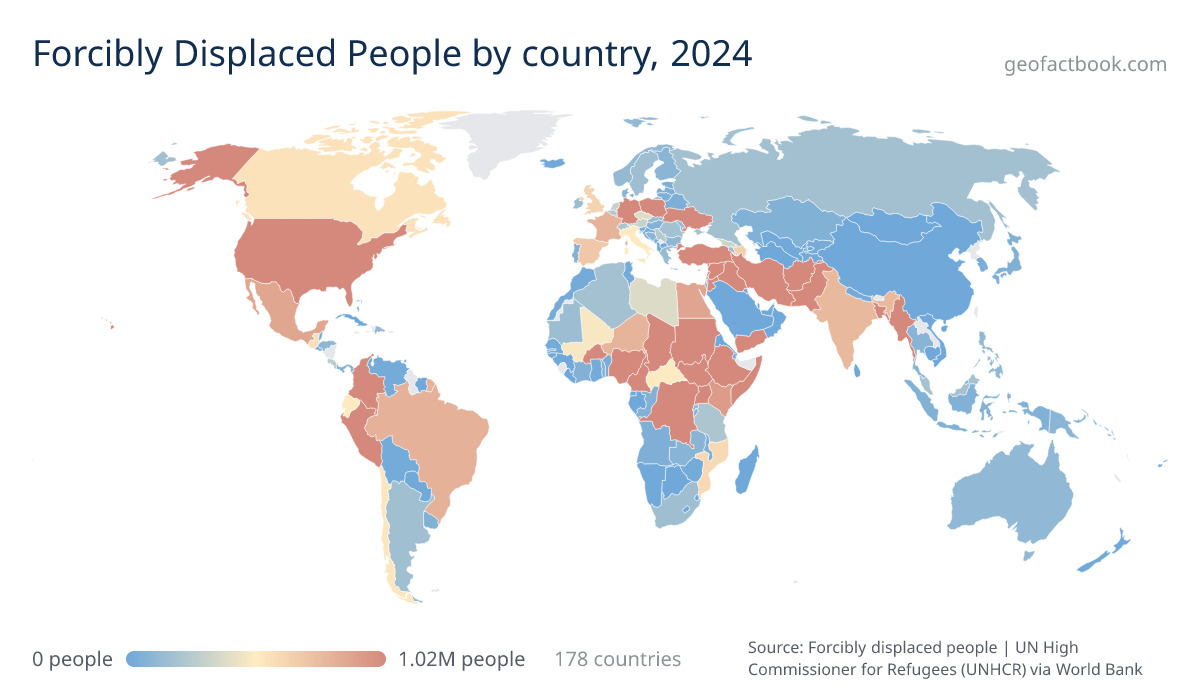
Forcibly Displaced People by country, 2024: map image
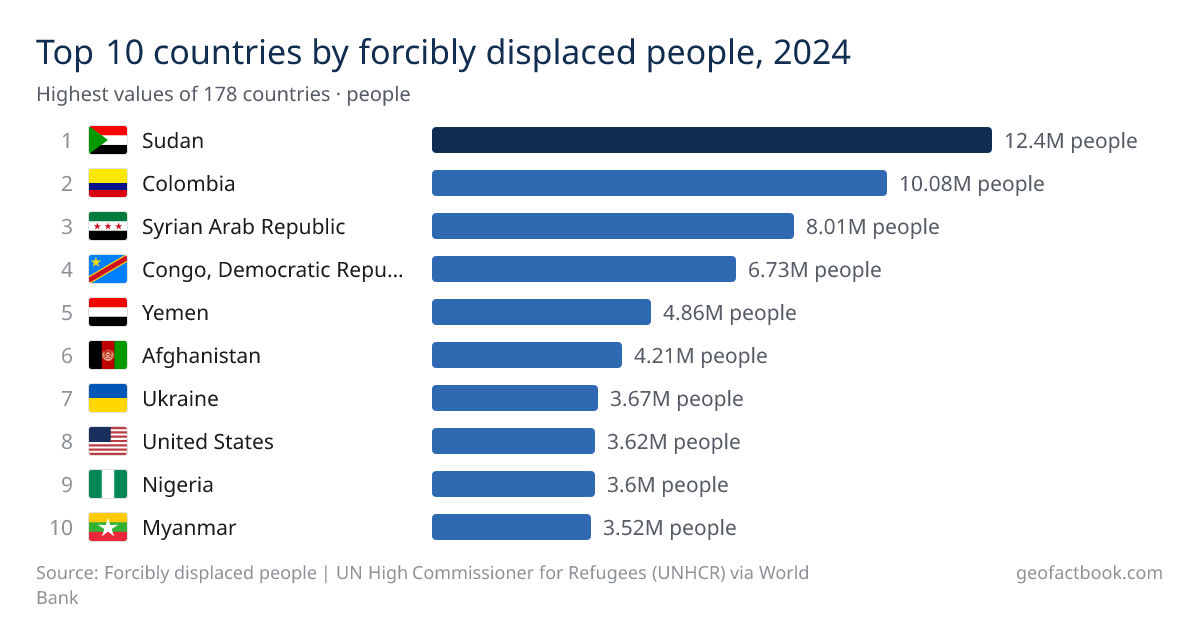
Top 10 countries by forcibly displaced people, 2024: chart
Insights by country
Malawi
In 2024, Malawi ranks #96 globally with 57,539 forcibly displaced people. This figure is notably higher than some neighboring countries, indicating a significant challenge in the region. The primary drivers of displacement in Malawi include ongoing economic hardships, which exacerbate vulnerability, and environmental factors such as climate change that lead to natural disasters, displacing communities and straining resources.
Cyprus
In 2024, Cyprus ranks #50 globally with 318,303 forcibly displaced people. This figure is notably high for a small island nation, particularly when compared to neighboring countries in the Eastern Mediterranean. The significant number of displaced individuals is largely driven by ongoing geopolitical tensions and the island's strategic location, which has made it a transit point for migrants and refugees seeking safety in Europe.
Congo, Democratic Republic of the
Congo, Democratic Republic of the ranks #4 globally with 6,733,445 forcibly displaced people in 2024. This figure is significantly higher than the global average, reflecting ongoing instability in the region. The primary drivers include prolonged conflict, widespread violence, and the presence of armed groups, which have forced millions to flee their homes in search of safety and stability.
Slovakia
In 2024, Slovakia ranks #69 with 144,349 Forcibly Displaced People. This figure is notable when compared to its regional neighbors, as it reflects ongoing challenges in managing migration flows in Central Europe. Key drivers include Slovakia's geographic location as a transit country for refugees and its evolving asylum policies, which have faced criticism for their effectiveness in addressing displacement issues.
Afghanistan
In 2024, Afghanistan ranks #6 globally with 4,208,236 forcibly displaced people. This figure is significantly higher than many neighboring countries, reflecting ongoing instability in the region. Key drivers include prolonged conflict, economic hardship, and a lack of effective governance, which have displaced millions and exacerbated humanitarian crises.
Norway
In 2024, Norway ranks #71 globally with 129,894 Forcibly Displaced People. This figure is relatively low compared to the global context, where countries like Syria and Venezuela have millions displaced. The number of forcibly displaced individuals in Norway is influenced by its robust social welfare system, which attracts asylum seekers, alongside its geographical stability and commitment to humanitarian policies.
Ecuador
Ecuador ranks #45 globally with 518338 forcibly displaced people in 2024. This figure is significant compared to neighboring Colombia, which has a substantially higher number of displaced individuals due to ongoing conflict. Key drivers of Ecuador's displacement include economic instability and the influx of Venezuelan migrants, exacerbating pressures on local resources and social services.
Libya
In 2024, Libya ranks #48 globally with 384,010 forcibly displaced people. This figure reflects a significant humanitarian challenge, particularly when compared to neighboring countries like Tunisia, which has a much lower number of displaced individuals. Ongoing conflict, political instability, and economic hardships have driven many Libyans to flee their homes, exacerbating the crisis and complicating recovery efforts.
Gambia
In 2024, Gambia ranks #134 globally with 4,411 forcibly displaced people. This number is significant when compared to the global context, as many neighboring countries face similar challenges but with varying scales of displacement. The primary drivers of displacement in Gambia include economic instability and political factors, which have led to internal migration and refugee flows, particularly among vulnerable populations seeking better opportunities.
Palau
In 2024, Palau ranks #173 globally with 5 forcibly displaced people. This figure is significantly lower than many countries, particularly those facing ongoing conflicts or natural disasters. Palau's geographical isolation and stable political environment contribute to its minimal displacement figures, as the nation has not experienced the same levels of turmoil that affect its regional neighbors.
Analysis & Context
In 2024, Sudan leads the world in terms of Forcibly Displaced People, with a staggering 12,397,988 individuals, highlighting a significant global issue. The range of forcibly displaced people spans from 0 in several small island nations to 12,397,988 in Sudan. The global context is further illustrated by an average of 686,230 forcibly displaced individuals per country, providing a stark contrast to the median value of 69,176.
Drivers of Displacement: Conflict and Instability
The primary driver of forced displacement continues to be conflict and political instability. Sudan tops the list, primarily due to ongoing internal conflicts and political turmoil that have displaced millions. Similarly, the Syrian Arab Republic and the Democratic Republic of the Congo report high numbers of forcibly displaced people, with 8,008,147 and 6,733,445 respectively. These countries face protracted conflicts that create unsafe living conditions, forcing people to flee their homes.
In Yemen, with 4,856,921 displaced individuals, the prolonged civil war has led to one of the world's worst humanitarian crises. The conflict has devastated infrastructure and basic services, pushing people into displacement both internally and across borders.
Impact of Economic Conditions and Governance
Economic conditions and governance also play significant roles in displacement patterns. Colombia, with 10,075,215 forcibly displaced individuals, faces challenges from both internal displacement due to armed conflict and cross-border influxes from neighboring Venezuela. The socio-economic pressures compound the displacement issue, making recovery and resettlement efforts more complex.
In contrast, the United States, with 3,619,495 displaced individuals, showcases a different dynamic where immigration policies and asylum processes influence displacement figures. The U.S. sees a significant number of asylum seekers and undocumented migrants, contributing to its high displacement numbers.
Year-over-Year Changes and Emerging Trends
Analysis of year-over-year changes reveals significant shifts in displacement patterns. Sudan witnessed an increase of 2,383,004 displaced persons, a 23.8% rise, driven by escalating violence and humanitarian needs. Colombia also saw a substantial increase of 2,121,831 or 26.7%, reflecting ongoing regional instability and migration pressures.
Conversely, Russia experienced the most significant decrease, with -1,108,582 displaced individuals, an 85.9% drop. This reduction could be attributed to policy changes or improved conditions for certain displaced populations. Similarly, Somalia and the Democratic Republic of the Congo also reported decreases, with -722,507 and -530,053 respectively, highlighting potential areas of stabilization or effective intervention measures.
Regional Disparities and Policy Implications
Regional disparities in displacement figures underscore the need for targeted policy interventions. While some countries like Cabo Verde and Brunei Darussalam report zero forcibly displaced people, others like Myanmar with 3,521,000 highlight severe regional challenges. Myanmar's increase of 896,000 displaced individuals (a 34.1% rise) is indicative of ongoing conflicts and ethnic tensions.
These disparities call for international cooperation and comprehensive policies that address root causes of displacement, improve governance, and enhance economic resilience in affected regions. Understanding these patterns enables better resource allocation and humanitarian assistance, ensuring more effective support for displaced populations worldwide.
Frequently Asked Questions About Forcibly Displaced People in 2024
Which country has the highest number of forcibly displaced people in 2024?
Sudan has the highest number of forcibly displaced people in 2024, with 12,397,988 people.
What is the average number of forcibly displaced people per country in 2024?
The average number of forcibly displaced people per country in 2024 is 686,230 people.
Which country has the lowest number of forcibly displaced people in 2024?
Cabo Verde has the lowest number of forcibly displaced people in 2024, with 0 people.
What is the median number of forcibly displaced people per country in 2024?
The median number of forcibly displaced people per country in 2024 is 69,070 people.
How many countries are included in the dataset for forcibly displaced people in 2024?
The dataset includes 178 countries for forcibly displaced people in 2024.
Which countries are in the top 3 for forcibly displaced people in 2024?
The top 3 countries for forcibly displaced people in 2024 are Sudan, Colombia, and the Syrian Arab Republic.
Data Source
Forcibly displaced people | UN High Commissioner for Refugees (UNHCR) via World Bank
Data produced by Refugee Population Statistics Database, UN High Commissioner for Refugees (UNHCR), compiled and published by World Bank as "Forcibly displaced people".
Visit Data SourceCite this page
Geo Factbook. (n.d.). Forcibly Displaced People by Country, 2024. Retrieved November 27, 2026, from https://geofactbook.com/fact/forcibly-displaced-people/2024
The figures on this page come from Forcibly displaced people | UN High Commissioner for Refugees (UNHCR) via World Bank. For academic work, cite the original source as well.
›Embed this ranking on your site
Free to embed with attribution. Shows the top 10 countries and links back to the full ranking.
Historical Data by Year
Explore Forcibly Displaced People data across different years. Compare trends and see how statistics have changed over time.
You might also like
Rule of Law Index by Country
FeaturedCompare countries by Rule of Law percentile rank, reflecting confidence in laws, courts, police, property rights, and protection from crime and violence.
Highest: Finland100%Human Capital Index
FeaturedThe Human Capital Index measures a country's investment in education and health, reflecting its potential for economic growth and productivity. This vital statistic highlights the importance of nurturing human resources for sustainable development.
Highest: Singapore0.91Total population
FeaturedDiscover the latest total population statistics for every country and region worldwide. Explore accurate, up-to-date data on global population growth, density, and demographic trends — sourced from trusted international databases like the UN and World Bank. Perfect for researchers, students, and data enthusiasts looking to understand how the world’s population is changing.
Highest: India1.48B persons