
Forcibly Displaced People 2020
Forcibly displaced people include refugees, asylum seekers, and internally displaced persons worldwide.
Newer data is available: Forcibly Displaced People by country 2025 →
 Syrian Arab Republic
 Vietnam
Where does your country rank? Pick it to see its position.
Related Transnational Issues statistics
More ↓Interactive Map
Complete Data Rankings
Rank | Actions | ||
|---|---|---|---|
1 | Syrian Arab Republic | 7,160,803 people | |
2 |  Colombia | 6,672,427 people | |
3 |  Congo, Democratic Republic of the | 5,759,723 people | |
4 |  Turkey | 3,974,550 people | |
5 |  Yemen | 3,812,599 people | |
6 |  Afghanistan | 3,619,445 people | |
7 |  Sudan | 3,332,311 people | |
8 |  Jordan | 3,059,158 people | |
9 |  Somalia | 2,992,449 people | |
10 |  Ethiopia | 2,862,355 people | |
11 |  Nigeria | 2,798,843 people | |
12 |  State of Palestine | 2,479,243 people | |
13 |  South Sudan | 1,754,201 people | |
14 |  Pakistan | 1,546,734 people | |
15 |  Iraq | 1,507,047 people | |
16 |  Germany | 1,453,753 people | |
17 |  Uganda | 1,447,369 people | |
18 |  Cameroon | 1,446,205 people | |
19 |  Lebanon | 1,367,203 people | |
20 |  United States | 1,338,842 people | |
21 |  Bangladesh | 1,292,552 people | |
22 |  Peru | 1,116,863 people | |
23 |  Burkina Faso | 1,095,282 people | |
24 |  Chad | 825,217 people | |
25 |  Iran | 800,059 people | |
26 |  Ukraine | 738,608 people | |
27 |  Azerbaijan | 736,620 people | |
28 |  Mozambique | 703,199 people | |
29 |  Kenya | 694,832 people | |
30 |  Central African Republic | 691,368 people | |
31 |  India | 679,590 people | |
32 |  Mexico | 568,073 people | |
33 |  France | 554,192 people | |
34 |  Ecuador | 532,360 people | |
35 |  Myanmar | 505,000 people | |
36 |  Niger | 493,578 people | |
37 |  Chile | 464,669 people | |
38 |  Brazil | 425,507 people | |
39 |  Mali | 374,349 people | |
40 |  Egypt | 332,472 people | |
41 |  Libya | 322,188 people | |
42 |  Côte d'Ivoire | 310,310 people | |
43 |  China | 304,148 people | |
44 |  Georgia | 292,062 people | |
45 |  Sweden | 266,975 people | |
46 |  Tanzania | 263,393 people | |
47 |  Cyprus | 262,480 people | |
48 |  South Africa | 250,190 people | |
49 |  Honduras | 247,201 people | |
50 |  Guatemala | 243,226 people | |
51 |  Serbia | 239,387 people | |
52 |  United Kingdom | 209,549 people | |
53 |  Spain | 207,009 people | |
54 |  Canada | 194,566 people | |
55 |  Argentina | 184,800 people | |
56 |  Italy | 181,934 people | |
57 |  Malaysia | 179,724 people | |
58 |  Congo | 174,719 people | |
59 |  Greece | 163,974 people | |
60 |  Austria | 162,526 people | |
61 |  Philippines | 154,106 people | |
62 |  Rwanda | 139,956 people | |
63 |  Australia | 138,212 people | |
64 |  Panama | 134,391 people | |
65 |  Switzerland | 122,345 people | |
66 |  Costa Rica | 121,738 people | |
67 |  Dominican Republic | 114,837 people | |
68 |  Armenia | 108,846 people | |
69 |  Netherlands | 107,779 people | |
70 |  Bosnia and Herzegovina | 104,488 people | |
71 |  Burundi | 102,375 people | |
72 |  Algeria | 99,775 people | |
73 |  Thailand | 97,031 people | |
74 |  Mauritania | 95,567 people | |
75 |  Belgium | 94,278 people | |
76 |  Indonesia | 78,711 people | |
77 |  Zambia | 70,363 people | |
78 |  Venezuela | 68,373 people | |
79 |  Angola | 56,069 people | |
80 |  Norway | 50,736 people | |
81 |  Malawi | 48,021 people | |
82 |  Denmark | 37,974 people | |
83 |  Israel | 34,361 people | |
84 |  Djibouti | 32,004 people | |
85 |  Finland | 29,744 people | |
86 |  Trinidad and Tobago | 27,768 people | |
87 |  Sri Lanka | 27,232 people | |
88 |  Uruguay | 25,358 people | |
89 |  Japan | 24,897 people | |
90 |  Senegal | 24,674 people | |
91 |  Papua New Guinea | 23,889 people | |
92 |  South Korea | 23,516 people | |
93 |  Bulgaria | 23,051 people | |
94 |  Russia | 22,173 people | |
95 |  Zimbabwe | 21,190 people | |
96 |  Nepal | 19,597 people | |
97 |  Liberia | 18,881 people | |
98 |  Curaçao | 17,077 people | |
99 |  Aruba | 17,000 people | |
100 |  Ireland | 16,428 people | |
101 |  Ghana | 13,917 people | |
102 |  Morocco | 13,516 people | |
103 |  Malta | 13,215 people | |
104 |  Togo | 11,458 people | |
105 |  Bolivia | 10,830 people | |
106 |  Saudi Arabia | 9,764 people | |
107 |  Guinea | 9,572 people | |
108 |  United Arab Emirates | 8,544 people | |
109 |  Luxembourg | 6,558 people | |
110 |  Poland | 6,373 people | |
111 |  Tunisia | 6,280 people | |
112 |  Paraguay | 6,017 people | |
113 |  Tajikistan | 5,986 people | |
114 |  Hungary | 5,876 people | |
115 |  Romania | 5,823 people | |
116 |  Namibia | 5,792 people | |
117 |  Benin | 5,360 people | |
118 |  Gambia | 4,585 people | |
119 |  Portugal | 3,559 people | |
120 |  Czech Republic | 3,456 people | |
121 |  Belarus | 3,043 people | |
122 |  Sierra Leone | 2,842 people | |
123 |  New Zealand | 2,439 people | |
124 |  Belize | 2,278 people | |
125 |  Eswatini | 2,049 people | |
126 |  Suriname | 2,007 people | |
127 |  Lithuania | 2,002 people | |
128 |  Guinea-Bissau | 1,876 people | |
129 |  Kuwait | 1,786 people | |
130 |  Iceland | 1,641 people | |
131 |  Croatia | 1,523 people | |
132 |  Kyrgyzstan | 1,447 people | |
133 |  Nauru | 1,164 people | |
134 |  Slovenia | 1,100 people | |
135 |  Slovakia | 1,050 people | |
136 |  Botswana | 1,039 people | |
137 |  Latvia | 710 people | |
138 |  Kazakhstan | 663 people | |
139 |  Oman | 638 people | |
140 |  Gabon | 547 people | |
141 |  Nicaragua | 514 people | |
142 |  Republic of Moldova | 464 people | |
143 |  North Macedonia | 464 people | |
144 |  Lesotho | 450 people | |
145 |  Qatar | 444 people | |
146 |  Bahrain | 360 people | |
147 |  Montenegro | 359 people | |
148 |  Madagascar | 301 people | |
149 |  Estonia | 282 people | |
150 |  China, Hong Kong SAR | 245 people | |
151 |  Grenada | 234 people | |
152 |  Cuba | 232 people | |
153 |  Eritrea | 201 people | |
154 |  Liechtenstein | 149 people | |
155 |  New Caledonia | 140 people | |
156 |  Albania | 105 people | |
157 |  Cayman Islands | 105 people | |
158 |  El Salvador | 101 people | |
159 |  Jamaica | 99 people | |
160 |  Bahamas | 28 people | |
161 |  Monaco | 22 people | |
162 |  Mauritius | 20 people | |
163 |  Turkmenistan | 20 people | |
164 |  Fiji | 19 people | |
165 |  Saint Kitts and Nevis | 19 people | |
166 |  Saint Vincent and the Grenadines | 14 people | |
167 |  Uzbekistan | 13 people | |
168 |  Cambodia | 12 people | |
169 |  Mongolia | 10 people | |
170 |  Sint Maarten (Dutch part) | 8 people | |
171 |  Turks and Caicos Islands | 8 people | |
172 |  Barbados | 5 people | |
173 |  Cabo Verde | 0 people | |
174 |  Singapore | 0 people | |
175 | Vietnam | 0 people |
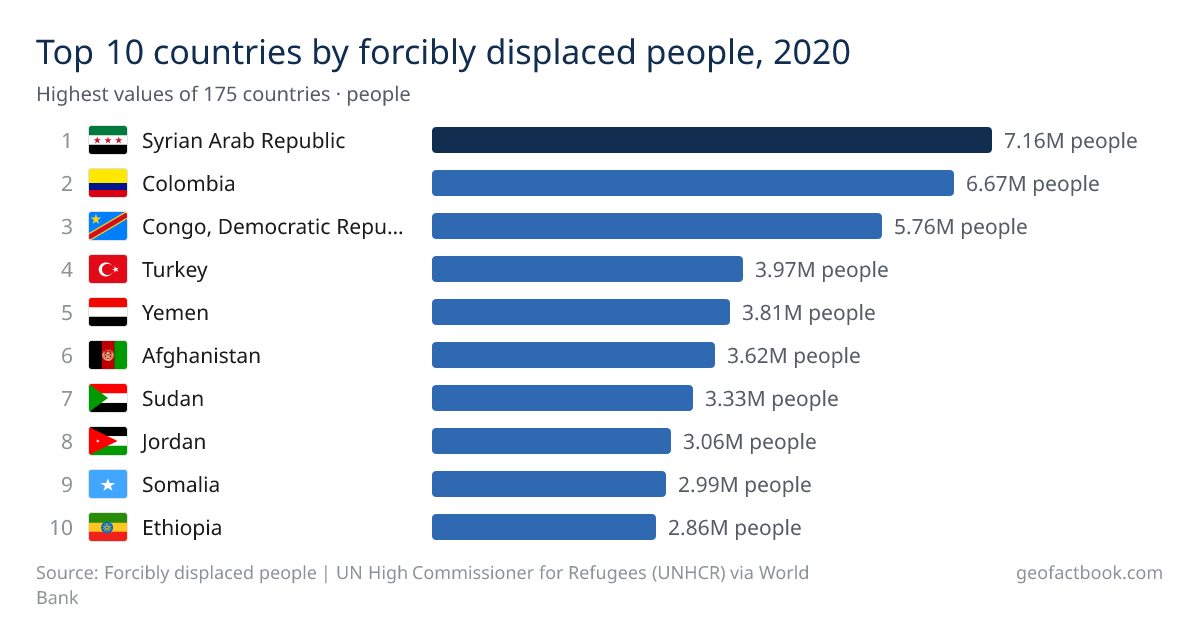
- #1Syrian Arab Republic
- #2Colombia
- #3Congo, Democratic Republic of the
- #4Turkey
- #5Yemen
- #6Afghanistan
- #7Sudan
- #8Jordan
- #9Somalia
- #10Ethiopia
Analysis: These countries represent the highest values in this dataset, showcasing significant scale and impact on global statistics.
- #175Vietnam
- #174Singapore
- #173Cabo Verde
- #172Barbados
- #171Turks and Caicos Islands
- #170Sint Maarten (Dutch part)
- #169Mongolia
- #168Cambodia
- #167Uzbekistan
- #166Saint Vincent and the Grenadines
Context: These countries or territories have the lowest values, often due to geographic size, administrative status, or specific characteristics.
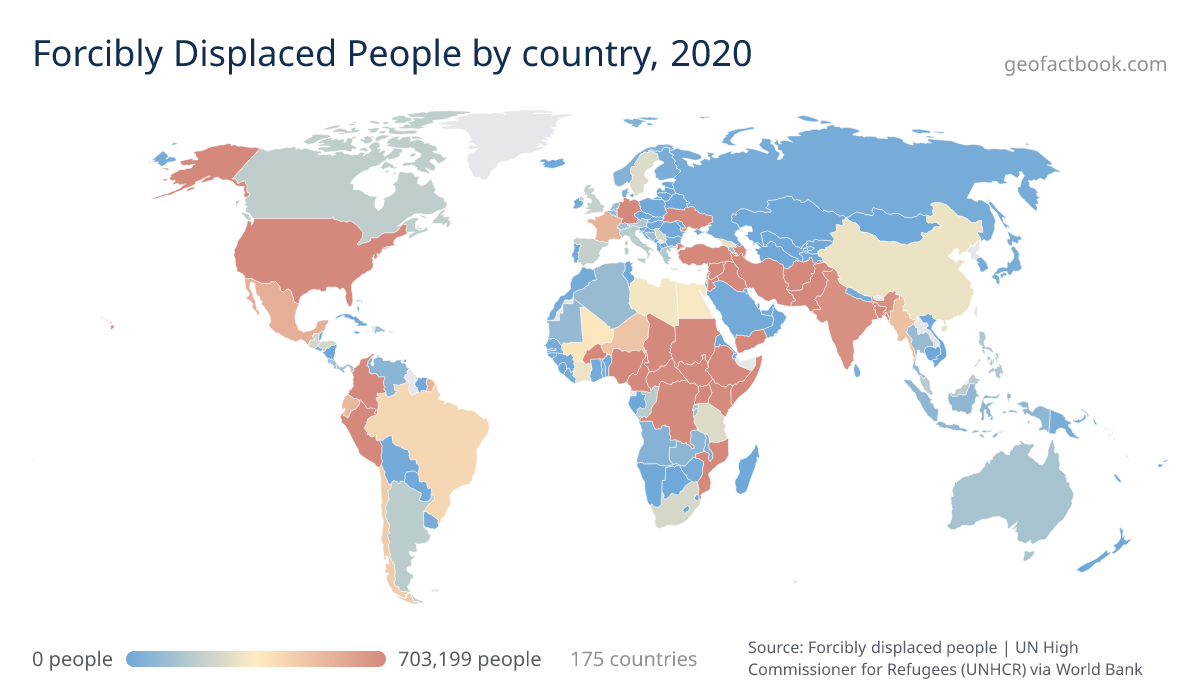
Forcibly Displaced People by country, 2020: map image
Top 10 countries by forcibly displaced people, 2020: chart
Insights by country
Bosnia and Herzegovina
In 2020, Bosnia and Herzegovina had 104488 forcibly displaced people, ranking #70 out of 175 countries. This figure is significant when compared to neighboring countries, reflecting ongoing regional challenges. The high number of displaced individuals is largely attributed to the aftermath of the Bosnian War, which resulted in extensive population displacement and ongoing socio-economic instability.
Algeria
In 2020, Algeria ranked #72 globally with 99,775 people classified as Forcibly Displaced. This number is significant when compared to neighboring countries, highlighting a regional challenge in managing displacement. Key drivers include Algeria's geographic location as a transit country for migrants and the ongoing socio-economic issues that contribute to instability in the region.
Russia
In 2020, Russia had 94th rank globally with 22,173 people classified as Forcibly Displaced People. This figure is notably lower than many neighboring countries, reflecting Russia's relatively stable internal conditions compared to conflict-affected regions. Key drivers of this statistic include the country's extensive geography and government policies that have historically managed population movements, particularly in response to regional conflicts and economic pressures.
Montenegro
In 2020, Montenegro had 359 Forcibly Displaced People, ranking #147 out of 175 countries. This figure is relatively low compared to many neighboring countries in the Balkans, which have faced higher levels of displacement due to regional conflicts in the past. Montenegro's stability and efforts to integrate displaced persons have contributed to this lower number, although economic challenges and limited resources continue to impact its capacity to support vulnerable populations.
Monaco
In 2020, Monaco had 22 Forcibly Displaced People, ranking #161 out of 175 countries. This figure is notably low compared to many other nations, reflecting Monaco's limited population and geographic size. The country's robust economic stability and strict immigration policies contribute to its minimal number of displaced individuals, as it attracts few refugees or asylum seekers.
Portugal
In 2020, Portugal ranked #119 globally with 3,559 forcibly displaced people. This figure is relatively low compared to many other European nations, reflecting Portugal's stable socio-political environment and effective immigration policies. The country's historical ties to former colonies may also influence its approach to asylum seekers and refugees, contributing to a manageable number of forcibly displaced individuals.
Chile
In 2020, Chile ranked #37 globally with 464,669 Forcibly Displaced People. This figure is significant compared to neighboring countries like Argentina, which has a lower number of displaced individuals. Key drivers of this situation in Chile include its geographic location as a transit country for migrants from crisis-stricken nations and its relatively stable economy, which attracts those seeking better opportunities.
Niger
Niger ranked #36 globally with 493,578 forcibly displaced people in 2020. This figure is significant when compared to other countries in the Sahel region, which face similar challenges. Key drivers of displacement in Niger include ongoing conflicts with militant groups, such as Boko Haram, and environmental factors like desertification that exacerbate food insecurity and force populations to flee. Additionally, Niger's strategic location as a transit country for migrants contributes to its high displacement numbers.
Barbados
In 2020, Barbados ranked #172 globally with 5 forcibly displaced people. This figure is significantly lower than many countries, particularly those experiencing conflict, such as Syria, which has millions of displaced individuals. The low number of displaced people in Barbados can be attributed to its stable political environment and effective governance, which have fostered social cohesion and minimized the risk of internal displacement.
Botswana
In 2020, Botswana had 1,039 Forcibly Displaced People, ranking #136 out of 175 countries. This figure is relatively low compared to global hotspots for displacement, indicating a stable internal situation. Factors contributing to this statistic include Botswana's effective governance and relatively strong economy, which have helped maintain social stability and limit the influx of refugees.
Analysis & Context
In 2020, the country with the highest number of Forcibly Displaced People was the Syrian Arab Republic, with a staggering 7,160,803 displaced individuals, while the global range spanned from 0 to 7,160,803. The median number of forcibly displaced people across 175 countries was 25,358, providing a critical context to understand the distribution of displacement worldwide.
Conflict-Driven Displacement: The Case of Syria and Beyond
The ongoing conflict in the Syrian Arab Republic is the primary driver behind its position as the country with the highest number of forcibly displaced people in 2020. The civil war, which began in 2011, has resulted in millions fleeing their homes, seeking refuge both internally and in neighboring countries. Similarly, the Democratic Republic of the Congo, with 5,759,723 displaced people, and Afghanistan, with 3,619,445, have experienced prolonged conflicts contributing to significant displacement figures.
Conflict-induced displacement is a critical factor in understanding why certain countries have higher numbers of displaced people. In Yemen, for example, the civil war has led to 3,812,599 individuals being displaced, illustrating how internal strife directly impacts population movements.
Host Countries and Regional Pressures
Countries like Turkey and Jordan have emerged as major host nations for refugees, primarily from conflict zones. Turkey, hosting 3,974,550 displaced people, primarily from Syria, has implemented policies to accommodate these individuals, which has significant socio-economic implications. Jordan follows with 3,059,158 displaced people, reflecting its role as a key refugee haven in the Middle East.
This regional pressure is also evident in Sudan, which hosts 3,332,311 displaced individuals, largely driven by conflicts in neighboring countries like South Sudan. The capacity of host countries to manage such large numbers of refugees is crucial for regional stability and requires substantial international support.
Year-over-Year Trends and Policy Implications
The year-over-year changes in forcibly displaced populations provide insight into the dynamic nature of global displacement. Ethiopia saw the largest increase, with an additional 803,555 displaced people, a 39.0% rise, due to ongoing ethnic conflicts and natural disasters. Similarly, Mozambique experienced a 482.7% increase, adding 582,511 displaced individuals, primarily due to escalating violence from insurgent groups.
Conversely, Colombia reported the largest decrease, with 684,538 fewer displaced people, a -9.3% change, possibly reflecting improved security conditions and successful reintegration efforts. Iraq also saw a reduction of 312,877, indicating potential stabilization in certain regions.
Understanding these trends is essential for policymakers aiming to address the root causes of displacement and implement sustainable solutions. The data reflects both the challenges and progress in managing displacement, highlighting areas where international cooperation and strategic interventions are necessary.
Minimal Displacement and Stability
At the other end of the spectrum, countries like Singapore, Vietnam, and Cabo Verde reported minimal to no forcibly displaced people, with values at 0. This can be attributed to factors such as stable political environments, robust economic conditions, and geographic locations that shield them from regional conflicts.
These countries serve as examples of how stability can mitigate forced displacement. However, it is crucial to recognize that even countries with low displacement figures must remain vigilant in maintaining conditions that prevent potential future crises.
In summary, the data on forcibly displaced people in 2020 underscores the complex interplay of conflict, regional dynamics, and policy responses that shape global displacement patterns. Addressing these issues requires a multifaceted approach, encompassing peace-building efforts, humanitarian aid, and long-term development strategies.
Frequently Asked Questions About Forcibly Displaced People in 2020
Which country had the highest number of forcibly displaced people in 2020?
The Syrian Arab Republic had the highest number of forcibly displaced people in 2020, with 7,160,803 people.
What was the average number of forcibly displaced people per country in 2020?
The average number of forcibly displaced people per country in 2020 was 465,363 people.
Which country had the lowest number of forcibly displaced people in 2020?
Singapore had the lowest number of forcibly displaced people in 2020, with 0 people.
What was the median number of forcibly displaced people per country in 2020?
The median number of forcibly displaced people per country in 2020 was 25,358 people.
How many countries had zero forcibly displaced people in 2020?
Three countries had zero forcibly displaced people in 2020: Singapore, Vietnam, and Cabo Verde.
Which countries were in the top 3 for forcibly displaced people in 2020?
The top 3 countries for forcibly displaced people in 2020 were the Syrian Arab Republic, Colombia, and the Democratic Republic of the Congo.
Data Source
Forcibly displaced people | UN High Commissioner for Refugees (UNHCR) via World Bank
Data produced by Refugee Population Statistics Database, UN High Commissioner for Refugees (UNHCR), compiled and published by World Bank as "Forcibly displaced people".
Visit Data SourceCite this page
Geo Factbook. (n.d.). Forcibly Displaced People by Country, 2020. Retrieved November 27, 2026, from https://geofactbook.com/fact/forcibly-displaced-people/2020
The figures on this page come from Forcibly displaced people | UN High Commissioner for Refugees (UNHCR) via World Bank. For academic work, cite the original source as well.
›Embed this ranking on your site
Free to embed with attribution. Shows the top 10 countries and links back to the full ranking.
Historical Data by Year
Explore Forcibly Displaced People data across different years. Compare trends and see how statistics have changed over time.
You might also like
Rule of Law Index by Country
FeaturedCompare countries by Rule of Law percentile rank, reflecting confidence in laws, courts, police, property rights, and protection from crime and violence.
Highest: Finland100%Human Capital Index
FeaturedThe Human Capital Index measures a country's investment in education and health, reflecting its potential for economic growth and productivity. This vital statistic highlights the importance of nurturing human resources for sustainable development.
Highest: Singapore0.91Total population
FeaturedDiscover the latest total population statistics for every country and region worldwide. Explore accurate, up-to-date data on global population growth, density, and demographic trends — sourced from trusted international databases like the UN and World Bank. Perfect for researchers, students, and data enthusiasts looking to understand how the world’s population is changing.
Highest: India1.48B persons