
Forcibly Displaced People 2013
Forcibly displaced people include refugees, asylum seekers, and internally displaced persons worldwide.
Newer data is available: Forcibly Displaced People by country 2025 →
 Syrian Arab Republic
 Vietnam
Where does your country rank? Pick it to see its position.
Related Transnational Issues statistics
More ↓Interactive Map
Complete Data Rankings
Rank | Actions | ||
|---|---|---|---|
1 | Syrian Arab Republic | 7,169,021 people | |
2 |  Colombia | 5,700,265 people | |
3 |  Nigeria | 3,302,500 people | |
4 |  Congo, Democratic Republic of the | 3,078,810 people | |
5 |  Jordan | 2,717,260 people | |
6 |  Sudan | 2,597,640 people | |
7 |  Pakistan | 2,368,889 people | |
8 |  Iraq | 2,352,285 people | |
9 |  State of Palestine | 2,140,493 people | |
10 |  Turkey | 1,616,379 people | |
11 |  Lebanon | 1,326,124 people | |
12 |  Somalia | 1,112,303 people | |
13 |  Kenya | 999,206 people | |
14 |  Central African Republic | 951,958 people | |
15 |  Iran | 857,398 people | |
16 |  Ethiopia | 750,863 people | |
17 |  India | 718,060 people | |
18 |  Bangladesh | 657,150 people | |
19 |  Afghanistan | 647,922 people | |
20 |  Myanmar | 641,000 people | |
21 |  South Sudan | 612,623 people | |
22 |  Yemen | 556,471 people | |
23 |  Azerbaijan | 544,645 people | |
24 |  Chad | 524,779 people | |
25 |  United States | 347,970 people | |
26 |  Germany | 323,060 people | |
27 |  South Africa | 303,207 people | |
28 |  China | 301,419 people | |
29 |  France | 284,178 people | |
30 |  Uganda | 274,764 people | |
31 |  Egypt | 253,220 people | |
32 |  Guatemala | 242,168 people | |
33 |  Mali | 232,604 people | |
34 |  Cyprus | 218,508 people | |
35 |  Georgia | 208,172 people | |
36 |  Venezuela | 205,388 people | |
37 |  Canada | 182,492 people | |
38 |  Thailand | 176,174 people | |
39 |  Serbia | 171,459 people | |
40 |  Mexico | 163,161 people | |
41 |  Peru | 151,628 people | |
42 |  United Kingdom | 151,136 people | |
43 |  Sweden | 141,877 people | |
44 |  Malaysia | 140,509 people | |
45 |  Ecuador | 134,741 people | |
46 |  Burundi | 130,533 people | |
47 |  Cameroon | 123,068 people | |
48 |  Philippines | 116,246 people | |
49 |  Bosnia and Herzegovina | 109,958 people | |
50 |  Tanzania | 102,506 people | |
51 |  Indonesia | 100,282 people | |
52 |  Nepal | 96,540 people | |
53 |  Algeria | 95,937 people | |
54 |  Mauritania | 93,605 people | |
55 |  Sri Lanka | 91,748 people | |
56 |  Libya | 91,153 people | |
57 |  Italy | 89,883 people | |
58 |  Côte d'Ivoire | 83,566 people | |
59 |  Austria | 78,306 people | |
60 |  Liberia | 76,291 people | |
61 |  Netherlands | 74,700 people | |
62 |  Switzerland | 74,535 people | |
63 |  Rwanda | 73,562 people | |
64 |  Niger | 68,733 people | |
65 |  Congo | 61,477 people | |
66 |  Greece | 53,268 people | |
67 |  Israel | 52,942 people | |
68 |  Norway | 52,399 people | |
69 |  Australia | 47,994 people | |
70 |  Angola | 43,802 people | |
71 |  Senegal | 40,715 people | |
72 |  Russia | 39,692 people | |
73 |  Belgium | 37,096 people | |
74 |  Togo | 31,039 people | |
75 |  Burkina Faso | 30,019 people | |
76 |  Zambia | 25,801 people | |
77 |  Djibouti | 23,802 people | |
78 |  Armenia | 22,197 people | |
79 |  Costa Rica | 21,147 people | |
80 |  Ghana | 20,519 people | |
81 |  Poland | 18,585 people | |
82 |  Panama | 18,274 people | |
83 |  Malawi | 16,930 people | |
84 |  Mozambique | 15,107 people | |
85 |  Denmark | 14,758 people | |
86 |  Eritrea | 13,171 people | |
87 |  Finland | 12,746 people | |
88 |  Ireland | 11,455 people | |
89 |  Malta | 10,800 people | |
90 |  Brazil | 9,811 people | |
91 |  Papua New Guinea | 9,777 people | |
92 |  Gambia | 9,557 people | |
93 |  Japan | 9,316 people | |
94 |  Spain | 8,970 people | |
95 |  Guinea | 8,863 people | |
96 |  Bulgaria | 8,844 people | |
97 |  Montenegro | 8,660 people | |
98 |  Guinea-Bissau | 8,639 people | |
99 |  Ukraine | 8,414 people | |
100 |  Zimbabwe | 6,866 people | |
101 |  Morocco | 4,944 people | |
102 |  Tajikistan | 4,320 people | |
103 |  Hungary | 4,298 people | |
104 |  Argentina | 4,239 people | |
105 |  Turkmenistan | 4,045 people | |
106 |  Gabon | 4,020 people | |
107 |  Uzbekistan | 3,543 people | |
108 |  Namibia | 3,483 people | |
109 |  Czech Republic | 3,258 people | |
110 |  Botswana | 2,944 people | |
111 |  South Korea | 2,935 people | |
112 |  Sierra Leone | 2,852 people | |
113 |  North Macedonia | 2,401 people | |
114 |  Chile | 2,154 people | |
115 |  China, Hong Kong SAR | 1,961 people | |
116 |  Luxembourg | 1,904 people | |
117 |  Romania | 1,868 people | |
118 |  New Zealand | 1,679 people | |
119 |  Kuwait | 1,662 people | |
120 |  Dominican Republic | 1,543 people | |
121 |  Tunisia | 1,078 people | |
122 |  Eswatini | 1,032 people | |
123 |  Lithuania | 992 people | |
124 |  Timor-Leste | 900 people | |
125 |  Slovakia | 891 people | |
126 |  Croatia | 868 people | |
127 |  Kyrgyzstan | 847 people | |
128 |  Portugal | 794 people | |
129 |  Bolivia | 739 people | |
130 |  Belarus | 683 people | |
131 |  United Arab Emirates | 676 people | |
132 |  Saudi Arabia | 655 people | |
133 |  Kazakhstan | 654 people | |
134 |  Nauru | 533 people | |
135 |  Cuba | 377 people | |
136 |  Bahrain | 346 people | |
137 |  Iceland | 339 people | |
138 |  Latvia | 332 people | |
139 |  Albania | 324 people | |
140 |  Republic of Moldova | 299 people | |
141 |  Benin | 296 people | |
142 |  Uruguay | 228 people | |
143 |  Oman | 218 people | |
144 |  Slovenia | 207 people | |
145 |  Nicaragua | 199 people | |
146 |  Qatar | 140 people | |
147 |  Paraguay | 132 people | |
148 |  Liechtenstein | 116 people | |
149 |  Belize | 83 people | |
150 |  Cambodia | 70 people | |
151 |  Estonia | 67 people | |
152 |  Curaçao | 58 people | |
153 |  Trinidad and Tobago | 48 people | |
154 |  El Salvador | 47 people | |
155 |  Monaco | 34 people | |
156 |  Lesotho | 29 people | |
157 |  Bahamas | 27 people | |
158 |  Jamaica | 18 people | |
159 |  Mongolia | 13 people | |
160 |  Madagascar | 11 people | |
161 |  Cayman Islands | 10 people | |
162 |  Turks and Caicos Islands | 10 people | |
163 |  Haiti | 8 people | |
164 |  Fiji | 7 people | |
165 |  China, Macao SAR | 5 people | |
166 |  Sint Maarten (Dutch part) | 5 people | |
167 |  Solomon Islands | 5 people | |
168 |  Saint Lucia | 5 people | |
169 | Vietnam | 0 people |
- #1Syrian Arab Republic
- #2Colombia
- #3Nigeria
- #4Congo, Democratic Republic of the
- #5Jordan
- #6Sudan
- #7Pakistan
- #8Iraq
- #9State of Palestine
- #10Turkey
Analysis: These countries represent the highest values in this dataset, showcasing significant scale and impact on global statistics.
- #169Vietnam
- #168Saint Lucia
- #167Solomon Islands
- #166Sint Maarten (Dutch part)
- #165China, Macao SAR
- #164Fiji
- #163Haiti
- #162Turks and Caicos Islands
- #161Cayman Islands
- #160Madagascar
Context: These countries or territories have the lowest values, often due to geographic size, administrative status, or specific characteristics.
Forcibly Displaced People by country, 2013: map image
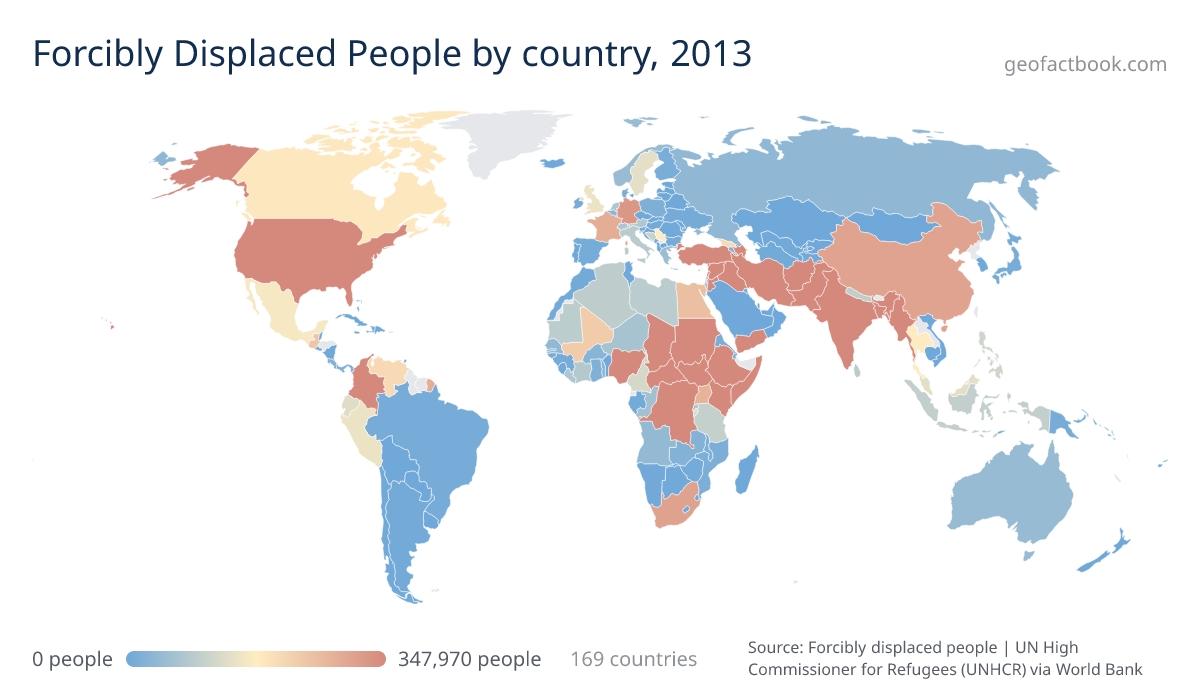
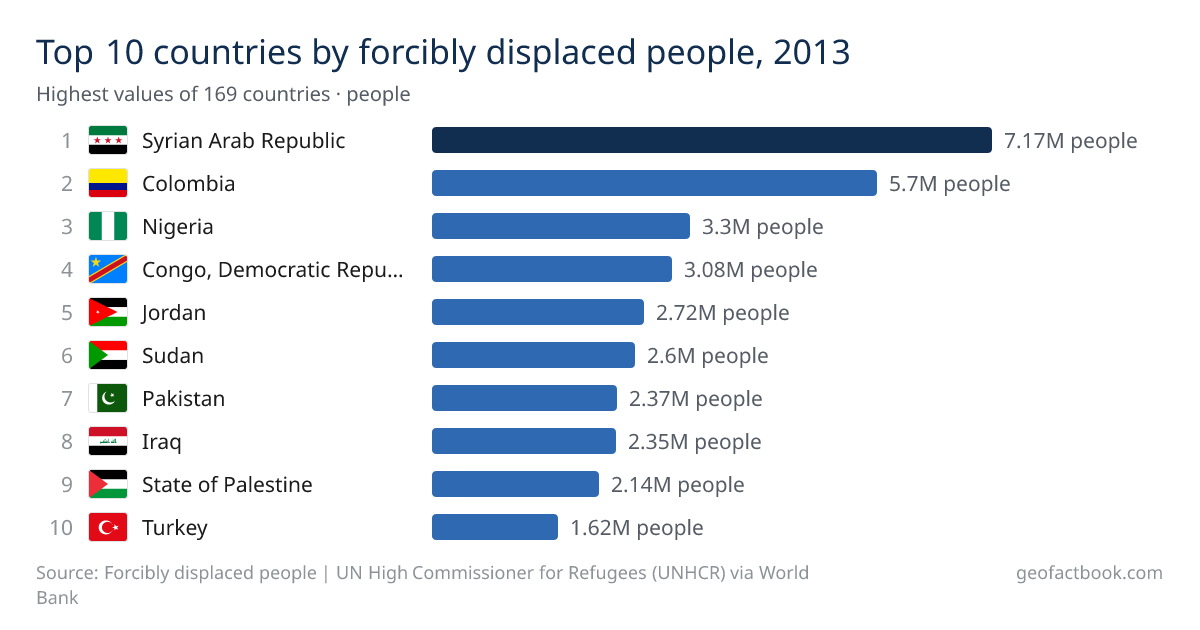
Top 10 countries by forcibly displaced people, 2013: chart
Insights by country
Cameroon
In 2013, Cameroon ranked #47 globally with 123068 forcibly displaced people. This figure is significant compared to other countries in the region, highlighting the challenges faced by Cameroon amidst ongoing conflicts and instability. Key drivers include the impact of the ongoing Boko Haram insurgency and internal conflicts that have led to displacement, exacerbating humanitarian needs and straining resources.
Iceland
In 2013, Iceland had 339 people classified as Forcibly Displaced People, ranking #137 out of 169 countries. This figure is notably low compared to many countries with larger populations and conflict histories, highlighting Iceland's relative stability. The country's geographic isolation and robust social policies contribute to its minimal displacement issues, as it maintains a strong commitment to human rights and refugee support.
Albania
In 2013, Albania ranked #139 globally with 324 forcibly displaced people. This figure is relatively low compared to countries with significant displacement issues, such as Syria, which has millions of displaced individuals. The limited number of forcibly displaced people in Albania can be attributed to its relatively stable political environment and lack of major conflict, although economic challenges and emigration trends continue to influence demographic movements.
Belgium
In 2013, Belgium ranked #73 globally with 37,096 Forcibly Displaced People. This figure is indicative of Belgium's relatively stable socio-political environment compared to countries facing severe conflict, though it remains higher than many of its European neighbors. Key drivers for this statistic include Belgium's role as a host nation for asylum seekers and its commitment to international refugee agreements, reflecting its geographic position in Europe and its demographic policies.
Bahrain
In 2013, Bahrain had 346 forcibly displaced people, ranking #136 out of 169 countries. This figure is relatively low compared to regional neighbors, reflecting a more stable internal situation than countries experiencing significant conflict or unrest. Economic diversification efforts and a relatively small population have contributed to maintaining this low number, as Bahrain has not faced large-scale displacement issues typical in more volatile regions.
Czech Republic
In 2013, the Czech Republic had 3258 forcibly displaced people, ranking #109 out of 169 countries. This figure is relatively low compared to many other European nations, reflecting a more stable refugee situation within the region. Contributing factors include the country's robust economy and relatively strict immigration policies, which have limited the influx of displaced individuals.
Angola
In 2013, Angola had 43,802 people classified as Forcibly Displaced People, ranking #70 out of 169 countries. This figure is notable, especially when compared to the global average, reflecting the ongoing challenges in the region. The primary drivers of displacement in Angola include the aftermath of decades of civil conflict and ongoing economic difficulties, which have hindered stability and development.
Russia
In 2013, Russia had 72 rank with 39,692 people classified as Forcibly Displaced People. This figure is notably higher than many of its neighbors, reflecting regional instability and conflicts in surrounding areas. Key drivers include ongoing tensions in the North Caucasus region and the impact of international sanctions, which have influenced migration patterns and internal displacement.
Cayman Islands
In 2013, the Cayman Islands had 10 forcibly displaced people, ranking #161 out of 169 countries for this metric. This figure is notably low compared to many other nations, reflecting the country's stable political environment and economic prosperity. The Cayman Islands' geographic isolation and strong legal framework contribute to a low incidence of forced displacement, making it an outlier in the Caribbean region.
Libya
In 2013, Libya ranked #56 globally with 91,153 Forcibly Displaced People. This figure is significant when compared to other countries in the region, reflecting ongoing instability and conflict following the 2011 civil war. The displacement is primarily driven by political unrest, armed conflict, and a deteriorating security situation, which have forced many Libyans to flee their homes.
Analysis & Context
In 2013, the Syrian Arab Republic led the world in the number of Forcibly Displaced People, with a staggering 7,169,021 individuals affected. Globally, the range of forcibly displaced people spanned from 0 to this maximum figure. On average, countries had 303,147.88 forcibly displaced people, providing a stark context to the global displacement crisis.
Conflict and Displacement: The Syrian Crisis
The Syrian conflict, which began in 2011, significantly escalated by 2013, resulting in the highest number of forcibly displaced individuals globally. The civil war, characterized by intense fighting and humanitarian crises, forced millions to flee their homes, seeking refuge both within and outside Syrian borders. Jordan and Turkey became major hosts for Syrian refugees, with 2,717,260 and 1,616,379 displaced individuals, respectively. This mass displacement illustrates the profound impact of ongoing conflict on human migration patterns.
Regional Instability and Displacement in Africa
Africa's complex tapestry of conflicts also contributed to high displacement figures. Nigeria, with 3,302,500 forcibly displaced people, faced internal strife primarily due to Boko Haram insurgency. Similarly, the Democratic Republic of the Congo saw 3,078,810 individuals displaced amid ongoing violence and political instability. These figures underscore how regional instability can drive significant population displacement, affecting neighboring countries and regions.
Significant Year-over-Year Changes
2013 witnessed dramatic shifts in displacement statistics. Nigeria experienced the most considerable increase, with an additional 3,298,311 displaced people, marking a 78,737.4% rise. This surge aligns with intensified violence in Northern Nigeria. Similarly, the Syrian Arab Republic saw an increase of 3,191,120 displaced people, an 80.2% rise, reflecting the escalating civil conflict. Conversely, Sudan recorded a decrease of 562,213 displaced individuals, a 17.8% reduction, possibly due to stabilization efforts in certain regions.
Low Displacement: Stability or Underreporting?
At the opposite end of the spectrum, several countries reported minimal or no displacement. Vietnam, for instance, had 0 forcibly displaced people, while Saint Lucia and China, Macao SAR each reported only 5 displaced individuals. These low figures may indicate relative political stability or effective refugee management systems. However, they could also reflect underreporting or a lack of comprehensive data collection in these regions.
The 2013 data on forcibly displaced people reveals the profound impact of geopolitical conflicts and instability on global migration patterns. With countries like Syria and Nigeria experiencing significant displacement due to internal conflicts, the numbers highlight the critical need for international intervention and support. Meanwhile, the low displacement figures in other regions prompt further examination of data accuracy and reporting practices.
Frequently Asked Questions About Forcibly Displaced People in 2013
Which country had the highest number of forcibly displaced people in 2013?
The Syrian Arab Republic had the highest number of forcibly displaced people in 2013, with 7,169,021 individuals.
What was the average number of forcibly displaced people per country in 2013?
The average number of forcibly displaced people per country in 2013 was 303,148.
Which country had the lowest number of forcibly displaced people in 2013?
Vietnam had the lowest number of forcibly displaced people in 2013, with 0 individuals.
What was the median number of forcibly displaced people per country in 2013?
The median number of forcibly displaced people per country in 2013 was 14,758.
What are the top three countries with the most forcibly displaced people in 2013?
The top three countries with the most forcibly displaced people in 2013 were the Syrian Arab Republic with 7,169,021 people, Colombia with 5,700,265 people, and Nigeria with 3,302,500 people.
How many countries had zero or very few forcibly displaced people in 2013?
In 2013, Vietnam had zero forcibly displaced people, and several countries like Saint Lucia, China, Macao SAR, Solomon Islands, and Sint Maarten (Dutch part) had as few as 5 people each.
Data Source
Forcibly displaced people | UN High Commissioner for Refugees (UNHCR) via World Bank
Data produced by Refugee Population Statistics Database, UN High Commissioner for Refugees (UNHCR), compiled and published by World Bank as "Forcibly displaced people".
Visit Data SourceCite this page
Geo Factbook. (n.d.). Forcibly Displaced People by Country, 2013. Retrieved November 27, 2026, from https://geofactbook.com/fact/forcibly-displaced-people/2013
The figures on this page come from Forcibly displaced people | UN High Commissioner for Refugees (UNHCR) via World Bank. For academic work, cite the original source as well.
›Embed this ranking on your site
Free to embed with attribution. Shows the top 10 countries and links back to the full ranking.
Historical Data by Year
Explore Forcibly Displaced People data across different years. Compare trends and see how statistics have changed over time.
You might also like
Rule of Law Index by Country
FeaturedCompare countries by Rule of Law percentile rank, reflecting confidence in laws, courts, police, property rights, and protection from crime and violence.
Highest: Finland100%Human Capital Index
FeaturedThe Human Capital Index measures a country's investment in education and health, reflecting its potential for economic growth and productivity. This vital statistic highlights the importance of nurturing human resources for sustainable development.
 Highest: Singapore0.91
Total population
FeaturedDiscover the latest total population statistics for every country and region worldwide. Explore accurate, up-to-date data on global population growth, density, and demographic trends — sourced from trusted international databases like the UN and World Bank. Perfect for researchers, students, and data enthusiasts looking to understand how the world’s population is changing.
Highest: India1.48B persons