
Forcibly Displaced People 2010
Forcibly displaced people include refugees, asylum seekers, and internally displaced persons worldwide.
Newer data is available: Forcibly Displaced People by country 2025 →
Where does your country rank? Pick it to see its position.
Related Transnational Issues statistics
More ↓Interactive Map
Complete Data Rankings
Rank | Actions | ||
|---|---|---|---|
1 |  Colombia | 5,196,363 people | |
2 |  Sudan | 4,984,343 people | |
3 |  Pakistan | 2,882,712 people | |
4 |  Iraq | 2,837,719 people | |
5 |  Jordan | 2,395,476 people | |
6 |  State of Palestine | 2,001,769 people | |
7 |  Syrian Arab Republic | 1,917,707 people | |
8 |  Congo, Democratic Republic of the | 1,867,253 people | |
9 |  Somalia | 1,526,045 people | |
10 |  Iran | 1,075,130 people | |
11 |  Turkey | 1,016,724 people | |
12 |  India | 838,555 people | |
13 |  Kenya | 680,848 people | |
14 |  Bangladesh | 655,256 people | |
15 |  Germany | 646,180 people | |
16 |  Azerbaijan | 594,909 people | |
17 |  Côte d'Ivoire | 548,459 people | |
18 |  Chad | 519,036 people | |
19 |  Lebanon | 514,530 people | |
20 |  Ethiopia | 455,302 people | |
21 |  Myanmar | 446,000 people | |
22 |  Yemen | 418,635 people | |
23 |  Afghanistan | 358,464 people | |
24 |  Sri Lanka | 327,358 people | |
25 |  Uganda | 322,602 people | |
26 |  Serbia | 316,798 people | |
27 |  China | 301,104 people | |
28 |  United States | 270,781 people | |
29 |  Georgia | 257,680 people | |
30 |  United Kingdom | 253,013 people | |
31 |  France | 249,263 people | |
32 |  South Africa | 229,601 people | |
33 |  Venezuela | 217,388 people | |
34 |  Cyprus | 216,782 people | |
35 |  Canada | 216,542 people | |
36 |  Central African Republic | 214,781 people | |
37 |  Indonesia | 202,866 people | |
38 |  Ecuador | 171,096 people | |
39 |  Peru | 151,386 people | |
40 |  Congo | 146,417 people | |
41 |  Burundi | 141,423 people | |
42 |  Nepal | 140,741 people | |
43 |  Mexico | 124,520 people | |
44 |  Bosnia and Herzegovina | 120,163 people | |
45 |  Tanzania | 110,532 people | |
46 |  Egypt | 109,327 people | |
47 |  Thailand | 106,899 people | |
48 |  Cameroon | 106,647 people | |
49 |  Sweden | 101,226 people | |
50 |  Algeria | 94,441 people | |
51 |  Malaysia | 92,835 people | |
52 |  Netherlands | 87,982 people | |
53 |  Russia | 84,356 people | |
54 |  Kyrgyzstan | 78,010 people | |
55 |  Austria | 68,215 people | |
56 |  Switzerland | 61,697 people | |
57 |  Italy | 60,472 people | |
58 |  Greece | 57,157 people | |
59 |  Rwanda | 55,682 people | |
60 |  Norway | 52,688 people | |
61 |  Zambia | 48,177 people | |
62 |  Liberia | 47,761 people | |
63 |  Senegal | 46,844 people | |
64 |  Belgium | 36,179 people | |
65 |  Israel | 31,036 people | |
66 |  Mauritania | 26,946 people | |
67 |  Australia | 25,504 people | |
68 |  Togo | 24,195 people | |
69 |  Denmark | 21,241 people | |
70 |  Costa Rica | 19,863 people | |
71 |  Angola | 19,370 people | |
72 |  Poland | 17,648 people | |
73 |  Panama | 17,535 people | |
74 |  Montenegro | 16,368 people | |
75 |  Djibouti | 15,829 people | |
76 |  Philippines | 15,296 people | |
77 |  Mali | 15,254 people | |
78 |  Malawi | 15,094 people | |
79 |  Eritrea | 14,944 people | |
80 |  Guinea | 14,873 people | |
81 |  Ghana | 14,576 people | |
82 |  Ireland | 14,187 people | |
83 |  Gabon | 13,135 people | |
84 |  Armenia | 11,706 people | |
85 |  Niger | 11,326 people | |
86 |  Libya | 11,107 people | |
87 |  Finland | 10,796 people | |
88 |  Nigeria | 10,553 people | |
89 |  Mozambique | 9,974 people | |
90 |  Papua New Guinea | 9,699 people | |
91 |  Namibia | 8,660 people | |
92 |  Sierra Leone | 8,566 people | |
93 |  Gambia | 8,447 people | |
94 |  Guinea-Bissau | 7,998 people | |
95 |  Malta | 7,425 people | |
96 |  Benin | 7,229 people | |
97 |  Bulgaria | 6,911 people | |
98 |  Spain | 6,502 people | |
99 |  Ukraine | 5,965 people | |
100 |  Hungary | 5,754 people | |
101 |  Japan | 5,606 people | |
102 |  Brazil | 5,198 people | |
103 |  Zimbabwe | 4,846 people | |
104 |  Tajikistan | 4,785 people | |
105 |  Kazakhstan | 4,717 people | |
106 |  Argentina | 4,173 people | |
107 |  Turkmenistan | 4,064 people | |
108 |  Luxembourg | 3,914 people | |
109 |  Uzbekistan | 3,709 people | |
110 |  Kuwait | 3,457 people | |
111 |  Czech Republic | 3,455 people | |
112 |  Croatia | 3,297 people | |
113 |  Botswana | 3,234 people | |
114 |  New Zealand | 2,455 people | |
115 |  Dominican Republic | 2,356 people | |
116 |  North Macedonia | 2,186 people | |
117 |  Vietnam | 1,928 people | |
118 |  Chile | 1,884 people | |
119 |  Romania | 1,391 people | |
120 |  Morocco | 1,067 people | |
121 |  Burkina Faso | 1,061 people | |
122 |  South Korea | 1,046 people | |
123 |  Lithuania | 875 people | |
124 |  Eswatini | 757 people | |
125 |  Bolivia | 723 people | |
126 |  Slovakia | 718 people | |
127 |  Saudi Arabia | 663 people | |
128 |  Belarus | 649 people | |
129 |  United Arab Emirates | 626 people | |
130 |  China, Hong Kong SAR | 600 people | |
131 |  Portugal | 429 people | |
132 |  Slovenia | 427 people | |
133 |  Cuba | 417 people | |
134 |  Timor-Leste | 400 people | |
135 |  Bahrain | 231 people | |
136 |  Uruguay | 214 people | |
137 |  Republic of Moldova | 206 people | |
138 |  Cambodia | 173 people | |
139 |  Belize | 165 people | |
140 |  Liechtenstein | 121 people | |
141 |  Trinidad and Tobago | 116 people | |
142 |  Tunisia | 110 people | |
143 |  Latvia | 103 people | |
144 |  Paraguay | 103 people | |
145 |  Iceland | 97 people | |
146 |  Albania | 95 people | |
147 |  Oman | 91 people | |
148 |  Nicaragua | 74 people | |
149 |  Qatar | 66 people | |
150 |  El Salvador | 57 people | |
151 |  Estonia | 36 people | |
152 |  Bahamas | 35 people | |
153 |  Jamaica | 19 people | |
154 |  Mongolia | 12 people | |
155 |  China, Macao SAR | 10 people | |
156 |  Curaçao | 7 people | |
157 |  Saint Lucia | 6 people | |
158 |  Cayman Islands | 5 people | |
159 |  Fiji | 5 people | |
160 |  Grenada | 5 people | |
161 |  Haiti | 5 people | |
162 |  Singapore | 5 people | |
163 |  Sint Maarten (Dutch part) | 5 people | |
164 |  Vanuatu | 5 people |
- #1Colombia
- #2Sudan
- #3Pakistan
- #4Iraq
- #5Jordan
- #6State of Palestine
- #7Syrian Arab Republic
- #8Congo, Democratic Republic of the
- #9Somalia
- #10Iran
Analysis: These countries represent the highest values in this dataset, showcasing significant scale and impact on global statistics.
- #164Vanuatu
- #163Sint Maarten (Dutch part)
- #162Singapore
- #161Haiti
- #160Grenada
- #159Fiji
- #158Cayman Islands
- #157Saint Lucia
- #156Curaçao
- #155China, Macao SAR
Context: These countries or territories have the lowest values, often due to geographic size, administrative status, or specific characteristics.
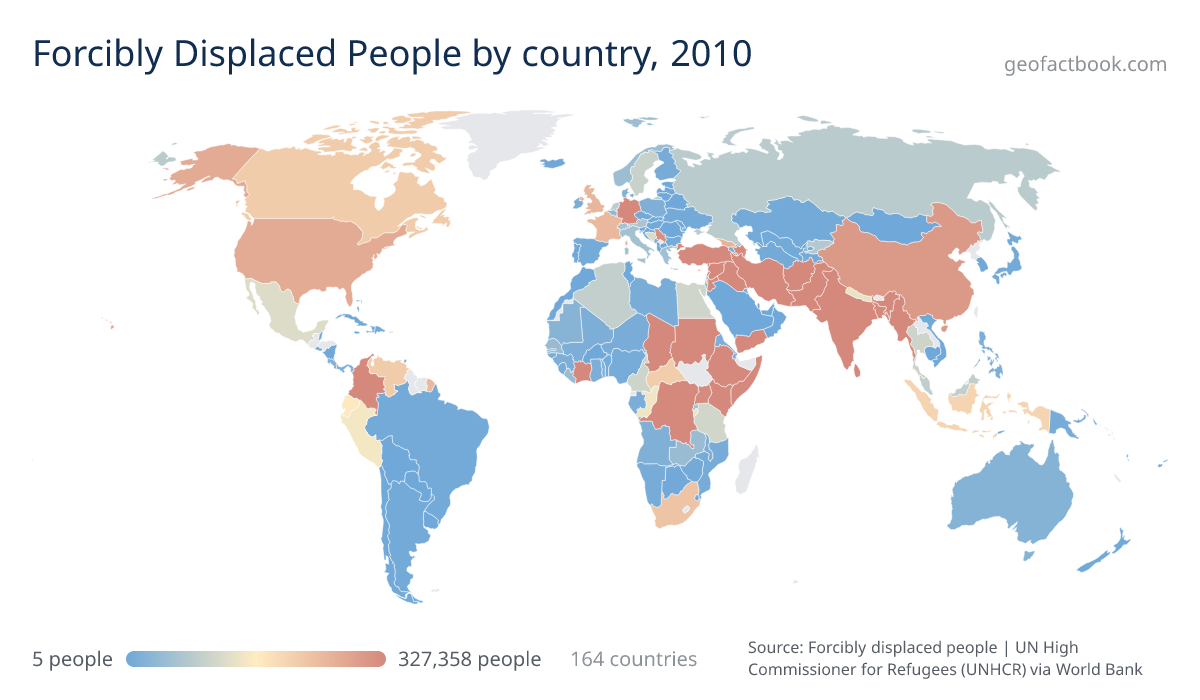
Forcibly Displaced People by country, 2010: map image
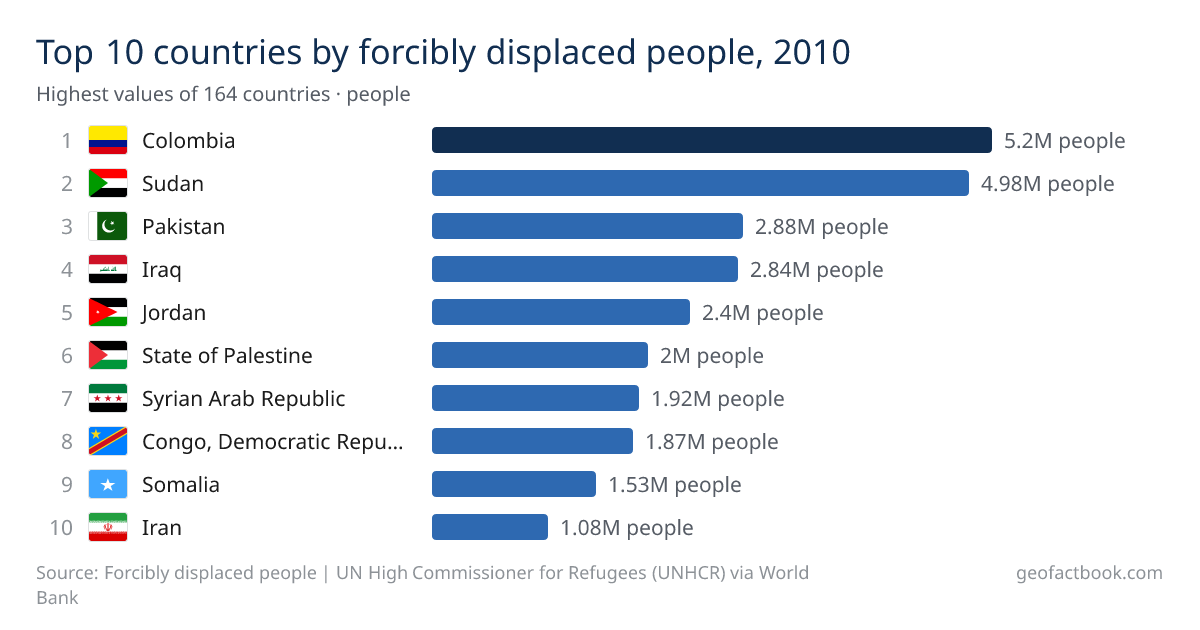
Top 10 countries by forcibly displaced people, 2010: chart
Insights by country
Latvia
In 2010, Latvia had 103 forcibly displaced people, ranking #143 out of 164 countries. This figure is notably low compared to many other countries, reflecting a stable domestic situation in contrast to regions experiencing conflict. Factors contributing to this statistic include Latvia's relatively stable political environment and its geographic location in Northern Europe, which has historically seen fewer large-scale displacements compared to neighboring regions.
Mauritania
Mauritania ranked #66 globally with 26,946 forcibly displaced people in 2010. This figure is notable compared to the global average, highlighting significant challenges faced by the country. Key drivers include ongoing regional instability, particularly in the Sahel, and the impact of climate change on livelihoods, which has exacerbated displacement issues within Mauritania.
Papua New Guinea
In 2010, Papua New Guinea ranked #90 globally with 9,699 people classified as Forcibly Displaced People. This figure is significant in the context of the Pacific region, where displacement often stems from environmental factors and social unrest. The country's diverse geography, including mountainous terrain and remote islands, complicates access to resources and services, contributing to instability and displacement among its populations.
South Africa
In 2010, South Africa had 229,601 forcibly displaced people, ranking #32 out of 164 countries. This figure is notable compared to regional neighbors, reflecting the complexities of migration and displacement in Southern Africa. Key drivers include ongoing socio-economic challenges, high levels of violence, and a significant influx of refugees from neighboring countries such as Zimbabwe and Mozambique.
Liechtenstein
In 2010, Liechtenstein had 121 Forcibly Displaced People, ranking #140 out of 164 countries. This figure is notably low compared to the global average, reflecting the country's stable political environment and minimal conflict. Liechtenstein's geographical isolation and small population contribute to its limited capacity for hosting displaced individuals, alongside a robust social welfare system that manages migration effectively.
Syrian Arab Republic
In 2010, the Syrian Arab Republic ranked #7 globally with 1,917,707 people identified as Forcibly Displaced People. This figure is significant compared to neighboring countries, highlighting the severe impact of the ongoing conflict in the region. The primary drivers of this displacement include the escalating violence due to civil unrest, economic instability, and the government's repressive policies that led to widespread human rights violations.
Finland
In 2010, Finland had 87 global rank for Forcibly Displaced People with a total of 10,796 people. This figure is relatively low compared to countries experiencing significant conflict or instability, such as Syria, which has millions of displaced individuals. Finland's robust social welfare system and strong commitment to human rights contribute to its ability to manage displacement effectively, alongside its geographic stability in Northern Europe.
United Arab Emirates
In 2010, the United Arab Emirates had 626 people classified as Forcibly Displaced People, ranking #129 out of 164 countries. This figure is relatively low compared to regional neighbors, reflecting the UAE's stability and economic prosperity. The country's robust economy, driven by oil revenues and a diverse labor market, has attracted many expatriates, minimizing the number of forcibly displaced individuals.
France
In 2010, France ranked #31 globally with 249,263 forcibly displaced people. This figure is significant compared to the global average, highlighting France's role as a destination for asylum seekers in Europe. Key drivers include its established legal framework for refugee protection and its geographic location, which makes it a primary entry point for individuals fleeing conflict in neighboring regions.
Vietnam
In 2010, Vietnam ranked #117 with 1,928 Forcibly Displaced People. This figure is notably lower than the global average, indicating a relatively stable internal situation compared to countries facing severe conflict. Key drivers for this statistic include Vietnam's ongoing economic reforms and a commitment to social stability, which have contributed to a decrease in displacement due to conflict or persecution.
Analysis & Context
In 2010, the country with the highest number of Forcibly Displaced People was Colombia, with a staggering 5,196,363 individuals. The global range of forcibly displaced people spanned from a minimum of 5 to a maximum of 5,196,363. The global average for this year was approximately 250,351.55 people, while the median value stood at 14,187, highlighting significant disparities in displacement figures across different regions.
Conflict and Political Instability: Primary Drivers
Conflict and political instability are the leading causes of forced displacement, as evidenced by the top-ranking countries in 2010. In Colombia, prolonged internal conflict involving government forces and guerrilla groups like the FARC led to the displacement of over 5 million individuals. Similarly, Sudan, with 4,984,343 displaced people, suffered from the civil war in Darfur and tensions between the north and south, which culminated in the eventual secession of South Sudan in 2011.
The situation in Iraq further exemplifies the impact of conflict on displacement, with 2,837,719 people affected due to ongoing violence and instability following the 2003 invasion and subsequent insurgency. These cases underscore the critical role that prolonged conflict plays in driving people from their homes.
Regional Influences and Displacement Patterns
Geographic and regional factors also play a significant role in displacement dynamics. In the Middle East, countries like Jordan and the State of Palestine had 2,395,476 and 2,001,769 displaced people, respectively. Jordan's numbers are largely due to the influx of refugees from neighboring Iraq and Palestine, demonstrating how regional conflicts can have spillover effects.
In Africa, the Democratic Republic of the Congo and Somalia faced displacement due to internal conflicts and instability, with figures reaching 1,867,253 and 1,526,045, respectively. These patterns highlight the interconnectedness of regional politics and displacement, as conflicts in one country can exacerbate situations in neighboring states.
Minimal Displacement: The Case of Small Island Nations
At the other end of the spectrum, several small island nations reported the lowest numbers of forcibly displaced people, with Grenada, Singapore, and Cayman Islands each recording only 5 displaced individuals. This minimal displacement can be attributed to several factors, including geographic isolation, stable political environments, and limited involvement in regional conflicts.
These countries, along with others like Fiji and Vanuatu, demonstrate how geographic and political stability can insulate populations from the forces that typically drive displacement in larger or more politically volatile nations.
Understanding the Displacement Spectrum
The vast differences in displacement figures highlight the complexity of the issues surrounding forcibly displaced people. The high numbers in countries like Colombia and Sudan contrast sharply with the stability of small island nations, underscoring the importance of context-specific solutions to address the root causes of displacement.
Efforts to mitigate displacement must consider the unique political, economic, and geographic factors at play in each region. This requires international cooperation, targeted aid, and conflict resolution strategies tailored to the specific challenges faced by each country. Understanding these dynamics is crucial for developing effective interventions that can reduce the number of forcibly displaced people worldwide.
Frequently Asked Questions About Forcibly Displaced People in 2010
Which country had the highest number of forcibly displaced people in 2010?
Colombia had the highest number of forcibly displaced people in 2010, with 5,196,363 people.
Which country had the lowest number of forcibly displaced people in 2010?
Grenada had the lowest number of forcibly displaced people in 2010, with 5 people.
What was the average number of forcibly displaced people per country in 2010?
The average number of forcibly displaced people per country in 2010 was 250,352 people.
What was the median number of forcibly displaced people per country in 2010?
The median number of forcibly displaced people per country in 2010 was 13,661 people.
How many countries were included in the dataset for forcibly displaced people in 2010?
The dataset for forcibly displaced people in 2010 included 164 countries.
Which countries were in the top 10 for forcibly displaced people in 2010?
The top 10 countries for forcibly displaced people in 2010 were Colombia, Sudan, Pakistan, Iraq, Jordan, State of Palestine, Syrian Arab Republic, Democratic Republic of the Congo, Somalia, and Iran.
Data Source
Forcibly displaced people | UN High Commissioner for Refugees (UNHCR) via World Bank
Data produced by Refugee Population Statistics Database, UN High Commissioner for Refugees (UNHCR), compiled and published by World Bank as "Forcibly displaced people".
Visit Data SourceCite this page
Geo Factbook. (n.d.). Forcibly Displaced People by Country, 2010. Retrieved November 27, 2026, from https://geofactbook.com/fact/forcibly-displaced-people/2010
The figures on this page come from Forcibly displaced people | UN High Commissioner for Refugees (UNHCR) via World Bank. For academic work, cite the original source as well.
›Embed this ranking on your site
Free to embed with attribution. Shows the top 10 countries and links back to the full ranking.
Historical Data by Year
Explore Forcibly Displaced People data across different years. Compare trends and see how statistics have changed over time.
You might also like
Rule of Law Index by Country
FeaturedCompare countries by Rule of Law percentile rank, reflecting confidence in laws, courts, police, property rights, and protection from crime and violence.
Highest: Finland100%Human Capital Index
FeaturedThe Human Capital Index measures a country's investment in education and health, reflecting its potential for economic growth and productivity. This vital statistic highlights the importance of nurturing human resources for sustainable development.
Highest: Singapore0.91Total population
FeaturedDiscover the latest total population statistics for every country and region worldwide. Explore accurate, up-to-date data on global population growth, density, and demographic trends — sourced from trusted international databases like the UN and World Bank. Perfect for researchers, students, and data enthusiasts looking to understand how the world’s population is changing.
Highest: India1.48B persons