
Forcibly Displaced People 2023
Forcibly displaced people include refugees, asylum seekers, and internally displaced persons worldwide.
Newer data is available: Forcibly Displaced People by country 2025 →
Where does your country rank? Pick it to see its position.
Related Transnational Issues statistics
More ↓Interactive Map
Complete Data Rankings
Rank | Actions | ||
|---|---|---|---|
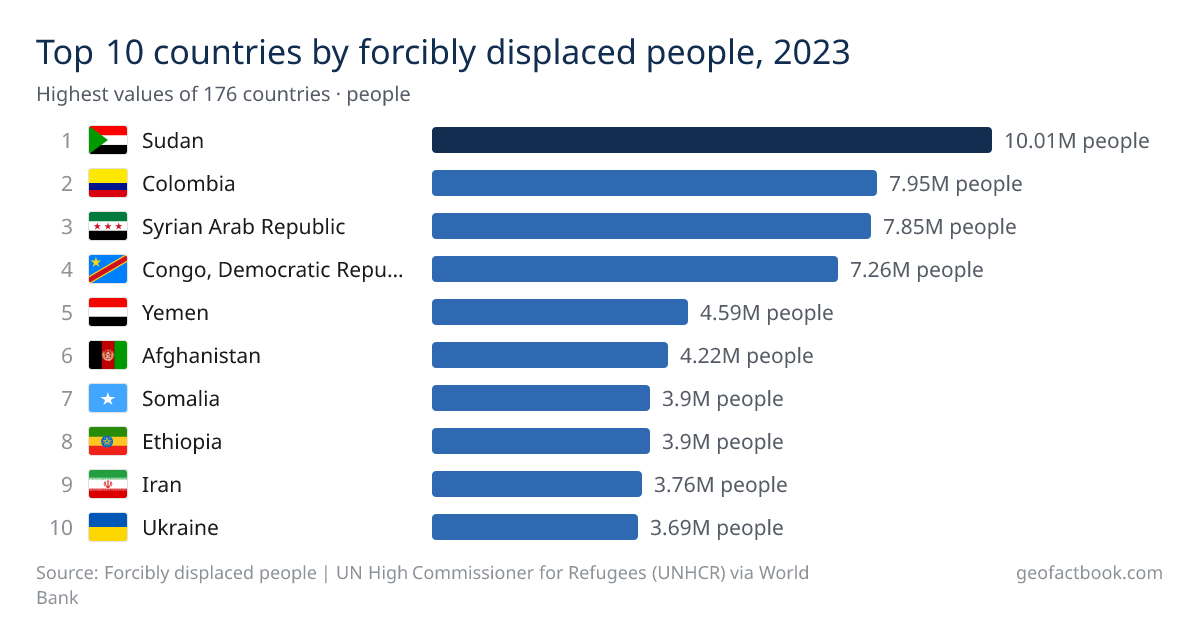
1 |  Sudan | 10,014,984 people | |
2 |  Colombia | 7,953,384 people | |
3 |  Syrian Arab Republic | 7,851,450 people | |
4 |  Congo, Democratic Republic of the | 7,263,498 people | |
5 |  Yemen | 4,586,827 people | |
6 |  Afghanistan | 4,222,076 people | |
7 |  Somalia | 3,900,270 people | |
8 |  Ethiopia | 3,895,593 people | |
9 |  Iran | 3,764,517 people | |
10 |  Ukraine | 3,692,010 people | |
11 |  Turkey | 3,473,196 people | |
12 |  Nigeria | 3,444,110 people | |
13 |  Jordan | 3,116,372 people | |
14 |  United States | 3,010,670 people | |
15 |  State of Palestine | 3,008,794 people | |
16 |  Germany | 2,954,500 people | |
17 |  Myanmar | 2,625,000 people | |
18 |  Burkina Faso | 2,101,881 people | |
19 |  Pakistan | 2,070,879 people | |
20 |  Peru | 1,633,763 people | |
21 |  Uganda | 1,619,955 people | |
22 |  Chad | 1,557,837 people | |
23 |  Cameroon | 1,539,573 people | |
24 |  South Sudan | 1,507,107 people | |
25 |  Iraq | 1,423,066 people | |
26 |  Bangladesh | 1,397,984 people | |
27 |  Lebanon | 1,362,919 people | |
28 |  Russia | 1,291,022 people | |
29 |  Poland | 978,467 people | |
30 |  Mexico | 845,933 people | |
31 |  India | 781,793 people | |
32 |  France | 744,008 people | |
33 |  Kenya | 729,841 people | |
34 |  Brazil | 682,947 people | |
35 |  Azerbaijan | 663,939 people | |
36 |  Niger | 652,566 people | |
37 |  Mozambique | 615,590 people | |
38 |  Spain | 589,971 people | |
39 |  United Kingdom | 586,776 people | |
40 |  Central African Republic | 577,419 people | |
41 |  Guatemala | 576,040 people | |
42 |  Ecuador | 540,040 people | |
43 |  Egypt | 472,751 people | |
44 |  Chile | 450,760 people | |
45 |  Italy | 445,218 people | |
46 |  Mali | 410,716 people | |
47 |  Czech Republic | 378,359 people | |
48 |  Canada | 367,409 people | |
49 |  Georgia | 323,070 people | |
50 |  Cyprus | 318,708 people | |
51 |  Austria | 295,850 people | |
52 |  Netherlands | 281,682 people | |
53 |  Sweden | 248,903 people | |
54 |  Serbia | 239,528 people | |
55 |  Costa Rica | 235,588 people | |
56 |  Tanzania | 229,096 people | |
57 |  Argentina | 226,774 people | |
58 |  Israel | 226,699 people | |
59 |  Greece | 225,071 people | |
60 |  Belgium | 212,431 people | |
61 |  Switzerland | 211,391 people | |
62 |  Malaysia | 184,443 people | |
63 |  Libya | 175,674 people | |
64 |  Armenia | 158,295 people | |
65 |  South Africa | 154,676 people | |
66 |  Ireland | 136,152 people | |
67 |  Rwanda | 128,303 people | |
68 |  Slovakia | 126,958 people | |
69 |  Dominican Republic | 126,804 people | |
70 |  Republic of Moldova | 121,503 people | |
71 |  Mauritania | 118,476 people | |
72 |  Australia | 117,127 people | |
73 |  Philippines | 111,963 people | |
74 |  Bulgaria | 109,559 people | |
75 |  Norway | 108,573 people | |
76 |  Algeria | 102,191 people | |
77 |  Honduras | 101,283 people | |
78 |  Papua New Guinea | 97,821 people | |
79 |  Finland | 97,279 people | |
80 |  Burundi | 95,599 people | |
81 |  Bosnia and Herzegovina | 95,429 people | |
82 |  Thailand | 88,988 people | |
83 |  Romania | 88,555 people | |
84 |  Lithuania | 80,558 people | |
85 |  Zambia | 77,960 people | |
86 |  Denmark | 71,268 people | |
87 |  Panama | 68,501 people | |
88 |  Congo | 67,222 people | |
89 |  Montenegro | 64,907 people | |
90 |  Portugal | 64,074 people | |
91 |  Hungary | 63,185 people | |
92 |  Indonesia | 60,243 people | |
93 |  Angola | 55,442 people | |
94 |  Uruguay | 54,086 people | |
95 |  Malawi | 52,896 people | |
96 |  Togo | 50,640 people | |
97 |  El Salvador | 49,369 people | |
98 |  Latvia | 46,313 people | |
99 |  Japan | 46,251 people | |
100 |  Kazakhstan | 43,161 people | |
101 |  Estonia | 42,351 people | |
102 |  Belarus | 40,386 people | |
103 |  Côte d'Ivoire | 39,830 people | |
104 |  Trinidad and Tobago | 39,728 people | |
105 |  Djibouti | 31,505 people | |
106 |  Venezuela | 30,914 people | |
107 |  South Korea | 30,791 people | |
108 |  Kyrgyzstan | 28,993 people | |
109 |  Croatia | 26,626 people | |
110 |  Zimbabwe | 22,565 people | |
111 |  Benin | 21,758 people | |
112 |  Senegal | 21,026 people | |
113 |  Nepal | 19,882 people | |
114 |  Morocco | 19,635 people | |
115 |  North Macedonia | 19,047 people | |
116 |  Luxembourg | 17,480 people | |
117 |  Bolivia | 17,296 people | |
118 |  Aruba | 17,085 people | |
119 |  Tunisia | 15,087 people | |
120 |  Ghana | 15,066 people | |
121 |  Curaçao | 14,000 people | |
122 |  Malta | 12,539 people | |
123 |  Slovenia | 11,668 people | |
124 |  Iceland | 11,565 people | |
125 |  Sri Lanka | 11,555 people | |
126 |  Tajikistan | 11,479 people | |
127 |  Gambia | 9,955 people | |
128 |  Uzbekistan | 9,405 people | |
129 |  United Arab Emirates | 8,460 people | |
130 |  Paraguay | 7,589 people | |
131 |  Namibia | 7,135 people | |
132 |  Albania | 5,087 people | |
133 |  Saudi Arabia | 4,422 people | |
134 |  New Zealand | 3,676 people | |
135 |  Turkmenistan | 3,614 people | |
136 |  Eswatini | 2,974 people | |
137 |  Suriname | 2,633 people | |
138 |  Guinea | 2,245 people | |
139 |  Belize | 2,187 people | |
140 |  Liberia | 1,782 people | |
141 |  Nicaragua | 1,735 people | |
142 |  Kuwait | 1,451 people | |
143 |  Solomon Islands | 1,000 people | |
144 |  China | 995 people | |
145 |  Madagascar | 987 people | |
146 |  Botswana | 858 people | |
147 |  Oman | 721 people | |
148 |  Lesotho | 682 people | |
149 |  Liechtenstein | 607 people | |
150 |  Bahrain | 376 people | |
151 |  Qatar | 337 people | |
152 |  China, Hong Kong SAR | 301 people | |
153 |  Gabon | 290 people | |
154 |  Cuba | 161 people | |
155 |  New Caledonia | 150 people | |
156 |  Cayman Islands | 142 people | |
157 |  Sint Maarten (Dutch part) | 133 people | |
158 |  Eritrea | 119 people | |
159 |  Guinea-Bissau | 54 people | |
160 |  Bahamas | 31 people | |
161 |  Cambodia | 29 people | |
162 |  Mauritius | 24 people | |
163 |  Saint Kitts and Nevis | 19 people | |
164 |  Vietnam | 19 people | |
165 |  Monaco | 17 people | |
166 |  Barbados | 15 people | |
167 |  Fiji | 15 people | |
168 |  Nauru | 13 people | |
169 |  Comoros | 10 people | |
170 |  Mongolia | 10 people | |
171 |  Turks and Caicos Islands | 7 people | |
172 |  Saint Lucia | 5 people | |
173 |  Vanuatu | 5 people | |
174 |  Brunei Darussalam | 0 people | |
175 |  Cabo Verde | 0 people | |
176 |  Singapore | 0 people |
- #1Sudan
- #2Colombia
- #3Syrian Arab Republic
- #4Congo, Democratic Republic of the
- #5Yemen
- #6Afghanistan
- #7Somalia
- #8Ethiopia
- #9Iran
- #10Ukraine
Analysis: These countries represent the highest values in this dataset, showcasing significant scale and impact on global statistics.
- #176Singapore
- #175Cabo Verde
- #174Brunei Darussalam
- #173Vanuatu
- #172Saint Lucia
- #171Turks and Caicos Islands
- #170Mongolia
- #169Comoros
- #168Nauru
- #167Fiji
Context: These countries or territories have the lowest values, often due to geographic size, administrative status, or specific characteristics.
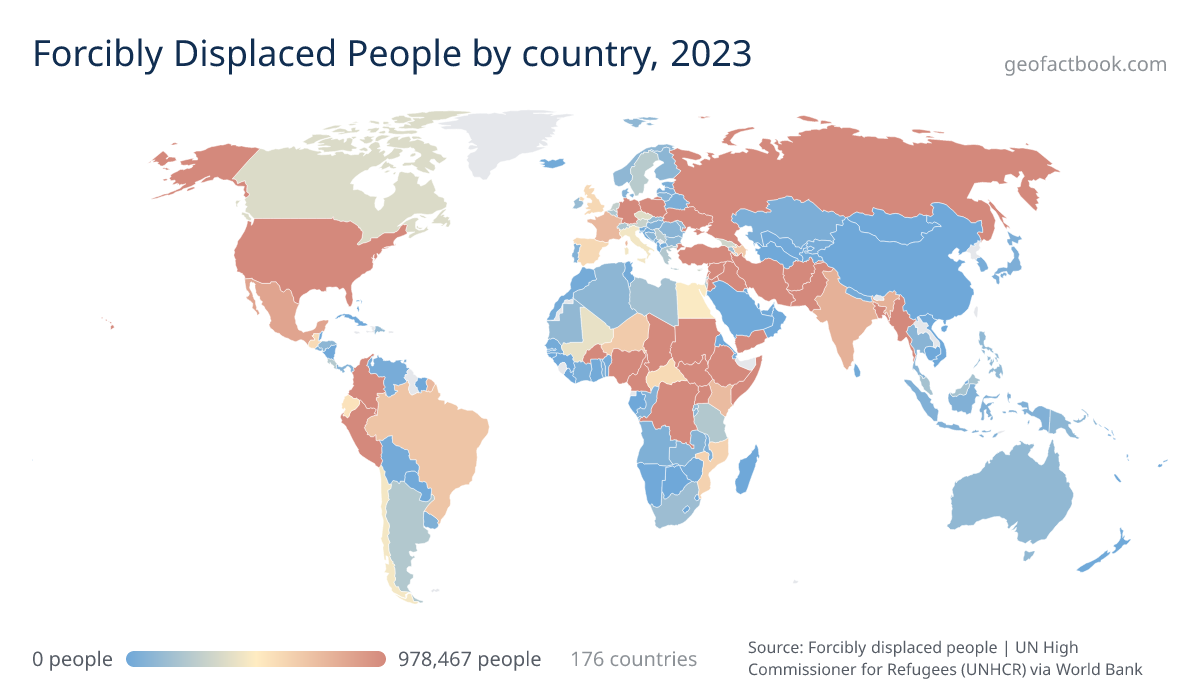
Forcibly Displaced People by country, 2023: map image
Top 10 countries by forcibly displaced people, 2023: chart
Insights by country
Russia
In 2023, Russia ranks #28 globally with 1,291,022 forcibly displaced people. This figure is significant when compared to countries with similar geopolitical tensions, such as Ukraine, which has also seen substantial displacement due to conflict. The high number of forcibly displaced individuals in Russia can be attributed to ongoing regional conflicts, economic instability, and restrictive immigration policies that complicate the situation for those seeking refuge.
Liechtenstein
In 2023, Liechtenstein ranks #149 globally with 607 forcibly displaced people. This figure is notably low compared to many neighboring countries, reflecting the country's small size and limited capacity for hosting large populations. Factors contributing to this statistic include Liechtenstein's robust economic stability, which attracts skilled migrants, and its stringent immigration policies that limit the influx of asylum seekers.
Republic of Moldova
In 2023, the Republic of Moldova ranks #70 globally with 121,503 forcibly displaced people. This figure is significant compared to neighboring Romania, which has a lower number of displaced individuals, reflecting Moldova's unique geopolitical challenges. The primary drivers of this situation include the country's proximity to conflict zones and its status as a transit point for refugees, exacerbated by ongoing regional instability.
Romania
In 2023, Romania ranks #83 globally with 88,555 forcibly displaced people. This figure is notable compared to neighboring Hungary, which has a significantly lower number of displaced individuals. The high number of forcibly displaced people in Romania can be attributed to its geographic proximity to conflict zones, particularly the ongoing crisis in Ukraine, as well as its role as a transit country for refugees seeking asylum in Western Europe.
Mongolia
Mongolia ranks #170 globally with 10 forcibly displaced people in 2023. This figure is significantly lower than many countries in the region, reflecting a relative stability compared to nations facing larger displacement crises. Key factors contributing to this low number include Mongolia's geographic isolation and its policies promoting social cohesion, which have mitigated the impacts of regional conflicts and economic challenges.
Chile
In 2023, Chile ranks #44 globally with 450,760 forcibly displaced people. This figure is significant when compared to neighboring countries, as Chile has a higher number of forcibly displaced individuals than many of its South American counterparts. The primary drivers of this situation include ongoing political instability in the region and economic challenges that have prompted migration, particularly from Venezuela and other neighboring countries.
Sri Lanka
Sri Lanka ranks #125 globally with 11,555 Forcibly Displaced People in 2023. This figure is notably higher than many countries in the South Asian region, reflecting ongoing challenges in displacement management. Key drivers include the aftermath of a prolonged civil conflict and recent economic instability, which have contributed to internal displacements and a lack of robust support systems for affected populations.
Oman
In 2023, Oman ranks #147 globally with 721 forcibly displaced people. This figure is relatively low compared to regional neighbors, reflecting a more stable internal situation than countries experiencing prolonged conflict. Factors contributing to this statistic include Oman's strategic geographical position, which has allowed it to maintain neutrality in regional disputes, and its policies that prioritize economic stability and social cohesion.
Aruba
In 2023, Aruba has 17085 Forcibly Displaced People, ranking #118 out of 176 countries. This figure is notably higher than many Caribbean neighbors, reflecting regional instability and migration pressures. Economic challenges, coupled with limited resources for asylum seekers, contribute to the significant number of displaced individuals in Aruba.
Rwanda
In 2023, Rwanda ranks #67 globally with 128,303 forcibly displaced people. This figure is significant within the East African region, where countries like Uganda and Kenya also face substantial displacement challenges. Contributing factors include Rwanda's ongoing efforts to provide refuge for those fleeing conflict in neighboring nations and its own historical context of ethnic tensions and instability.
Analysis & Context
In 2023, the country with the highest number of Forcibly Displaced People is Sudan, with a staggering 10,014,984 individuals affected, while the global range spans from 0 to 10,014,984. The global average number of forcibly displaced individuals per country is approximately 658,992, offering a glimpse into the widespread nature of this issue.
Conflict and Human Displacement
Conflict remains a primary driver of forced displacement in several countries. Sudan leads with over 10 million displaced due to ongoing internal conflicts and political instability. Similarly, the Syrian Arab Republic reports 7,851,450 displaced individuals as a result of a protracted civil war that has devastated the nation. In Yemen, the civil war has led to the displacement of 4,586,827 people, highlighting the severe humanitarian crises in these regions. These high figures underscore how conflict zones are hotspots for forced migration, often leading to regional instability and humanitarian challenges.
Economic and Social Factors
In some regions, economic hardship and social unrest contribute to forced displacement. Colombia, with 7,953,384 displaced individuals, faces ongoing challenges from internal conflicts and economic instability that push people to migrate within the country. Afghanistan, with 4,222,076 displaced, experiences similar issues, exacerbated by political changes and economic sanctions. These countries illustrate how, beyond immediate violence, economic conditions and governance issues can pressure populations to relocate.
Year-over-Year Trends in Displacement
Significant changes in displacement figures from the previous year highlight shifting dynamics. Sudan saw the largest increase, with an additional 5,333,026 displaced individuals, marking a 113.9% rise, driven by escalating conflict. Meanwhile, Myanmar experienced an increase of 1,127,000 displaced, a consequence of military actions against ethnic groups. Conversely, Ukraine reported a decrease of 2,225,012 displaced individuals, a 37.6% drop, possibly reflecting stabilization efforts and return movements. These trends reveal the volatile nature of forced displacement, closely tied to political and conflict developments.
Regions with Minimal Displacement
In stark contrast, some countries report negligible numbers of forcibly displaced individuals. Cabo Verde, Singapore, and Brunei Darussalam each report 0 displaced persons. Other countries such as Vanuatu and Saint Lucia report single-digit figures. These minimal displacement figures can be attributed to factors such as stable political environments, effective governance, and geographical isolation which shield these nations from the types of conflict and economic pressures experienced elsewhere.
The data on forcibly displaced people in 2023 illustrates a complex global issue driven by conflict, economic hardship, and geopolitical dynamics. While some regions experience acute crises leading to massive displacement, others maintain stability, highlighting diverse national and regional challenges. Understanding these patterns is crucial for formulating effective international policies and humanitarian responses to address the needs of displaced populations worldwide.
Frequently Asked Questions About Forcibly Displaced People in 2023
Which country has the highest number of forcibly displaced people in 2023?
Sudan has the highest number of forcibly displaced people in 2023, with 10,014,984 individuals.
What is the average number of forcibly displaced people per country in 2023?
The average number of forcibly displaced people per country in 2023 is 658,992.
Which country has the lowest number of forcibly displaced people in 2023?
Cabo Verde has the lowest number of forcibly displaced people in 2023, with 0 individuals.
What is the median number of forcibly displaced people per country in 2023?
The median number of forcibly displaced people per country in 2023 is 66,065.
How many countries are included in the dataset for forcibly displaced people in 2023?
The dataset includes 176 countries for forcibly displaced people in 2023.
What is the range of forcibly displaced people among the countries in the dataset for 2023?
The range of forcibly displaced people in the dataset for 2023 spans from 0 people in Cabo Verde to 10,014,984 people in Sudan.
Data Source
Forcibly displaced people | UN High Commissioner for Refugees (UNHCR) via World Bank
Data produced by Refugee Population Statistics Database, UN High Commissioner for Refugees (UNHCR), compiled and published by World Bank as "Forcibly displaced people".
Visit Data SourceCite this page
Geo Factbook. (n.d.). Forcibly Displaced People by Country, 2023. Retrieved November 27, 2026, from https://geofactbook.com/fact/forcibly-displaced-people/2023
The figures on this page come from Forcibly displaced people | UN High Commissioner for Refugees (UNHCR) via World Bank. For academic work, cite the original source as well.
›Embed this ranking on your site
Free to embed with attribution. Shows the top 10 countries and links back to the full ranking.
Historical Data by Year
Explore Forcibly Displaced People data across different years. Compare trends and see how statistics have changed over time.
You might also like
Rule of Law Index by Country
FeaturedCompare countries by Rule of Law percentile rank, reflecting confidence in laws, courts, police, property rights, and protection from crime and violence.
Highest: Finland100%Human Capital Index
FeaturedThe Human Capital Index measures a country's investment in education and health, reflecting its potential for economic growth and productivity. This vital statistic highlights the importance of nurturing human resources for sustainable development.
Highest: Singapore0.91Total population
FeaturedDiscover the latest total population statistics for every country and region worldwide. Explore accurate, up-to-date data on global population growth, density, and demographic trends — sourced from trusted international databases like the UN and World Bank. Perfect for researchers, students, and data enthusiasts looking to understand how the world’s population is changing.
Highest: India1.48B persons