
State of Palestine Forcibly Displaced People 2025: 3.1 Million
State of Palestine's forcibly displaced people in 2025 is 3.1 Million, up 0.4% from 2024. It ranks #13 of 173 countries.
Forcibly displaced people include refugees, asylum seekers, and internally displaced persons worldwide.
Source (2025): Forcibly displaced people
Where State of Palestine ranks (2025)
#13 of 173- #11
 Ethiopia3.5M people
- #12
 Somalia3.39M people
- #13
 State of Palestine3.1M people
- #14
 Germany2.95M people
- #15
 Jordan2.84M people
Forcibly Displaced People over time
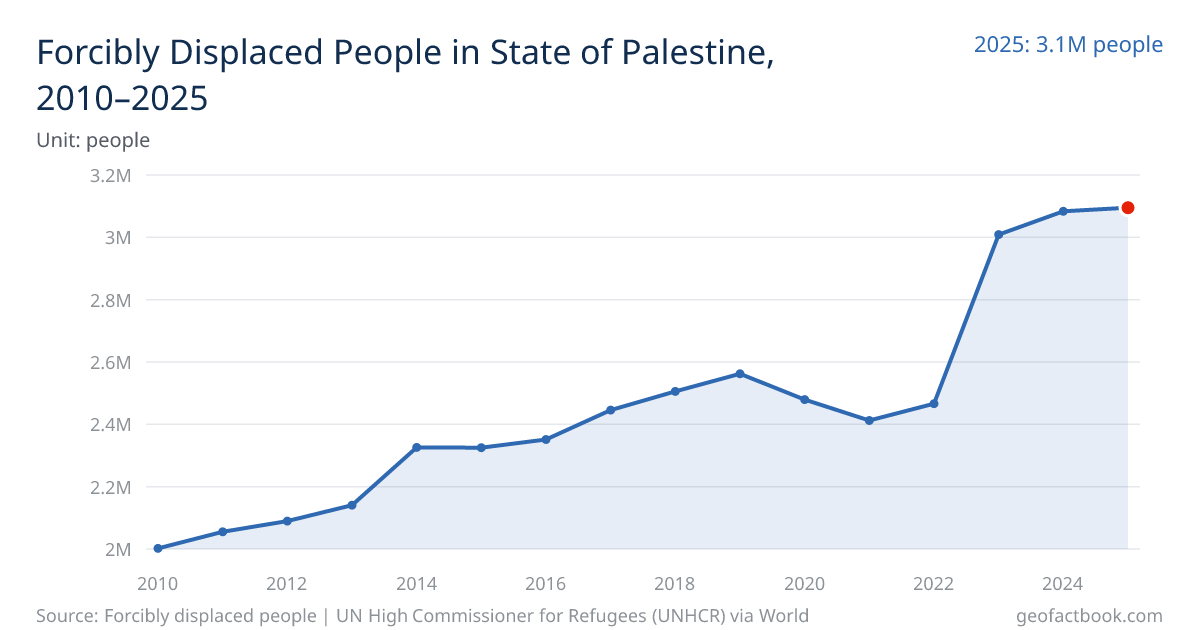
| Year | Value | Change | % Change | Actions |
|---|---|---|---|---|
| 2025 | 3.10M people | +11.48K people | +0.37% | |
| 2024 | 3.08M people | +74.81K people | +2.49% | |
| 2023 | 3.01M people | +542.54K people | +22.00% | |
| 2022 | 2.47M people | +54.05K people | +2.24% | |
| 2021 | 2.41M people | 67.03K people | -2.70% | |
| 2020 | 2.48M people | 82.83K people | -3.23% | |
| 2019 | 2.56M people | +56.33K people | +2.25% | |
| 2018 | 2.51M people | +59.96K people | +2.45% | |
| 2017 | 2.45M people | +94.51K people | +4.02% | |
| 2016 | 2.35M people | +26.27K people | +1.13% | |
| 2015 | 2.33M people | 1.09K people | -0.05% | |
| 2014 | 2.33M people | +185.60K people | +8.67% | |
| 2013 | 2.14M people | +50.95K people | +2.44% | |
| 2012 | 2.09M people | +34.50K people | +1.68% | |
| 2011 | 2.06M people | +53.27K people | +2.66% | |
| 2010 | 2.00M people | — | — |
Forcibly Displaced People in State of Palestine, 2010–2025: chart
Cite this page
Geo Factbook. (n.d.). State of Palestine: Forcibly Displaced People. Retrieved November 28, 2026, from https://geofactbook.com/countries/state-of-palestine/forcibly-displaced-people
The figures on this page come from Forcibly displaced people | UN High Commissioner for Refugees (UNHCR) via World Bank. For academic work, cite the original source as well.
Frequently Asked Questions About State of Palestine Forcibly Displaced People
What is State of Palestine's forcibly displaced people in 2025?▾
State of Palestine's forcibly displaced people is 3.1 Million in 2025, according to Forcibly displaced people | UN High Commissioner for Refugees (UNHCR) via World Bank.
Is State of Palestine's forcibly displaced people increasing or decreasing?▾
State of Palestine's forcibly displaced people rose by 0.4% from 2024 (3.08 Million) to 2025 (3.1 Million). Over the past decade (2015–2025) it rose by 33.1%.
How does State of Palestine rank for forcibly displaced people?▾
In 2025, State of Palestine has the 13th highest forcibly displaced people out of 173 countries with data.
What was State of Palestine's forcibly displaced people in 2010?▾
In 2010, State of Palestine's forcibly displaced people was 2 Million. By 2025 it rose by 54.6%.
Explore additional statistical insights
Press Freedom Index Score in State of Palestine
The Press Freedom Index Score measures the level of media freedom in countries worldwide. A higher score indicates stronger press independence, essential for democracy and transparency. Understanding these scores helps highlight the importance of free expression in society.
AI Investment (% of GDP) in State of Palestine
AI investment as a percentage of GDP measures a country's commitment to AI development and innovation, influencing global competitiveness.
Capture Fisheries Production in State of Palestine
Capture fisheries production measures the total fish catch in a country annually, indicating its fishing industry's size and activity.
Total net-migration in State of Palestine
Total net-migration measures the difference between the number of immigrants and emigrants in a country, reflecting population shifts and economic opportunities. Understanding this statistic is crucial for analyzing demographic trends and policy impacts in nations worldwide.
Urban Population Share 2050 in State of Palestine
Urban population share by 2050 shows urbanization trends. Discover which countries will be most urbanized.
Mathematics Proficiency Scores in State of Palestine
Mathematics proficiency scores assess students' ability to understand and apply mathematical concepts across countries.