
Forcibly Displaced People 2019
Forcibly displaced people include refugees, asylum seekers, and internally displaced persons worldwide.
Newer data is available: Forcibly Displaced People by country 2025 →
Where does your country rank? Pick it to see its position.
Related Transnational Issues statistics
More ↓Interactive Map
Complete Data Rankings
Rank | Actions | ||
|---|---|---|---|
1 |  Colombia | 7,356,965 people | |
2 |  Syrian Arab Republic | 7,085,590 people | |
3 |  Congo, Democratic Republic of the | 6,038,925 people | |
4 |  Yemen | 3,914,172 people | |
5 |  Turkey | 3,909,788 people | |
6 |  Sudan | 3,205,030 people | |
7 |  Afghanistan | 3,065,474 people | |
8 |  Jordan | 3,017,362 people | |
9 |  Somalia | 2,683,671 people | |
10 |  Nigeria | 2,638,189 people | |
11 |  State of Palestine | 2,562,073 people | |
12 |  Ethiopia | 2,058,800 people | |
13 |  Iraq | 1,819,924 people | |
14 |  South Sudan | 1,653,986 people | |
15 |  Pakistan | 1,529,124 people | |
16 |  Germany | 1,455,913 people | |
17 |  Uganda | 1,413,116 people | |
18 |  Lebanon | 1,411,269 people | |
19 |  Cameroon | 1,385,189 people | |
20 |  Bangladesh | 1,280,813 people | |
21 |  United States | 1,189,323 people | |
22 |  Iran | 979,468 people | |
23 |  Peru | 927,763 people | |
24 |  Ukraine | 734,552 people | |
25 |  India | 677,305 people | |
26 |  Azerbaijan | 652,290 people | |
27 |  Kenya | 651,728 people | |
28 |  Chad | 622,426 people | |
29 |  Central African Republic | 599,479 people | |
30 |  Burkina Faso | 585,898 people | |
31 |  France | 510,055 people | |
32 |  Ecuador | 503,607 people | |
33 |  Mexico | 497,950 people | |
34 |  Chile | 463,279 people | |
35 |  Myanmar | 457,000 people | |
36 |  Libya | 456,448 people | |
37 |  Niger | 412,893 people | |
38 |  Brazil | 363,645 people | |
39 |  Egypt | 327,900 people | |
40 |  Côte d'Ivoire | 304,171 people | |
41 |  China | 304,023 people | |
42 |  Georgia | 288,466 people | |
43 |  Sweden | 281,793 people | |
44 |  Tanzania | 271,725 people | |
45 |  South Africa | 266,630 people | |
46 |  Cyprus | 259,110 people | |
47 |  Italy | 254,632 people | |
48 |  Honduras | 247,184 people | |
49 |  Guatemala | 243,039 people | |
50 |  Mali | 235,676 people | |
51 |  Canada | 198,774 people | |
52 |  United Kingdom | 195,030 people | |
53 |  Spain | 190,781 people | |
54 |  Greece | 186,138 people | |
55 |  Argentina | 185,181 people | |
56 |  Philippines | 180,999 people | |
57 |  Malaysia | 179,721 people | |
58 |  Congo | 174,085 people | |
59 |  Austria | 162,647 people | |
60 |  Rwanda | 145,547 people | |
61 |  Thailand | 139,393 people | |
62 |  Panama | 135,977 people | |
63 |  Australia | 135,891 people | |
64 |  Switzerland | 121,362 people | |
65 |  Mozambique | 120,688 people | |
66 |  Costa Rica | 114,186 people | |
67 |  Burundi | 110,460 people | |
68 |  Netherlands | 110,016 people | |
69 |  Bosnia and Herzegovina | 104,966 people | |
70 |  Algeria | 100,246 people | |
71 |  Mauritania | 86,440 people | |
72 |  Belgium | 72,524 people | |
73 |  Venezuela | 67,798 people | |
74 |  Zambia | 62,585 people | |
75 |  Angola | 55,971 people | |
76 |  Norway | 55,389 people | |
77 |  Israel | 54,586 people | |
78 |  Russia | 45,658 people | |
79 |  Malawi | 44,380 people | |
80 |  Serbia | 42,701 people | |
81 |  Indonesia | 42,630 people | |
82 |  Denmark | 38,955 people | |
83 |  Dominican Republic | 34,541 people | |
84 |  Finland | 31,766 people | |
85 |  Djibouti | 30,792 people | |
86 |  Japan | 30,586 people | |
87 |  South Korea | 28,758 people | |
88 |  Uruguay | 28,602 people | |
89 |  Sri Lanka | 27,402 people | |
90 |  Trinidad and Tobago | 27,336 people | |
91 |  Senegal | 24,658 people | |
92 |  Papua New Guinea | 23,830 people | |
93 |  Bulgaria | 21,492 people | |
94 |  Zimbabwe | 20,488 people | |
95 |  Nepal | 19,627 people | |
96 |  Armenia | 18,138 people | |
97 |  Poland | 17,441 people | |
98 |  Aruba | 17,008 people | |
99 |  Curaçao | 16,577 people | |
100 |  Ireland | 15,648 people | |
101 |  Ghana | 13,455 people | |
102 |  Togo | 12,656 people | |
103 |  Malta | 12,589 people | |
104 |  Morocco | 9,721 people | |
105 |  United Arab Emirates | 8,508 people | |
106 |  Liberia | 8,236 people | |
107 |  Guinea | 6,944 people | |
108 |  Bolivia | 6,608 people | |
109 |  Hungary | 5,972 people | |
110 |  Sierra Leone | 5,941 people | |
111 |  Paraguay | 5,282 people | |
112 |  Tajikistan | 5,201 people | |
113 |  Benin | 5,111 people | |
114 |  Namibia | 5,088 people | |
115 |  Romania | 4,776 people | |
116 |  Gambia | 4,508 people | |
117 |  Luxembourg | 4,333 people | |
118 |  Czech Republic | 3,686 people | |
119 |  Portugal | 3,432 people | |
120 |  Tunisia | 3,249 people | |
121 |  Belarus | 2,856 people | |
122 |  Saudi Arabia | 2,642 people | |
123 |  New Zealand | 2,267 people | |
124 |  Lithuania | 2,230 people | |
125 |  Belize | 2,173 people | |
126 |  Haiti | 2,105 people | |
127 |  Eswatini | 1,903 people | |
128 |  Guinea-Bissau | 1,876 people | |
129 |  Kuwait | 1,765 people | |
130 |  Suriname | 1,470 people | |
131 |  Croatia | 1,370 people | |
132 |  Kyrgyzstan | 1,281 people | |
133 |  Botswana | 1,263 people | |
134 |  Iceland | 1,259 people | |
135 |  Nauru | 1,170 people | |
136 |  Montenegro | 1,137 people | |
137 |  Slovenia | 1,049 people | |
138 |  Slovakia | 970 people | |
139 |  Kazakhstan | 730 people | |
140 |  Latvia | 706 people | |
141 |  North Macedonia | 569 people | |
142 |  Oman | 562 people | |
143 |  Gabon | 530 people | |
144 |  Republic of Moldova | 511 people | |
145 |  Nicaragua | 448 people | |
146 |  Estonia | 364 people | |
147 |  Bahrain | 309 people | |
148 |  Qatar | 301 people | |
149 |  Cuba | 265 people | |
150 |  Madagascar | 241 people | |
151 |  Lesotho | 221 people | |
152 |  Eritrea | 199 people | |
153 |  Liechtenstein | 154 people | |
154 |  China, Hong Kong SAR | 128 people | |
155 |  Jamaica | 126 people | |
156 |  Albania | 125 people | |
157 |  Cayman Islands | 100 people | |
158 |  El Salvador | 77 people | |
159 |  Saint Vincent and the Grenadines | 38 people | |
160 |  Cambodia | 27 people | |
161 |  Mauritius | 25 people | |
162 |  Bahamas | 23 people | |
163 |  Fiji | 22 people | |
164 |  Monaco | 22 people | |
165 |  Turkmenistan | 21 people | |
166 |  Uzbekistan | 13 people | |
167 |  Barbados | 10 people | |
168 |  Sint Maarten (Dutch part) | 10 people | |
169 |  Mongolia | 5 people | |
170 |  Saint Kitts and Nevis | 5 people | |
171 |  Turks and Caicos Islands | 5 people | |
172 |  Cabo Verde | 0 people | |
173 |  Singapore | 0 people | |
174 |  Vietnam | 0 people |
- #1Colombia
- #2Syrian Arab Republic
- #3Congo, Democratic Republic of the
- #4Yemen
- #5Turkey
- #6Sudan
- #7Afghanistan
- #8Jordan
- #9Somalia
- #10Nigeria
Analysis: These countries represent the highest values in this dataset, showcasing significant scale and impact on global statistics.
- #174Vietnam
- #173Singapore
- #172Cabo Verde
- #171Turks and Caicos Islands
- #170Saint Kitts and Nevis
- #169Mongolia
- #168Sint Maarten (Dutch part)
- #167Barbados
- #166Uzbekistan
- #165Turkmenistan
Context: These countries or territories have the lowest values, often due to geographic size, administrative status, or specific characteristics.
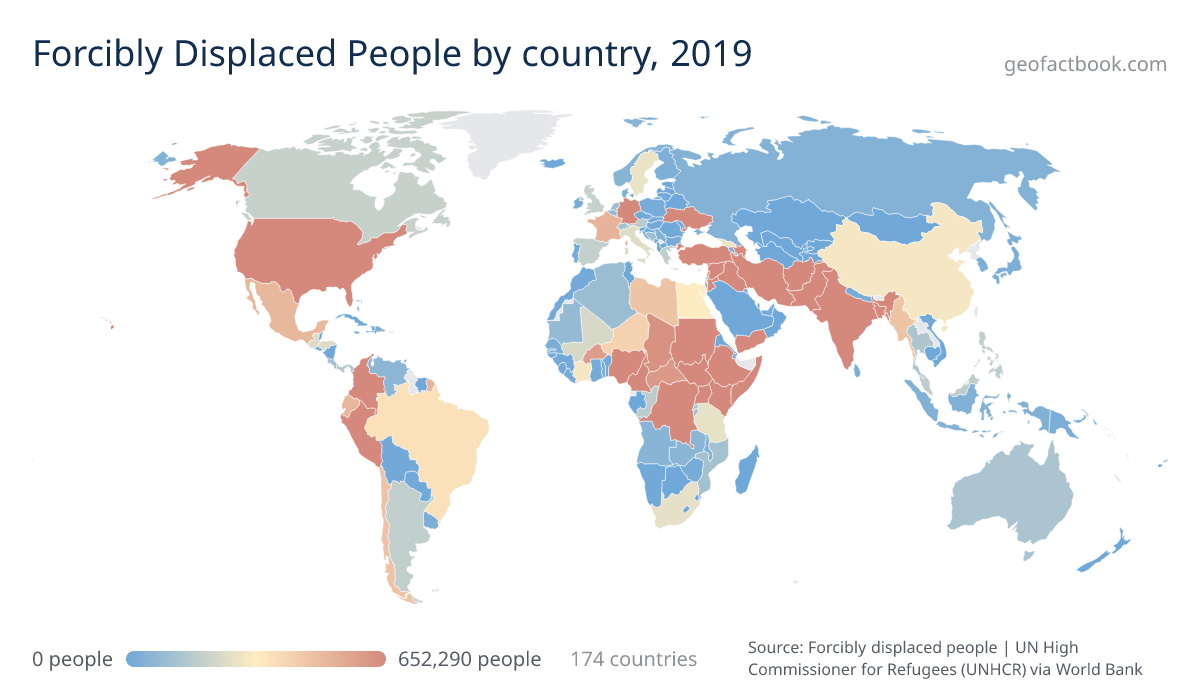
Forcibly Displaced People by country, 2019: map image
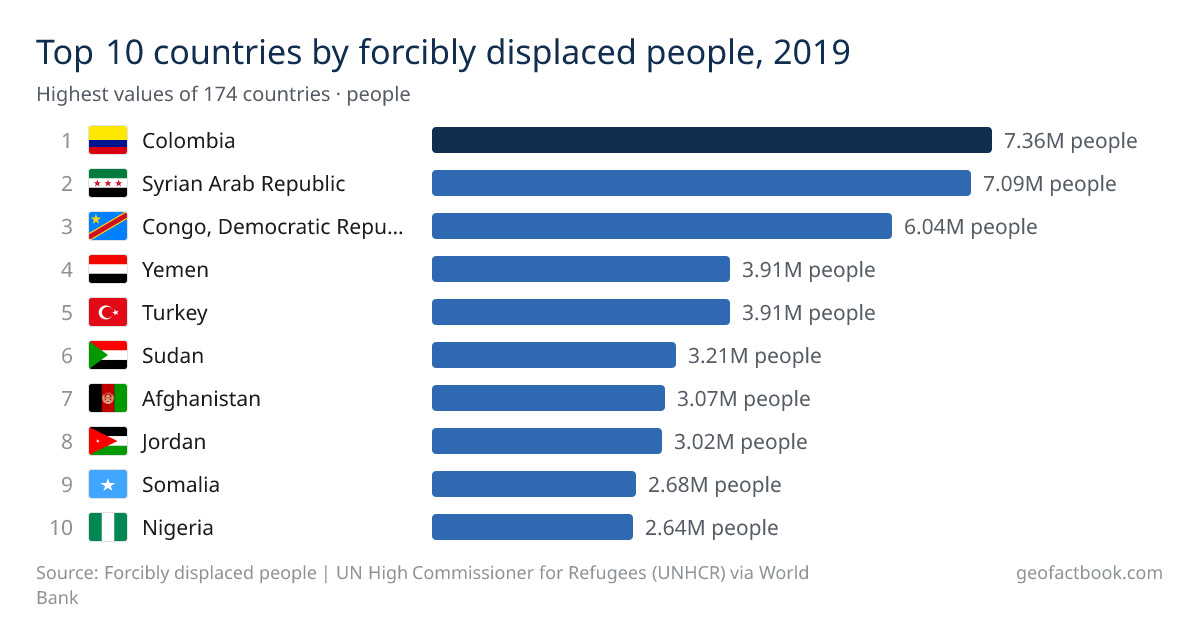
Top 10 countries by forcibly displaced people, 2019: chart
Insights by country
United Arab Emirates
The United Arab Emirates ranked #105 globally with 8,508 forcibly displaced people in 2019. This figure is relatively low compared to regional neighbors, indicating a more stable environment for residents. The UAE's economic prosperity and strategic location have attracted a diverse expatriate population, while its robust legal frameworks and policies contribute to minimizing displacement within its borders.
Canada
In 2019, Canada ranked #51 globally with 198,774 Forcibly Displaced People. This figure is notable when compared to its neighbor, the United States, which has a significantly higher number of displaced individuals. Key drivers for Canada's displaced population include its welcoming immigration policies and commitment to resettling refugees, which reflects the country's broader humanitarian approach.
Australia
In 2019, Australia had 135,891 Forcibly Displaced People, ranking #63 out of 174 countries. This figure is notable when compared to regional neighbors, as Australia has a higher number than countries like New Zealand, which reports significantly fewer displaced individuals. Key drivers of this statistic include Australia's immigration policies and its geographical position as a destination for asylum seekers fleeing conflict and persecution in neighboring regions.
Argentina
In 2019, Argentina had 185,181 Forcibly Displaced People, ranking #55 out of 174 countries. This figure is notable as it reflects a significant challenge compared to regional neighbors, with countries like Colombia experiencing much higher displacement figures due to ongoing conflict. Key drivers of Argentina's displacement include its geographic location as a transit country for migrants and refugees, alongside economic factors that influence migration patterns in South America.
Belize
In 2019, Belize had 2173 forcibly displaced people, ranking #125 out of 174 countries. This figure is relatively low compared to regional averages in Central America, where displacement often exceeds thousands due to violence and natural disasters. Factors contributing to Belize's displacement include its geographic vulnerability to hurricanes and socio-economic challenges that drive migration.
Benin
In 2019, Benin had 5,111 Forcibly Displaced People, ranking #113 out of 174 countries. This figure is relatively low compared to regional neighbors, indicating a more stable situation than some countries in West Africa. Factors contributing to Benin's displacement numbers include its relatively peaceful political climate and efforts to maintain social cohesion, despite challenges such as economic disparities and environmental vulnerabilities.
Azerbaijan
Azerbaijan ranked #26 globally with 652290 forcibly displaced people in 2019. This figure is significant compared to many regional neighbors, highlighting the ongoing challenges faced by the country. The high number of displaced individuals can be attributed to the unresolved conflict over Nagorno-Karabakh, which has led to a protracted humanitarian situation and significant internal displacement.
Brazil
In 2019, Brazil had 363,645 forcibly displaced people, ranking #38 out of 174 countries. This figure is significant compared to regional neighbors, as many South American countries have lower displacement rates. Key drivers of this statistic include Brazil's socio-economic challenges, such as inequality and violence, which contribute to internal displacement, as well as its role as a host country for refugees from neighboring nations facing conflict.
Colombia
In 2019, Colombia ranked #1 globally with 7,356,965 people classified as Forcibly Displaced People. This figure is significantly higher than that of its regional neighbors, reflecting the ongoing challenges faced by the country. The primary drivers of this displacement include decades of armed conflict, violence from illegal armed groups, and socio-economic instability, which have compelled millions to flee their homes in search of safety.
Angola
In 2019, Angola had 75 rank globally with 55,971 people classified as Forcibly Displaced People. This figure is significant compared to many neighboring countries, highlighting Angola's ongoing challenges in managing displacement. Key drivers include the aftermath of decades of civil conflict and economic instability, which have contributed to internal displacement and migration pressures within the region.
Analysis & Context
In 2019, Colombia reported the highest number of Forcibly Displaced People, with a staggering 7,356,965 individuals, while the global range spanned from 0 to 7,356,965 across 174 countries. The median number of forcibly displaced people worldwide was 28,758, providing a central point of reference amid significant variations.
Global Hotspots for Displacement
The countries with the highest numbers of forcibly displaced individuals in 2019 reveal underlying crises and conflicts. Colombia topped the list with 7,356,965 displaced persons, largely due to long-standing internal conflicts involving guerrilla groups and drug cartels. The Syrian Arab Republic followed closely with 7,085,590, primarily driven by the ongoing civil war that began in 2011. Similarly, the Democratic Republic of the Congo reported 6,038,925 displaced people, a consequence of internal strife and armed conflicts in the region.
These countries highlight how protracted conflicts and instability lead to massive displacement. Other significant contributors include Yemen with 3,914,172 and Turkey with 3,909,788, both of which are affected by regional instability and refugee influxes, particularly from neighboring Syria in Turkey's case.
Minimal Displacement: A Different Perspective
At the other end of the spectrum, several countries reported minimal or no forcibly displaced persons. For instance, Cabo Verde, Vietnam, and Singapore each recorded 0 displaced individuals. This absence of displacement often reflects stable political environments, robust governance, and effective conflict resolution mechanisms, which prevent the conditions that typically lead to large-scale displacement.
Countries like Saint Kitts and Nevis and Turks and Caicos Islands, with just 5 displaced persons each, also demonstrate how geographic isolation and small population sizes can contribute to lower displacement figures.
Year-over-Year Movements: Emerging Trends
The year 2019 witnessed significant changes in displacement figures across various nations. The Democratic Republic of the Congo saw the largest increase, with an additional 2,423,090 displaced individuals, marking a 67.0% rise. This surge is largely attributable to intensified violence and ongoing conflicts. Yemen also experienced a substantial rise of 1,317,008 displaced persons (50.7% increase), reflecting the persistent humanitarian crisis exacerbated by war.
Conversely, some countries experienced decreases in their displaced populations. Ethiopia saw the most significant reduction of 983,562 individuals, a 32.3% decrease, possibly due to successful peace initiatives and resettlement efforts. South Sudan and Iraq also reported declines of 509,387 and 439,107 respectively, highlighting regional efforts to stabilize and repatriate displaced populations.
Economic and Policy Drivers
Economic conditions and policy decisions greatly influence displacement patterns. In countries like Colombia and the Democratic Republic of the Congo, economic instability and insufficient infrastructure exacerbate the impacts of conflict, leading to higher displacement. In contrast, nations with strong economies and comprehensive social policies, such as Singapore and Vietnam, maintain stability and prevent mass displacement.
Policy interventions, such as those seen in Ethiopia, where government efforts have focused on conflict resolution and integration of displaced persons, demonstrate how targeted strategies can mitigate displacement. Meanwhile, countries like Turkey continue to face challenges due to external factors, such as the Syrian refugee crisis, despite having robust policies in place.
In summary, the statistics for 2019 reveal a complex landscape of forcibly displaced people, where conflict, economic conditions, and policy responses play pivotal roles. Understanding these dynamics is crucial for addressing the root causes of displacement and fostering sustainable solutions.
Frequently Asked Questions About Forcibly Displaced People in 2019
Which country had the highest number of forcibly displaced people in 2019?
Colombia had the highest number of forcibly displaced people in 2019, with 7,356,965 people.
Which country had the lowest number of forcibly displaced people in 2019?
Cabo Verde had the lowest number of forcibly displaced people in 2019, with 0 people.
What was the average number of forcibly displaced people per country in 2019?
The average number of forcibly displaced people per country in 2019 was 450,139 people.
What was the median number of forcibly displaced people per country in 2019?
The median number of forcibly displaced people per country in 2019 was 28,680 people.
How many countries had zero forcibly displaced people in 2019?
Three countries had zero forcibly displaced people in 2019: Cabo Verde, Vietnam, and Singapore.
Which countries were in the top 3 for forcibly displaced people in 2019?
The top 3 countries for forcibly displaced people in 2019 were Colombia, Syrian Arab Republic, and the Democratic Republic of the Congo.
Data Source
Forcibly displaced people | UN High Commissioner for Refugees (UNHCR) via World Bank
Data produced by Refugee Population Statistics Database, UN High Commissioner for Refugees (UNHCR), compiled and published by World Bank as "Forcibly displaced people".
Visit Data SourceCite this page
Geo Factbook. (n.d.). Forcibly Displaced People by Country, 2019. Retrieved November 27, 2026, from https://geofactbook.com/fact/forcibly-displaced-people/2019
The figures on this page come from Forcibly displaced people | UN High Commissioner for Refugees (UNHCR) via World Bank. For academic work, cite the original source as well.
›Embed this ranking on your site
Free to embed with attribution. Shows the top 10 countries and links back to the full ranking.
Historical Data by Year
Explore Forcibly Displaced People data across different years. Compare trends and see how statistics have changed over time.
You might also like
Rule of Law Index by Country
FeaturedCompare countries by Rule of Law percentile rank, reflecting confidence in laws, courts, police, property rights, and protection from crime and violence.
Highest: Finland100%Human Capital Index
FeaturedThe Human Capital Index measures a country's investment in education and health, reflecting its potential for economic growth and productivity. This vital statistic highlights the importance of nurturing human resources for sustainable development.
Highest: Singapore0.91Total population
FeaturedDiscover the latest total population statistics for every country and region worldwide. Explore accurate, up-to-date data on global population growth, density, and demographic trends — sourced from trusted international databases like the UN and World Bank. Perfect for researchers, students, and data enthusiasts looking to understand how the world’s population is changing.
Highest: India1.48B persons