
Forcibly Displaced People 2018
Forcibly displaced people include refugees, asylum seekers, and internally displaced persons worldwide.
Newer data is available: Forcibly Displaced People by country 2025 →
Where does your country rank? Pick it to see its position.
Related Transnational Issues statistics
More ↓Interactive Map
Complete Data Rankings
Rank | Actions | ||
|---|---|---|---|
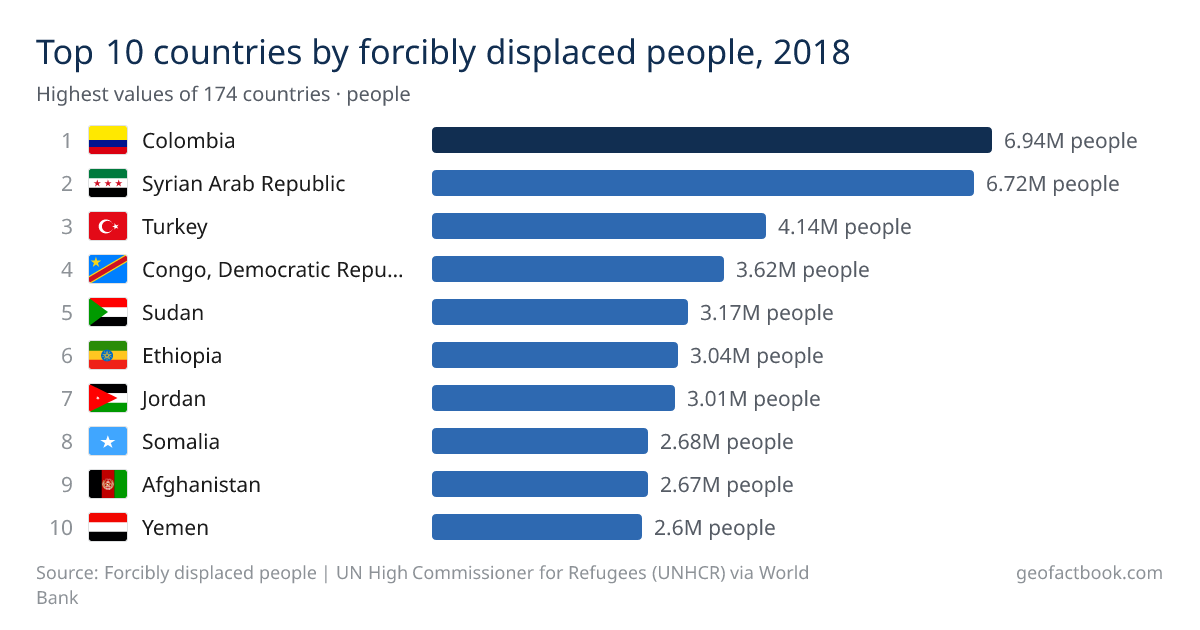
1 |  Colombia | 6,935,697 people | |
2 |  Syrian Arab Republic | 6,716,587 people | |
3 |  Turkey | 4,137,387 people | |
4 |  Congo, Democratic Republic of the | 3,615,835 people | |
5 |  Sudan | 3,167,899 people | |
6 |  Ethiopia | 3,042,362 people | |
7 |  Jordan | 3,010,411 people | |
8 |  Somalia | 2,681,099 people | |
9 |  Afghanistan | 2,670,509 people | |
10 |  Yemen | 2,597,164 people | |
11 |  State of Palestine | 2,505,747 people | |
12 |  Nigeria | 2,278,667 people | |
13 |  Iraq | 2,259,031 people | |
14 |  South Sudan | 2,163,373 people | |
15 |  Pakistan | 1,526,178 people | |
16 |  Lebanon | 1,452,132 people | |
17 |  Germany | 1,433,074 people | |
18 |  Bangladesh | 1,332,679 people | |
19 |  Uganda | 1,222,915 people | |
20 |  Cameroon | 1,056,419 people | |
21 |  United States | 1,032,234 people | |
22 |  Iran | 979,468 people | |
23 |  Ukraine | 808,995 people | |
24 |  Peru | 720,565 people | |
25 |  India | 686,825 people | |
26 |  Central African Republic | 648,049 people | |
27 |  Azerbaijan | 645,339 people | |
28 |  Kenya | 633,701 people | |
29 |  Chad | 544,670 people | |
30 |  France | 457,400 people | |
31 |  Mexico | 423,467 people | |
32 |  Myanmar | 401,000 people | |
33 |  Ecuador | 374,859 people | |
34 |  Niger | 334,960 people | |
35 |  China | 322,341 people | |
36 |  Egypt | 318,114 people | |
37 |  Tanzania | 317,981 people | |
38 |  Côte d'Ivoire | 304,006 people | |
39 |  Philippines | 301,869 people | |
40 |  Chile | 299,141 people | |
41 |  Italy | 294,833 people | |
42 |  Sweden | 286,102 people | |
43 |  Georgia | 280,664 people | |
44 |  South Africa | 273,478 people | |
45 |  Cyprus | 249,269 people | |
46 |  Libya | 243,195 people | |
47 |  Guatemala | 242,631 people | |
48 |  Brazil | 203,745 people | |
49 |  Canada | 192,867 people | |
50 |  Honduras | 190,083 people | |
51 |  United Kingdom | 171,942 people | |
52 |  Austria | 166,126 people | |
53 |  Malaysia | 163,106 people | |
54 |  Congo | 153,667 people | |
55 |  Mali | 147,455 people | |
56 |  Rwanda | 145,782 people | |
57 |  Thailand | 144,168 people | |
58 |  Greece | 137,503 people | |
59 |  Argentina | 136,696 people | |
60 |  Switzerland | 118,787 people | |
61 |  Australia | 117,579 people | |
62 |  Netherlands | 114,127 people | |
63 |  Panama | 110,503 people | |
64 |  Burundi | 109,159 people | |
65 |  Bosnia and Herzegovina | 105,230 people | |
66 |  Algeria | 103,251 people | |
67 |  Spain | 99,122 people | |
68 |  Mauritania | 84,309 people | |
69 |  Russia | 81,043 people | |
70 |  Burkina Faso | 72,160 people | |
71 |  Angola | 69,984 people | |
72 |  Venezuela | 67,425 people | |
73 |  Belgium | 61,708 people | |
74 |  Norway | 59,250 people | |
75 |  Israel | 54,123 people | |
76 |  Zambia | 53,177 people | |
77 |  Serbia | 47,163 people | |
78 |  Trinidad and Tobago | 42,564 people | |
79 |  Mozambique | 40,043 people | |
80 |  Denmark | 39,298 people | |
81 |  Sri Lanka | 38,540 people | |
82 |  Costa Rica | 37,126 people | |
83 |  Malawi | 36,918 people | |
84 |  Senegal | 34,058 people | |
85 |  Japan | 30,933 people | |
86 |  Djibouti | 28,772 people | |
87 |  Indonesia | 26,982 people | |
88 |  Dominican Republic | 26,919 people | |
89 |  Curaçao | 26,127 people | |
90 |  Finland | 25,551 people | |
91 |  South Korea | 22,717 people | |
92 |  Papua New Guinea | 22,173 people | |
93 |  Bulgaria | 21,466 people | |
94 |  Nepal | 20,855 people | |
95 |  Uruguay | 18,388 people | |
96 |  Ghana | 18,208 people | |
97 |  Armenia | 18,071 people | |
98 |  Zimbabwe | 18,002 people | |
99 |  Aruba | 16,009 people | |
100 |  Poland | 15,554 people | |
101 |  Ireland | 13,171 people | |
102 |  Togo | 13,029 people | |
103 |  Malta | 10,439 people | |
104 |  Liberia | 9,143 people | |
105 |  Morocco | 7,761 people | |
106 |  United Arab Emirates | 7,667 people | |
107 |  Hungary | 6,139 people | |
108 |  Guinea | 5,872 people | |
109 |  Romania | 5,610 people | |
110 |  Benin | 4,975 people | |
111 |  Guinea-Bissau | 4,874 people | |
112 |  Gambia | 4,376 people | |
113 |  Czech Republic | 4,096 people | |
114 |  Namibia | 3,910 people | |
115 |  Sierra Leone | 3,591 people | |
116 |  Luxembourg | 3,505 people | |
117 |  Belize | 3,334 people | |
118 |  Tajikistan | 2,969 people | |
119 |  Saudi Arabia | 2,430 people | |
120 |  Belarus | 2,409 people | |
121 |  Botswana | 2,312 people | |
122 |  Eritrea | 2,252 people | |
123 |  Portugal | 2,215 people | |
124 |  Madagascar | 2,129 people | |
125 |  Lithuania | 2,004 people | |
126 |  New Zealand | 1,991 people | |
127 |  Kuwait | 1,654 people | |
128 |  Eswatini | 1,613 people | |
129 |  Paraguay | 1,413 people | |
130 |  Nauru | 1,380 people | |
131 |  Tunisia | 1,311 people | |
132 |  Slovenia | 991 people | |
133 |  Iceland | 986 people | |
134 |  Croatia | 985 people | |
135 |  Slovakia | 955 people | |
136 |  Montenegro | 889 people | |
137 |  Bolivia | 836 people | |
138 |  Gabon | 768 people | |
139 |  Kazakhstan | 758 people | |
140 |  Latvia | 709 people | |
141 |  Oman | 564 people | |
142 |  North Macedonia | 558 people | |
143 |  Republic of Moldova | 502 people | |
144 |  Nicaragua | 447 people | |
145 |  Kyrgyzstan | 434 people | |
146 |  Estonia | 349 people | |
147 |  Bahrain | 320 people | |
148 |  Cuba | 311 people | |
149 |  Albania | 291 people | |
150 |  Qatar | 280 people | |
151 |  Suriname | 247 people | |
152 |  Liechtenstein | 236 people | |
153 |  China, Hong Kong SAR | 128 people | |
154 |  Lesotho | 92 people | |
155 |  Cayman Islands | 61 people | |
156 |  El Salvador | 60 people | |
157 |  Bahamas | 38 people | |
158 |  Jamaica | 34 people | |
159 |  Monaco | 25 people | |
160 |  Turkmenistan | 21 people | |
161 |  Fiji | 17 people | |
162 |  Mauritius | 16 people | |
163 |  Uzbekistan | 13 people | |
164 |  Barbados | 5 people | |
165 |  Haiti | 5 people | |
166 |  Mongolia | 5 people | |
167 |  Samoa | 5 people | |
168 |  Sint Maarten (Dutch part) | 5 people | |
169 |  Solomon Islands | 5 people | |
170 |  Saint Kitts and Nevis | 5 people | |
171 |  Turks and Caicos Islands | 5 people | |
172 |  Cabo Verde | 0 people | |
173 |  Singapore | 0 people | |
174 |  Vietnam | 0 people |
- #1Colombia
- #2Syrian Arab Republic
- #3Turkey
- #4Congo, Democratic Republic of the
- #5Sudan
- #6Ethiopia
- #7Jordan
- #8Somalia
- #9Afghanistan
- #10Yemen
Analysis: These countries represent the highest values in this dataset, showcasing significant scale and impact on global statistics.
- #174Vietnam
- #173Singapore
- #172Cabo Verde
- #171Turks and Caicos Islands
- #170Saint Kitts and Nevis
- #169Solomon Islands
- #168Sint Maarten (Dutch part)
- #167Samoa
- #166Mongolia
- #165Haiti
Context: These countries or territories have the lowest values, often due to geographic size, administrative status, or specific characteristics.
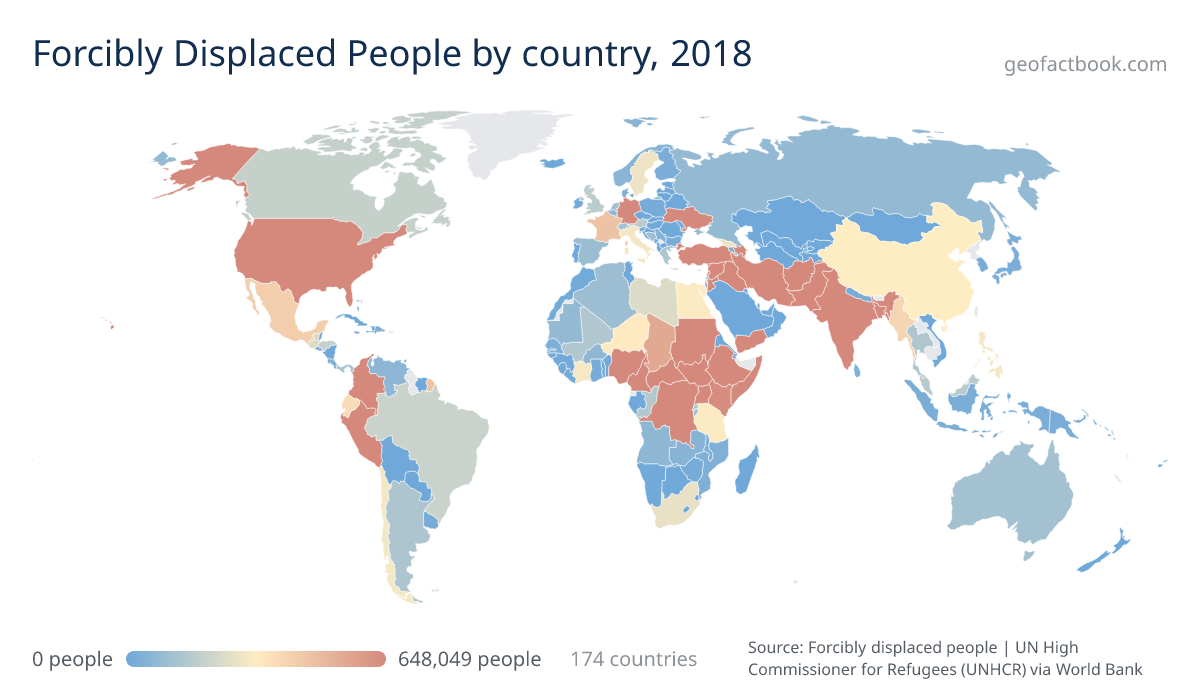
Forcibly Displaced People by country, 2018: map image
Top 10 countries by forcibly displaced people, 2018: chart
Insights by country
Argentina
In 2018, Argentina ranked #59 globally with 136,696 forcibly displaced people. This figure is notable when compared to regional neighbors, as countries like Venezuela have significantly higher displacement figures due to ongoing crises. Economic challenges, including inflation and unemployment, have driven many Argentinians to seek refuge elsewhere, contributing to this displacement statistic.
Guinea-Bissau
In 2018, Guinea-Bissau had 4,874 Forcibly Displaced People, ranking #111 out of 174 countries. This figure reflects ongoing instability in the region, particularly when compared to neighboring countries that often experience similar challenges. Factors contributing to this displacement include political turmoil, economic hardship, and a lack of effective governance, which have hindered the country's ability to provide security and stability for its citizens.
Israel
In 2018, Israel had 75 rank with 54,123 people classified as Forcibly Displaced People. This figure is notable when compared to the global context, where countries facing severe crises often report significantly higher numbers of displaced individuals. The primary drivers behind Israel's displacement statistics include ongoing regional conflicts, security concerns, and complex immigration policies that impact both internal and external population movements.
Estonia
In 2018, Estonia had 349 Forcibly Displaced People, ranking #146 out of 174 countries. This figure is relatively low compared to global averages, indicating a stable internal environment. The limited number of forcibly displaced individuals in Estonia can be attributed to its strong governance and policies that promote social cohesion, alongside a relatively low level of conflict and instability in the region.
United Arab Emirates
The United Arab Emirates had 7667 forcibly displaced people in 2018, ranking #106 out of 174 countries. This number is relatively low compared to regional neighbors, reflecting a stable socio-economic environment. Factors contributing to this statistic include the UAE's robust economy, which attracts expatriates, and its strategic policies aimed at maintaining social cohesion and security.
Slovakia
In 2018, Slovakia had 955 forcibly displaced people, ranking #135 out of 174 countries. This figure is notably lower than many of its European neighbors, reflecting a relatively stable internal situation compared to countries experiencing significant conflict or instability. Factors contributing to this low number include Slovakia's geographic location in Central Europe, which has not been a frontline in recent conflicts, and its immigration policies that have historically focused on integration rather than large-scale refugee resettlement.
Japan
In 2018, Japan had 85th rank globally with 30,933 people classified as Forcibly Displaced People. This figure is notably lower than many neighboring countries, reflecting Japan's stringent immigration policies and relatively low rates of asylum seekers compared to regional averages. Contributing factors include Japan's geographic isolation as an island nation and its cultural emphasis on homogeneity, which influences its refugee acceptance rates.
Vietnam
In 2018, Vietnam ranked #174 globally for Forcibly Displaced People with a total of 0 people. This contrasts sharply with neighboring countries in Southeast Asia, where displacement figures are often much higher due to conflict and environmental factors. Vietnam's stability can be attributed to its relatively peaceful political climate and effective government policies that promote internal migration rather than displacement.
Bosnia and Herzegovina
In 2018, Bosnia and Herzegovina had 105230 forcibly displaced people, ranking #65 out of 174 countries. This figure is notable when compared to its regional neighbors, many of which face similar challenges but report different displacement rates. The high number of forcibly displaced individuals can be attributed to the lingering effects of the 1990s conflict, ongoing economic instability, and limited integration policies for refugees and internally displaced persons.
Myanmar
In 2018, Myanmar had 401,000 forcibly displaced people, ranking #32 out of 174 countries. This figure is significant compared to the global average, reflecting ongoing humanitarian crises in the region. Key drivers include prolonged ethnic conflicts and military operations that have forcibly displaced many communities, particularly in Rakhine State, exacerbating the challenges of governance and stability.
Analysis & Context
In 2018, the country with the highest number of Forcibly Displaced People was Colombia, with a staggering 6,935,697 individuals. The global range for forcibly displaced persons spanned from 0 to 6,935,697 across 174 countries. The median number of forcibly displaced people worldwide stood at 26,982, providing a significant context to the disparities in displacement numbers.
Drivers of Displacement: Conflict and Instability
Several countries with high numbers of forcibly displaced people in 2018 were significantly impacted by ongoing conflicts and political instability. Colombia, leading the list, has been plagued by decades of internal conflict involving government forces, rebel groups, and paramilitaries. Despite peace agreements, displacement remains a severe issue due to lingering violence and land disputes.
In the Syrian Arab Republic, with 6,716,587 displaced individuals, the civil war that began in 2011 continued to drive mass displacement. The conflict has devastated infrastructure and services, leaving millions in search of safety both within and outside the country's borders.
Similarly, the Democratic Republic of the Congo experienced significant displacement, with 3,615,835 people affected. Ethnic violence and armed group activities in regions such as Kivu and Ituri contributed to these high numbers.
Geopolitical Influence on Displacement Patterns
The geopolitical landscape plays a crucial role in influencing displacement patterns. Turkey, hosting 4,137,387 forcibly displaced people, has become a critical hub due to its geographical proximity to conflict zones. As a neighboring country to Syria, Turkey has absorbed massive refugee inflows, impacting its social and economic structures.
Jordan, with 3,010,411 displaced individuals, also reflects similar geopolitical dynamics. As a relatively stable country in a volatile region, Jordan has provided refuge to those fleeing conflicts in neighboring Syria and Iraq.
Conversely, countries like Singapore and Vietnam reported zero forcibly displaced people, reflecting their stable political climates and geographic distance from major conflict zones.
Significant Year-Over-Year Changes
The year-over-year changes in forcibly displaced populations reveal significant shifts. Somalia saw the largest increase, with +1,826,828 people displaced, a 213.8% rise. This surge is largely attributed to ongoing conflict and climatic shocks, exacerbating food insecurity and prompting mass movements.
An increase in Afghanistan by 1,308,367 individuals (96.1%) reflects the intensified conflict and political instability in the region, particularly following the withdrawal of international forces.
In contrast, the Democratic Republic of the Congo experienced a decrease of 1,402,061 people, a reduction of 27.9%. This drop could be due to temporary improvements in security or successful repatriation efforts, although such changes are often fragile.
Impact of Economic and Social Stability
The economic and social stability of a country significantly influences its capacity to either generate or absorb forcibly displaced populations. For instance, Nigeria, with an increase of 566,107 displaced people, faces challenges despite having Africa's largest economy. Internal conflicts, particularly in the northeastern region, continue to drive displacement.
On the other hand, countries with minimal displacement, such as Haiti and Barbados, each with just 5 displaced individuals, often benefit from relative political stability and lower exposure to regional conflicts.
Understanding these patterns is crucial for policy-makers and humanitarian organizations aiming to address the root causes of displacement and to provide effective support for affected populations. The data from 2018 underscores the complexity of displacement dynamics and the multifaceted nature of solutions required to tackle this global challenge.
Frequently Asked Questions About Forcibly Displaced People in 2018
Which country had the highest number of forcibly displaced people in 2018?
Colombia had the highest number of forcibly displaced people in 2018, with 6,935,697 people.
Which country had the lowest number of forcibly displaced people in 2018?
Singapore had the lowest number of forcibly displaced people in 2018, with 0 people.
What was the average number of forcibly displaced people per country in 2018?
The average number of forcibly displaced people per country in 2018 was 416,606 people.
What was the median number of forcibly displaced people per country in 2018?
The median number of forcibly displaced people per country in 2018 was 26,951 people.
Which countries were in the top 3 for forcibly displaced people in 2018?
The top 3 countries for forcibly displaced people in 2018 were Colombia, Syrian Arab Republic, and Turkey.
How many countries had zero forcibly displaced people in 2018?
In 2018, three countries had zero forcibly displaced people: Singapore, Vietnam, and Cabo Verde.
Data Source
Forcibly displaced people | UN High Commissioner for Refugees (UNHCR) via World Bank
Data produced by Refugee Population Statistics Database, UN High Commissioner for Refugees (UNHCR), compiled and published by World Bank as "Forcibly displaced people".
Visit Data SourceCite this page
Geo Factbook. (n.d.). Forcibly Displaced People by Country, 2018. Retrieved November 27, 2026, from https://geofactbook.com/fact/forcibly-displaced-people/2018
The figures on this page come from Forcibly displaced people | UN High Commissioner for Refugees (UNHCR) via World Bank. For academic work, cite the original source as well.
›Embed this ranking on your site
Free to embed with attribution. Shows the top 10 countries and links back to the full ranking.
Historical Data by Year
Explore Forcibly Displaced People data across different years. Compare trends and see how statistics have changed over time.
You might also like
Rule of Law Index by Country
FeaturedCompare countries by Rule of Law percentile rank, reflecting confidence in laws, courts, police, property rights, and protection from crime and violence.
Highest: Finland100%Human Capital Index
FeaturedThe Human Capital Index measures a country's investment in education and health, reflecting its potential for economic growth and productivity. This vital statistic highlights the importance of nurturing human resources for sustainable development.
Highest: Singapore0.91Total population
FeaturedDiscover the latest total population statistics for every country and region worldwide. Explore accurate, up-to-date data on global population growth, density, and demographic trends — sourced from trusted international databases like the UN and World Bank. Perfect for researchers, students, and data enthusiasts looking to understand how the world’s population is changing.
Highest: India1.48B persons