
Republic of Moldova Forcibly Displaced People 2025: 149,918
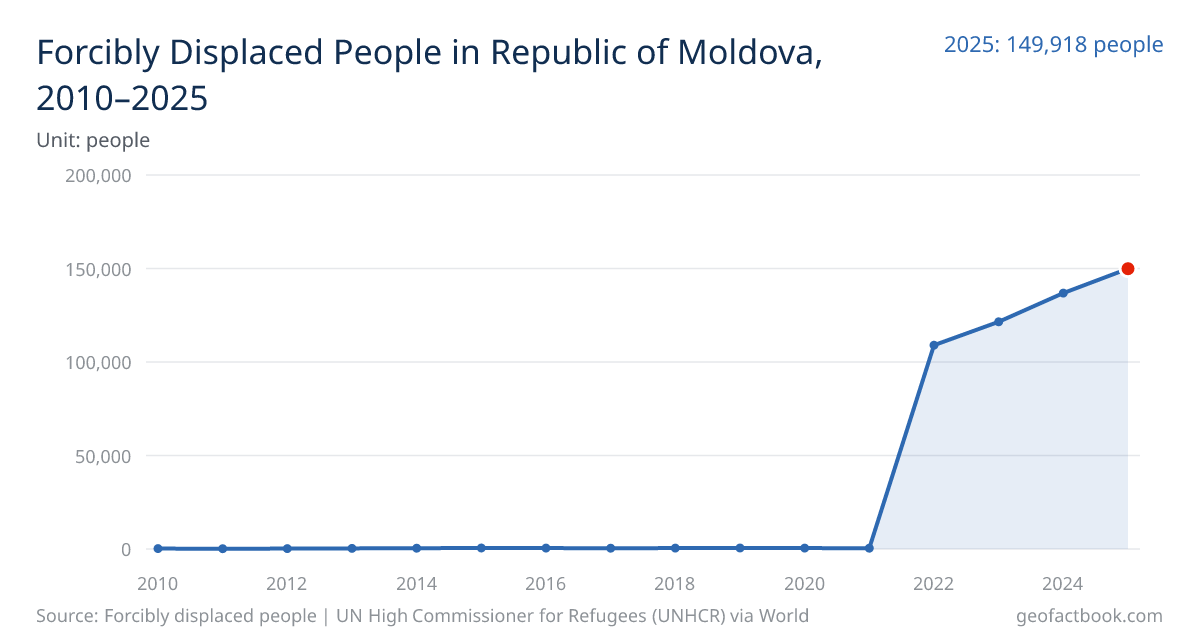
Republic of Moldova's forcibly displaced people in 2025 is 149,918, up 9.6% from 2024. It ranks #66 of 173 countries.
Forcibly displaced people include refugees, asylum seekers, and internally displaced persons worldwide.
Source (2025): Forcibly displaced people
Where Republic of Moldova ranks (2025)
#66 of 173- #64
 Ireland171,597 people
- #65
 Greece166,491 people
- #66
 Republic of Moldova149,918 people
- #67
 Sweden148,777 people
- #68
 Slovakia140,901 people
Forcibly Displaced People over time
| Year | Value | Change | % Change | Actions |
|---|---|---|---|---|
| 2025 | 149.92K people | +13.07K people | +9.55% | |
| 2024 | 136.84K people | +15.34K people | +12.63% | |
| 2023 | 121.50K people | +12.51K people | +11.48% | |
| 2022 | 108.99K people | +108.59K people | +26812.10% | |
| 2021 | 405 people | 59 people | -12.72% | |
| 2020 | 464 people | 47 people | -9.20% | |
| 2019 | 511 people | +9 people | +1.79% | |
| 2018 | 502 people | +50 people | +11.06% | |
| 2017 | 452 people | 42 people | -8.50% | |
| 2016 | 494 people | 34 people | -6.44% | |
| 2015 | 528 people | +75 people | +16.56% | |
| 2014 | 453 people | +154 people | +51.51% | |
| 2013 | 299 people | +70 people | +30.57% | |
| 2012 | 229 people | +56 people | +32.37% | |
| 2011 | 173 people | 33 people | -16.02% | |
| 2010 | 206 people | — | — |
Forcibly Displaced People in Republic of Moldova, 2010–2025: chart
Cite this page
Geo Factbook. (n.d.). Republic of Moldova: Forcibly Displaced People. Retrieved November 28, 2026, from https://geofactbook.com/countries/republic-of-moldova/forcibly-displaced-people
The figures on this page come from Forcibly displaced people | UN High Commissioner for Refugees (UNHCR) via World Bank. For academic work, cite the original source as well.
Frequently Asked Questions About Republic of Moldova Forcibly Displaced People
What is Republic of Moldova's forcibly displaced people in 2025?▾
Republic of Moldova's forcibly displaced people is 149,918 in 2025, according to Forcibly displaced people | UN High Commissioner for Refugees (UNHCR) via World Bank.
Is Republic of Moldova's forcibly displaced people increasing or decreasing?▾
Republic of Moldova's forcibly displaced people rose by 9.6% from 2024 (136,845) to 2025 (149,918). Over the past decade (2015–2025) it rose by 28293.6%.
How does Republic of Moldova rank for forcibly displaced people?▾
In 2025, Republic of Moldova has the 66th highest forcibly displaced people out of 173 countries with data.
What was Republic of Moldova's forcibly displaced people in 2010?▾
In 2010, Republic of Moldova's forcibly displaced people was 206. By 2025 it rose by 72675.7%.
Explore additional statistical insights
Egg Consumption per Capita in Republic of Moldova
Egg consumption per capita measures the average number of eggs consumed annually by individuals in a country.
Industrial Production Growth Rate (%) in Republic of Moldova
Industrial Production Growth Rate measures economic activity. Compare countries, explore rankings, and see interactive maps for trends.
Human Capital Index in Republic of Moldova
The Human Capital Index measures a country's investment in education and health, reflecting its potential for economic growth and productivity. This vital statistic highlights the importance of nurturing human resources for sustainable development.
Urban Population Annual Growth Rate in Republic of Moldova
Urban population annual growth rate measures the year-over-year percentage increase in a country's urban population.
Inflation Rate in Republic of Moldova
Inflation rate reflects the annual percentage change in the cost of goods and services, influencing purchasing power.
Total population in Republic of Moldova
Discover the latest total population statistics for every country and region worldwide. Explore accurate, up-to-date data on global population growth, density, and demographic trends — sourced from trusted international databases like the UN and World Bank. Perfect for researchers, students, and data enthusiasts looking to understand how the world’s population is changing.