
Forcibly Displaced People 2016
Forcibly displaced people include refugees, asylum seekers, and internally displaced persons worldwide.
Newer data is available: Forcibly Displaced People by country 2025 →
Where does your country rank? Pick it to see its position.
Related Transnational Issues statistics
More ↓Interactive Map
Complete Data Rankings
Rank | Actions | ||
|---|---|---|---|
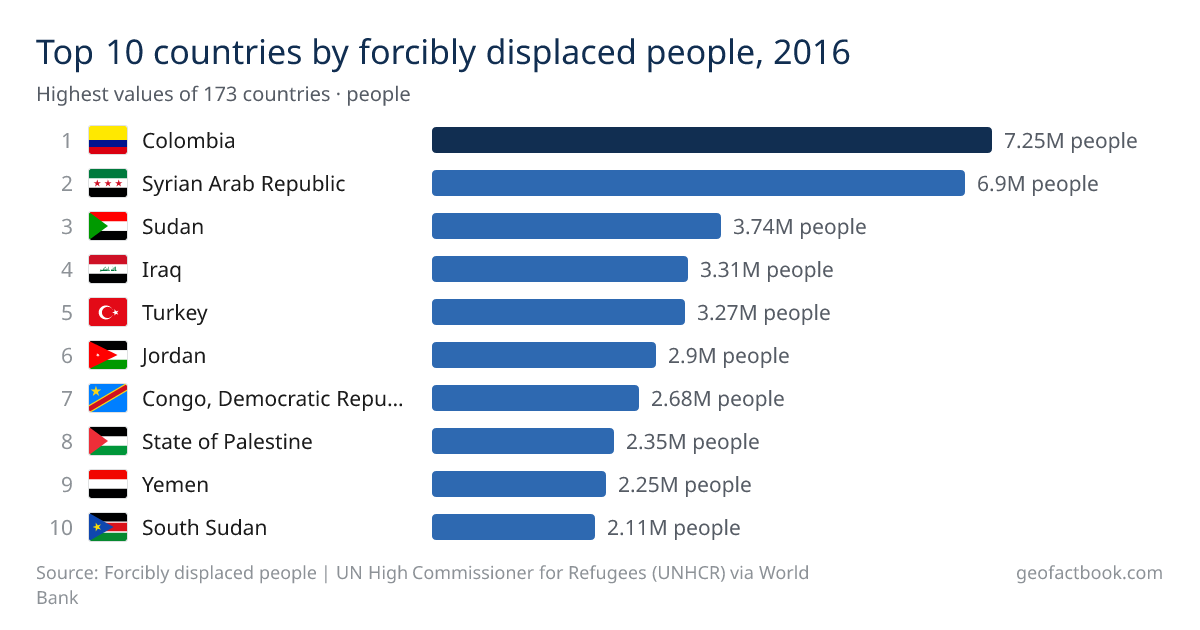
1 |  Colombia | 7,246,609 people | |
2 |  Syrian Arab Republic | 6,901,305 people | |
3 |  Sudan | 3,737,515 people | |
4 |  Iraq | 3,308,351 people | |
5 |  Turkey | 3,269,345 people | |
6 |  Jordan | 2,896,279 people | |
7 |  Congo, Democratic Republic of the | 2,683,281 people | |
8 |  State of Palestine | 2,351,274 people | |
9 |  Yemen | 2,252,866 people | |
10 |  South Sudan | 2,111,348 people | |
11 |  Nigeria | 1,956,821 people | |
12 |  Pakistan | 1,821,405 people | |
13 |  Ukraine | 1,662,828 people | |
14 |  Lebanon | 1,502,347 people | |
15 |  Afghanistan | 1,259,893 people | |
16 |  Germany | 1,256,774 people | |
17 |  Somalia | 1,131,371 people | |
18 |  Ethiopia | 1,051,579 people | |
19 |  Uganda | 1,035,697 people | |
20 |  India | 1,003,057 people | |
21 |  Iran | 979,526 people | |
22 |  United States | 712,827 people | |
23 |  Bangladesh | 702,203 people | |
24 |  Myanmar | 644,000 people | |
25 |  Kenya | 632,845 people | |
26 |  Azerbaijan | 583,448 people | |
27 |  Cameroon | 555,650 people | |
28 |  Chad | 501,143 people | |
29 |  Central African Republic | 424,427 people | |
30 |  France | 367,291 people | |
31 |  Libya | 342,532 people | |
32 |  Mexico | 319,814 people | |
33 |  China | 317,901 people | |
34 |  Sweden | 313,198 people | |
35 |  South Africa | 309,293 people | |
36 |  Côte d'Ivoire | 302,673 people | |
37 |  Niger | 302,150 people | |
38 |  Tanzania | 290,037 people | |
39 |  Cyprus | 283,527 people | |
40 |  Egypt | 272,459 people | |
41 |  Guatemala | 257,295 people | |
42 |  Russia | 251,006 people | |
43 |  Italy | 247,258 people | |
44 |  Georgia | 231,427 people | |
45 |  Honduras | 190,026 people | |
46 |  Venezuela | 172,947 people | |
47 |  Austria | 169,624 people | |
48 |  United Kingdom | 162,469 people | |
49 |  Rwanda | 156,521 people | |
50 |  Malaysia | 148,569 people | |
51 |  Thailand | 146,417 people | |
52 |  Ecuador | 127,390 people | |
53 |  Canada | 121,268 people | |
54 |  Burundi | 120,070 people | |
55 |  Switzerland | 113,446 people | |
56 |  Netherlands | 112,096 people | |
57 |  Bosnia and Herzegovina | 103,317 people | |
58 |  Algeria | 102,420 people | |
59 |  Philippines | 87,597 people | |
60 |  Greece | 86,371 people | |
61 |  Congo | 78,126 people | |
62 |  Nepal | 75,320 people | |
63 |  Mauritania | 74,719 people | |
64 |  Australia | 71,820 people | |
65 |  Peru | 67,983 people | |
66 |  Norway | 67,017 people | |
67 |  Belgium | 66,256 people | |
68 |  Mali | 54,809 people | |
69 |  Serbia | 53,639 people | |
70 |  Israel | 51,803 people | |
71 |  Angola | 45,678 people | |
72 |  Sri Lanka | 45,175 people | |
73 |  Brazil | 45,125 people | |
74 |  Senegal | 41,788 people | |
75 |  Denmark | 40,502 people | |
76 |  Bulgaria | 33,824 people | |
77 |  Burkina Faso | 33,377 people | |
78 |  Spain | 33,343 people | |
79 |  Zambia | 32,656 people | |
80 |  Mozambique | 32,639 people | |
81 |  Malawi | 30,408 people | |
82 |  Armenia | 26,356 people | |
83 |  Djibouti | 25,741 people | |
84 |  Finland | 23,961 people | |
85 |  Panama | 21,797 people | |
86 |  Japan | 21,313 people | |
87 |  Indonesia | 21,082 people | |
88 |  Liberia | 18,992 people | |
89 |  Papua New Guinea | 17,945 people | |
90 |  Poland | 15,150 people | |
91 |  Togo | 14,763 people | |
92 |  Ghana | 13,231 people | |
93 |  Ireland | 9,941 people | |
94 |  Guinea-Bissau | 9,293 people | |
95 |  Malta | 8,809 people | |
96 |  South Korea | 8,633 people | |
97 |  Zimbabwe | 8,371 people | |
98 |  Hungary | 8,132 people | |
99 |  Gambia | 7,936 people | |
100 |  Costa Rica | 7,788 people | |
101 |  Argentina | 7,184 people | |
102 |  Morocco | 6,705 people | |
103 |  Guinea | 5,171 people | |
104 |  Chile | 4,948 people | |
105 |  Czech Republic | 4,409 people | |
106 |  Luxembourg | 4,206 people | |
107 |  Namibia | 3,411 people | |
108 |  Tajikistan | 3,155 people | |
109 |  Romania | 2,952 people | |
110 |  Albania | 2,891 people | |
111 |  Gabon | 2,837 people | |
112 |  Belize | 2,427 people | |
113 |  Eritrea | 2,350 people | |
114 |  Botswana | 2,168 people | |
115 |  Portugal | 2,039 people | |
116 |  Belarus | 1,875 people | |
117 |  Kuwait | 1,758 people | |
118 |  New Zealand | 1,706 people | |
119 |  United Arab Emirates | 1,493 people | |
120 |  Lithuania | 1,431 people | |
121 |  Dominican Republic | 1,380 people | |
122 |  Eswatini | 1,102 people | |
123 |  Montenegro | 1,043 people | |
124 |  Benin | 1,028 people | |
125 |  Slovakia | 1,018 people | |
126 |  Croatia | 829 people | |
127 |  Nauru | 817 people | |
128 |  North Macedonia | 799 people | |
129 |  Kazakhstan | 780 people | |
130 |  Bolivia | 776 people | |
131 |  Slovenia | 763 people | |
132 |  Sierra Leone | 688 people | |
133 |  Oman | 681 people | |
134 |  Tunisia | 676 people | |
135 |  Nicaragua | 663 people | |
136 |  Uruguay | 651 people | |
137 |  Iceland | 569 people | |
138 |  Republic of Moldova | 494 people | |
139 |  Latvia | 491 people | |
140 |  Kyrgyzstan | 454 people | |
141 |  Bahrain | 381 people | |
142 |  Estonia | 355 people | |
143 |  Cuba | 340 people | |
144 |  Qatar | 319 people | |
145 |  Trinidad and Tobago | 306 people | |
146 |  Liechtenstein | 239 people | |
147 |  Cambodia | 231 people | |
148 |  Paraguay | 230 people | |
149 |  Saudi Arabia | 187 people | |
150 |  Curaçao | 108 people | |
151 |  China, Hong Kong SAR | 91 people | |
152 |  Lesotho | 51 people | |
153 |  Madagascar | 49 people | |
154 |  Suriname | 43 people | |
155 |  Cayman Islands | 42 people | |
156 |  El Salvador | 41 people | |
157 |  Monaco | 27 people | |
158 |  Bahamas | 26 people | |
159 |  Turkmenistan | 26 people | |
160 |  Uzbekistan | 26 people | |
161 |  Jamaica | 21 people | |
162 |  Mongolia | 10 people | |
163 |  Sint Maarten (Dutch part) | 10 people | |
164 |  Fiji | 7 people | |
165 |  Antigua and Barbuda | 5 people | |
166 |  Haiti | 5 people | |
167 |  China, Macao SAR | 5 people | |
168 |  Mauritius | 5 people | |
169 |  Micronesia (Fed. States of) | 5 people | |
170 |  Samoa | 5 people | |
171 |  Turks and Caicos Islands | 5 people | |
172 |  Cabo Verde | 0 people | |
173 |  Vietnam | 0 people |
- #1Colombia
- #2Syrian Arab Republic
- #3Sudan
- #4Iraq
- #5Turkey
- #6Jordan
- #7Congo, Democratic Republic of the
- #8State of Palestine
- #9Yemen
- #10South Sudan
Analysis: These countries represent the highest values in this dataset, showcasing significant scale and impact on global statistics.
- #173Vietnam
- #172Cabo Verde
- #171Turks and Caicos Islands
- #170Samoa
- #169Micronesia (Fed. States of)
- #168Mauritius
- #167China, Macao SAR
- #166Haiti
- #165Antigua and Barbuda
- #164Fiji
Context: These countries or territories have the lowest values, often due to geographic size, administrative status, or specific characteristics.
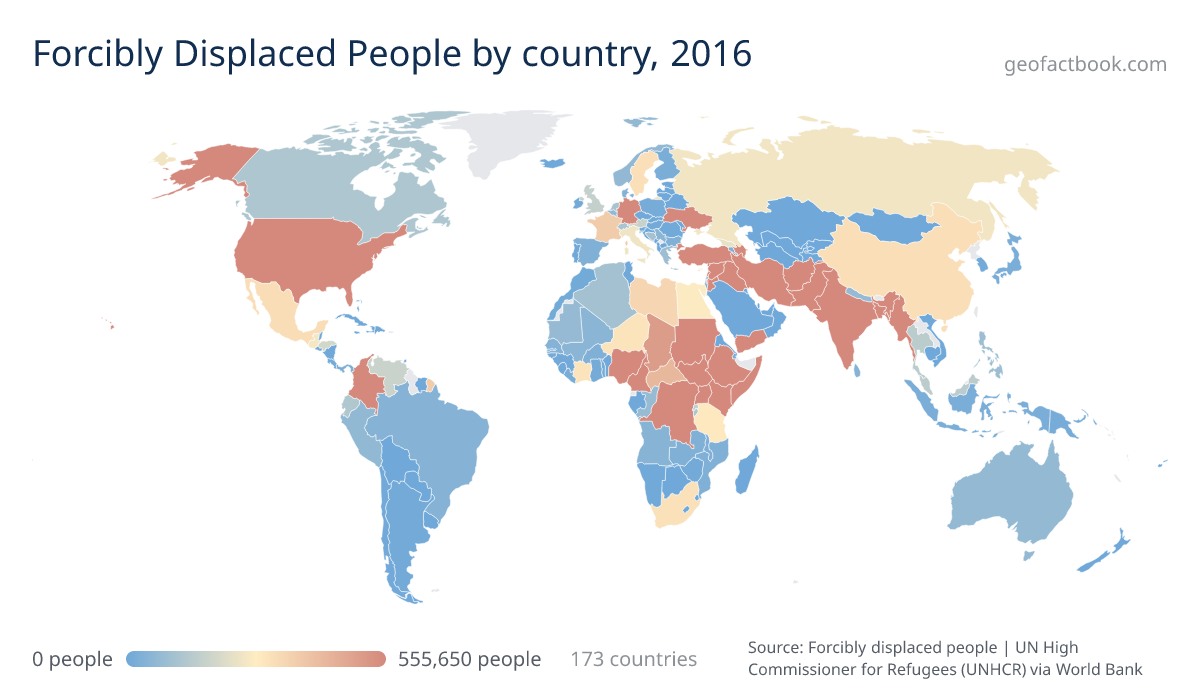
Forcibly Displaced People by country, 2016: map image
Top 10 countries by forcibly displaced people, 2016: chart
Insights by country
Russia
In 2016, Russia had 251,006 forcibly displaced people, ranking #42 out of 173 countries. This figure is significant when compared to neighboring countries, indicating a complex regional dynamic. Key drivers of this displacement include ongoing conflicts in nearby regions and domestic policies affecting migration and asylum seekers.
Peru
In 2016, Peru ranked #65 globally with 67,983 Forcibly Displaced People. This figure is notable when compared to neighboring Colombia, which has a significantly higher number of displaced individuals due to ongoing conflict. Key drivers for Peru's displacement include internal violence and economic instability, which have historically prompted migration and displacement within the country.
Montenegro
In 2016, Montenegro had 1,043 Forcibly Displaced People, ranking #123 out of 173 countries. This figure is relatively low compared to regional neighbors, reflecting a more stable situation than countries experiencing ongoing conflict. The primary drivers of this statistic in Montenegro include its geographic stability and effective post-war recovery policies, which have helped mitigate displacement issues.
Mali
In 2016, Mali ranked #68 globally with 54,809 forcibly displaced people. This figure is significant when compared to other countries in the Sahel region, where instability has led to similar challenges. Ongoing conflicts, particularly in the north, and the effects of climate change have exacerbated displacement, driving many from their homes in search of safety and stability.
Malaysia
In 2016, Malaysia ranked #50 globally with 148,569 Forcibly Displaced People. This figure is notable when compared to neighboring countries, reflecting the region's complex migration dynamics.
The primary drivers for this statistic include Malaysia's geographic location as a transit hub for refugees and its economic opportunities that attract displaced individuals seeking better living conditions. Additionally, Malaysia's policies regarding refugee status and asylum seekers influence the number of forcibly displaced people within its borders.
Malta
In 2016, Malta had 8809 people classified as Forcibly Displaced People, ranking #95 out of 173 countries. This figure is notable as it reflects challenges faced by small island nations, particularly in the Mediterranean region, where migration pressures are significant. Malta's geographic location makes it a key entry point for migrants seeking refuge, exacerbated by ongoing crises in neighboring regions.
China, Hong Kong SAR
In 2016, China, Hong Kong SAR reported 91 people as forcibly displaced, ranking #151 out of 173 countries. This figure is notably lower than many global counterparts, reflecting the region's relative stability compared to countries experiencing conflict or natural disasters. The low number of forcibly displaced people in Hong Kong can be attributed to its robust legal framework and economic conditions, which generally provide a secure environment for residents.
Bolivia
In 2016, Bolivia ranked #130 with 776 forcibly displaced people. This figure is relatively low compared to regional neighbors like Peru, which has higher displacement numbers due to ongoing internal conflicts. The modest number of forcibly displaced individuals in Bolivia can be attributed to its stable political climate and efforts to address social issues, although challenges remain in fully integrating marginalized communities.
Sierra Leone
Sierra Leone ranked #132 globally with 688 forcibly displaced people in 2016. This figure is relatively low compared to many countries affected by conflict, but it highlights ongoing challenges within the region. The legacy of the civil war and subsequent economic instability has contributed to displacement issues, though Sierra Leone has made strides in stability and recovery since the conflict ended in 2002.
Turkey
In 2016, Turkey ranked #5 globally with 3,269,345 people classified as Forcibly Displaced People. This figure is significant compared to the global average, reflecting Turkey's role as a major host for refugees, particularly from neighboring Syria. The ongoing civil war in Syria has driven millions to seek safety, with Turkey implementing policies to accommodate a large influx of displaced individuals, impacting its demographic landscape and social services.
Analysis & Context
In 2016, Colombia had the highest number of Forcibly Displaced People with a total of 7,246,609, while the global range spanned from 0 to 7,246,609 across 173 countries. The median number of forcibly displaced people globally was 21,082, providing a central point of reference in understanding the distribution of displacement worldwide.
Concentration of Displacement in Conflict Zones
The data highlights a significant concentration of forcibly displaced individuals in regions afflicted by conflict and instability. Colombia leads the list, largely due to its prolonged internal conflict involving government forces and rebel groups. Similarly, the Syrian Arab Republic, with 6,901,305 displaced people, reflects the ongoing civil war that has devastated the nation's infrastructure and displaced millions. Sudan, with 3,737,515 displaced people, and Iraq, with 3,308,351, also underscore how prolonged conflicts contribute to large-scale displacement.
These figures demonstrate how conflict regions inevitably become epicenters of displacement, highlighting the direct correlation between prolonged violence and the surge in displaced populations.
Impact of Regional Politics and Policies
The role of neighboring countries in hosting displaced populations is evident. Turkey, hosting 3,269,345 displaced persons, and Jordan, with 2,896,279, have been pivotal in accommodating Syrian refugees. These numbers reflect regional geopolitical dynamics, where countries in proximity to conflict zones bear the brunt of refugee influxes due to shared borders and political agreements.
In contrast, Vietnam and Cabo Verde reported 0 displaced individuals, illustrating how geographic isolation and stable political climates contribute to negligible displacement figures.
Year-over-Year Trends and Shifts
Examining year-over-year changes reveals significant shifts in displacement patterns. Colombia experienced an increase of 976,292 displaced people, a 15.6% rise, reflecting ongoing internal strife. The Democratic Republic of the Congo saw a dramatic increase of 799,208 displaced individuals, marking a 42.4% rise, indicative of renewed violence and political instability.
Contrastingly, Pakistan reported a decrease of 1,205,189, a significant 39.8% reduction, potentially due to improved internal security and repatriation efforts. Similarly, South Africa experienced a decrease of 908,363, a 74.6% drop, possibly driven by policy changes and shifts in asylum seeker management.
Global Displacement Patterns and Implications
The data on forcibly displaced people in 2016 underscores the persistent and complex nature of global displacement. While some countries, such as Germany, saw an increase of 520,106, indicating a welcoming stance towards refugees, others like Yemen experienced a decrease of 533,154, likely due to worsening conditions that limit movement.
This dynamic landscape of forced displacement calls for a nuanced understanding of the interplay between conflict, regional policies, and international humanitarian responses. The disparities in displacement figures across different countries highlight the need for targeted interventions and robust international cooperation to address the root causes and consequences of forced migration.
Frequently Asked Questions About Forcibly Displaced People in 2016
Which country had the highest number of forcibly displaced people in 2016?
Colombia had the highest number of forcibly displaced people in 2016, with 7,246,609 people.
Which country had the lowest number of forcibly displaced people in 2016?
Vietnam had the lowest number of forcibly displaced people in 2016, with 0 people.
What was the average number of forcibly displaced people per country in 2016?
The average number of forcibly displaced people per country in 2016 was 370,831 people.
What was the median number of forcibly displaced people per country in 2016?
The median number of forcibly displaced people per country in 2016 was 21,082 people.
Which countries were in the top 3 for forcibly displaced people in 2016?
The top 3 countries for forcibly displaced people in 2016 were Colombia, the Syrian Arab Republic, and Sudan.
How many countries had zero forcibly displaced people in 2016?
Two countries, Vietnam and Cabo Verde, had zero forcibly displaced people in 2016.
Data Source
Forcibly displaced people | UN High Commissioner for Refugees (UNHCR) via World Bank
Data produced by Refugee Population Statistics Database, UN High Commissioner for Refugees (UNHCR), compiled and published by World Bank as "Forcibly displaced people".
Visit Data SourceCite this page
Geo Factbook. (n.d.). Forcibly Displaced People by Country, 2016. Retrieved November 27, 2026, from https://geofactbook.com/fact/forcibly-displaced-people/2016
The figures on this page come from Forcibly displaced people | UN High Commissioner for Refugees (UNHCR) via World Bank. For academic work, cite the original source as well.
›Embed this ranking on your site
Free to embed with attribution. Shows the top 10 countries and links back to the full ranking.
Historical Data by Year
Explore Forcibly Displaced People data across different years. Compare trends and see how statistics have changed over time.
You might also like
Rule of Law Index by Country
FeaturedCompare countries by Rule of Law percentile rank, reflecting confidence in laws, courts, police, property rights, and protection from crime and violence.
Highest: Finland100%Human Capital Index
FeaturedThe Human Capital Index measures a country's investment in education and health, reflecting its potential for economic growth and productivity. This vital statistic highlights the importance of nurturing human resources for sustainable development.
 Highest: Singapore0.91
Total population
FeaturedDiscover the latest total population statistics for every country and region worldwide. Explore accurate, up-to-date data on global population growth, density, and demographic trends — sourced from trusted international databases like the UN and World Bank. Perfect for researchers, students, and data enthusiasts looking to understand how the world’s population is changing.
Highest: India1.48B persons