
Forcibly Displaced People 2012
Forcibly displaced people include refugees, asylum seekers, and internally displaced persons worldwide.
Newer data is available: Forcibly Displaced People by country 2025 →
Where does your country rank? Pick it to see its position.
Related Transnational Issues statistics
More ↓Interactive Map
Complete Data Rankings
Rank | Actions | ||
|---|---|---|---|
1 |  Colombia | 5,455,274 people | |
2 |  Syrian Arab Republic | 3,977,901 people | |
3 |  Sudan | 3,159,853 people | |
4 |  Congo, Democratic Republic of the | 2,766,927 people | |
5 |  Pakistan | 2,399,733 people | |
6 |  Jordan | 2,340,275 people | |
7 |  Iraq | 2,203,726 people | |
8 |  State of Palestine | 2,089,544 people | |
9 |  Somalia | 1,360,768 people | |
10 |  Turkey | 1,290,848 people | |
11 |  India | 1,189,193 people | |
12 |  Kenya | 906,861 people | |
13 |  Iran | 868,257 people | |
14 |  Ethiopia | 727,225 people | |
15 |  Germany | 675,242 people | |
16 |  Bangladesh | 656,696 people | |
17 |  Yemen | 628,650 people | |
18 |  Lebanon | 622,362 people | |
19 |  Azerbaijan | 601,604 people | |
20 |  South Sudan | 552,613 people | |
21 |  Afghanistan | 508,233 people | |
22 |  Chad | 463,863 people | |
23 |  Myanmar | 450,000 people | |
24 |  Serbia | 309,682 people | |
25 |  China | 301,290 people | |
26 |  South Africa | 295,645 people | |
27 |  United States | 280,952 people | |
28 |  Georgia | 280,919 people | |
29 |  France | 267,750 people | |
30 |  Uganda | 255,933 people | |
31 |  Mali | 244,166 people | |
32 |  Cyprus | 216,251 people | |
33 |  Venezuela | 204,535 people | |
34 |  Canada | 196,398 people | |
35 |  Indonesia | 177,918 people | |
36 |  Kyrgyzstan | 169,288 people | |
37 |  United Kingdom | 168,686 people | |
38 |  Mexico | 163,854 people | |
39 |  Peru | 151,573 people | |
40 |  Central African Republic | 148,618 people | |
41 |  Ecuador | 138,346 people | |
42 |  Thailand | 134,029 people | |
43 |  Burundi | 126,940 people | |
44 |  Egypt | 126,861 people | |
45 |  Sweden | 115,699 people | |
46 |  Bosnia and Herzegovina | 109,935 people | |
47 |  Congo | 109,561 people | |
48 |  Nepal | 106,280 people | |
49 |  Cameroon | 102,083 people | |
50 |  Malaysia | 101,796 people | |
51 |  Tanzania | 101,542 people | |
52 |  Algeria | 95,852 people | |
53 |  Sri Lanka | 93,364 people | |
54 |  Liberia | 88,945 people | |
55 |  Côte d'Ivoire | 84,480 people | |
56 |  Netherlands | 82,299 people | |
57 |  Mauritania | 81,296 people | |
58 |  Italy | 79,102 people | |
59 |  Austria | 74,125 people | |
60 |  Switzerland | 72,403 people | |
61 |  Libya | 63,609 people | |
62 |  Niger | 61,608 people | |
63 |  Rwanda | 59,690 people | |
64 |  Israel | 54,172 people | |
65 |  Norway | 52,122 people | |
66 |  Angola | 43,722 people | |
67 |  Australia | 41,052 people | |
68 |  Burkina Faso | 39,988 people | |
69 |  Senegal | 38,562 people | |
70 |  Greece | 38,273 people | |
71 |  Belgium | 37,046 people | |
72 |  Togo | 33,938 people | |
73 |  Russia | 32,980 people | |
74 |  Zambia | 26,837 people | |
75 |  Djibouti | 22,229 people | |
76 |  Costa Rica | 21,059 people | |
77 |  Ghana | 18,615 people | |
78 |  Poland | 18,291 people | |
79 |  Panama | 17,771 people | |
80 |  Malawi | 16,656 people | |
81 |  Eritrea | 13,617 people | |
82 |  Denmark | 13,336 people | |
83 |  Mozambique | 12,587 people | |
84 |  Finland | 11,777 people | |
85 |  Ireland | 11,732 people | |
86 |  Armenia | 11,627 people | |
87 |  Montenegro | 11,301 people | |
88 |  Guinea | 10,899 people | |
89 |  Gambia | 9,846 people | |
90 |  Papua New Guinea | 9,534 people | |
91 |  Malta | 8,996 people | |
92 |  Guinea-Bissau | 7,875 people | |
93 |  Ukraine | 7,852 people | |
94 |  Spain | 7,292 people | |
95 |  Japan | 7,274 people | |
96 |  Brazil | 6,106 people | |
97 |  Argentina | 5,369 people | |
98 |  Benin | 5,093 people | |
99 |  Zimbabwe | 4,786 people | |
100 |  Hungary | 4,420 people | |
101 |  Tajikistan | 4,388 people | |
102 |  Sierra Leone | 4,269 people | |
103 |  Nigeria | 4,189 people | |
104 |  Luxembourg | 4,149 people | |
105 |  Turkmenistan | 4,046 people | |
106 |  Gabon | 4,029 people | |
107 |  Uzbekistan | 3,578 people | |
108 |  Bulgaria | 3,543 people | |
109 |  Czech Republic | 3,346 people | |
110 |  Botswana | 2,996 people | |
111 |  Morocco | 2,906 people | |
112 |  Namibia | 2,892 people | |
113 |  North Macedonia | 2,214 people | |
114 |  Chile | 2,045 people | |
115 |  South Korea | 2,014 people | |
116 |  Tunisia | 1,768 people | |
117 |  New Zealand | 1,752 people | |
118 |  Dominican Republic | 1,521 people | |
119 |  Kuwait | 1,507 people | |
120 |  Romania | 1,284 people | |
121 |  Croatia | 1,051 people | |
122 |  Lithuania | 941 people | |
123 |  Eswatini | 914 people | |
124 |  China, Hong Kong SAR | 903 people | |
125 |  Timor-Leste | 900 people | |
126 |  Slovakia | 844 people | |
127 |  Bolivia | 725 people | |
128 |  United Arab Emirates | 719 people | |
129 |  Saudi Arabia | 673 people | |
130 |  Portugal | 665 people | |
131 |  Kazakhstan | 642 people | |
132 |  Belarus | 628 people | |
133 |  Nauru | 379 people | |
134 |  Cuba | 371 people | |
135 |  Bahrain | 335 people | |
136 |  Latvia | 284 people | |
137 |  Slovenia | 262 people | |
138 |  Republic of Moldova | 229 people | |
139 |  Uruguay | 210 people | |
140 |  Philippines | 170 people | |
141 |  Oman | 159 people | |
142 |  Iceland | 142 people | |
143 |  Nicaragua | 135 people | |
144 |  Paraguay | 134 people | |
145 |  Qatar | 134 people | |
146 |  Liechtenstein | 120 people | |
147 |  Albania | 112 people | |
148 |  Belize | 102 people | |
149 |  Cambodia | 95 people | |
150 |  Bahamas | 49 people | |
151 |  Estonia | 48 people | |
152 |  El Salvador | 43 people | |
153 |  Curaçao | 37 people | |
154 |  Monaco | 37 people | |
155 |  Lesotho | 33 people | |
156 |  Turks and Caicos Islands | 21 people | |
157 |  Jamaica | 19 people | |
158 |  Mongolia | 16 people | |
159 |  Haiti | 11 people | |
160 |  Sint Maarten (Dutch part) | 10 people | |
161 |  Fiji | 7 people | |
162 |  China, Macao SAR | 5 people | |
163 |  Madagascar | 5 people | |
164 |  Solomon Islands | 5 people | |
165 |  Vietnam | 0 people |
- #1Colombia
- #2Syrian Arab Republic
- #3Sudan
- #4Congo, Democratic Republic of the
- #5Pakistan
- #6Jordan
- #7Iraq
- #8State of Palestine
- #9Somalia
- #10Turkey
Analysis: These countries represent the highest values in this dataset, showcasing significant scale and impact on global statistics.
- #165Vietnam
- #164Solomon Islands
- #163Madagascar
- #162China, Macao SAR
- #161Fiji
- #160Sint Maarten (Dutch part)
- #159Haiti
- #158Mongolia
- #157Jamaica
- #156Turks and Caicos Islands
Context: These countries or territories have the lowest values, often due to geographic size, administrative status, or specific characteristics.
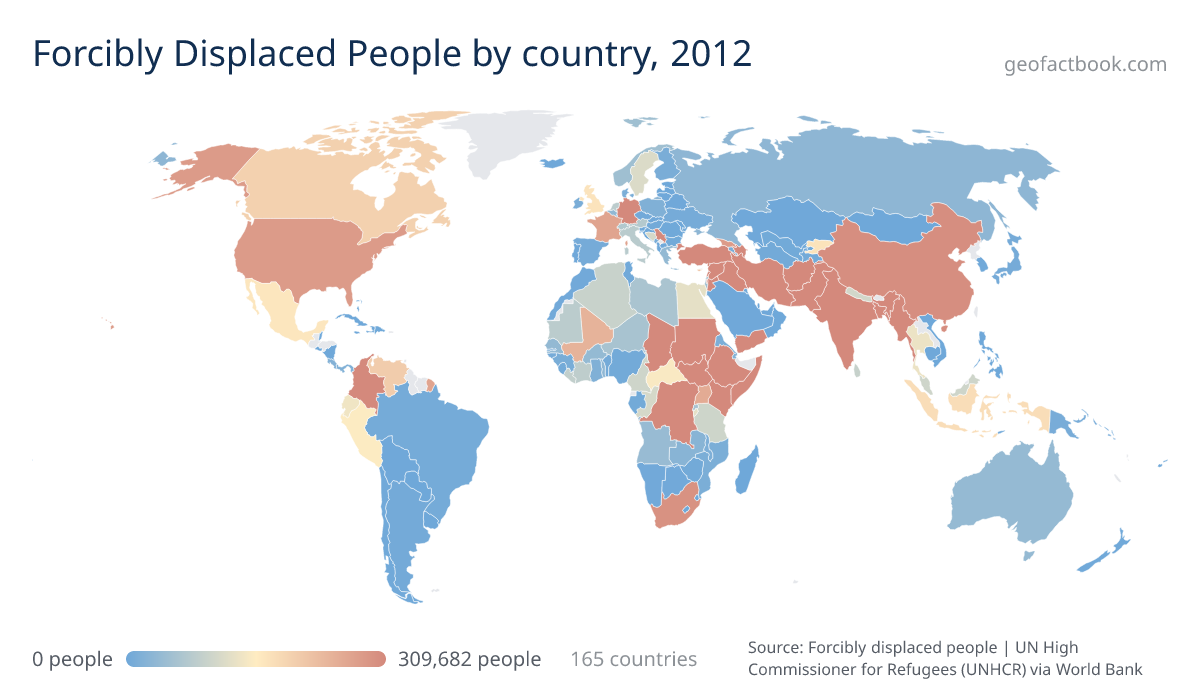
Forcibly Displaced People by country, 2012: map image
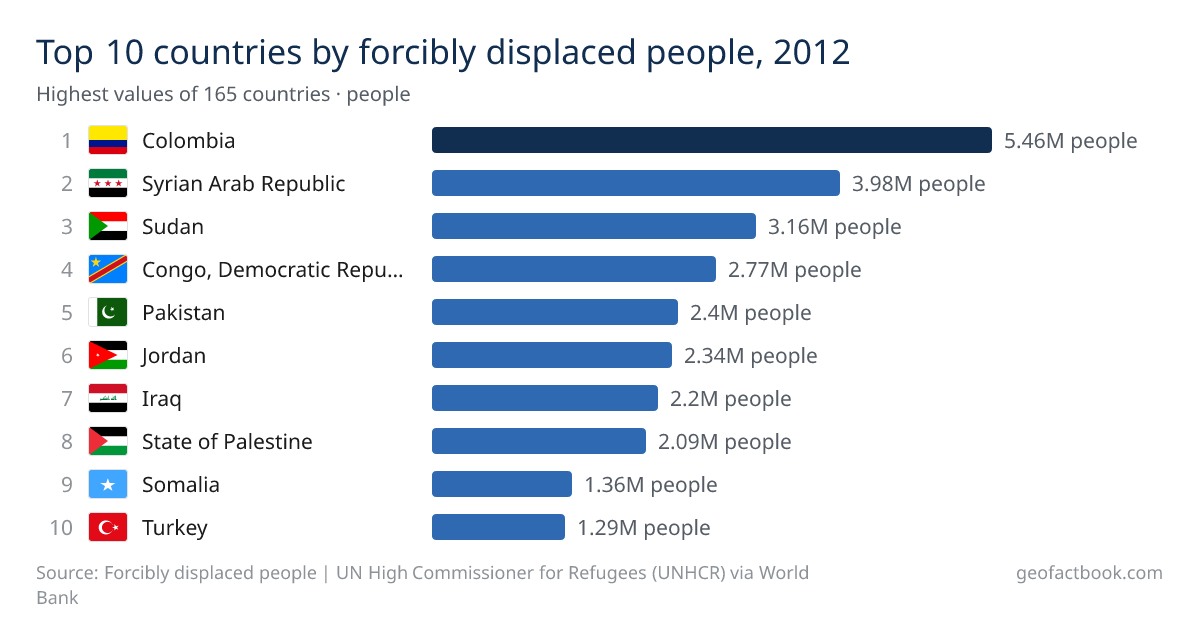
Top 10 countries by forcibly displaced people, 2012: chart
Insights by country
Tunisia
In 2012, Tunisia had 1768 forcibly displaced people, ranking #116 out of 165 countries. This figure reflects a relatively low level of forced displacement compared to regional neighbors, indicating a more stable situation in terms of internal and external conflicts. Key drivers behind this statistic include Tunisia's geographic location, which has historically made it a transit country for migrants, and its post-revolutionary political climate that has allowed for some degree of stability.
Austria
In 2012, Austria had 59th rank globally with 74,125 forcibly displaced people. This figure is significant when compared to its neighbor Germany, which had a higher number of displaced individuals due to its larger population and different immigration policies. Austria's position can be attributed to its geographic location as a transit country for refugees and its historical role in European migration patterns, alongside a relatively stable economy that attracted those seeking asylum.
Sierra Leone
Sierra Leone ranked #102 globally in 2012 with 4,269 forcibly displaced people. This figure is notable when compared to the global context, where many countries face significantly higher displacement rates due to conflict and instability. The primary drivers of displacement in Sierra Leone include the aftermath of the civil war that ended in 2002 and ongoing economic challenges that hinder recovery and stability.
Angola
In 2012, Angola had 43722 forcibly displaced people, ranking #66 out of 165 countries. This figure is notable compared to regional neighbors, reflecting ongoing challenges in managing displacement due to conflict and economic instability. The legacy of civil war and subsequent economic difficulties have driven many Angolans to seek refuge, highlighting the need for comprehensive policies to address the root causes of displacement.
Estonia
In 2012, Estonia reported 48 Forcibly Displaced People, ranking #151 out of 165 countries. This figure is notably lower than many of its European neighbors, reflecting Estonia's stable political climate and effective governance. The country's small population and geographic location contribute to its limited experience with large-scale displacement, as it has not faced significant conflict or humanitarian crises that typically drive such numbers.
Afghanistan
In 2012, Afghanistan ranked #21 globally with 508233 forcibly displaced people. This figure is significant compared to many neighboring countries, highlighting the ongoing challenges faced by the nation. Key drivers of this displacement include decades of conflict, political instability, and economic hardship, which have forced many Afghans to flee their homes in search of safety and stability.
Kazakhstan
In 2012, Kazakhstan had 131 global rank for Forcibly Displaced People, with a total of 642 people affected. This figure is relatively low compared to countries with significant displacement crises, such as Syria or Afghanistan. The low number of forcibly displaced individuals in Kazakhstan can be attributed to its stable political environment and relatively low levels of conflict, as well as effective government policies aimed at maintaining social cohesion.
Greece
In 2012, Greece ranked #70 globally with 38,273 forcibly displaced people. This figure is notably higher than many neighboring countries, reflecting the broader regional challenges of migration and asylum. Key drivers include Greece's geographic position as a gateway to Europe and its economic struggles, which have made it a focal point for individuals fleeing conflict and instability in nearby regions.
Belarus
In 2012, Belarus had 628 Forcibly Displaced People, ranking #132 out of 165 countries. This figure is notably lower than many of its Eastern European neighbors, reflecting a relatively stable internal situation compared to countries facing significant conflict. The low number of forcibly displaced individuals can be attributed to Belarus's stringent immigration policies and a lack of major internal conflicts, which have contributed to a more controlled demographic environment.
Turkmenistan
In 2012, Turkmenistan had 4046 forcibly displaced people, ranking #105 out of 165 countries. This figure is relatively low compared to global averages, but it reflects ongoing regional challenges in Central Asia. The displacement is largely attributed to the country's strict governmental policies and limited freedom of movement, which can exacerbate internal conflicts and hinder economic opportunities.
Analysis & Context
In 2012, Colombia had the highest number of Forcibly Displaced People globally, totaling 5,455,274, while the range spanned from 0 to 5,455,274 across 165 countries. The global average number of forcibly displaced individuals per country was 259,062.68, with a median value of 12,587. This data highlights significant disparities in displacement across different regions.
Concentration of Displacement in Conflict Zones
The data from 2012 reveals a pronounced concentration of forcibly displaced populations in countries experiencing conflict. Colombia leads with 5,455,274 displaced people, largely due to its prolonged internal conflict involving government forces and insurgent groups. Similarly, the Syrian Arab Republic reported 3,977,901 displaced individuals, driven by the escalating civil war that began in 2011. In Sudan, the figure reached 3,159,853, reflecting ongoing conflicts in regions such as Darfur. These numbers underscore how armed conflict remains a primary driver of forced displacement, as people flee violence and instability.
Regional Disparities and Economic Influences
While conflict is a significant factor, geopolitical and economic conditions also play crucial roles in displacement patterns. Pakistan and Jordan, with 2,399,733 and 2,340,275 displaced people respectively, largely owe these figures to their roles as host countries for refugees from neighboring conflict zones, such as Afghanistan and Syria. In contrast, smaller or economically stable countries like Vietnam and Solomon Islands recorded negligible displacement figures, at 0 and 5 respectively. These disparities illustrate how economic capacity and geopolitical stability can influence a country's ability to either generate or host displaced populations.
Significant Year-over-Year Changes
2012 saw notable shifts in displacement figures in several countries. The Syrian Arab Republic experienced the largest increase, with an additional 2,133,707 people displaced, marking a 115.7% rise from the previous year. This stark increase corresponds with the intensification of the Syrian civil war. The Congo, Democratic Republic of the also saw a significant rise of 903,048 displaced individuals, a 48.4% increase, due to ongoing regional conflicts. Conversely, Iraq experienced a decrease of 435,653 displaced people, a 16.5% reduction, possibly due to stabilization efforts following the peak of sectarian violence in previous years.
Understanding the Outliers
The data also highlights outliers at both ends of the spectrum. While countries like Colombia and Syria struggle with millions of displaced people, others like Vietnam and Madagascar report minimal displacement. These differences can often be attributed to a combination of factors including geographic isolation, political stability, and the absence of large-scale conflicts. For instance, Vietnam's peaceful geopolitical environment and economic growth contribute to its low displacement figures, while Madagascar's geographic isolation limits cross-border displacement.
The 2012 statistics on forcibly displaced people underscore the complex interplay between conflict, economic conditions, and geopolitical factors in shaping global displacement patterns. Understanding these dynamics is crucial for developing effective international policies aimed at reducing forced displacement and supporting affected populations.
Frequently Asked Questions About Forcibly Displaced People in 2012
Which country had the highest number of forcibly displaced people in 2012?
Colombia had the highest number of forcibly displaced people in 2012, with 5,455,274 people.
What was the average number of forcibly displaced people per country in 2012?
The average number of forcibly displaced people per country in 2012 was 259,063 people.
Which country had the lowest number of forcibly displaced people in 2012?
Vietnam had the lowest number of forcibly displaced people in 2012, with 0 people.
What was the median number of forcibly displaced people per country in 2012?
The median number of forcibly displaced people per country in 2012 was 12,587 people.
How many countries had forcibly displaced people in 2012?
In 2012, 165 countries had forcibly displaced people.
What is the range of forcibly displaced people across countries in 2012?
The range of forcibly displaced people across countries in 2012 is from 0 people in Vietnam to 5,455,274 people in Colombia.
Data Source
Forcibly displaced people | UN High Commissioner for Refugees (UNHCR) via World Bank
Data produced by Refugee Population Statistics Database, UN High Commissioner for Refugees (UNHCR), compiled and published by World Bank as "Forcibly displaced people".
Visit Data SourceCite this page
Geo Factbook. (n.d.). Forcibly Displaced People by Country, 2012. Retrieved November 27, 2026, from https://geofactbook.com/fact/forcibly-displaced-people/2012
The figures on this page come from Forcibly displaced people | UN High Commissioner for Refugees (UNHCR) via World Bank. For academic work, cite the original source as well.
›Embed this ranking on your site
Free to embed with attribution. Shows the top 10 countries and links back to the full ranking.
Historical Data by Year
Explore Forcibly Displaced People data across different years. Compare trends and see how statistics have changed over time.
You might also like
Rule of Law Index by Country
FeaturedCompare countries by Rule of Law percentile rank, reflecting confidence in laws, courts, police, property rights, and protection from crime and violence.
Highest: Finland100%Human Capital Index
FeaturedThe Human Capital Index measures a country's investment in education and health, reflecting its potential for economic growth and productivity. This vital statistic highlights the importance of nurturing human resources for sustainable development.
 Highest: Singapore0.91
Total population
FeaturedDiscover the latest total population statistics for every country and region worldwide. Explore accurate, up-to-date data on global population growth, density, and demographic trends — sourced from trusted international databases like the UN and World Bank. Perfect for researchers, students, and data enthusiasts looking to understand how the world’s population is changing.
Highest: India1.48B persons