
Forcibly Displaced People 2015
Forcibly displaced people include refugees, asylum seekers, and internally displaced persons worldwide.
Newer data is available: Forcibly Displaced People by country 2025 →
 Syrian Arab Republic
 Vietnam
Where does your country rank? Pick it to see its position.
Related Transnational Issues statistics
More ↓Interactive Map
Complete Data Rankings
Rank | Actions | ||
|---|---|---|---|
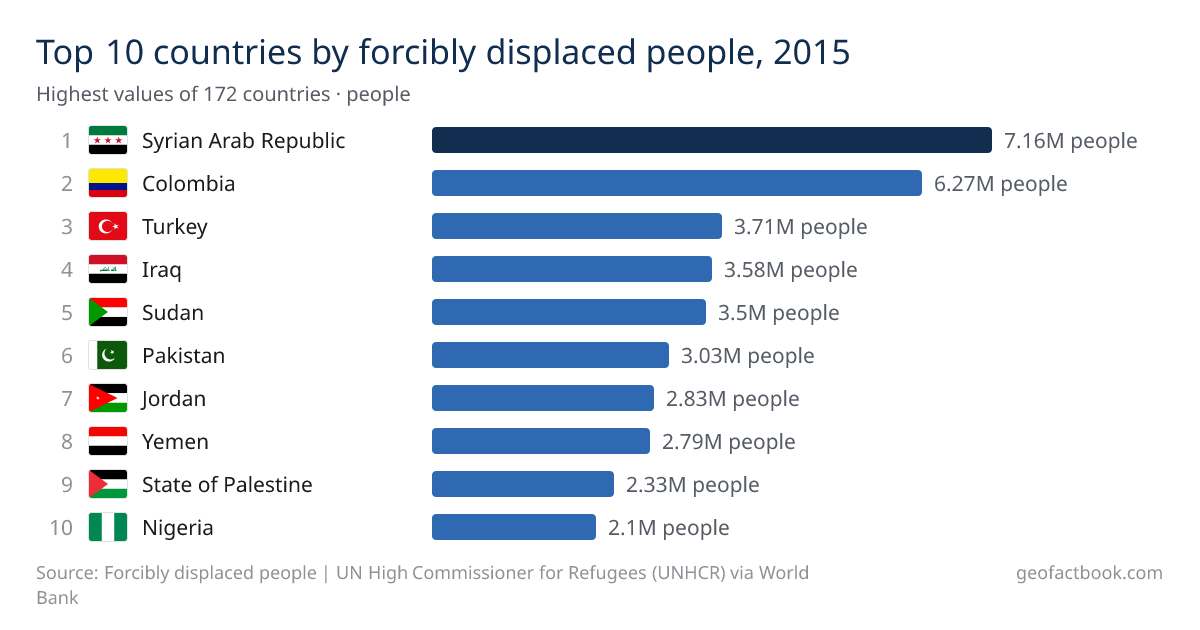
1 | Syrian Arab Republic | 7,161,014 people | |
2 |  Colombia | 6,270,317 people | |
3 |  Turkey | 3,707,716 people | |
4 |  Iraq | 3,575,116 people | |
5 |  Sudan | 3,504,214 people | |
6 |  Pakistan | 3,026,594 people | |
7 |  Jordan | 2,833,249 people | |
8 |  Yemen | 2,786,020 people | |
9 |  State of Palestine | 2,325,001 people | |
10 |  Nigeria | 2,097,772 people | |
11 |  South Sudan | 1,960,847 people | |
12 |  Congo, Democratic Republic of the | 1,884,073 people | |
13 |  Ukraine | 1,688,740 people | |
14 |  Lebanon | 1,553,327 people | |
15 |  Afghanistan | 1,431,631 people | |
16 |  Somalia | 1,241,196 people | |
17 |  South Africa | 1,217,656 people | |
18 |  Ethiopia | 1,188,207 people | |
19 |  Iran | 979,477 people | |
20 |  Kenya | 902,860 people | |
21 |  India | 819,855 people | |
22 |  Germany | 736,668 people | |
23 |  Bangladesh | 657,954 people | |
24 |  Myanmar | 644,000 people | |
25 |  Azerbaijan | 565,494 people | |
26 |  United States | 559,375 people | |
27 |  Uganda | 542,955 people | |
28 |  Libya | 536,768 people | |
29 |  Chad | 479,428 people | |
30 |  Cameroon | 472,326 people | |
31 |  Central African Republic | 459,664 people | |
32 |  Russia | 343,545 people | |
33 |  France | 336,160 people | |
34 |  Sweden | 326,533 people | |
35 |  Côte d'Ivoire | 305,616 people | |
36 |  China | 301,716 people | |
37 |  Mexico | 291,248 people | |
38 |  Cyprus | 281,272 people | |
39 |  Niger | 277,820 people | |
40 |  Egypt | 259,727 people | |
41 |  Guatemala | 251,345 people | |
42 |  Georgia | 241,693 people | |
43 |  Tanzania | 213,995 people | |
44 |  Italy | 178,171 people | |
45 |  Honduras | 174,038 people | |
46 |  Venezuela | 173,962 people | |
47 |  United Kingdom | 168,904 people | |
48 |  Canada | 155,521 people | |
49 |  Burundi | 155,286 people | |
50 |  Malaysia | 154,551 people | |
51 |  Austria | 152,258 people | |
52 |  Thailand | 151,500 people | |
53 |  Rwanda | 145,145 people | |
54 |  Ecuador | 133,094 people | |
55 |  Netherlands | 116,548 people | |
56 |  Switzerland | 106,017 people | |
57 |  Bosnia and Herzegovina | 104,809 people | |
58 |  Algeria | 100,749 people | |
59 |  Nepal | 82,687 people | |
60 |  Mauritania | 77,882 people | |
61 |  Norway | 75,651 people | |
62 |  Belgium | 71,298 people | |
63 |  Mali | 66,249 people | |
64 |  Philippines | 62,439 people | |
65 |  Peru | 61,804 people | |
66 |  Australia | 57,669 people | |
67 |  Congo | 57,092 people | |
68 |  Serbia | 52,434 people | |
69 |  Greece | 50,953 people | |
70 |  Angola | 45,678 people | |
71 |  Sri Lanka | 45,383 people | |
72 |  Israel | 44,606 people | |
73 |  Senegal | 41,499 people | |
74 |  Hungary | 41,054 people | |
75 |  Finland | 37,032 people | |
76 |  Liberia | 36,506 people | |
77 |  Burkina Faso | 34,158 people | |
78 |  Denmark | 30,243 people | |
79 |  Brazil | 29,501 people | |
80 |  Zambia | 28,842 people | |
81 |  Armenia | 27,765 people | |
82 |  Bulgaria | 26,031 people | |
83 |  Togo | 25,694 people | |
84 |  Malawi | 23,485 people | |
85 |  Djibouti | 22,008 people | |
86 |  Mozambique | 20,443 people | |
87 |  Panama | 20,233 people | |
88 |  Indonesia | 19,620 people | |
89 |  Ghana | 19,254 people | |
90 |  Spain | 17,470 people | |
91 |  Poland | 17,338 people | |
92 |  Japan | 16,302 people | |
93 |  Papua New Guinea | 16,251 people | |
94 |  Ireland | 11,090 people | |
95 |  Guinea | 9,034 people | |
96 |  Guinea-Bissau | 8,800 people | |
97 |  Gambia | 7,851 people | |
98 |  Malta | 7,642 people | |
99 |  Zimbabwe | 7,200 people | |
100 |  South Korea | 6,881 people | |
101 |  Costa Rica | 6,862 people | |
102 |  Morocco | 5,433 people | |
103 |  Czech Republic | 4,294 people | |
104 |  Argentina | 4,249 people | |
105 |  Luxembourg | 3,655 people | |
106 |  Romania | 2,989 people | |
107 |  Chile | 2,895 people | |
108 |  Gabon | 2,876 people | |
109 |  Namibia | 2,832 people | |
110 |  Eritrea | 2,549 people | |
111 |  China, Hong Kong SAR | 2,407 people | |
112 |  Botswana | 2,260 people | |
113 |  Tajikistan | 2,249 people | |
114 |  Belarus | 2,078 people | |
115 |  Montenegro | 1,780 people | |
116 |  Kuwait | 1,639 people | |
117 |  New Zealand | 1,452 people | |
118 |  Portugal | 1,422 people | |
119 |  Dominican Republic | 1,365 people | |
120 |  Lithuania | 1,169 people | |
121 |  United Arab Emirates | 1,085 people | |
122 |  Slovakia | 989 people | |
123 |  Eswatini | 957 people | |
124 |  Albania | 939 people | |
125 |  North Macedonia | 912 people | |
126 |  Nauru | 817 people | |
127 |  Kazakhstan | 790 people | |
128 |  Sierra Leone | 772 people | |
129 |  Bolivia | 762 people | |
130 |  Belize | 750 people | |
131 |  Tunisia | 739 people | |
132 |  Benin | 702 people | |
133 |  Croatia | 547 people | |
134 |  Republic of Moldova | 528 people | |
135 |  Kyrgyzstan | 509 people | |
136 |  Nicaragua | 451 people | |
137 |  Oman | 434 people | |
138 |  Slovenia | 376 people | |
139 |  Latvia | 375 people | |
140 |  Uruguay | 361 people | |
141 |  Bahrain | 359 people | |
142 |  Iceland | 329 people | |
143 |  Cuba | 323 people | |
144 |  Liechtenstein | 233 people | |
145 |  Qatar | 233 people | |
146 |  Estonia | 231 people | |
147 |  Paraguay | 194 people | |
148 |  Trinidad and Tobago | 192 people | |
149 |  Saudi Arabia | 155 people | |
150 |  Uzbekistan | 106 people | |
151 |  Cambodia | 98 people | |
152 |  Curaçao | 80 people | |
153 |  El Salvador | 46 people | |
154 |  Monaco | 32 people | |
155 |  Lesotho | 31 people | |
156 |  Bahamas | 27 people | |
157 |  Turkmenistan | 25 people | |
158 |  Madagascar | 16 people | |
159 |  Mongolia | 16 people | |
160 |  Antigua and Barbuda | 15 people | |
161 |  Cayman Islands | 15 people | |
162 |  Micronesia (Fed. States of) | 15 people | |
163 |  Sint Maarten (Dutch part) | 15 people | |
164 |  Fiji | 13 people | |
165 |  Jamaica | 13 people | |
166 |  Haiti | 10 people | |
167 |  China, Macao SAR | 5 people | |
168 |  Samoa | 5 people | |
169 |  Solomon Islands | 5 people | |
170 |  Turks and Caicos Islands | 5 people | |
171 |  Cabo Verde | 0 people | |
172 | Vietnam | 0 people |
- #1Syrian Arab Republic
- #2Colombia
- #3Turkey
- #4Iraq
- #5Sudan
- #6Pakistan
- #7Jordan
- #8Yemen
- #9State of Palestine
- #10Nigeria
Analysis: These countries represent the highest values in this dataset, showcasing significant scale and impact on global statistics.
- #172Vietnam
- #171Cabo Verde
- #170Turks and Caicos Islands
- #169Solomon Islands
- #168Samoa
- #167China, Macao SAR
- #166Haiti
- #165Jamaica
- #164Fiji
- #163Sint Maarten (Dutch part)
Context: These countries or territories have the lowest values, often due to geographic size, administrative status, or specific characteristics.
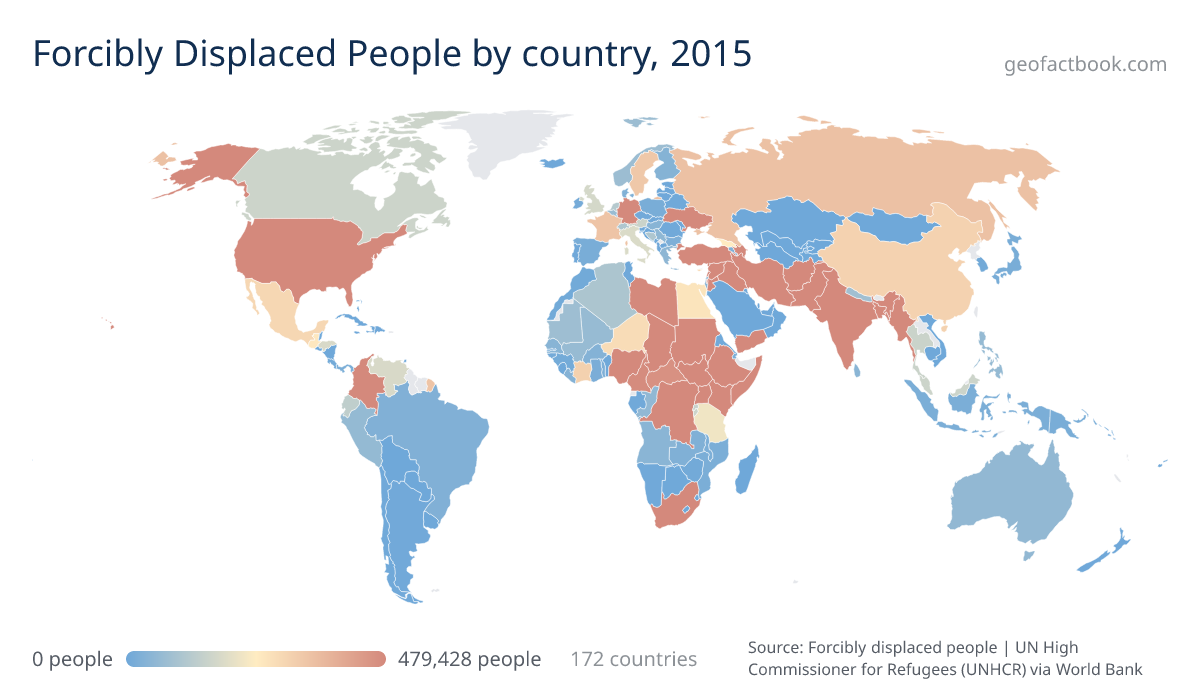
Forcibly Displaced People by country, 2015: map image
Top 10 countries by forcibly displaced people, 2015: chart
Insights by country
Angola
In 2015, Angola ranked #70 globally with 45,678 forcibly displaced people. This number is notable when compared to countries with similar conflict histories, such as the Democratic Republic of the Congo, which has a significantly higher number of displaced individuals. The primary drivers of displacement in Angola include the aftermath of decades of civil war, which has led to ongoing instability and challenges in governance, as well as economic difficulties that hinder resettlement efforts.
Iraq
In 2015, Iraq ranked #4 globally with 3,575,116 forcibly displaced people. This figure is significant, as it highlights Iraq's challenges compared to regional neighbors, many of which have lower displacement numbers. The key drivers of this situation include ongoing conflict, particularly from the rise of ISIS, and the resulting humanitarian crises that have forced millions to flee their homes in search of safety.
Belarus
In 2015, Belarus ranked #114 globally with 2,078 forcibly displaced people. This figure is relatively low compared to regional neighbors, indicating a more stable internal situation. The primary drivers of this statistic include Belarus's relatively strict immigration policies and the absence of significant armed conflict within its borders, which have limited the influx of refugees and displaced individuals.
Azerbaijan
Azerbaijan ranked #25 globally, with 565,494 Forcibly Displaced People in 2015. This figure is significant compared to many regional neighbors, highlighting the ongoing challenges faced by the country. The primary drivers of this displacement include the unresolved conflict over Nagorno-Karabakh and the resulting influx of refugees and internally displaced persons from the 1990s, which continues to impact Azerbaijan's socio-economic landscape.
Guatemala
In 2015, Guatemala ranked #41 globally with 251,345 forcibly displaced people. This figure reflects a significant challenge compared to neighboring countries, where displacement rates are often lower. Factors contributing to this situation in Guatemala include high levels of violence, particularly from organized crime, and widespread poverty, which drive many to flee their homes in search of safety and stability.
Bahamas
In 2015, the Bahamas ranked #156 globally with 27 forcibly displaced people. This figure is notably lower than many Caribbean neighbors, reflecting a relatively stable social environment. The low number of forcibly displaced individuals can be attributed to the country's geographic isolation and robust tourism-driven economy, which provides a level of stability compared to regions facing more significant political or economic turmoil.
Niger
In 2015, Niger ranked #39 globally with 277,820 people classified as Forcibly Displaced People. This figure is significant when compared to regional averages, highlighting the challenges faced by Niger in the Sahel region, which is often affected by conflict and environmental stress. Key drivers for this displacement include ongoing insecurity from militant groups and the impact of climate change on livelihoods, forcing many to flee their homes.
Burundi
In 2015, Burundi ranked #49 globally with 155,286 forcibly displaced people. This figure is significant when compared to the regional average in East Africa, highlighting the ongoing challenges faced by the nation. The primary drivers of displacement in Burundi include political instability and ethnic tensions, which have historically led to violence and economic hardship, forcing many to flee their homes.
Ecuador
In 2015, Ecuador had 133,094 forcibly displaced people, ranking #54 out of 172 countries. This figure is noteworthy compared to the regional average in South America, highlighting the challenges faced by the nation. Factors contributing to this situation include economic instability and the influx of refugees from neighboring countries, particularly Colombia, due to ongoing violence and conflict.
Italy
In 2015, Italy ranked #44 globally with 178,171 Forcibly Displaced People. This figure is significant compared to neighboring countries, as Italy faced a considerable influx of migrants and refugees, particularly from North Africa and the Middle East. The country's geographic location as a primary entry point into Europe, combined with ongoing conflicts in surrounding regions, has driven this displacement. Additionally, Italy's economic challenges and evolving immigration policies have influenced its capacity to manage this population effectively.
Analysis & Context
In 2015, the country with the highest number of Forcibly Displaced People was the Syrian Arab Republic, with figures reaching 7,161,014. The global range for forcibly displaced individuals spanned from 0 to 7,161,014 across 172 countries. The average number of forcibly displaced people worldwide was approximately 377,586.52, while the median stood at 20,443, highlighting significant disparities between countries.
Concentration of Displacement in Conflict Zones
The concentration of Forcibly Displaced People in 2015 predominantly occurred in regions plagued by conflict and instability. The Syrian Arab Republic led with over 7 million displaced individuals, a direct result of the ongoing civil war. Similarly, Colombia and Iraq reported figures of 6,270,317 and 3,575,116 respectively, due to prolonged internal conflicts and insurgencies. These countries illustrate how warfare and violence drive mass displacement, disrupting societies and creating humanitarian crises.
Meanwhile, Sudan and Yemen, with 3,504,214 and 2,786,020 displaced people respectively, further demonstrate the impact of civil unrest and regional conflicts. The data underscores the correlation between geopolitical instability and high displacement figures.
Regional Disparities and Their Drivers
The data reveals stark regional disparities in displacement figures, often influenced by geographic and political factors. For instance, Turkey, hosting 3,707,716 displaced people, became a key refuge for Syrians fleeing their homeland due to its proximity and political stance towards the crisis. In contrast, countries like Cabo Verde and Vietnam reported zero displaced individuals, reflecting their relative stability and lack of direct involvement in regional conflicts.
Jordan and the State of Palestine, with 2,833,249 and 2,325,001 displaced people respectively, further highlight how neighboring countries often bear the brunt of regional displacements. These figures emphasize the burden placed on nations adjacent to conflict zones, often stretching their resources and infrastructure.
Year-Over-Year Changes: Emerging Trends
Significant changes in displacement figures from the previous year were observed in several countries. Yemen experienced the largest increase, with an additional 2,185,716 displaced individuals, a 364.1% rise, due largely to escalating conflict and humanitarian crises. Turkey also saw a substantial increase of 1,059,994 people, reflecting its growing role as a host country for Syrian refugees.
Conversely, the Syrian Arab Republic saw a decrease of 1,119,484 displaced people, potentially due to shifts in population movements and resettlement efforts. Similarly, the Democratic Republic of the Congo experienced a decrease of 993,861, indicating changes in internal displacement patterns.
Implications and Global Response
The global average of 377,586.52 forcibly displaced people per country highlights the widespread nature of this issue, affecting both developed and developing nations. The humanitarian implications are vast, requiring coordinated international efforts to provide aid, resettlement, and support for affected populations.
Countries like Turkey, Jordan, and Lebanon are on the front lines of the refugee crisis, necessitating international support to manage the influx. The disparities in displacement figures also call for targeted interventions, addressing the root causes of displacement such as conflict resolution and economic development.
Overall, the data from 2015 underscores the urgent need for global cooperation in addressing the challenges posed by forcibly displaced populations, ensuring both immediate relief and long-term solutions.
Frequently Asked Questions About Forcibly Displaced People in 2015
Which country had the highest number of forcibly displaced people in 2015?
The Syrian Arab Republic had the highest number of forcibly displaced people in 2015, with 7,161,014 people.
Which country had the lowest number of forcibly displaced people in 2015?
Cabo Verde had the lowest number of forcibly displaced people in 2015, with 0 people.
What was the average number of forcibly displaced people per country in 2015?
The average number of forcibly displaced people per country in 2015 was 377,587 people.
What was the median number of forcibly displaced people per country in 2015?
The median number of forcibly displaced people per country in 2015 was 20,338 people.
Which countries were in the top 3 for forcibly displaced people in 2015?
The top 3 countries for forcibly displaced people in 2015 were the Syrian Arab Republic, Colombia, and Turkey.
How many countries had zero forcibly displaced people in 2015?
Two countries had zero forcibly displaced people in 2015: Cabo Verde and Vietnam.
Data Source
Forcibly displaced people | UN High Commissioner for Refugees (UNHCR) via World Bank
Data produced by Refugee Population Statistics Database, UN High Commissioner for Refugees (UNHCR), compiled and published by World Bank as "Forcibly displaced people".
Visit Data SourceCite this page
Geo Factbook. (n.d.). Forcibly Displaced People by Country, 2015. Retrieved November 27, 2026, from https://geofactbook.com/fact/forcibly-displaced-people/2015
The figures on this page come from Forcibly displaced people | UN High Commissioner for Refugees (UNHCR) via World Bank. For academic work, cite the original source as well.
›Embed this ranking on your site
Free to embed with attribution. Shows the top 10 countries and links back to the full ranking.
Historical Data by Year
Explore Forcibly Displaced People data across different years. Compare trends and see how statistics have changed over time.
You might also like
Rule of Law Index by Country
FeaturedCompare countries by Rule of Law percentile rank, reflecting confidence in laws, courts, police, property rights, and protection from crime and violence.
Highest: Finland100%Human Capital Index
FeaturedThe Human Capital Index measures a country's investment in education and health, reflecting its potential for economic growth and productivity. This vital statistic highlights the importance of nurturing human resources for sustainable development.
 Highest: Singapore0.91
Total population
FeaturedDiscover the latest total population statistics for every country and region worldwide. Explore accurate, up-to-date data on global population growth, density, and demographic trends — sourced from trusted international databases like the UN and World Bank. Perfect for researchers, students, and data enthusiasts looking to understand how the world’s population is changing.
Highest: India1.48B persons