
Germany Forcibly Displaced People 2025: 2.95 Million
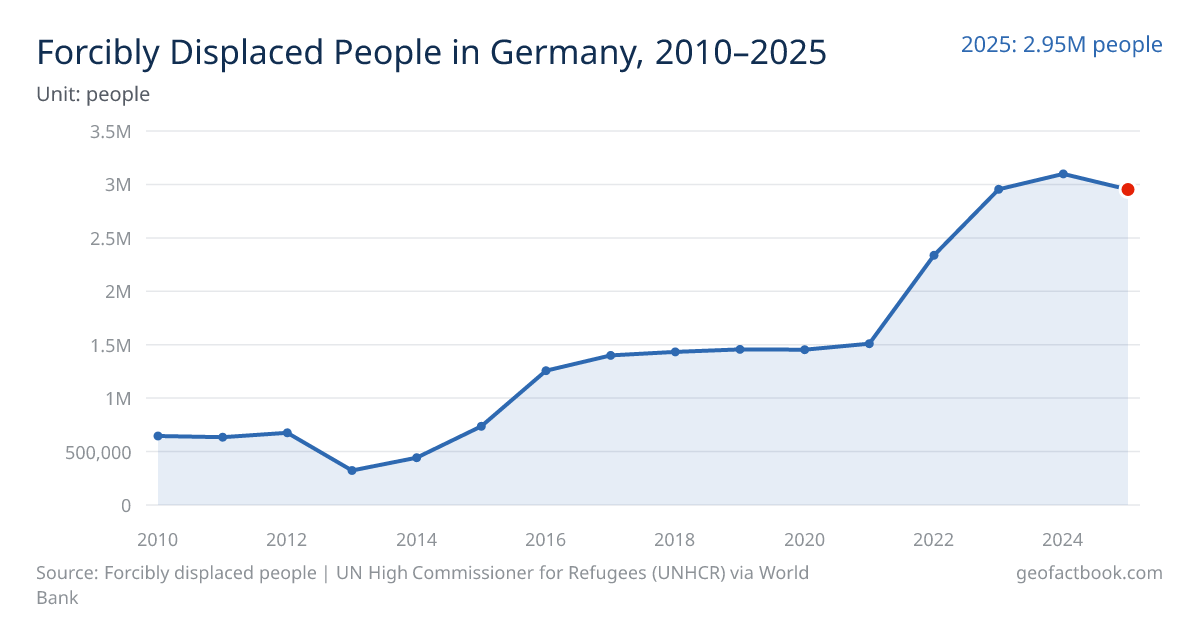
Germany's forcibly displaced people in 2025 is 2.95 Million, down 4.7% from 2024. It ranks #14 of 173 countries.
Forcibly displaced people include refugees, asylum seekers, and internally displaced persons worldwide.
Source (2025): Forcibly displaced people
Where Germany ranks (2025)
#14 of 173- #12
 Somalia3.39M people
- #13
 State of Palestine3.1M people
- #14
 Germany2.95M people
- #15
 Jordan2.84M people
- #16
 Turkey2.49M people
Forcibly Displaced People over time
| Year | Value | Change | % Change | Actions |
|---|---|---|---|---|
| 2025 | 2.95M people | 145.47K people | -4.70% | |
| 2024 | 3.10M people | +143.67K people | +4.86% | |
| 2023 | 2.95M people | +618.04K people | +26.45% | |
| 2022 | 2.34M people | +826.90K people | +54.78% | |
| 2021 | 1.51M people | +55.81K people | +3.84% | |
| 2020 | 1.45M people | 2.16K people | -0.15% | |
| 2019 | 1.46M people | +22.84K people | +1.59% | |
| 2018 | 1.43M people | +33.45K people | +2.39% | |
| 2017 | 1.40M people | +142.85K people | +11.37% | |
| 2016 | 1.26M people | +520.11K people | +70.60% | |
| 2015 | 736.67K people | +293.56K people | +66.25% | |
| 2014 | 443.10K people | +120.04K people | +37.16% | |
| 2013 | 323.06K people | 352.18K people | -52.16% | |
| 2012 | 675.24K people | +40.92K people | +6.45% | |
| 2011 | 634.33K people | 11.85K people | -1.83% | |
| 2010 | 646.18K people | — | — |
Forcibly Displaced People in Germany, 2010–2025: chart
Cite this page
Geo Factbook. (n.d.). Germany: Forcibly Displaced People. Retrieved November 27, 2026, from https://geofactbook.com/countries/germany/forcibly-displaced-people
The figures on this page come from Forcibly displaced people | UN High Commissioner for Refugees (UNHCR) via World Bank. For academic work, cite the original source as well.
Frequently Asked Questions About Germany Forcibly Displaced People
What is Germany's forcibly displaced people in 2025?▾
Germany's forcibly displaced people is 2.95 Million in 2025, according to Forcibly displaced people | UN High Commissioner for Refugees (UNHCR) via World Bank.
Is Germany's forcibly displaced people increasing or decreasing?▾
Germany's forcibly displaced people fell by 4.7% from 2024 (3.1 Million) to 2025 (2.95 Million). Over the past decade (2015–2025) it rose by 300.8%.
How does Germany rank for forcibly displaced people?▾
In 2025, Germany has the 14th highest forcibly displaced people out of 173 countries with data.
What was Germany's forcibly displaced people in 2010?▾
In 2010, Germany's forcibly displaced people was 646,180. By 2025 it rose by 356.9%.
Explore additional statistical insights
AI Preparedness Index in Germany
The IMF's AI Preparedness Index scores how ready a country is to adopt artificial intelligence, on a scale from 0 to 1 (higher is better prepared). It combines four areas: digital infrastructure, human capital and labour market policies, innovation and economic integration, and regulation and ethics. It measures readiness, not how many jobs AI has replaced or could affect.
Public Debt in Germany
Public Debt reveals the financial obligations of countries. Compare rankings and explore trends with interactive maps.
Agriculture Value Added in Germany
Explore the agriculture value added as a share of GDP by country, measuring the economic impact of farming sectors. This statistic highlights the importance of agriculture in national economies and informs investment decisions.
Wheat Production Volume in Germany
Wheat production volume measures total tonnes produced annually. Key for understanding agricultural output.
AI Investment (% of GDP) in Germany
AI investment as a percentage of GDP measures a country's commitment to AI development and innovation, influencing global competitiveness.
Trade as a Share of GDP in Germany
Trade as a share of GDP measures the economic activity of countries. A higher share indicates a more open economy.