
Forcibly Displaced People 2014
Forcibly displaced people include refugees, asylum seekers, and internally displaced persons worldwide.
Newer data is available: Forcibly Displaced People by country 2025 →
 Syrian Arab Republic
 Vietnam
Where does your country rank? Pick it to see its position.
Related Transnational Issues statistics
More ↓Interactive Map
Complete Data Rankings
Rank | Actions | ||
|---|---|---|---|
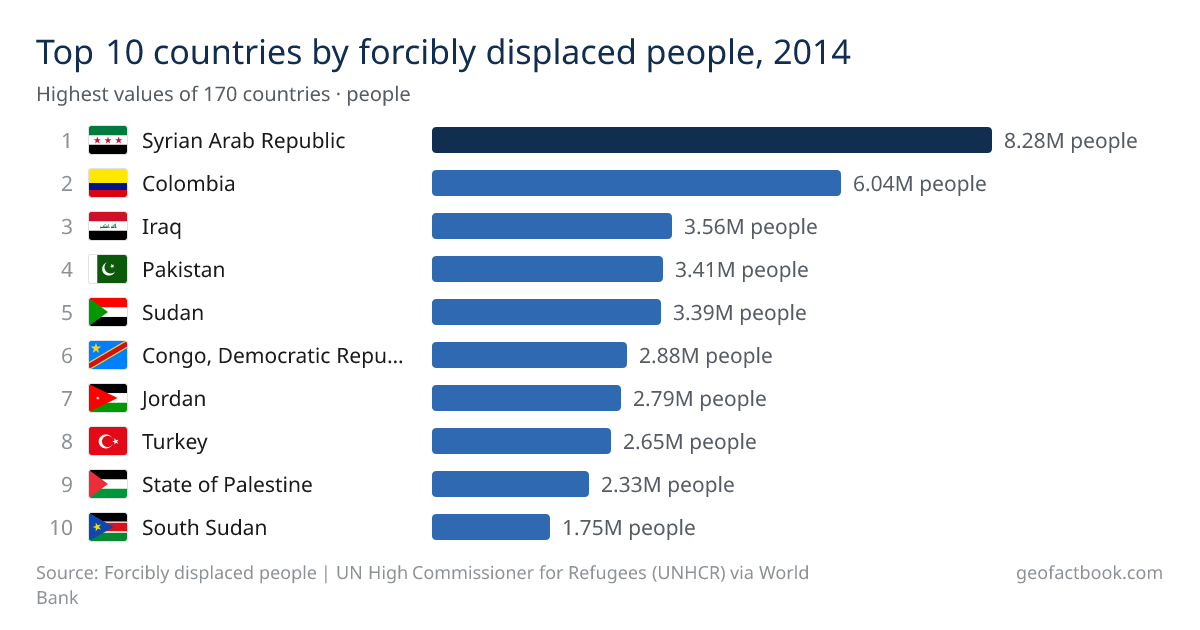
1 | Syrian Arab Republic | 8,280,498 people | |
2 |  Colombia | 6,044,352 people | |
3 |  Iraq | 3,555,605 people | |
4 |  Pakistan | 3,411,045 people | |
5 |  Sudan | 3,388,012 people | |
6 |  Congo, Democratic Republic of the | 2,877,934 people | |
7 |  Jordan | 2,790,268 people | |
8 |  Turkey | 2,647,722 people | |
9 |  State of Palestine | 2,326,096 people | |
10 |  South Sudan | 1,746,280 people | |
11 |  Lebanon | 1,634,133 people | |
12 |  Somalia | 1,118,994 people | |
13 |  Afghanistan | 1,105,480 people | |
14 |  Nigeria | 1,077,085 people | |
15 |  Ethiopia | 1,060,640 people | |
16 |  India | 1,058,988 people | |
17 |  Iran | 982,067 people | |
18 |  Kenya | 894,345 people | |
19 |  Bangladesh | 658,482 people | |
20 |  Ukraine | 656,095 people | |
21 |  Myanmar | 645,000 people | |
22 |  Yemen | 600,304 people | |
23 |  South Africa | 576,091 people | |
24 |  Azerbaijan | 570,696 people | |
25 |  Chad | 525,690 people | |
26 |  United States | 455,029 people | |
27 |  Uganda | 450,971 people | |
28 |  Central African Republic | 447,100 people | |
29 |  Germany | 443,103 people | |
30 |  Libya | 436,850 people | |
31 |  Cameroon | 315,858 people | |
32 |  France | 308,074 people | |
33 |  Côte d'Ivoire | 303,578 people | |
34 |  China | 301,499 people | |
35 |  Mexico | 285,682 people | |
36 |  Egypt | 265,788 people | |
37 |  Russia | 263,783 people | |
38 |  Guatemala | 249,257 people | |
39 |  Georgia | 235,098 people | |
40 |  Cyprus | 219,556 people | |
41 |  Sweden | 198,945 people | |
42 |  Venezuela | 174,001 people | |
43 |  Thailand | 173,144 people | |
44 |  Canada | 165,863 people | |
45 |  Serbia | 158,188 people | |
46 |  United Kingdom | 153,580 people | |
47 |  Peru | 151,649 people | |
48 |  Malaysia | 150,579 people | |
49 |  Italy | 139,442 people | |
50 |  Burundi | 133,977 people | |
51 |  Ecuador | 133,712 people | |
52 |  Bosnia and Herzegovina | 106,890 people | |
53 |  Algeria | 98,983 people | |
54 |  Indonesia | 95,171 people | |
55 |  Sri Lanka | 91,453 people | |
56 |  Netherlands | 89,397 people | |
57 |  Tanzania | 89,375 people | |
58 |  Niger | 88,929 people | |
59 |  Nepal | 88,624 people | |
60 |  Austria | 83,469 people | |
61 |  Switzerland | 83,401 people | |
62 |  Philippines | 78,304 people | |
63 |  Mali | 77,826 people | |
64 |  Mauritania | 76,045 people | |
65 |  Rwanda | 74,040 people | |
66 |  Congo | 65,834 people | |
67 |  Liberia | 61,619 people | |
68 |  Australia | 57,027 people | |
69 |  Norway | 54,173 people | |
70 |  Angola | 45,668 people | |
71 |  Israel | 45,256 people | |
72 |  Greece | 42,190 people | |
73 |  Senegal | 41,178 people | |
74 |  Belgium | 39,113 people | |
75 |  Togo | 32,483 people | |
76 |  Burkina Faso | 32,095 people | |
77 |  Honduras | 29,042 people | |
78 |  Zambia | 27,740 people | |
79 |  Armenia | 26,092 people | |
80 |  Djibouti | 24,357 people | |
81 |  Costa Rica | 22,477 people | |
82 |  Denmark | 22,035 people | |
83 |  Ghana | 21,082 people | |
84 |  Malawi | 20,364 people | |
85 |  Brazil | 18,678 people | |
86 |  Panama | 18,651 people | |
87 |  Hungary | 18,518 people | |
88 |  Poland | 18,405 people | |
89 |  Mozambique | 17,850 people | |
90 |  Bulgaria | 17,761 people | |
91 |  Papua New Guinea | 17,401 people | |
92 |  Finland | 13,517 people | |
93 |  Spain | 13,305 people | |
94 |  Eritrea | 12,898 people | |
95 |  Japan | 11,846 people | |
96 |  Gambia | 11,606 people | |
97 |  Ireland | 10,408 people | |
98 |  Guinea | 9,046 people | |
99 |  Guinea-Bissau | 8,800 people | |
100 |  Zimbabwe | 6,718 people | |
101 |  Montenegro | 6,525 people | |
102 |  Malta | 6,271 people | |
103 |  South Korea | 4,634 people | |
104 |  Argentina | 4,319 people | |
105 |  Turkmenistan | 4,034 people | |
106 |  Czech Republic | 3,588 people | |
107 |  Uzbekistan | 3,523 people | |
108 |  Morocco | 3,033 people | |
109 |  Gabon | 2,891 people | |
110 |  Botswana | 2,837 people | |
111 |  North Macedonia | 2,647 people | |
112 |  Namibia | 2,581 people | |
113 |  Romania | 2,496 people | |
114 |  China, Hong Kong SAR | 2,383 people | |
115 |  Chile | 2,335 people | |
116 |  Luxembourg | 2,317 people | |
117 |  Tajikistan | 2,150 people | |
118 |  Kuwait | 1,650 people | |
119 |  New Zealand | 1,582 people | |
120 |  Sierra Leone | 1,383 people | |
121 |  Dominican Republic | 1,351 people | |
122 |  Belarus | 1,173 people | |
123 |  Lithuania | 1,146 people | |
124 |  Tunisia | 1,118 people | |
125 |  Nauru | 1,116 people | |
126 |  Portugal | 1,031 people | |
127 |  Slovakia | 1,011 people | |
128 |  Timor-Leste | 900 people | |
129 |  Croatia | 811 people | |
130 |  Eswatini | 777 people | |
131 |  Bolivia | 767 people | |
132 |  Kazakhstan | 720 people | |
133 |  Kyrgyzstan | 694 people | |
134 |  Saudi Arabia | 658 people | |
135 |  United Arab Emirates | 631 people | |
136 |  Albania | 593 people | |
137 |  Benin | 482 people | |
138 |  Republic of Moldova | 453 people | |
139 |  Latvia | 403 people | |
140 |  Oman | 382 people | |
141 |  Bahrain | 354 people | |
142 |  Nicaragua | 330 people | |
143 |  Slovenia | 312 people | |
144 |  Uruguay | 305 people | |
145 |  Iceland | 303 people | |
146 |  Cuba | 282 people | |
147 |  Qatar | 218 people | |
148 |  Liechtenstein | 168 people | |
149 |  Estonia | 166 people | |
150 |  Paraguay | 158 people | |
151 |  Trinidad and Tobago | 156 people | |
152 |  Belize | 124 people | |
153 |  Cambodia | 97 people | |
154 |  Curaçao | 74 people | |
155 |  Lesotho | 43 people | |
156 |  El Salvador | 33 people | |
157 |  Monaco | 33 people | |
158 |  Bahamas | 31 people | |
159 |  Jamaica | 23 people | |
160 |  Fiji | 18 people | |
161 |  Madagascar | 16 people | |
162 |  Mongolia | 10 people | |
163 |  Sint Maarten (Dutch part) | 10 people | |
164 |  Turks and Caicos Islands | 10 people | |
165 |  Cayman Islands | 5 people | |
166 |  China, Macao SAR | 5 people | |
167 |  Singapore | 5 people | |
168 |  Solomon Islands | 5 people | |
169 |  Cabo Verde | 0 people | |
170 | Vietnam | 0 people |
- #1Syrian Arab Republic
- #2Colombia
- #3Iraq
- #4Pakistan
- #5Sudan
- #6Congo, Democratic Republic of the
- #7Jordan
- #8Turkey
- #9State of Palestine
- #10South Sudan
Analysis: These countries represent the highest values in this dataset, showcasing significant scale and impact on global statistics.
- #170Vietnam
- #169Cabo Verde
- #168Solomon Islands
- #167Singapore
- #166China, Macao SAR
- #165Cayman Islands
- #164Turks and Caicos Islands
- #163Sint Maarten (Dutch part)
- #162Mongolia
- #161Madagascar
Context: These countries or territories have the lowest values, often due to geographic size, administrative status, or specific characteristics.
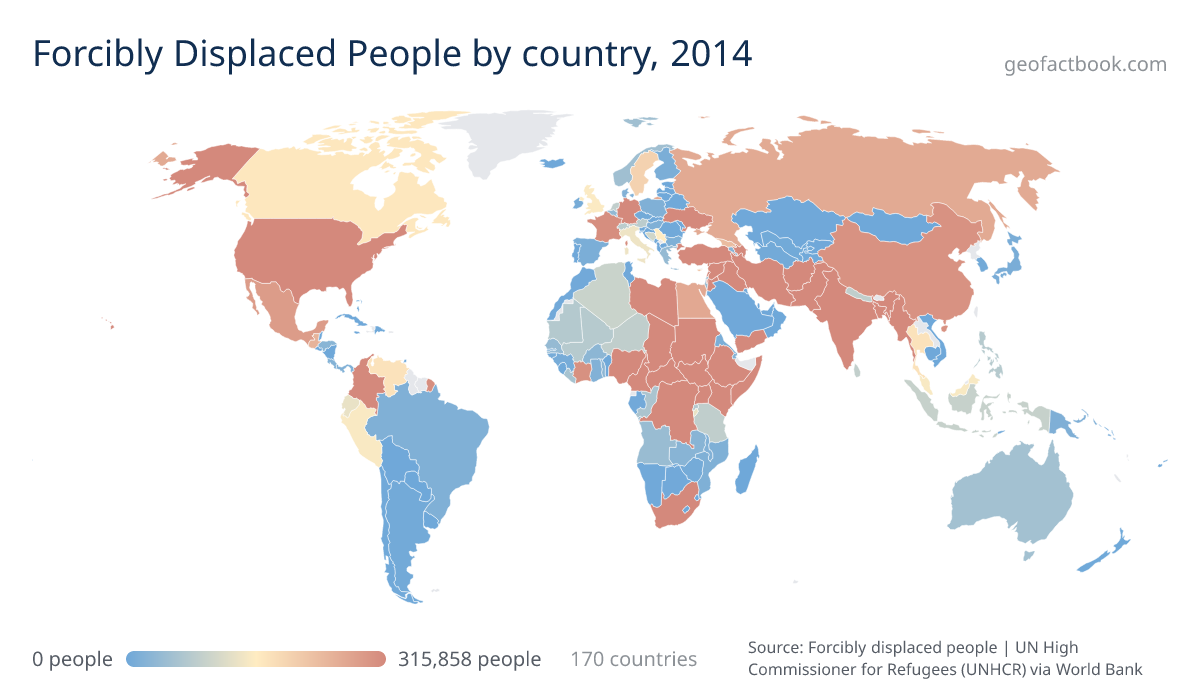
Forcibly Displaced People by country, 2014: map image
Top 10 countries by forcibly displaced people, 2014: chart
Insights by country
Czech Republic
In 2014, the Czech Republic had 3588 forcibly displaced people, ranking #106 out of 170 countries. This number is relatively low compared to countries experiencing significant conflict, such as Syria, which has millions of displaced individuals. The Czech Republic's stable political environment and strong social policies have contributed to its ability to manage displacement effectively, although it has faced challenges related to the integration of refugees and asylum seekers.
Bosnia and Herzegovina
In 2014, Bosnia and Herzegovina had 106,890 forcibly displaced people, ranking #52 out of 170 countries. This figure is significant compared to neighboring countries, highlighting ongoing regional challenges related to displacement. The primary drivers of this statistic include the aftermath of the 1992-1995 Bosnian War, which resulted in substantial population displacements, and ongoing socio-economic instability that affects the reintegration of displaced individuals.
United Kingdom
In 2014, the United Kingdom had 46 rank globally with 153580 people classified as Forcibly Displaced People. This figure is notable compared to neighboring countries, which often report lower numbers due to different immigration policies and social support systems. The UK's relatively high number of forcibly displaced individuals can be attributed to its role as a destination for asylum seekers fleeing conflict and persecution, alongside its comprehensive legal framework for refugee protection.
Botswana
In 2014, Botswana had 2837 forcibly displaced people, ranking #110 out of 170 countries. This figure is relatively low compared to regional neighbors, reflecting a stable political environment and effective governance. The country's robust economy and commitment to human rights have contributed to maintaining lower levels of displacement, unlike many nations facing conflict or severe economic instability.
Afghanistan
In 2014, Afghanistan ranked #13 globally with 1,105,480 forcibly displaced people. This number is significant as it reflects a humanitarian crisis exacerbated by ongoing conflict and instability, which has forced many to flee their homes. The country's complex geopolitical landscape, alongside persistent violence and economic challenges, has contributed to this high level of displacement.
Kazakhstan
In 2014, Kazakhstan had 132 global rank for Forcibly Displaced People with a total of 720 people. This figure is relatively low compared to some neighboring countries, indicating a more stable internal situation. Key factors contributing to this number include Kazakhstan's vast geography, which allows for a relatively low population density, and its policies aimed at maintaining social stability in a diverse demographic landscape.
Iran
In 2014, Iran had 982067 Forcibly Displaced People, ranking #17 out of 170 countries. This figure is significant as it reflects the complex regional dynamics, particularly in comparison to neighboring countries like Iraq, which has faced even higher displacement rates due to ongoing conflict. Key drivers of Iran's displacement include its geopolitical situation, economic challenges, and the influx of refugees from neighboring war-torn regions.
Estonia
In 2014, Estonia had 166 Forcibly Displaced People, ranking #149 out of 170 countries. This figure is significantly lower than many of its European neighbors, reflecting Estonia's relatively stable socio-political environment. The country’s strong governance, coupled with its small population size and effective immigration policies, has contributed to maintaining low levels of forced displacement.
Colombia
In 2014, Colombia ranked #2 globally with 6,044,352 Forcibly Displaced People. This figure is significantly higher than many of its neighbors, reflecting ongoing challenges in the region. The primary drivers of displacement in Colombia include decades of armed conflict, violence from illegal armed groups, and widespread poverty, which have forced millions to flee their homes in search of safety and stability.
Albania
In 2014, Albania ranked #136 globally with 593 forcibly displaced people. This figure is notably lower than many neighboring countries, reflecting Albania's relatively stable internal conditions compared to regional instability. Key drivers include Albania's ongoing efforts to improve its socio-economic landscape and its geographic position, which has limited large-scale refugee movements compared to its neighbors in the Balkans.
Malta
In 2014, Malta ranked #102 globally with 6,271 forcibly displaced people. This figure is notable when compared to the global context, where countries with higher displacement figures often face more significant conflict or instability. Malta's geographic position in the Mediterranean makes it a key transit point for migrants and refugees, influencing its displacement statistics.
Guinea
In 2014, Guinea had 9,046 Forcibly Displaced People, ranking #98 out of 170 countries. This figure is notably lower than that of its neighbor Sierra Leone, which faced significant displacement due to civil conflict. Contributing factors to Guinea's displacement numbers include regional instability and its geographical proximity to conflict-affected areas, alongside internal challenges such as economic constraints and limited infrastructure.
Oman
In 2014, Oman had 382 forcibly displaced people, ranking #140 out of 170 countries globally. This figure is notably lower than that of many neighboring countries, reflecting Oman's relatively stable internal conditions and effective governance. Factors contributing to this low number include the nation's economic stability and a lack of significant conflict or civil unrest, which are prevalent in other regions.
Namibia
In 2014, Namibia had 2581 forcibly displaced people, ranking #112 out of 170 countries globally. This figure is relatively low compared to regional neighbors, indicating a more stable situation than many countries in Southern Africa. Contributing factors include Namibia's relatively peaceful political climate and its policies aimed at addressing displacement issues, though challenges remain in economic development and land reform.
Côte d'Ivoire
Côte d'Ivoire ranked #33 globally with 303,578 Forcibly Displaced People in 2014. This figure is notably higher than many of its West African neighbors, reflecting ongoing regional instability. The displacement is largely driven by political unrest and conflict, particularly stemming from the civil wars in the early 2000s, which have had lasting effects on the population's security and livelihoods.
Algeria
In 2014, Algeria ranked #53 globally with 98,983 forcibly displaced people. This figure is notable compared to the global context, where many countries face higher displacement rates due to conflict and instability. Algeria's displacement issues are largely driven by its geographic location and historical conflicts, including the legacy of the civil war in the 1990s, which has contributed to ongoing social and economic challenges.
Mozambique
In 2014, Mozambique had 17850 Forcibly Displaced People, ranking #89 out of 170 countries. This figure is notable when compared to neighboring countries, such as Tanzania, which faced a significantly higher number of displaced individuals. The primary drivers of displacement in Mozambique include ongoing economic challenges and the impact of natural disasters, such as cyclones and flooding, which have historically displaced communities and hindered recovery efforts.
Finland
In 2014, Finland had 92 global rank with 13,517 people classified as Forcibly Displaced People. This figure is relatively low compared to other European nations facing larger influxes of displaced individuals during that period, such as Germany. Finland's position can be attributed to its stringent immigration policies and effective integration programs, which aim to manage the number of asylum seekers and support their resettlement.
Analysis & Context
In 2014, the country with the highest number of Forcibly Displaced People was the Syrian Arab Republic with a staggering 8,280,498 individuals, while globally, the range spanned from 0 in several countries to the maximum in Syria. The average number of forcibly displaced individuals across the world was 348,153.16, offering a stark contrast to the median value of 18,678, indicating that a few countries had disproportionately high numbers.
Conflict Zones and Displacement
The data from 2014 highlights a clear pattern of displacement driven by conflict, with the Syrian Arab Republic, Iraq, and South Sudan featuring prominently among the countries with the highest numbers of forcibly displaced people. Syria's civil war, which began in 2011, had escalated, leading to the displacement of over 8 million people by 2014. Similarly, Iraq faced intense conflict with the rise of ISIS, resulting in 3,555,605 displaced individuals.
In South Sudan, the civil war that erupted in 2013 led to a significant increase in displacement, with numbers reaching 1,746,280. The ongoing conflicts in these regions not only displaced millions but also placed immense pressure on neighboring countries and international humanitarian resources.
Neighboring Countries as Safe Havens
Countries bordering conflict zones often become the primary refuges for displaced populations. In 2014, Turkey and Jordan were among the top ten countries with the most forcibly displaced people, hosting 2,647,722 and 2,790,268 individuals, respectively. Turkey's geographic proximity to Syria made it a critical refuge for Syrians fleeing the war. Jordan, sharing borders with both Syria and Iraq, also became a significant host country, despite its limited resources.
The presence of large refugee populations in these countries often leads to social and economic challenges, including strain on public services and infrastructure. Nevertheless, these nations' roles as safe havens are crucial in providing immediate relief to those fleeing violence and persecution.
Year-over-Year Trends and Changes
The year-over-year data reveals dynamic shifts in forcibly displaced populations. Iraq saw the largest increase in displaced individuals, with numbers rising by 1,203,320 (a 51.2% increase) due to intensifying conflict. South Sudan also experienced a dramatic increase, up by 1,133,657 (185.0%), as civil unrest escalated.
Conversely, Nigeria witnessed the most significant decrease, with a reduction of 2,225,415 people (-67.4%). This drop could be attributed to temporary stabilizations in regions affected by the Boko Haram insurgency or misreporting corrections from previous years. The Central African Republic also saw a decrease of 504,858 (-53.0%), potentially reflecting a lull in its ongoing conflict.
Minimal Displacement in Stable Regions
On the other end of the spectrum, several countries reported minimal or no displacement. Cabo Verde and Vietnam recorded 0 forcibly displaced people, reflecting their relative political stability and the absence of significant internal or external conflicts. Small island nations such as the Solomon Islands and Singapore reported negligible numbers, with only 5 individuals each, emphasizing the role of geographic isolation in reducing exposure to regional conflicts.
These countries' low displacement figures underscore the importance of political stability and effective governance in preventing forced migration, acting as a reminder of the disparate realities faced by nations worldwide.
Overall, the 2014 data on forcibly displaced people highlights the profound impact of conflict on global migration patterns. Countries like Syria, Iraq, and South Sudan illustrate how wars and upheavals can force millions to flee, while nations such as Turkey and Jordan reveal the critical role of neighboring countries in providing refuge. These insights underscore the necessity for international cooperation and support to manage and mitigate the humanitarian consequences of forced displacement effectively.
Frequently Asked Questions About Forcibly Displaced People in 2014
Which country had the highest number of forcibly displaced people in 2014?
The Syrian Arab Republic had the highest number of forcibly displaced people in 2014, with 8,280,498 individuals.
Which country had the lowest number of forcibly displaced people in 2014?
Cabo Verde had the lowest number of forcibly displaced people in 2014, with 0 individuals.
What was the average number of forcibly displaced people per country in 2014?
The average number of forcibly displaced people per country in 2014 was 348,153.
What was the median number of forcibly displaced people per country in 2014?
The median number of forcibly displaced people per country in 2014 was 18,665.
How many countries were included in the dataset for forcibly displaced people in 2014?
The dataset for forcibly displaced people in 2014 included 170 countries.
Which countries were in the top 10 for forcibly displaced people in 2014?
The top 10 countries for forcibly displaced people in 2014 were the Syrian Arab Republic, Colombia, Iraq, Pakistan, Sudan, the Democratic Republic of the Congo, Jordan, Turkey, the State of Palestine, and South Sudan.
Data Source
Forcibly displaced people | UN High Commissioner for Refugees (UNHCR) via World Bank
Data produced by Refugee Population Statistics Database, UN High Commissioner for Refugees (UNHCR), compiled and published by World Bank as "Forcibly displaced people".
Visit Data SourceCite this page
Geo Factbook. (n.d.). Forcibly Displaced People by Country, 2014. Retrieved November 27, 2026, from https://geofactbook.com/fact/forcibly-displaced-people/2014
The figures on this page come from Forcibly displaced people | UN High Commissioner for Refugees (UNHCR) via World Bank. For academic work, cite the original source as well.
›Embed this ranking on your site
Free to embed with attribution. Shows the top 10 countries and links back to the full ranking.
Historical Data by Year
Explore Forcibly Displaced People data across different years. Compare trends and see how statistics have changed over time.
You might also like
Rule of Law Index by Country
FeaturedCompare countries by Rule of Law percentile rank, reflecting confidence in laws, courts, police, property rights, and protection from crime and violence.
Highest: Finland100%Human Capital Index
FeaturedThe Human Capital Index measures a country's investment in education and health, reflecting its potential for economic growth and productivity. This vital statistic highlights the importance of nurturing human resources for sustainable development.
Highest: Singapore0.91Total population
FeaturedDiscover the latest total population statistics for every country and region worldwide. Explore accurate, up-to-date data on global population growth, density, and demographic trends — sourced from trusted international databases like the UN and World Bank. Perfect for researchers, students, and data enthusiasts looking to understand how the world’s population is changing.
Highest: India1.48B persons