
Forcibly Displaced People 2021
Forcibly displaced people include refugees, asylum seekers, and internally displaced persons worldwide.
Newer data is available: Forcibly Displaced People by country 2025 →
 Syrian Arab Republic
 Vietnam
Where does your country rank? Pick it to see its position.
Related Transnational Issues statistics
More ↓Interactive Map
Complete Data Rankings
Rank | Actions | ||
|---|---|---|---|
1 | Syrian Arab Republic | 7,260,307 people | |
2 |  Colombia | 7,107,814 people | |
3 |  Congo, Democratic Republic of the | 5,865,366 people | |
4 |  Ethiopia | 4,412,534 people | |
5 |  Yemen | 4,391,060 people | |
6 |  Afghanistan | 4,381,200 people | |
7 |  Sudan | 4,305,537 people | |
8 |  Turkey | 4,064,787 people | |
9 |  Nigeria | 3,306,790 people | |
10 |  Jordan | 3,094,809 people | |
11 |  Somalia | 2,998,062 people | |
12 |  State of Palestine | 2,412,208 people | |
13 |  South Sudan | 1,706,987 people | |
14 |  United States | 1,642,360 people | |
15 |  Burkina Faso | 1,614,423 people | |
16 |  Pakistan | 1,608,499 people | |
17 |  Uganda | 1,574,891 people | |
18 |  Germany | 1,509,561 people | |
19 |  Iraq | 1,478,580 people | |
20 |  Peru | 1,394,279 people | |
21 |  Cameroon | 1,374,287 people | |
22 |  Bangladesh | 1,344,955 people | |
23 |  Lebanon | 1,337,308 people | |
24 |  Chad | 957,487 people | |
25 |  Ukraine | 859,101 people | |
26 |  Iran | 798,377 people | |
27 |  Mozambique | 764,183 people | |
28 |  India | 731,781 people | |
29 |  Kenya | 730,049 people | |
30 |  Central African Republic | 702,070 people | |
31 |  Mexico | 672,777 people | |
32 |  Azerbaijan | 656,710 people | |
33 |  Myanmar | 649,000 people | |
34 |  France | 575,622 people | |
35 |  Ecuador | 567,622 people | |
36 |  Chile | 512,495 people | |
37 |  Niger | 490,446 people | |
38 |  Brazil | 458,181 people | |
39 |  Mali | 376,838 people | |
40 |  Egypt | 341,078 people | |
41 |  Côte d'Ivoire | 306,478 people | |
42 |  China | 304,221 people | |
43 |  Georgia | 293,047 people | |
44 |  Cyprus | 283,613 people | |
45 |  Sweden | 254,808 people | |
46 |  Honduras | 247,243 people | |
47 |  Guatemala | 245,418 people | |
48 |  South Africa | 242,923 people | |
49 |  United Kingdom | 241,975 people | |
50 |  Tanzania | 234,870 people | |
51 |  Spain | 226,389 people | |
52 |  Libya | 199,882 people | |
53 |  Italy | 196,641 people | |
54 |  Canada | 193,269 people | |
55 |  Congo | 188,435 people | |
56 |  Costa Rica | 184,497 people | |
57 |  Malaysia | 181,458 people | |
58 |  Austria | 180,361 people | |
59 |  Argentina | 179,698 people | |
60 |  Greece | 156,697 people | |
61 |  Panama | 142,172 people | |
62 |  Australia | 138,416 people | |
63 |  Switzerland | 125,938 people | |
64 |  Rwanda | 122,289 people | |
65 |  Dominican Republic | 116,804 people | |
66 |  Netherlands | 116,691 people | |
67 |  Indonesia | 112,098 people | |
68 |  Philippines | 109,387 people | |
69 |  Mauritania | 105,311 people | |
70 |  Burundi | 104,788 people | |
71 |  Belgium | 103,018 people | |
72 |  Thailand | 101,707 people | |
73 |  Algeria | 100,020 people | |
74 |  Bosnia and Herzegovina | 92,390 people | |
75 |  Zambia | 79,548 people | |
76 |  Angola | 56,324 people | |
77 |  Malawi | 52,433 people | |
78 |  Norway | 47,310 people | |
79 |  Serbia | 41,867 people | |
80 |  Venezuela | 39,844 people | |
81 |  Denmark | 37,542 people | |
82 |  Armenia | 35,709 people | |
83 |  Djibouti | 34,695 people | |
84 |  Trinidad and Tobago | 33,596 people | |
85 |  Bulgaria | 30,377 people | |
86 |  Uruguay | 29,391 people | |
87 |  Israel | 28,274 people | |
88 |  Finland | 26,486 people | |
89 |  Senegal | 24,924 people | |
90 |  Zimbabwe | 21,434 people | |
91 |  Nepal | 19,711 people | |
92 |  Morocco | 18,228 people | |
93 |  Japan | 18,217 people | |
94 |  Liberia | 17,987 people | |
95 |  Aruba | 17,000 people | |
96 |  Curaçao | 17,000 people | |
97 |  Ireland | 16,475 people | |
98 |  South Korea | 15,705 people | |
99 |  Ghana | 13,773 people | |
100 |  Tajikistan | 13,770 people | |
101 |  Uzbekistan | 13,032 people | |
102 |  Malta | 13,009 people | |
103 |  Bolivia | 12,971 people | |
104 |  Saudi Arabia | 12,782 people | |
105 |  Sri Lanka | 12,108 people | |
106 |  Papua New Guinea | 11,964 people | |
107 |  Russia | 11,895 people | |
108 |  Togo | 11,493 people | |
109 |  Tunisia | 9,326 people | |
110 |  Poland | 8,698 people | |
111 |  United Arab Emirates | 8,558 people | |
112 |  Luxembourg | 7,776 people | |
113 |  Paraguay | 7,254 people | |
114 |  Namibia | 6,480 people | |
115 |  Guinea | 5,994 people | |
116 |  Romania | 5,704 people | |
117 |  Hungary | 5,681 people | |
118 |  Benin | 4,942 people | |
119 |  Portugal | 4,813 people | |
120 |  Gambia | 4,625 people | |
121 |  Czech Republic | 2,982 people | |
122 |  Sierra Leone | 2,845 people | |
123 |  Belarus | 2,843 people | |
124 |  New Zealand | 2,505 people | |
125 |  Suriname | 2,162 people | |
126 |  Iceland | 2,136 people | |
127 |  Belize | 2,101 people | |
128 |  Lithuania | 2,002 people | |
129 |  Guinea-Bissau | 1,876 people | |
130 |  Kuwait | 1,805 people | |
131 |  Madagascar | 1,587 people | |
132 |  Croatia | 1,582 people | |
133 |  Eswatini | 1,541 people | |
134 |  Nicaragua | 1,539 people | |
135 |  Slovenia | 1,411 people | |
136 |  Slovakia | 1,089 people | |
137 |  Nauru | 1,029 people | |
138 |  Solomon Islands | 1,000 people | |
139 |  Kyrgyzstan | 998 people | |
140 |  Latvia | 914 people | |
141 |  Oman | 792 people | |
142 |  Botswana | 746 people | |
143 |  Kazakhstan | 657 people | |
144 |  Lesotho | 522 people | |
145 |  Qatar | 507 people | |
146 |  Bahrain | 446 people | |
147 |  North Macedonia | 427 people | |
148 |  Republic of Moldova | 405 people | |
149 |  Estonia | 336 people | |
150 |  Gabon | 325 people | |
151 |  Montenegro | 307 people | |
152 |  China, Hong Kong SAR | 271 people | |
153 |  Grenada | 234 people | |
154 |  Cuba | 213 people | |
155 |  Cayman Islands | 179 people | |
156 |  El Salvador | 164 people | |
157 |  Liechtenstein | 155 people | |
158 |  New Caledonia | 150 people | |
159 |  Eritrea | 121 people | |
160 |  Albania | 115 people | |
161 |  Jamaica | 103 people | |
162 |  Saint Kitts and Nevis | 60 people | |
163 |  Sint Maarten (Dutch part) | 41 people | |
164 |  Cambodia | 36 people | |
165 |  Comoros | 27 people | |
166 |  Bahamas | 23 people | |
167 |  Fiji | 18 people | |
168 |  Monaco | 17 people | |
169 |  Turkmenistan | 16 people | |
170 |  Barbados | 10 people | |
171 |  Mauritius | 10 people | |
172 |  Turks and Caicos Islands | 7 people | |
173 |  Mongolia | 5 people | |
174 |  Saint Vincent and the Grenadines | 5 people | |
175 |  Vanuatu | 5 people | |
176 |  Cabo Verde | 0 people | |
177 |  Singapore | 0 people | |
178 | Vietnam | 0 people |
- #1Syrian Arab Republic
- #2Colombia
- #3Congo, Democratic Republic of the
- #4Ethiopia
- #5Yemen
- #6Afghanistan
- #7Sudan
- #8Turkey
- #9Nigeria
- #10Jordan
Analysis: These countries represent the highest values in this dataset, showcasing significant scale and impact on global statistics.
- #178Vietnam
- #177Singapore
- #176Cabo Verde
- #175Vanuatu
- #174Saint Vincent and the Grenadines
- #173Mongolia
- #172Turks and Caicos Islands
- #171Mauritius
- #170Barbados
- #169Turkmenistan
Context: These countries or territories have the lowest values, often due to geographic size, administrative status, or specific characteristics.
Forcibly Displaced People by country, 2021: map image
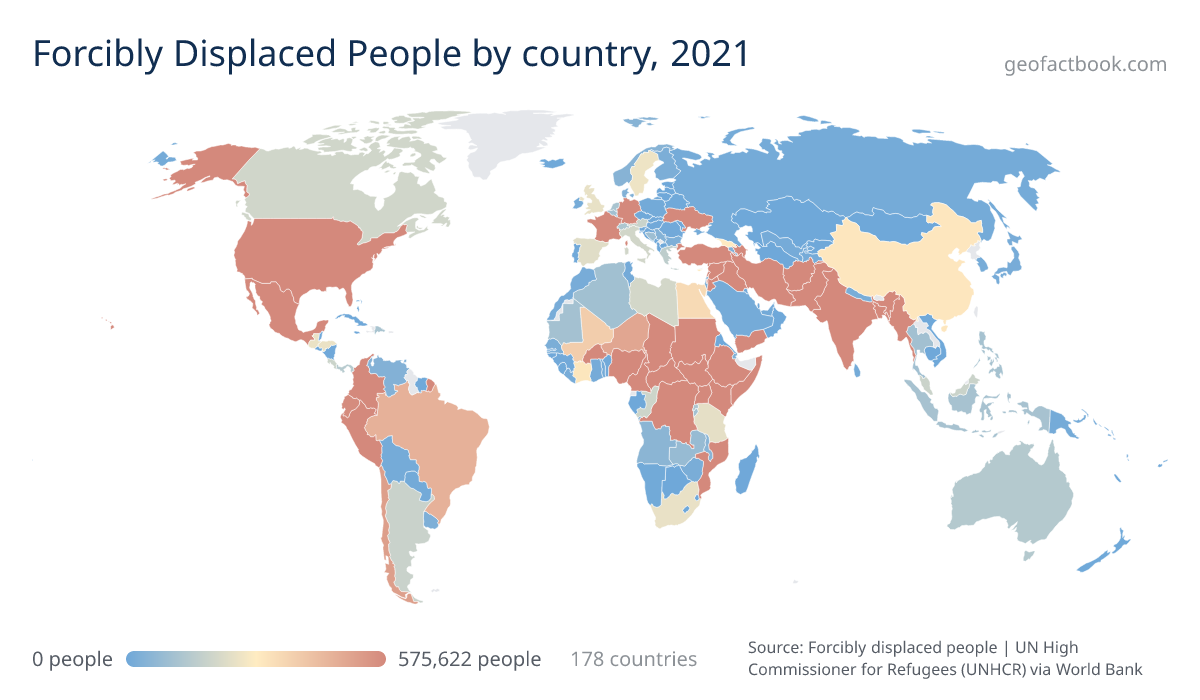
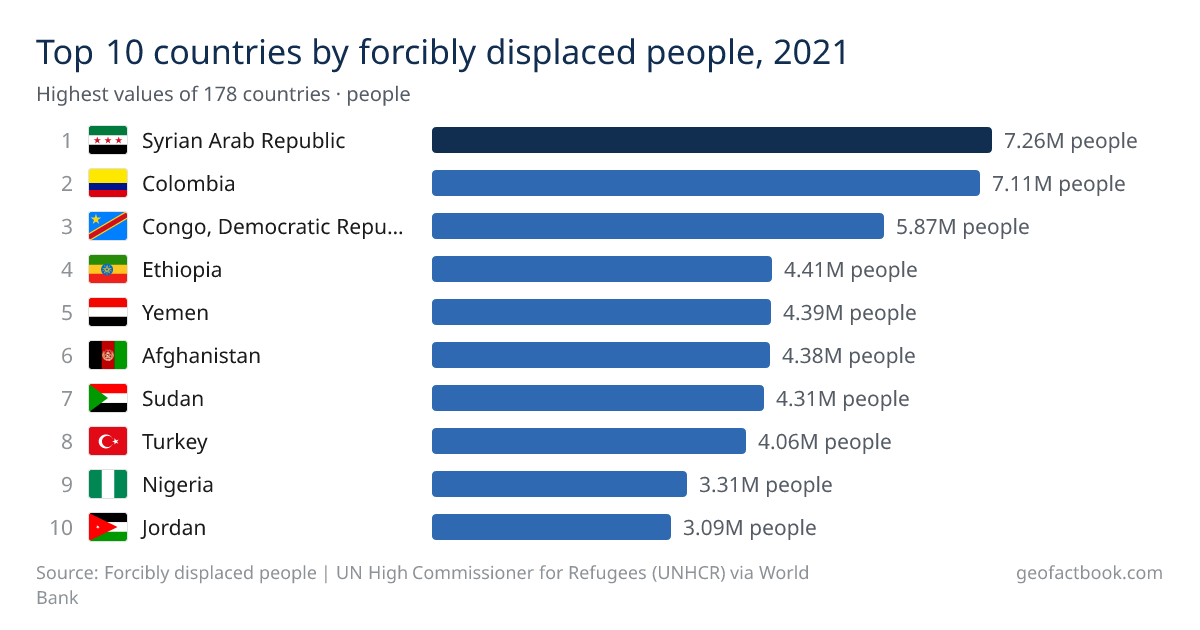
Top 10 countries by forcibly displaced people, 2021: chart
Insights by country
Suriname
In 2021, Suriname ranked #125 globally with 2,162 forcibly displaced people. This figure is relatively low compared to regional neighbors, reflecting a more stable internal situation than countries facing significant conflict or natural disasters. Key drivers of this statistic include Suriname's small population and its relatively peaceful political climate, which have contributed to fewer people being forced to flee their homes.
Finland
In 2021, Finland ranked #88 globally with 26,486 Forcibly Displaced People. This figure is notably lower than many countries in Europe, reflecting Finland's robust asylum policies and social support systems. The primary drivers of displacement in Finland include its geographical location, which influences migration patterns, and its commitment to international humanitarian obligations, providing refuge to those in need.
Sweden
In 2021, Sweden ranked #45 globally with 254,808 Forcibly Displaced People. This figure is notable when compared to neighboring Denmark, which has significantly lower displacement numbers. Key drivers of Sweden's high figure include its reputation for humanitarian policy and a longstanding commitment to accepting refugees, particularly from conflict zones in the Middle East and Africa.
Spain
In 2021, Spain ranked #51 globally with 226,389 Forcibly Displaced People. This figure is notable, especially when compared to neighboring Portugal, which has significantly fewer displaced individuals. Spain's geographic position as a gateway to Europe and its historical ties to Latin America contribute to its status as a destination for migrants and refugees, driven by conflicts and economic instability in their home countries.
Latvia
In 2021, Latvia ranked #140 globally with 914 forcibly displaced people. This figure is notably lower than many neighboring countries, reflecting Latvia's relatively stable socio-economic conditions. The primary drivers of this statistic include Latvia's EU membership, which provides a framework for managing migration, and its demographic policies that focus on integration rather than large-scale refugee resettlement.
Liechtenstein
In 2021, Liechtenstein had 155 forcibly displaced people, ranking #157 out of 178 countries. This figure is notably low compared to larger European nations, which typically host thousands of displaced individuals. The limited number of forcibly displaced people in Liechtenstein can be attributed to its small geographic size, stringent immigration policies, and a stable political environment that minimizes the influx of refugees.
Senegal
In 2021, Senegal ranked #89 globally with 24,924 forcibly displaced people. This figure is relatively low compared to the global total, reflecting the country's stability in a region often affected by conflict and displacement. Key drivers of this statistic include Senegal's effective governance and diplomatic efforts in managing regional tensions, particularly in neighboring countries facing more severe crises.
Ukraine
In 2021, Ukraine ranked #25 globally with 859,101 Forcibly Displaced People. This figure highlights a significant humanitarian challenge, especially when compared to neighboring countries like Poland, which has a lower number of displaced individuals. The primary drivers of displacement in Ukraine include ongoing conflict in the eastern regions and economic instability, which have forced many citizens to flee their homes in search of safety and better living conditions.
Kazakhstan
In 2021, Kazakhstan ranked #143 globally with 657 forcibly displaced people. This figure is notably lower than the global average, indicating that Kazakhstan experiences relatively fewer displacements compared to many countries facing significant conflict or instability. Contributing factors include Kazakhstan's geographic stability and policies aimed at maintaining internal security, although challenges remain in addressing the needs of all displaced individuals.
Hungary
In 2021, Hungary ranked #117 globally with 5,681 forcibly displaced people. This figure is notably lower than that of its neighbor, Ukraine, which has experienced significant displacement due to ongoing conflict. Hungary's relatively stable political environment and stringent immigration policies have contributed to maintaining lower levels of forced displacement compared to countries facing severe crises.
Analysis & Context
In 2021, the Syrian Arab Republic led the world in the number of Forcibly Displaced People, with a staggering 7,260,307 individuals, highlighting a global range from 0 to over seven million. The data, covering 178 countries, shows that the median number of forcibly displaced people is 24,924, offering a snapshot of the widespread impact of displacement worldwide.
Conflict and Political Instability as Primary Drivers
The top contributors to forcibly displaced populations are often countries experiencing severe conflict or political instability. Syria, with the highest number of displaced individuals, continues to grapple with a decade-long civil war, causing millions to flee. Similarly, Colombia, with 7,107,814 displaced people, is dealing with internal conflict and violence related to drug trafficking and guerrilla warfare. In Africa, the Democratic Republic of the Congo stands out with 5,865,366 displaced individuals, largely due to ongoing armed conflicts and ethnic violence. These figures underscore the critical role that prolonged conflicts play in displacement, disrupting lives and forcing millions to seek refuge either within their own countries or across borders.
Regional Disparities in Displacement Figures
While some countries face extensive displacement, others report minimal or no displacement. Nations like Singapore, Cabo Verde, and Vietnam have recorded 0 forcibly displaced individuals, reflecting stable political environments and effective governance in handling social issues. These stark contrasts highlight regional disparities where geopolitical stability directly correlates with lower displacement figures. In contrast, countries like Turkey and Jordan, hosting 4,064,787 and 3,094,809 displaced people respectively, are significantly impacted by their proximity to conflict zones, especially Syria, showcasing the regional spillover effect of neighboring conflicts.
Understanding Year-over-Year Changes
The data for 2021 reveals significant year-over-year changes in displacement figures, with an average increase of 39,150.43 people per country. Notably, Ethiopia saw the highest increase of 1,550,179 displaced individuals, marking a 54.2% rise, primarily due to the Tigray conflict. Similarly, Sudan experienced a rise of 973,226 displaced people, reflecting ongoing internal conflicts and humanitarian crises. In Afghanistan, the political turmoil following the Taliban's resurgence resulted in an increase of 761,755 displaced individuals. Conversely, some countries have witnessed decreases; Serbia recorded a reduction of 197,520, a significant 82.5% decrease, potentially due to stabilization efforts and successful resettlement programs. Such trends underscore the dynamic nature of global displacement, heavily influenced by evolving political landscapes and peace-building efforts.
Impact of Economic Conditions on Displacement
Economic factors also play a crucial role in the displacement narrative. Countries like Nigeria, with 3,306,790 displaced people, face challenges like poverty and unemployment, exacerbating the displacement crisis. Despite being Africa's largest economy, Nigeria's internal issues drive significant population movements. Conversely, economically stable nations with robust social support systems often report fewer displaced individuals. This correlation emphasizes the importance of economic stability in mitigating displacement risks, as financial security can enhance resilience against displacement triggers such as conflict and natural disasters.
In summary, the global landscape of Forcibly Displaced People in 2021 is shaped by a complex interplay of conflict, political instability, regional dynamics, and economic conditions. Understanding these factors is crucial for crafting effective policies and international cooperation aimed at addressing the root causes of displacement and providing sustainable solutions for affected populations.
Frequently Asked Questions About Forcibly Displaced People in 2021
Which country had the highest number of forcibly displaced people in 2021?
The Syrian Arab Republic had the highest number of forcibly displaced people in 2021, with 7,260,307 individuals.
Which country had the lowest number of forcibly displaced people in 2021?
Singapore had the lowest number of forcibly displaced people in 2021, with 0 individuals.
What was the average number of forcibly displaced people per country in 2021?
The average number of forcibly displaced people per country in 2021 was 495,357.
What was the median number of forcibly displaced people per country in 2021?
The median number of forcibly displaced people per country in 2021 was 23,179.
How many countries had no forcibly displaced people in 2021?
Three countries had no forcibly displaced people in 2021: Singapore, Cabo Verde, and Vietnam.
Which countries were in the top 3 for forcibly displaced people in 2021?
The top 3 countries for forcibly displaced people in 2021 were the Syrian Arab Republic, Colombia, and the Democratic Republic of the Congo.
Data Source
Forcibly displaced people | UN High Commissioner for Refugees (UNHCR) via World Bank
Data produced by Refugee Population Statistics Database, UN High Commissioner for Refugees (UNHCR), compiled and published by World Bank as "Forcibly displaced people".
Visit Data SourceCite this page
Geo Factbook. (n.d.). Forcibly Displaced People by Country, 2021. Retrieved November 27, 2026, from https://geofactbook.com/fact/forcibly-displaced-people/2021
The figures on this page come from Forcibly displaced people | UN High Commissioner for Refugees (UNHCR) via World Bank. For academic work, cite the original source as well.
›Embed this ranking on your site
Free to embed with attribution. Shows the top 10 countries and links back to the full ranking.
Historical Data by Year
Explore Forcibly Displaced People data across different years. Compare trends and see how statistics have changed over time.
You might also like
Rule of Law Index by Country
FeaturedCompare countries by Rule of Law percentile rank, reflecting confidence in laws, courts, police, property rights, and protection from crime and violence.
Highest: Finland100%Human Capital Index
FeaturedThe Human Capital Index measures a country's investment in education and health, reflecting its potential for economic growth and productivity. This vital statistic highlights the importance of nurturing human resources for sustainable development.
Highest: Singapore0.91Total population
FeaturedDiscover the latest total population statistics for every country and region worldwide. Explore accurate, up-to-date data on global population growth, density, and demographic trends — sourced from trusted international databases like the UN and World Bank. Perfect for researchers, students, and data enthusiasts looking to understand how the world’s population is changing.
Highest: India1.48B persons