
Share of Electricity from Natural Gas 2024
Share of electricity generated from natural gas highlights energy reliance patterns globally.
Where does your country rank? Pick it to see its position.
Related Energy statistics
More ↓Interactive Map
Complete Data Rankings
Rank | Actions | ||
|---|---|---|---|
1 |  Turkmenistan | 100 % | |
2 |  Bahrain | 99.674 % | |
3 |  Trinidad and Tobago | 99.548 % | |
4 |  Algeria | 98.979 % | |
5 |  Qatar | 96.47 % | |
6 |  Tunisia | 93.874 % | |
7 |  Oman | 93.351 % | |
8 |  Singapore | 93.124 % | |
9 |  Azerbaijan | 86.224 % | |
10 |  Republic of Moldova | 85.785 % | |
11 |  Malta | 84.256 % | |
12 |  Gibraltar | 80.932 % | |
13 |  Togo | 79.88 % | |
14 |  Iran | 79.152 % | |
15 |  Brunei Darussalam | 78.713 % | |
16 |  Egypt | 76.859 % | |
17 |  Uzbekistan | 76.268 % | |
18 |  Nigeria | 72.869 % | |
19 |  Israel | 71.474 % | |
20 |  Equatorial Guinea | 69.906 % | |
21 |  China, Hong Kong SAR | 69.668 % | |
22 |  United Arab Emirates | 69.556 % | |
23 |  Libya | 69.525 % | |
24 |  Côte d'Ivoire | 68.385 % | |
25 |  Congo | 67.267 % | |
26 |  Thailand | 66.815 % | |
27 |  Bangladesh | 65.321 % | |
28 |  Bolivia | 64.635 % | |
29 |  Kuwait | 62.555 % | |
30 |  Benin | 62.28 % | |
31 |  Mexico | 61.974 % | |
32 |  Jordan | 60.011 % | |
33 |  Jamaica | 59.744 % | |
34 |  Ghana | 59.385 % | |
35 |  Belarus | 57.763 % | |
36 |  Saudi Arabia | 57.711 % | |
37 |  Syrian Arab Republic | 53.99 % | |
38 |  Iraq | 52.646 % | |
39 |  Tanzania | 49.052 % | |
40 |  Argentina | 48.857 % | |
41 |  Ireland | 47.933 % | |
42 |  Russia | 45.278 % | |
43 |  Italy | 43.745 % | |
44 |  Myanmar | 42.912 % | |
45 |  United States | 41.969 % | |
46 |  Dominican Republic | 41.267 % | |
47 |  Gabon | 38.808 % | |
48 |  Peru | 38.779 % | |
49 |  Armenia | 37.467 % | |
50 |  Greece | 37.168 % | |
51 |  Malaysia | 36.159 % | |
52 |  Netherlands | 35.763 % | |
53 |  Japan | 32.125 % | |
54 |  Pakistan | 30.621 % | |
55 |  United Kingdom | 30.495 % | |
56 |  Kazakhstan | 29.286 % | |
57 |  South Korea | 27.631 % | |
58 |  Latvia | 26.546 % | |
59 |  El Salvador | 25.05 % | |
60 |  Croatia | 21.108 % | |
61 |  North Macedonia | 20.447 % | |
62 |  Georgia | 19.756 % | |
63 |  Turkey | 18.89 % | |
64 |  Romania | 18.797 % | |
65 |  Hungary | 18.759 % | |
66 |  Colombia | 18.658 % | |
67 |  Belgium | 18.351 % | |
68 |  Spain | 18.175 % | |
69 |  Canada | 17.714 % | |
70 |  Germany | 17.604 % | |
71 |  Australia | 17.336 % | |
72 |  Panama | 16.458 % | |
73 |  Mozambique | 15.299 % | |
74 |  Cuba | 14.918 % | |
75 |  Chile | 14.427 % | |
76 |  Philippines | 14.213 % | |
77 |  Indonesia | 12.5 % | |
78 |  Poland | 11.867 % | |
79 |  Ukraine | 11.267 % | |
80 |  Portugal | 11.028 % | |
81 |  Cameroon | 10.666 % | |
82 |  Lithuania | 10.419 % | |
83 |  New Zealand | 9.667 % | |
84 |  Morocco | 9.627 % | |
85 |  Slovakia | 9.589 % | |
86 |  Austria | 9.145 % | |
87 |  Vietnam | 7.442 % | |
88 |  Brazil | 6.361 % | |
89 |  Rwanda | 5.502 % | |
90 |  Bulgaria | 5.294 % | |
91 |  Czech Republic | 5.104 % | |
92 |  Venezuela | 4.928 % | |
93 |  Angola | 4.658 % | |
94 |  Serbia | 4.596 % | |
95 |  Niger | 3.794 % | |
96 |  Ecuador | 3.486 % | |
97 |  France | 3.172 % | |
98 |  China | 2.994 % | |
99 |  India | 2.861 % | |
100 |  Slovenia | 2.831 % | |
101 |  Denmark | 2.574 % | |
102 |  Luxembourg | 2.371 % | |
103 |  Kyrgyzstan | 1.839 % | |
104 |  Yemen | 1.693 % | |
105 |  Tajikistan | 1.356 % | |
106 |  Estonia | 1.194 % | |
107 |  Finland | 0.94 % | |
108 |  Norway | 0.929 % | |
109 |  Guatemala | 0.5 % | |
110 |  Switzerland | 0.287 % | |
111 |  Senegal | 0.106 % | |
112 |  Sweden | 0.061 % |
- #1Turkmenistan
- #2Bahrain
- #3Trinidad and Tobago
- #4Algeria
- #5Qatar
- #6Tunisia
- #7Oman
- #8Singapore
- #9Azerbaijan
- #10Republic of Moldova
Analysis: These countries represent the highest values in this dataset, showcasing significant scale and impact on global statistics.
- #112Sweden
- #111Senegal
- #110Switzerland
- #109Guatemala
- #108Norway
- #107Finland
- #106Estonia
- #105Tajikistan
- #104Yemen
- #103Kyrgyzstan
Context: These countries or territories have the lowest values, often due to geographic size, administrative status, or specific characteristics.
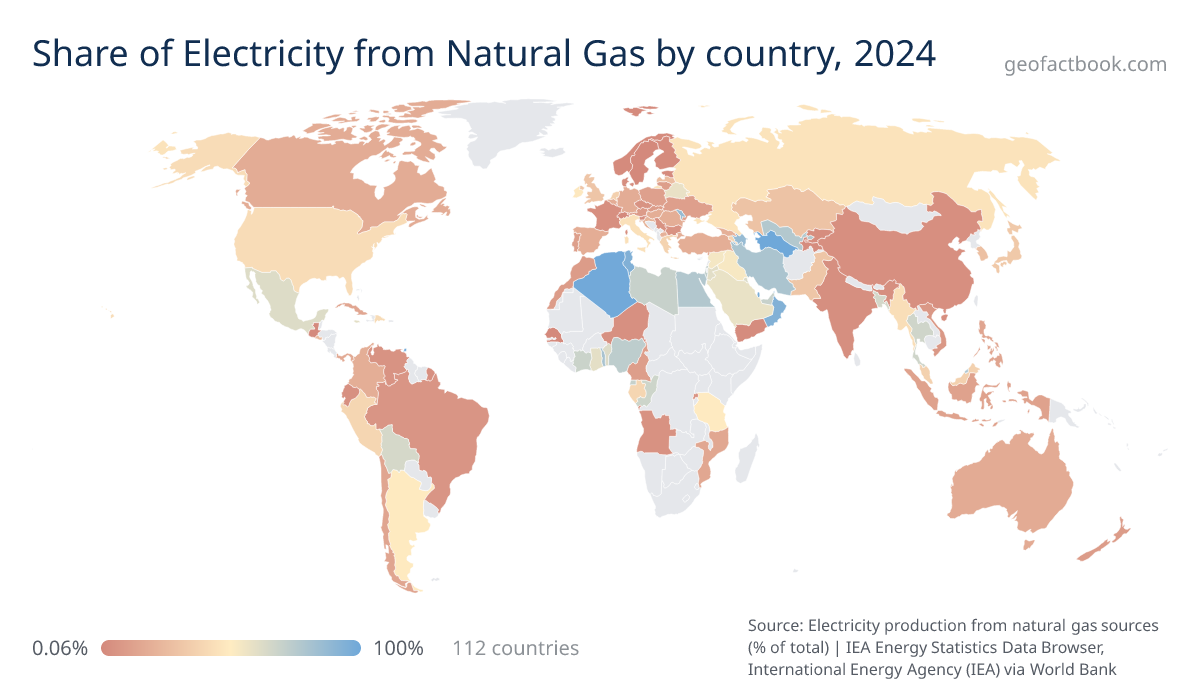
Share of Electricity from Natural Gas by country, 2024: map image
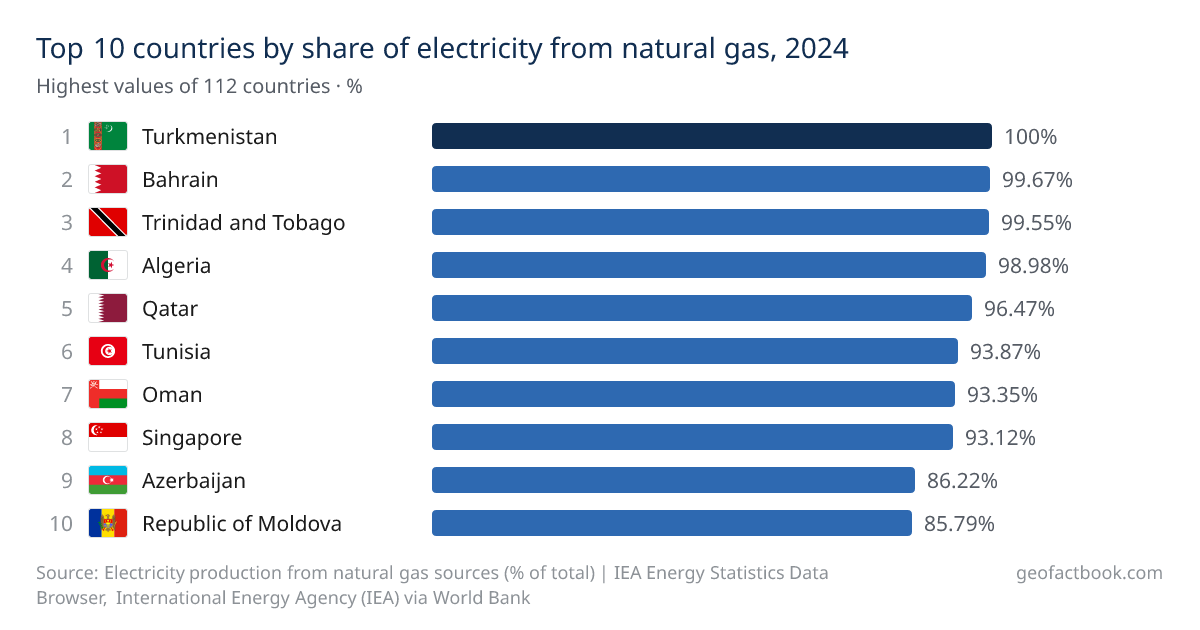
Top 10 countries by share of electricity from natural gas, 2024: chart
Insights by country
Japan
In 2024, Japan ranks #53 globally with a Share of Electricity from Natural Gas of 32.1248574895014 %. This figure is notably higher than the global average, reflecting Japan's reliance on natural gas following the Fukushima nuclear disaster in 2011, which significantly impacted its energy policy. The country's limited domestic energy resources and commitment to reducing carbon emissions have further driven the shift towards natural gas as a transitional energy source.
Thailand
In 2024, Thailand ranks #26 globally with a Share of Electricity from Natural Gas of 66.8153306662715 %. This figure is significantly higher than the global average, reflecting the country's reliance on natural gas for electricity generation compared to many other nations. Thailand's energy policy prioritizes natural gas to meet its growing energy demands, driven by industrial expansion and urbanization.
Myanmar
In 2024, Myanmar ranks #44 globally with a Share of Electricity from Natural Gas of 42.9123778671822 %. This figure is notable as it surpasses the regional average for Southeast Asia, where natural gas plays a crucial role in energy generation. The country's reliance on natural gas is driven by its abundant domestic reserves and ongoing investments in gas infrastructure, which are critical for supporting its growing energy demands.
Jamaica
In 2024, Jamaica ranks #33 globally with a Share of Electricity from Natural Gas of 59.7436454486205 %. This figure is notable as it exceeds the Caribbean regional average, reflecting Jamaica's strategic shift towards natural gas to enhance energy security and reduce reliance on imported oil. The country's investment in natural gas infrastructure is driven by a need to modernize its energy sector and lower electricity costs for consumers, aligning with broader economic development goals.
Croatia
Croatia ranks #60 globally with a Share of Electricity from Natural Gas of 21.108367983368 % in 2024. This percentage is notably higher than the lowest-ranked countries, indicating a significant reliance on natural gas for electricity generation. The country's energy mix is influenced by its geographical position and the availability of natural gas infrastructure, which supports its transition towards cleaner energy sources while still relying heavily on fossil fuels.
Bahrain
Bahrain ranks #2 globally for its Share of Electricity from Natural Gas in 2024, at an impressive 99.674358974359 %. This figure is significantly higher than the global average, reflecting the country's heavy reliance on natural gas for energy production. Bahrain's geographic location in a region rich in hydrocarbon resources, coupled with its established infrastructure for gas extraction and distribution, drives this near-total dependence on natural gas for electricity generation.
Bangladesh
In 2024, Bangladesh ranks #27 globally with a Share of Electricity from Natural Gas of 65.32097229627 %. This figure is significantly higher than the global average, reflecting the country's heavy reliance on natural gas for electricity generation. The key drivers of this statistic include Bangladesh's substantial natural gas reserves and government policies aimed at expanding gas-fired power plants to meet growing energy demands.
Iraq
Iraq ranks #38 globally with a Share of Electricity from Natural Gas of 52.6462916973456 % in 2024. This figure is significant, particularly when compared to regional neighbors like Iran, which relies heavily on oil for electricity generation. The high percentage of natural gas in Iraq's electricity mix is driven by the country's vast natural gas reserves and ongoing efforts to enhance energy security and reduce reliance on imported fuels.
Ghana
In 2024, Ghana ranks #34 globally with a Share of Electricity from Natural Gas of 59.3845311644639 %. This figure is significant compared to the global average, reflecting a growing reliance on natural gas as a cleaner energy source in the region. Key drivers include Ghana's investment in natural gas infrastructure and its strategic partnerships with international energy firms to enhance energy security and reduce dependence on oil.
Bolivia
In 2024, Bolivia ranks #28 globally with a Share of Electricity from Natural Gas of 64.6348337225219 %. This figure is notably higher than the global average, reflecting the country's reliance on its substantial natural gas reserves. Bolivia's electricity generation is significantly influenced by its geographic advantages, as it possesses one of the largest natural gas fields in South America, which supports its energy needs and export potential.
Analysis & Context
In 2024, Turkmenistan leads the world in the Share of Electricity from Natural Gas with a full 100% reliance, reflecting significant regional dependence on this energy source. The global range spans from a minimum of 0.06% in Sweden to the maximum in Turkmenistan. The global average stands at 36.76%, offering insight into the varied reliance on natural gas for electricity across different countries.
Regional Dependence and Economic Factors
The prominence of natural gas in electricity generation is often tied to regional resource availability and economic strategies. In the Middle East and North Africa, countries like Bahrain (99.67%) and Algeria (98.98%) exhibit high dependence on natural gas due to abundant domestic reserves. This resource advantage allows these nations to minimize energy import costs and focus on exploiting local resources to fuel economic growth. Conversely, Sweden (0.06%) and Switzerland (0.29%) display minimal reliance, opting instead for renewable energy sources such as hydropower and nuclear energy, which align with their environmental policies and resource availability.
Policy and Infrastructure Influences
National energy policies and infrastructure significantly impact the share of electricity derived from natural gas. In Qatar (96.47%) and Oman (93.35%), government policies have historically supported the development of natural gas infrastructure, facilitating high utilization rates. These policies often include incentives for natural gas exploration and subsidies for gas-based energy projects. In contrast, countries like Norway (0.93%) have invested heavily in renewable infrastructure, reflecting a strategic shift towards sustainable energy sources and reducing reliance on fossil fuels.
Year-over-Year Trends and Shifts
The year-over-year analysis reveals significant shifts in natural gas usage for electricity. Tanzania experienced the largest decrease, with a reduction of 20.74% (-29.7%), likely due to increased investment in alternative energy sources and changing energy policies. Similarly, Rwanda saw a significant drop of 19.67% (-78.1%), indicating a pivot away from natural gas. On the other hand, Togo saw a substantial increase of 7.04% (9.7%), reflecting potential new investments in natural gas infrastructure or changes in energy sourcing strategies.
Emerging Trends and Future Implications
Emerging trends suggest a complex future for the share of electricity from natural gas. The increase in countries like China, Hong Kong SAR (5.28%, 8.2%) and Greece (5.16%, 16.1%) may indicate economic shifts towards more flexible and less carbon-intensive energy options compared to coal. However, environmental concerns and international climate agreements may pressure countries to diversify their energy mixes further, potentially reducing reliance on natural gas over time. As technology advances and renewable energy becomes more cost-effective, nations currently dependent on natural gas may gradually shift towards more sustainable energy sources, reshaping the global energy landscape.
Frequently Asked Questions About Share of Electricity from Natural Gas in 2024
Which country has the highest share of electricity generated from natural gas in 2024?
Turkmenistan has the highest share of electricity generated from natural gas in 2024, with 100%.
What is the average share of electricity generated from natural gas among countries in 2024?
The average share of electricity generated from natural gas among countries in 2024 is 36.76%.
Which country has the lowest share of electricity generated from natural gas in 2024?
Sweden has the lowest share of electricity generated from natural gas in 2024, with 0.06%.
What is the median share of electricity generated from natural gas in 2024?
The median share of electricity generated from natural gas in 2024 is 28.46%.
How many countries are included in the dataset for the share of electricity from natural gas in 2024?
The dataset includes 112 countries for the share of electricity from natural gas in 2024.
Which countries are in the top 3 for the share of electricity generated from natural gas in 2024?
The top 3 countries for the share of electricity generated from natural gas in 2024 are Turkmenistan (100%), Bahrain (99.67%), and Trinidad and Tobago (99.55%).
Data Source
Electricity production from natural gas sources (% of total) | IEA Energy Statistics Data Browser, International Energy Agency (IEA) via World Bank
Data produced by IEA Energy Statistics Data Browser, International Energy Agency (IEA), compiled and published by World Bank as "Electricity production from natural gas sources (% of total)".
Visit Data SourceCite this page
Geo Factbook. (n.d.). Share of Electricity from Natural Gas by Country, 2024. Retrieved November 28, 2026, from https://geofactbook.com/fact/share-of-electricity-from-natural-gas/2024
The figures on this page come from Electricity production from natural gas sources (% of total) | IEA Energy Statistics Data Browser, International Energy Agency (IEA) via World Bank. For academic work, cite the original source as well.
›Embed this ranking on your site
Free to embed with attribution. Shows the top 10 countries and links back to the full ranking.
Historical Data by Year
Explore Share of Electricity from Natural Gas data across different years. Compare trends and see how statistics have changed over time.
More Energy Facts
See all Energy facts →Electricity from Fossil Fuels
Electricity from fossil fuels measures energy generation trends. Compare countries, explore rankings, and analyze historical data with interactive maps.
 Highest: Timor-Leste100 % of electricity generation
Refined Petroleum Products Exports
Refined petroleum products exports reflect a country's economic strength. Compare nations, explore rankings, and view interactive maps.
Highest: China848,400Electricity Consumption
Electricity consumption data reveals energy usage trends across countries. Explore rankings and interactive maps for deeper insights.
Highest: China10,069.88 TWhYou might also like
Rule of Law Index by Country
FeaturedCompare countries by Rule of Law percentile rank, reflecting confidence in laws, courts, police, property rights, and protection from crime and violence.
Highest: Finland100%Currently married (Percent)
FeaturedThe percentage of currently married individuals by country highlights societal trends in family structure and relationships. Understanding these statistics can provide insights into cultural norms and demographic shifts, influencing policies and social programs.
Highest: Bangladesh81.95%Population Change
FeaturedThis statistic measures population change across countries, highlighting shifts in demographics. Understanding these changes is crucial for planning resources, economic growth, and social services.
Highest: India14.13M persons