
South Korea Share of Electricity from Natural Gas 2024: 27.63 %
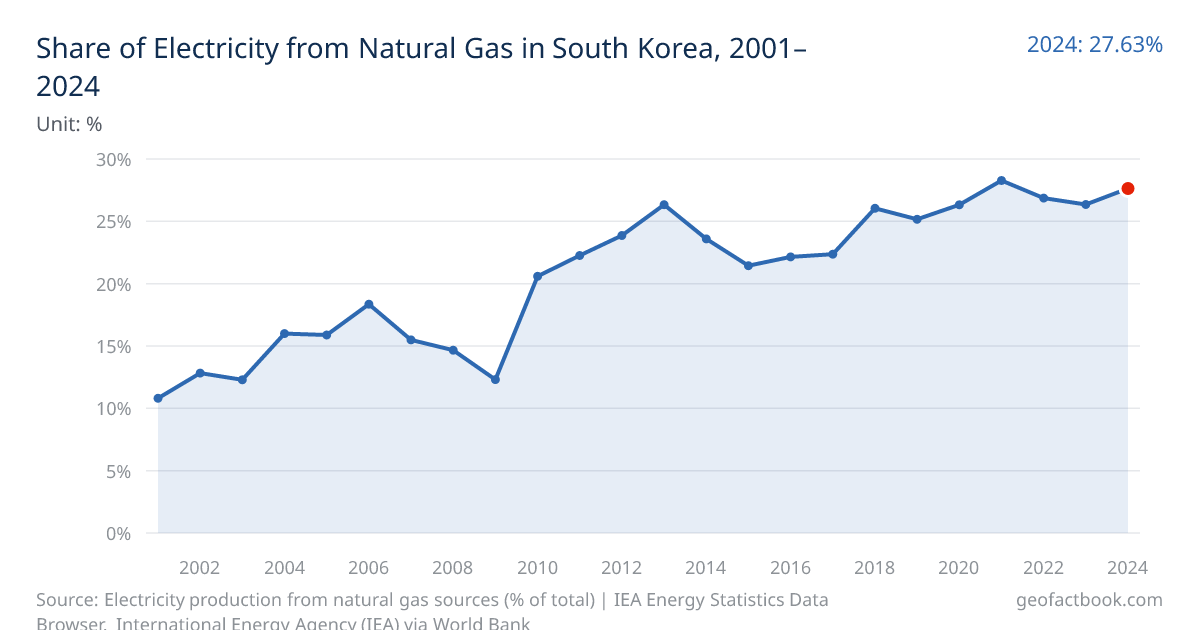
South Korea's share of electricity from natural gas in 2024 is 27.63 %, up 4.9% from 2023. It ranks #57 of 112 countries.
Share of electricity generated from natural gas highlights energy reliance patterns globally.
Source (2024): Share of electricity from natural gas
Where South Korea ranks (2024)
#57 of 112- #55
 United Kingdom30.5%
- #56
 Kazakhstan29.29%
- #57
 South Korea27.63%
- #58
 Latvia26.55%
- #59
 El Salvador25.05%
Share of Electricity from Natural Gas over time
| Year | Value | Change | % Change | Actions |
|---|---|---|---|---|
| 2024 | 27.63 % | +1.28 % | +4.86% | |
| 2023 | 26.35 % | 0.52 % | -1.92% | |
| 2022 | 26.87 % | 1.41 % | -4.98% | |
| 2021 | 28.27 % | +1.95 % | +7.40% | |
| 2020 | 26.33 % | +1.16 % | +4.61% | |
| 2019 | 25.17 % | 0.88 % | -3.38% | |
| 2018 | 26.05 % | +3.68 % | +16.45% | |
| 2017 | 22.37 % | +0.22 % | +0.98% | |
| 2016 | 22.15 % | +0.71 % | +3.31% | |
| 2015 | 21.44 % | 2.15 % | -9.13% | |
| 2014 | 23.59 % | 2.74 % | -10.42% | |
| 2013 | 26.34 % | +2.48 % | +10.38% | |
| 2012 | 23.86 % | +1.6 % | +7.20% | |
| 2011 | 22.26 % | +1.67 % | +8.11% | |
| 2010 | 20.59 % | +8.28 % | +67.32% | |
| 2009 | 12.3 % | 2.36 % | -16.10% | |
| 2008 | 14.67 % | 0.82 % | -5.31% | |
| 2007 | 15.49 % | 2.86 % | -15.60% | |
| 2006 | 18.35 % | +2.47 % | +15.55% | |
| 2005 | 15.88 % | 0.11 % | -0.69% | |
| 2004 | 15.99 % | +3.7 % | +30.10% | |
| 2003 | 12.29 % | 0.53 % | -4.16% | |
| 2002 | 12.83 % | +2.02 % | +18.68% | |
| 2001 | 10.81 % | — | — |
Share of Electricity from Natural Gas in South Korea, 2001–2024: chart
Cite this page
Geo Factbook. (n.d.). South Korea: Share of Electricity from Natural Gas. Retrieved November 29, 2026, from https://geofactbook.com/countries/south-korea/share-of-electricity-from-natural-gas
The figures on this page come from Electricity production from natural gas sources (% of total) | IEA Energy Statistics Data Browser, International Energy Agency (IEA) via World Bank. For academic work, cite the original source as well.
Frequently Asked Questions About South Korea Share of Electricity from Natural Gas
What is South Korea's share of electricity from natural gas in 2024?▾
South Korea's share of electricity from natural gas is 27.63 % in 2024, according to Electricity production from natural gas sources (% of total) | IEA Energy Statistics Data Browser, International Energy Agency (IEA) via World Bank.
Is South Korea's share of electricity from natural gas increasing or decreasing?▾
South Korea's share of electricity from natural gas rose by 4.9% from 2023 (26.35 %) to 2024 (27.63 %). Over the past decade (2014–2024) it rose by 17.1%.
How does South Korea rank for share of electricity from natural gas?▾
In 2024, South Korea has the 57th highest share of electricity from natural gas out of 112 countries with data.
What was South Korea's share of electricity from natural gas in 2001?▾
In 2001, South Korea's share of electricity from natural gas was 10.81 %. By 2024 it rose by 155.7%.
Explore additional statistical insights
Electricity from Other Renewables in South Korea
Electricity from other renewables measures alternative energy sources. Explore country comparisons, rankings, and historical trends with interactive maps.
Electricity Installed Capacity in South Korea
Electricity Installed Capacity measures the total power generation capability. Compare countries, explore rankings, and view interactive maps.
Natural Gas Consumption in South Korea
Natural gas consumption data reveals energy usage trends across countries. Compare figures, explore rankings, and visualize with interactive maps.
Total Coal Reserves in South Korea
Total coal reserves by country measure the quantity of coal available for extraction and use globally.
Share of Electricity from Coal in South Korea
Share of electricity from coal measures the percentage of a country's electricity generated using coal.
Oil Consumption in South Korea
Oil consumption measures the total oil used by a country. Explore rankings, compare countries, and view interactive maps to gain insights.