
Share of Electricity from Natural Gas 2006
Share of electricity generated from natural gas highlights energy reliance patterns globally.
Newer data is available: Share of Electricity from Natural Gas by country 2024 →
Where does your country rank? Pick it to see its position.
Related Energy statistics
More ↓

Interactive Map
Complete Data Rankings






































































































































































- #1
 Qatar
- #2
 Turkmenistan
- #3
 Trinidad and Tobago
- #4
 Brunei Darussalam
- #5
 Oman
- #6
 Bahrain
- #7
 Algeria
- #8
 United Arab Emirates
- #9
 Belarus
- #10
 Republic of Moldova
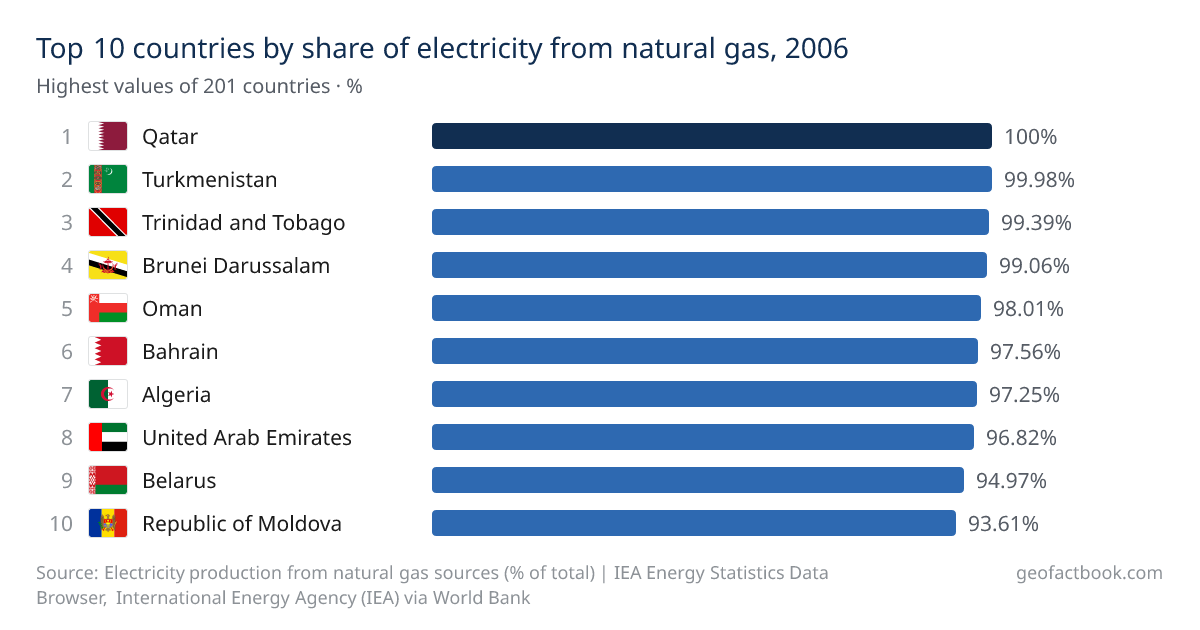
Analysis: These countries represent the highest values in this dataset, showcasing significant scale and impact on global statistics.
- #201
 Zimbabwe
- #200
 Zambia
- #199
 State of Palestine
- #198
 United States Virgin Islands
- #197
 Vanuatu
- #196
 Uganda
- #195
 Tuvalu
- #194
 Turks and Caicos Islands
- #193
 Tonga
- #192
 Timor-Leste
Context: These countries or territories have the lowest values, often due to geographic size, administrative status, or specific characteristics.
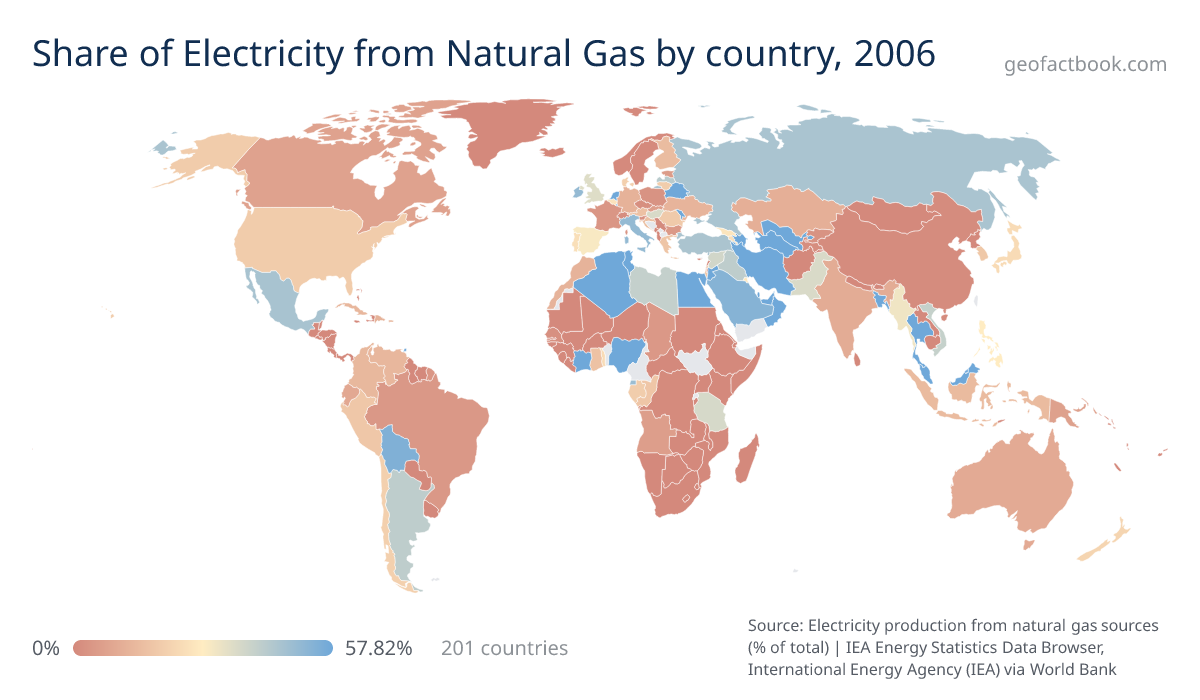
Share of Electricity from Natural Gas by country, 2006: map image
Top 10 countries by share of electricity from natural gas, 2006: chart
Insights by country
Ireland
In 2006, Ireland ranked #28 globally with a Share of Electricity from Natural Gas of 50.116338253472 %. This percentage is notably higher than the global average, reflecting a significant reliance on natural gas compared to many other countries. Key drivers for this dependency include Ireland's geographic limitations in renewable energy sources and a strategic policy focus on developing natural gas infrastructure to ensure energy security and support economic growth.
Belarus
In 2006, Belarus achieved a global rank of #9 with a Share of Electricity from Natural Gas of 94.973436861463 %. This high percentage places Belarus significantly above the global average, reflecting its heavy reliance on natural gas for electricity generation. The country's energy policy prioritizes natural gas imports, primarily from Russia, which has shaped its energy infrastructure and economic strategies.
Estonia
In 2006, Estonia ranked #87 globally with a Share of Electricity from Natural Gas of 5.53842992190711 %. This percentage is relatively low compared to many European countries that rely heavily on natural gas for electricity generation, reflecting Estonia's diverse energy mix. The country's energy policy has historically prioritized energy independence and the utilization of domestic resources, such as oil shale, which significantly influences its lower reliance on natural gas.
North Korea
In 2006, North Korea ranked #150 globally with a Share of Electricity from Natural Gas of 0 %. This figure is significantly lower than many countries in the region, reflecting a heavy reliance on coal and hydroelectric power for energy production. The lack of natural gas usage can be attributed to North Korea's limited access to international energy markets and its focus on developing domestic coal resources, alongside the country's strict governmental control over energy sources.
Papua New Guinea
In 2006, Papua New Guinea ranked #84 globally with a Share of Electricity from Natural Gas of 7.04935078785293 %. This figure is notably lower than many neighboring countries, reflecting the nation's reliance on hydroelectric power and other renewable sources. The limited infrastructure for natural gas extraction and distribution, coupled with a focus on harnessing its abundant hydropower resources, has shaped this energy landscape.
Armenia
In 2006, Armenia ranked #51 globally, with a Share of Electricity from Natural Gas of 24.8443023060091 %. This figure is notably lower than the global average, indicating a reliance on diverse energy sources compared to many other countries. Armenia's energy landscape is shaped by its limited domestic fossil fuel resources and a historical dependency on imported energy, particularly from neighboring countries.
Mongolia
Mongolia ranked #163 globally with a Share of Electricity from Natural Gas of 0 % in 2006. This figure is notably lower than many neighboring countries, reflecting a reliance on coal and other energy sources. The lack of natural gas infrastructure and the country's vast, sparsely populated terrain have limited the development of gas-based electricity generation. Additionally, Mongolia's energy policy has historically focused on coal, further entrenching its low natural gas usage.
Lesotho
In 2006, Lesotho ranked #154 globally with a Share of Electricity from Natural Gas of 0%. This figure is notably low compared to many countries that utilize natural gas as a significant energy source, reflecting Lesotho's reliance on hydropower and other renewable energy sources. The country’s mountainous terrain and limited fossil fuel resources contribute to its minimal use of natural gas, as it focuses on harnessing its abundant water resources for electricity generation.
Guinea-Bissau
In 2006, Guinea-Bissau ranked #179 globally with a Share of Electricity from Natural Gas of 0 %. This figure is notably lower than many neighboring countries, reflecting a lack of infrastructure for natural gas utilization in the region. Guinea-Bissau's energy sector is predominantly reliant on biomass and imported fuels, driven by limited investment in energy diversification and a focus on traditional energy sources.
Dominica
In 2006, Dominica ranked #127 globally with a Share of Electricity from Natural Gas of 0 %. This figure is notably lower than many Caribbean neighbors, which often utilize a mix of natural gas in their energy portfolios. The absence of natural gas usage in Dominica's electricity generation can be attributed to its reliance on hydropower and biomass, driven by the island's abundant water resources and a commitment to renewable energy sources.
Analysis & Context
In 2006, Qatar led the world with a 100% Share of Electricity from Natural Gas, showcasing complete reliance on this energy source. The global range spanned from 0.00% to 100.00%, highlighting diverse energy strategies across countries. The global average Share of Electricity from Natural Gas was 18.08%, with a median of 0.53%, indicating a significant skew towards lower usage among many nations.
High Reliance on Natural Gas: The Middle East and Central Asia
The Middle East and Central Asia emerged as regions with a pronounced reliance on natural gas for electricity generation. Qatar, Turkmenistan (99.98%), and Oman (98.01%) exemplify this trend, driven by abundant natural gas reserves and infrastructure investments. These countries have strategically leveraged their natural resources to generate electricity, reducing dependence on imports and enhancing energy security. This pattern is often a result of both geographic availability and economic policies prioritizing domestic energy resources.
Zero Dependency: A Diverse Group
Conversely, several countries reported a 0% share of electricity from natural gas, including Lebanon, Zambia, and Albania. The reasons for zero dependency vary widely. For instance, Zambia relies heavily on hydropower, while Lebanon and Albania might face infrastructural or economic challenges that limit the use of natural gas. The absence of domestic natural gas reserves or infrastructure to import and utilize it can also contribute to these statistics.
Year-over-Year Changes: Significant Movers
The year 2006 saw notable shifts in the Share of Electricity from Natural Gas in several countries. Jordan experienced the most significant increase, with a rise of 15.60% (28.8%), likely due to new infrastructure projects or policy changes encouraging natural gas use. Ghana exhibited a dramatic increase of 11.72% (242.5%), indicating a major shift towards natural gas, possibly as a part of efforts to diversify energy sources and stabilize supply.
On the other hand, Togo saw a decrease of 8.84% (-26.9%), which might be attributed to shifting towards alternative energy sources or economic constraints affecting natural gas imports. Similarly, Pakistan decreased by 7.63% (-17.3%), reflecting potential changes in energy policy or market dynamics affecting natural gas availability.
Economic and Policy Drivers
The reliance on natural gas for electricity generation in 2006 was heavily influenced by a combination of economic and policy factors. Countries like Belarus (94.97%) and the Republic of Moldova (93.61%) are examples where economic ties and energy agreements with natural gas-rich neighbors facilitate high usage. Policies promoting energy independence and investments in natural gas infrastructure also play crucial roles in shaping these statistics.
Conversely, countries with low or zero reliance on natural gas often face economic barriers or prioritize other energy sources due to environmental policies or geopolitical considerations. For instance, island nations such as American Samoa and Vanuatu may lack the infrastructure to import and convert natural gas efficiently, leading to reliance on alternative energy forms.
Overall, the 2006 data on the Share of Electricity from Natural Gas reveals a complex interplay of natural resource availability, economic strategy, and policy decisions that shape each country's energy landscape. Understanding these dynamics provides insights into global energy reliance patterns and the factors driving them.
Frequently Asked Questions About Share of Electricity from Natural Gas in 2006
Which country had the highest share of electricity generated from natural gas in 2006?
Qatar had the highest share of electricity generated from natural gas in 2006, with 100%.
Which country had the lowest share of electricity generated from natural gas in 2006?
Zimbabwe had the lowest share, with 0% of its electricity generated from natural gas in 2006.
What was the average share of electricity generated from natural gas across all countries in 2006?
The average share of electricity generated from natural gas across all countries in 2006 was 17.99%.
What was the median share of electricity generated from natural gas in 2006?
The median share of electricity generated from natural gas in 2006 was 0.41%.
Which countries were in the top 3 for the share of electricity generated from natural gas in 2006?
The top 3 countries were Qatar with 100%, Turkmenistan with 99.98%, and Trinidad and Tobago with 99.39%.
How many countries had a 0% share of electricity generated from natural gas in 2006?
In 2006, there were 10 countries with a 0% share of electricity generated from natural gas.
Data Source
Electricity production from natural gas sources (% of total) | IEA Energy Statistics Data Browser, International Energy Agency (IEA) via World Bank
Data produced by IEA Energy Statistics Data Browser, International Energy Agency (IEA), compiled and published by World Bank as "Electricity production from natural gas sources (% of total)".
Visit Data SourceCite this page
Geo Factbook. (n.d.). Share of Electricity from Natural Gas by Country, 2006. Retrieved November 28, 2026, from https://geofactbook.com/fact/share-of-electricity-from-natural-gas/2006
The figures on this page come from Electricity production from natural gas sources (% of total) | IEA Energy Statistics Data Browser, International Energy Agency (IEA) via World Bank. For academic work, cite the original source as well.
›Embed this ranking on your site
Free to embed with attribution. Shows the top 10 countries and links back to the full ranking.
Historical Data by Year
Explore Share of Electricity from Natural Gas data across different years. Compare trends and see how statistics have changed over time.
More Energy Facts
See all Energy facts →Electricity from Fossil Fuels
Electricity from fossil fuels measures energy generation trends. Compare countries, explore rankings, and analyze historical data with interactive maps.
Highest: Timor-Leste100 % of electricity generationRefined Petroleum Products Exports
Refined petroleum products exports reflect a country's economic strength. Compare nations, explore rankings, and view interactive maps.
 Highest: China848,400
Electricity Consumption
Electricity consumption data reveals energy usage trends across countries. Explore rankings and interactive maps for deeper insights.
Highest: China10,069.88 TWhYou might also like
Rule of Law Index by Country
FeaturedCompare countries by Rule of Law percentile rank, reflecting confidence in laws, courts, police, property rights, and protection from crime and violence.
 Highest: Finland100%
Currently married (Percent)
FeaturedThe percentage of currently married individuals by country highlights societal trends in family structure and relationships. Understanding these statistics can provide insights into cultural norms and demographic shifts, influencing policies and social programs.
 Highest: Bangladesh81.95%
Population Change
FeaturedThis statistic measures population change across countries, highlighting shifts in demographics. Understanding these changes is crucial for planning resources, economic growth, and social services.
 Highest: India14.13M persons