
Share of Electricity from Natural Gas 2007
Share of electricity generated from natural gas highlights energy reliance patterns globally.
Newer data is available: Share of Electricity from Natural Gas by country 2024 →
Where does your country rank? Pick it to see its position.
Related Energy statistics
More ↓

Interactive Map
Complete Data Rankings












































































































































































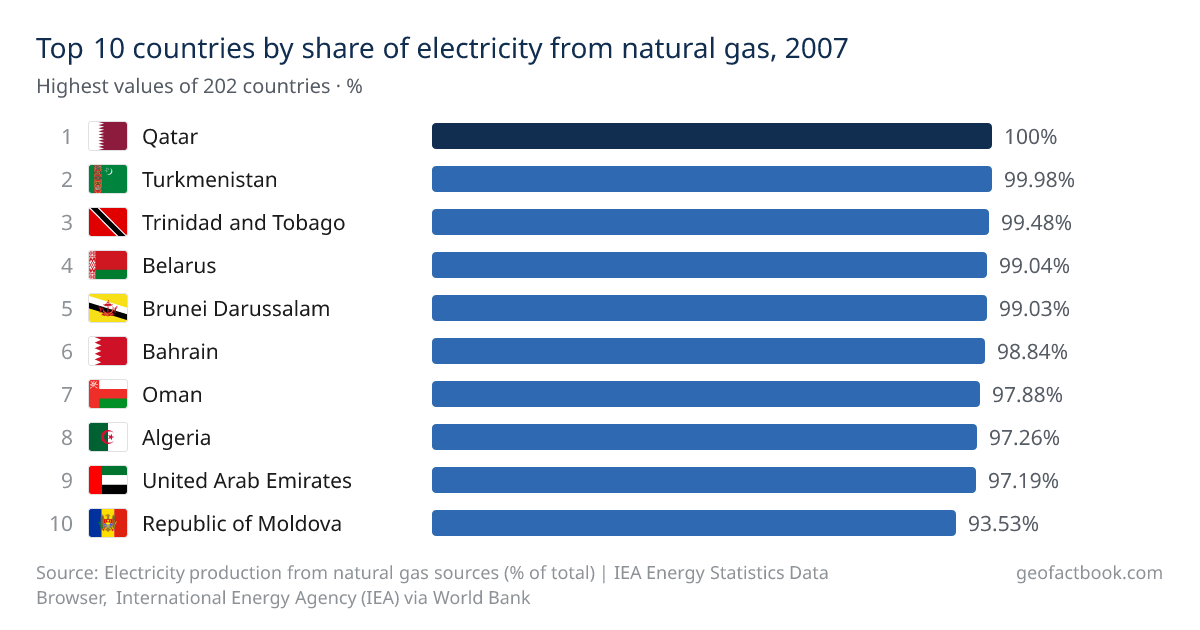
- #1
 Qatar
- #2
 Turkmenistan
- #3
 Trinidad and Tobago
- #4
 Belarus
- #5
 Brunei Darussalam
- #6
 Bahrain
- #7
 Oman
- #8
 Algeria
- #9
 United Arab Emirates
- #10
 Republic of Moldova
Analysis: These countries represent the highest values in this dataset, showcasing significant scale and impact on global statistics.
- #202
 Zimbabwe
- #201
 Zambia
- #200
 State of Palestine
- #199
 United States Virgin Islands
- #198
 Vanuatu
- #197
 Uganda
- #196
 Tuvalu
- #195
 Turks and Caicos Islands
- #194
 Tonga
- #193
 Timor-Leste
Context: These countries or territories have the lowest values, often due to geographic size, administrative status, or specific characteristics.
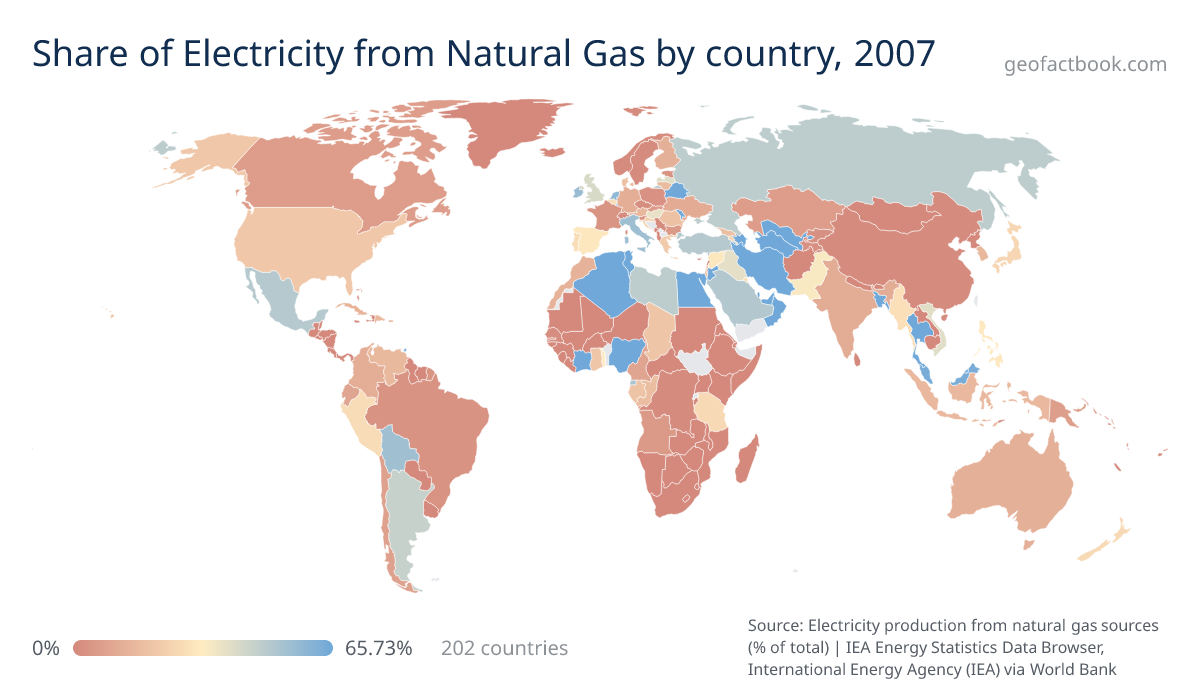
Share of Electricity from Natural Gas by country, 2007: map image
Top 10 countries by share of electricity from natural gas, 2007: chart
Insights by country
Algeria
In 2007, Algeria ranked #8 globally with a Share of Electricity from Natural Gas of 97.2577696526508 %. This figure significantly exceeds the global average, reflecting Algeria's reliance on its vast natural gas reserves compared to countries like Germany, which has a much lower share. The country's energy policy prioritizes natural gas for electricity generation due to its abundant resources, which are critical for both domestic consumption and export revenue.
Azerbaijan
Azerbaijan ranked #20 globally in 2007, with a Share of Electricity from Natural Gas of 70.9067606536367 %. This figure is significantly higher than the global average, reflecting the country's reliance on natural gas for energy production. Azerbaijan's rich natural gas reserves and strategic investments in energy infrastructure have driven this high dependency, positioning it as a key player in the regional energy market.
Sri Lanka
In 2007, Sri Lanka ranked #124 globally with a Share of Electricity from Natural Gas of 0 %. This figure is significantly lower than many countries, particularly those in the Asia-Pacific region, where natural gas plays a larger role in energy production. The absence of natural gas in Sri Lanka’s energy mix can be attributed to a reliance on hydropower and biomass, compounded by limited domestic natural gas resources and infrastructure challenges.
Kenya
In 2007, Kenya ranked #150 globally with a Share of Electricity from Natural Gas of 0 %. This figure is significantly lower than many countries in the region, reflecting a limited reliance on natural gas for energy production. The country's energy sector has primarily depended on hydroelectric power and geothermal sources, driven by its geographic advantages and policy focus on renewable energy development.
American Samoa
In 2007, American Samoa ranked #109 globally with a Share of Electricity from Natural Gas of 0%. This figure is significantly lower than many Pacific island nations that utilize natural gas as a cleaner energy source. The absence of natural gas infrastructure, combined with reliance on imported fossil fuels for electricity generation, limits the territory's energy diversification and sustainability efforts.
Myanmar
In 2007, Myanmar ranked #45 globally with a Share of Electricity from Natural Gas of 28.6732373009856%. This figure is notable compared to countries like Bangladesh, which relies less on natural gas for electricity generation. The reliance on natural gas in Myanmar can be attributed to its abundant natural gas reserves and the government's focus on developing energy infrastructure to support economic growth.
Trinidad and Tobago
In 2007, Trinidad and Tobago achieved a remarkable global rank of #3 with a Share of Electricity from Natural Gas of 99.4788952579468 %. This figure is significantly higher than many countries, reflecting the nation's heavy reliance on natural gas for electricity generation compared to the global average. The country's abundant natural gas resources, stemming from its offshore reserves, combined with a well-developed energy infrastructure, have positioned it as a leader in natural gas utilization for power generation.
Eritrea
Eritrea ranked #131 globally in 2007 for its Share of Electricity from Natural Gas, which stood at 0 %. This figure is significantly lower than the global average, reflecting the country's limited access to natural gas resources compared to nations that heavily rely on this energy source. The lack of natural gas infrastructure, combined with Eritrea's focus on renewable energy and hydropower, has shaped its energy landscape.
Ethiopia
Ethiopia ranked #130 globally in 2007, with a Share of Electricity from Natural Gas of 0 %. This figure is significantly lower than many of its neighbors, as countries like Egypt utilize natural gas extensively for electricity generation. Ethiopia's reliance on hydropower, driven by its abundant water resources, has limited the development of natural gas infrastructure and investment in this energy sector.
Guyana
In 2007, Guyana ranked #145 globally with a Share of Electricity from Natural Gas of 0 %. This figure places Guyana below many of its regional neighbors, where natural gas is increasingly utilized for electricity generation. The absence of natural gas infrastructure and reliance on hydropower and other energy sources have limited the country's ability to harness natural gas for electricity, impacting energy diversification and economic development.
Analysis & Context
In 2007, Qatar led the world with a 100% Share of Electricity from Natural Gas, illustrating its complete reliance on this energy source. The global range for this metric spanned from 0% to 100%. The worldwide average was 18.42%, reflecting diverse energy reliance patterns across countries.
Economic and Geographic Influences on Natural Gas Dependence
The countries with the highest share of electricity generated from natural gas, such as Qatar (100%), Turkmenistan (99.98%), and Trinidad and Tobago (99.48%), are typically nations with significant natural gas reserves. This abundance allows them to utilize natural gas as a primary energy source, reducing dependence on imported energy and supporting economic stability. In contrast, countries with a 0% share, like Zambia and Vanuatu, often lack natural gas reserves or infrastructure, leading them to rely on alternative energy sources such as hydropower or imported fuels.
Policy and Infrastructure Drivers
Government policies and infrastructure investments significantly impact the share of electricity derived from natural gas. For instance, in the United Arab Emirates (97.19%), strategic investments in gas infrastructure and favorable regulatory frameworks have facilitated high reliance on natural gas. Similarly, Oman (97.88%) benefits from policies promoting natural gas as a cleaner alternative to oil. Conversely, countries like State of Palestine (0%) lack the infrastructure needed to exploit natural gas, thereby missing out on its potential benefits.
Trends in Year-over-Year Changes
Examining year-over-year changes, Chad experienced a remarkable increase of 15.71% (349.9%), indicating a significant shift towards utilizing natural gas, possibly due to new discoveries or infrastructural developments. Jordan also saw a substantial increase of 12.57% (18.0%), likely driven by regional energy agreements and the expansion of gas import facilities. On the other hand, Chile experienced a decrease of 12.76% (-61.7%), which could be attributed to diversification of its energy mix and increased investments in renewable energy sources.
Implications of Diverse Energy Strategies
The wide variation in the share of electricity from natural gas reflects differing national strategies and resources. For countries like Qatar and Turkmenistan, natural gas is integral to their energy security and economic model. However, reliance on a single energy source can pose risks, such as market volatility or geopolitical tensions. Alternatively, countries with low or zero reliance on natural gas, such as Albania and Andorra, often pursue diversified energy portfolios, which can enhance resilience but may also involve higher costs or technological challenges.
Overall, the Share of Electricity from Natural Gas in 2007 highlights the complex interplay of natural resources, policy decisions, and economic strategies that shape global energy landscapes. These patterns underscore the importance of adaptive energy policies that can respond to both domestic needs and international market dynamics.
Frequently Asked Questions About Share of Electricity from Natural Gas in 2007
Which country had the highest share of electricity generated from natural gas in 2007?
Qatar had the highest share of electricity generated from natural gas in 2007, with 100%.
What was the average share of electricity generated from natural gas across all countries in 2007?
The average share of electricity generated from natural gas across all countries in 2007 was 18.24%.
Which country had the lowest share of electricity generated from natural gas in 2007?
Zimbabwe had the lowest share of electricity generated from natural gas in 2007, with 0%.
What was the median share of electricity generated from natural gas in 2007?
The median share of electricity generated from natural gas in 2007 was 1.02%.
How many countries had a 0% share of electricity generated from natural gas in 2007?
Ten countries had a 0% share of electricity generated from natural gas in 2007.
Which countries were in the top 3 for the share of electricity generated from natural gas in 2007?
The top 3 countries for the share of electricity generated from natural gas in 2007 were Qatar, Turkmenistan, and Trinidad and Tobago.
Data Source
Electricity production from natural gas sources (% of total) | IEA Energy Statistics Data Browser, International Energy Agency (IEA) via World Bank
Data produced by IEA Energy Statistics Data Browser, International Energy Agency (IEA), compiled and published by World Bank as "Electricity production from natural gas sources (% of total)".
Visit Data SourceCite this page
Geo Factbook. (n.d.). Share of Electricity from Natural Gas by Country, 2007. Retrieved November 28, 2026, from https://geofactbook.com/fact/share-of-electricity-from-natural-gas/2007
The figures on this page come from Electricity production from natural gas sources (% of total) | IEA Energy Statistics Data Browser, International Energy Agency (IEA) via World Bank. For academic work, cite the original source as well.
›Embed this ranking on your site
Free to embed with attribution. Shows the top 10 countries and links back to the full ranking.
Historical Data by Year
Explore Share of Electricity from Natural Gas data across different years. Compare trends and see how statistics have changed over time.
More Energy Facts
See all Energy facts →Electricity from Fossil Fuels
Electricity from fossil fuels measures energy generation trends. Compare countries, explore rankings, and analyze historical data with interactive maps.
Highest: Timor-Leste100 % of electricity generationRefined Petroleum Products Exports
Refined petroleum products exports reflect a country's economic strength. Compare nations, explore rankings, and view interactive maps.
 Highest: China848,400
Electricity Consumption
Electricity consumption data reveals energy usage trends across countries. Explore rankings and interactive maps for deeper insights.
Highest: China10,069.88 TWhYou might also like
Rule of Law Index by Country
FeaturedCompare countries by Rule of Law percentile rank, reflecting confidence in laws, courts, police, property rights, and protection from crime and violence.
 Highest: Finland100%
Currently married (Percent)
FeaturedThe percentage of currently married individuals by country highlights societal trends in family structure and relationships. Understanding these statistics can provide insights into cultural norms and demographic shifts, influencing policies and social programs.
 Highest: Bangladesh81.95%
Population Change
FeaturedThis statistic measures population change across countries, highlighting shifts in demographics. Understanding these changes is crucial for planning resources, economic growth, and social services.
 Highest: India14.13M persons