
Share of Electricity from Natural Gas 2020
Share of electricity generated from natural gas highlights energy reliance patterns globally.
Newer data is available: Share of Electricity from Natural Gas by country 2024 →
Where does your country rank? Pick it to see its position.
Related Energy statistics
More ↓

Interactive Map
Complete Data Rankings













































































































































































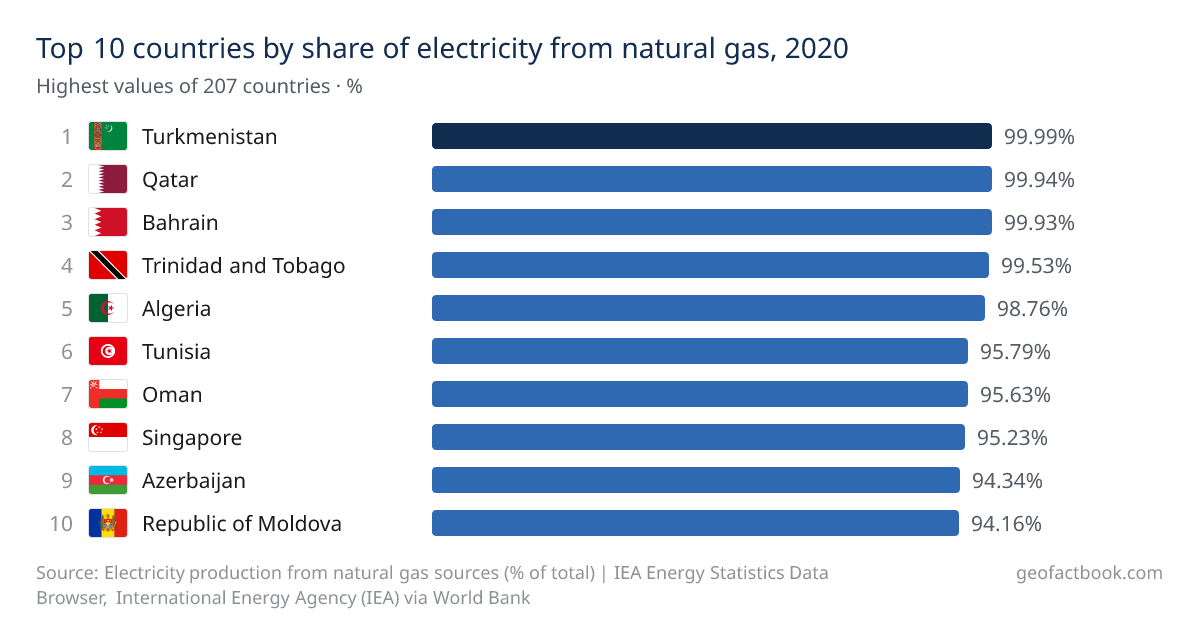
- #1
 Turkmenistan
- #2
 Qatar
- #3
 Bahrain
- #4
 Trinidad and Tobago
- #5
 Algeria
- #6
 Tunisia
- #7
 Oman
- #8
 Singapore
- #9
 Azerbaijan
- #10
 Republic of Moldova
Analysis: These countries represent the highest values in this dataset, showcasing significant scale and impact on global statistics.
- #207
 Zimbabwe
- #206
 Zambia
- #205
 State of Palestine
- #204
 United States Virgin Islands
- #203
 Vanuatu
- #202
 Uganda
- #201
 Tuvalu
- #200
 Turks and Caicos Islands
- #199
 Tonga
- #198
 Timor-Leste
Context: These countries or territories have the lowest values, often due to geographic size, administrative status, or specific characteristics.
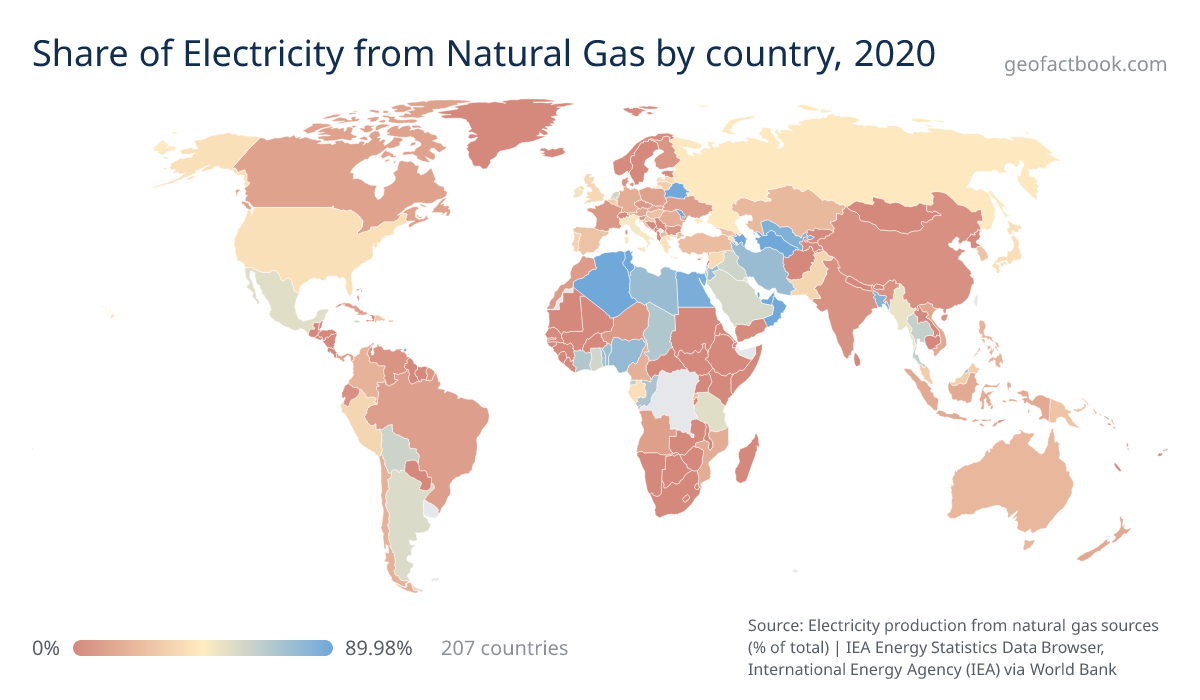
Share of Electricity from Natural Gas by country, 2020: map image
Top 10 countries by share of electricity from natural gas, 2020: chart
Insights by country
Nicaragua
Nicaragua ranked #179 globally in 2020, with a Share of Electricity from Natural Gas of 0%. This figure is significantly below the global average, where many countries utilize natural gas as a key energy source. The lack of infrastructure and investment in natural gas facilities, combined with a reliance on renewable sources such as hydropower, has shaped Nicaragua's energy landscape.
Guinea
In 2020, Guinea ranked #151 globally with a Share of Electricity from Natural Gas of 0 %. This figure is significantly lower than many of its regional neighbors, reflecting a reliance on other energy sources. The country's limited natural gas infrastructure and a focus on hydropower, driven by its abundant water resources, contribute to this low share of electricity generation from natural gas.
Russia
In 2020, Russia ranked #45 globally with a Share of Electricity from Natural Gas of 43.0179128118957%. This figure is notable as it reflects the country's heavy reliance on natural gas for electricity generation, which is higher than the global average. The vast natural gas reserves in Russia, coupled with its extensive pipeline infrastructure, significantly influence this high dependency, supporting both domestic consumption and export capabilities.
Vietnam
In 2020, Vietnam ranked #81 globally with a Share of Electricity from Natural Gas of 14.4431210288887 %. This figure is relatively low compared to regional neighbors like Thailand, which relies more heavily on natural gas for electricity generation. The growth in Vietnam's natural gas share is driven by its increasing energy demands, economic expansion, and the government's push to diversify energy sources amidst a rapidly industrializing economy.
Liberia
In 2020, Liberia ranked #162 globally with a Share of Electricity from Natural Gas of 0 %. This figure is significantly lower than many countries in the region, reflecting Liberia's reliance on hydroelectric power rather than natural gas. The lack of infrastructure and investment in natural gas facilities, coupled with a history of civil conflict, has hindered the development of diverse energy sources in the country.
Senegal
In 2020, Senegal ranked #110 globally with a Share of Electricity from Natural Gas of 0.895933838731909 %. This figure is significantly lower than many of its regional neighbors, reflecting a reliance on other energy sources. The limited share of natural gas in Senegal's energy mix is driven by the country's ongoing development of renewable energy projects and the relatively nascent state of its natural gas infrastructure.
Sweden
In 2020, Sweden ranked #114 globally with a Share of Electricity from Natural Gas of 0.059206631142688 %. This figure is notably lower than many European neighbors, reflecting Sweden's strong commitment to renewable energy sources, particularly hydropower and wind energy. The country's extensive investments in green technology and policies aimed at reducing carbon emissions contribute to its minimal reliance on natural gas for electricity generation.
Italy
In 2020, Italy ranked #44 globally with a Share of Electricity from Natural Gas of 47.653200537552 %. This figure is significant as it exceeds the European Union average, reflecting Italy's reliance on natural gas for electricity generation compared to its neighbors like France, which utilizes a larger share of nuclear power. Italy's geographic position as a major gas transit hub and its energy policies favoring natural gas have driven this high dependency, as the country seeks to balance energy security and environmental commitments.
Jordan
In 2020, Jordan ranked #20 globally with a Share of Electricity from Natural Gas of 77.0590792715328%. This figure is significantly higher than the global average, reflecting Jordan's reliance on natural gas for electricity generation compared to many countries. The key drivers for this high percentage include Jordan's strategic investments in natural gas infrastructure and its efforts to diversify energy sources in response to regional energy challenges.
Maldives
In 2020, the Maldives ranked #165 globally with a Share of Electricity from Natural Gas of 0 %. This figure is notably lower than many neighboring countries in South Asia, where natural gas is a more common energy source. The Maldives relies heavily on imported fossil fuels, primarily diesel, for its electricity generation, which is influenced by its geographic isolation and limited infrastructure for natural gas development.
Analysis & Context
In 2020, the country with the highest Share of Electricity from Natural Gas was Turkmenistan, with an impressive 99.99%. The global range for this metric spanned from a minimum of 0% to a maximum of 99.99%. The average share of electricity generated from natural gas across 200 countries was 22.64%, while the median value stood at 4.30%. These figures highlight the significant diversity in energy reliance worldwide.
Economic and Geographic Drivers of Natural Gas Reliance
The reliance on natural gas for electricity generation often correlates with a country's natural resources and economic strategies. For instance, Qatar and Bahrain, with shares of 99.94% and 99.93% respectively, are both rich in natural gas reserves, which makes it economically sensible to utilize this resource for electricity. Similarly, Trinidad and Tobago (99.53%) and Algeria (98.76%) are known for their substantial natural gas production, which aligns with their high reliance on this energy source.
On the other hand, countries like Albania and the State of Palestine report a 0% share of electricity from natural gas, indicating either a lack of resource availability or strategic choices to invest in alternative energy sources. Geographic factors, such as proximity to natural gas reserves, and policy decisions greatly influence these disparities.
Policy Impact and Energy Transition
Government policies and energy strategies significantly impact the share of electricity generated from natural gas. Tunisia (95.79%) and Oman (95.63%) have developed infrastructure that supports natural gas utilization, driven by both economic incentives and energy security considerations. Conversely, the lack of such infrastructure or policy support in countries like Vanuatu and Bhutan (both at 0%) suggests a reliance on alternative energy sources, possibly due to geographical constraints or environmental policies promoting renewable energy.
Countries with high shares often have policies that favor natural gas due to its relatively lower carbon emissions compared to coal. This aligns with global trends towards cleaner energy, albeit with regional variations in implementation and resource availability.
Significant Year-over-Year Changes
Analyzing year-over-year changes reveals dynamic shifts in energy strategies. Gibraltar saw the most substantial increase at 48.00%, a 144.8% rise, indicating a strategic pivot towards natural gas, possibly for economic or environmental reasons. Jamaica and China, Hong Kong SAR also experienced significant increases of 32.73% and 27.29% respectively, reflecting changes in energy policy or infrastructure enhancements facilitating natural gas use.
Conversely, countries like Latvia and Panama experienced decreases of 14.15% and 12.62% respectively, which might be attributable to shifts towards renewable energy sources or economic factors limiting natural gas supply or infrastructure.
Implications of Natural Gas Dependency
The dependency on natural gas for electricity generation has profound implications. For countries like Singapore (95.23%) and Azerbaijan (94.34%), this reliance underscores a commitment to a stable and efficient energy source, leveraging their strategic reserves and infrastructure. However, this dependency also poses risks, such as exposure to volatile natural gas prices and geopolitical tensions affecting supply chains.
In regions where natural gas is not prevalent, the focus has shifted towards sustainable and renewable energy sources. As the world moves towards decarbonization, countries heavily reliant on natural gas may need to diversify their energy portfolios to meet environmental targets and ensure long-term energy security.
Overall, the Share of Electricity from Natural Gas in 2020 illustrates a complex interplay of resource availability, economic strategy, and policy direction. Understanding these patterns provides critical insights into global energy dynamics and future trends in the transition towards sustainable energy systems.
Frequently Asked Questions About Share of Electricity from Natural Gas in 2020
Which country had the highest share of electricity generated from natural gas in 2020?
Turkmenistan had the highest share of electricity generated from natural gas in 2020, with 99.99%.
What was the lowest share of electricity from natural gas among countries in 2020?
Mali had the lowest share of electricity from natural gas in 2020, with 0%.
What was the average share of electricity from natural gas across all countries in 2020?
The average share of electricity from natural gas across all countries in 2020 was 21.87%.
What was the median share of electricity from natural gas in 2020?
The median share of electricity from natural gas in 2020 was 3.03%.
Which countries were in the top 3 for the share of electricity from natural gas in 2020?
The top 3 countries for the share of electricity from natural gas in 2020 were Turkmenistan, Qatar, and Bahrain.
How many countries had a 0% share of electricity from natural gas in 2020?
Ten countries had a 0% share of electricity from natural gas in 2020.
Data Source
Electricity production from natural gas sources (% of total) | IEA Energy Statistics Data Browser, International Energy Agency (IEA) via World Bank
Data produced by IEA Energy Statistics Data Browser, International Energy Agency (IEA), compiled and published by World Bank as "Electricity production from natural gas sources (% of total)".
Visit Data SourceCite this page
Geo Factbook. (n.d.). Share of Electricity from Natural Gas by Country, 2020. Retrieved November 28, 2026, from https://geofactbook.com/fact/share-of-electricity-from-natural-gas/2020
The figures on this page come from Electricity production from natural gas sources (% of total) | IEA Energy Statistics Data Browser, International Energy Agency (IEA) via World Bank. For academic work, cite the original source as well.
›Embed this ranking on your site
Free to embed with attribution. Shows the top 10 countries and links back to the full ranking.
Historical Data by Year
Explore Share of Electricity from Natural Gas data across different years. Compare trends and see how statistics have changed over time.
More Energy Facts
See all Energy facts →Electricity from Fossil Fuels
Electricity from fossil fuels measures energy generation trends. Compare countries, explore rankings, and analyze historical data with interactive maps.
Highest: Timor-Leste100 % of electricity generationRefined Petroleum Products Exports
Refined petroleum products exports reflect a country's economic strength. Compare nations, explore rankings, and view interactive maps.
 Highest: China848,400
Electricity Consumption
Electricity consumption data reveals energy usage trends across countries. Explore rankings and interactive maps for deeper insights.
Highest: China10,069.88 TWhYou might also like
Rule of Law Index by Country
FeaturedCompare countries by Rule of Law percentile rank, reflecting confidence in laws, courts, police, property rights, and protection from crime and violence.
 Highest: Finland100%
Currently married (Percent)
FeaturedThe percentage of currently married individuals by country highlights societal trends in family structure and relationships. Understanding these statistics can provide insights into cultural norms and demographic shifts, influencing policies and social programs.
 Highest: Bangladesh81.95%
Population Change
FeaturedThis statistic measures population change across countries, highlighting shifts in demographics. Understanding these changes is crucial for planning resources, economic growth, and social services.
 Highest: India14.13M persons