
Share of Electricity from Natural Gas 2011
Share of electricity generated from natural gas highlights energy reliance patterns globally.
Newer data is available: Share of Electricity from Natural Gas by country 2024 →
Where does your country rank? Pick it to see its position.
Related Energy statistics
More ↓

Interactive Map
Complete Data Rankings









































































































































































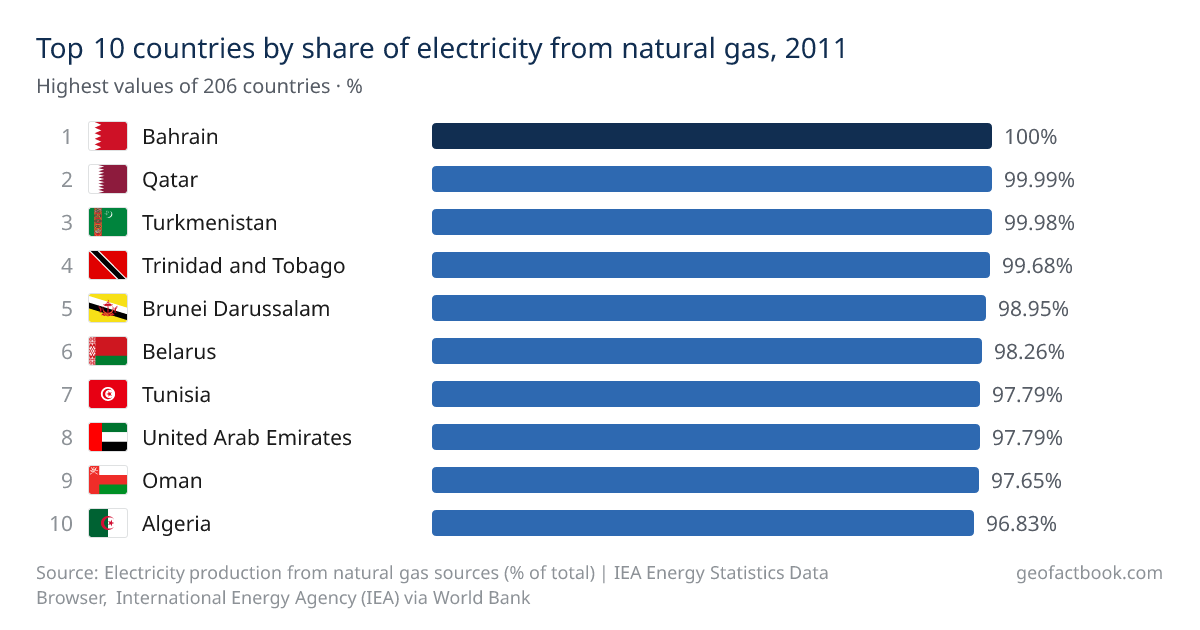
- #1
 Bahrain
- #2
 Qatar
- #3
 Turkmenistan
- #4
 Trinidad and Tobago
- #5
 Brunei Darussalam
- #6
 Belarus
- #7
 Tunisia
- #8
 United Arab Emirates
- #9
 Oman
- #10
 Algeria
Analysis: These countries represent the highest values in this dataset, showcasing significant scale and impact on global statistics.
- #206
 Zimbabwe
- #205
 Zambia
- #204
 State of Palestine
- #203
 United States Virgin Islands
- #202
 Vanuatu
- #201
 Uganda
- #200
 Tuvalu
- #199
 Turks and Caicos Islands
- #198
 Tonga
- #197
 Timor-Leste
Context: These countries or territories have the lowest values, often due to geographic size, administrative status, or specific characteristics.
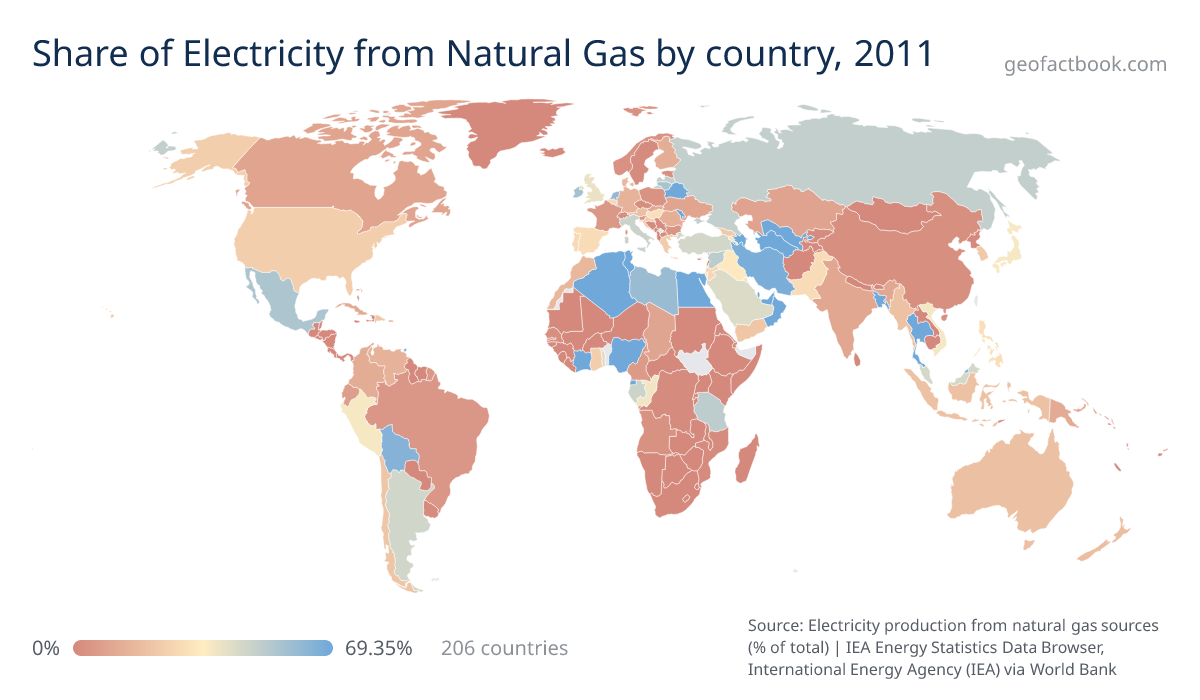
Share of Electricity from Natural Gas by country, 2011: map image
Top 10 countries by share of electricity from natural gas, 2011: chart
Insights by country
Chad
In 2011, Chad ranked #83 globally with a Share of Electricity from Natural Gas of 9.85221674876847 %. This figure is notably lower than the global average, reflecting the country's limited infrastructure and reliance on alternative energy sources. The low share is primarily driven by Chad's underdeveloped energy sector and ongoing challenges in accessing natural gas resources, which hampers electricity generation capacity.
Kenya
In 2011, Kenya ranked #154 globally with a Share of Electricity from Natural Gas of 0%. This figure is notably lower than regional averages, as many neighboring countries have begun integrating natural gas into their energy mix. The lack of natural gas resources and a reliance on hydroelectric power, alongside renewable energy initiatives, have shaped Kenya's energy landscape during this period.
Bhutan
In 2011, Bhutan ranked #118 globally with a Share of Electricity from Natural Gas of 0%. This figure is significantly lower than many countries, reflecting Bhutan's reliance on hydropower, which accounts for over 90% of its electricity generation. The country's topography and abundant water resources make hydropower a viable and sustainable energy source, while the lack of natural gas infrastructure limits its use.
United Arab Emirates
In 2011, the United Arab Emirates ranked #8 globally with a Share of Electricity from Natural Gas of 97.7919444808699 %. This figure is significantly higher than the global average, reflecting the country's heavy reliance on natural gas for electricity generation. The UAE's abundant natural gas reserves and its strategic investments in energy infrastructure have driven this dependency, supporting both its rapid economic growth and urban development.
Eritrea
Eritrea ranked #135 globally in 2011 with a Share of Electricity from Natural Gas of 0 %. This figure is significantly lower than many countries in the region, reflecting a broader reliance on alternative energy sources. The lack of natural gas infrastructure and investment in energy production, combined with the country's challenging economic conditions, has limited the development of this sector.
British Virgin Islands
In 2011, the British Virgin Islands ranked #122 globally with a Share of Electricity from Natural Gas of 0 %. This figure is significantly lower than many Caribbean neighbors, which often rely on a mix of natural gas and renewable energy sources. The lack of natural gas infrastructure and a heavy reliance on imported diesel for electricity generation are key factors contributing to this statistic in the British Virgin Islands.
Barbados
In 2011, Barbados ranked #117 globally with a Share of Electricity from Natural Gas of 0%. This figure is notably lower than many Caribbean neighbors, which often utilize natural gas as a key energy source. The country's reliance on renewable energy and imported fossil fuels, coupled with limited natural gas infrastructure, has shaped its energy landscape.
Austria
In 2011, Austria ranked #69 globally with a Share of Electricity from Natural Gas of 18.8959628037014 %. This figure is notable as it reflects Austria's reliance on natural gas compared to its European neighbors, many of which have lower percentages due to higher investments in renewable energy sources. The country's energy policy has historically favored a mix of natural gas and hydropower, driven by its geographic advantages, including abundant water resources for hydroelectricity.
Sri Lanka
Sri Lanka ranked #128 globally in 2011 with a Share of Electricity from Natural Gas of 0%. This figure is significantly lower than many neighboring countries, such as India, which has been increasing its natural gas utilization for power generation. The absence of natural gas infrastructure and reliance on hydropower and coal have limited Sri Lanka's ability to diversify its energy sources, impacting energy security and sustainability. Furthermore, the country's energy policies have historically prioritized hydropower development due to its abundant water resources.
Burundi
In 2011, Burundi ranked #123 globally with a Share of Electricity from Natural Gas of 0 %. This figure is notably lower than many neighboring countries, reflecting a broader reliance on hydroelectric power in the region. Burundi's limited access to natural gas infrastructure and its focus on renewable energy sources, particularly hydropower, significantly influence this statistic.
Analysis & Context
In 2011, Bahrain led the world in the Share of Electricity from Natural Gas, achieving a full 100% reliance. The global range for this metric was from 0.00% to 100.00%, illustrating significant diversity in energy sources worldwide. The average share across the 200 countries with available data was 19.58%, while the median was notably lower at 1.60%.
Economic and Geographic Drivers of High Natural Gas Reliance
Countries with the highest reliance on natural gas for electricity generation in 2011, such as Qatar at 99.99% and Turkmenistan at 99.98%, are often characterized by abundant natural gas reserves. These nations have capitalized on their natural resources to fuel economic growth and energy security. Trinidad and Tobago, with a share of 99.68%, exemplifies how smaller nations leverage natural gas exports to bolster their economies. Geographic proximity to major gas fields and established infrastructure also plays a crucial role, as seen in the United Arab Emirates with a reliance of 97.79%.
Policy and Infrastructure Influences on Low Natural Gas Usage
Conversely, countries with a 0% share of electricity from natural gas, like Tuvalu and the Turks and Caicos Islands, typically lack the infrastructure or resources to utilize natural gas effectively. Many of these countries rely on alternative sources such as renewables or imported fossil fuels due to geographical isolation or policy decisions prioritizing energy independence. In Timor-Leste and Tonga, the absence of natural gas infrastructure necessitates reliance on other energy forms.
Year-over-Year Trends: Movers and Shakers
In the analysis of year-over-year changes, Libya experienced the most significant increase, with its share of electricity from natural gas rising by 16.96%, a growth of 40.3%. This surge may be attributed to post-conflict reconstruction efforts focusing on utilizing domestic energy resources. Georgia saw an impressive 214.7% increase, reflecting a strategic shift towards diversifying energy sources and reducing dependence on imported fuels. On the downside, Jordan faced a drastic reduction of 44.15% in its natural gas share, a decrease of 62.0%, likely due to regional supply disruptions.
Global Energy Patterns and Their Implications
The diversity in the Share of Electricity from Natural Gas in 2011 highlights a complex interplay of resource availability, economic strategy, and policy decisions. Nations like Brunei Darussalam and Belarus, with shares above 98%, demonstrate the feasibility of high natural gas reliance given favorable conditions. However, the global average of 19.58% underscores the reality that many countries either cannot or choose not to heavily depend on this resource. The energy landscape reveals a tapestry of strategic choices influenced by economic imperatives and geopolitical realities, shaping the future of global energy security and sustainability.
Frequently Asked Questions About Share of Electricity from Natural Gas in 2011
Which country had the highest share of electricity from natural gas in 2011?
Bahrain had the highest share of electricity from natural gas in 2011, with 100%.
Which country had the lowest share of electricity from natural gas in 2011?
Afghanistan had the lowest share of electricity from natural gas in 2011, with 0%.
What was the average share of electricity from natural gas across all countries in 2011?
The average share of electricity from natural gas across all countries in 2011 was 19.01%.
What was the median share of electricity from natural gas in 2011?
The median share of electricity from natural gas in 2011 was 1.16%.
Which countries were in the top 3 for electricity from natural gas in 2011?
The top 3 countries for electricity from natural gas in 2011 were Bahrain (100%), Qatar (99.99%), and Turkmenistan (99.98%).
How many countries had a 0% share of electricity from natural gas in 2011?
There were 10 countries with a 0% share of electricity from natural gas in 2011.
Data Source
Electricity production from natural gas sources (% of total) | IEA Energy Statistics Data Browser, International Energy Agency (IEA) via World Bank
Data produced by IEA Energy Statistics Data Browser, International Energy Agency (IEA), compiled and published by World Bank as "Electricity production from natural gas sources (% of total)".
Visit Data SourceCite this page
Geo Factbook. (n.d.). Share of Electricity from Natural Gas by Country, 2011. Retrieved November 28, 2026, from https://geofactbook.com/fact/share-of-electricity-from-natural-gas/2011
The figures on this page come from Electricity production from natural gas sources (% of total) | IEA Energy Statistics Data Browser, International Energy Agency (IEA) via World Bank. For academic work, cite the original source as well.
›Embed this ranking on your site
Free to embed with attribution. Shows the top 10 countries and links back to the full ranking.
Historical Data by Year
Explore Share of Electricity from Natural Gas data across different years. Compare trends and see how statistics have changed over time.
More Energy Facts
See all Energy facts →Electricity from Fossil Fuels
Electricity from fossil fuels measures energy generation trends. Compare countries, explore rankings, and analyze historical data with interactive maps.
Highest: Timor-Leste100 % of electricity generationRefined Petroleum Products Exports
Refined petroleum products exports reflect a country's economic strength. Compare nations, explore rankings, and view interactive maps.
 Highest: China848,400
Electricity Consumption
Electricity consumption data reveals energy usage trends across countries. Explore rankings and interactive maps for deeper insights.
Highest: China10,069.88 TWhYou might also like
Rule of Law Index by Country
FeaturedCompare countries by Rule of Law percentile rank, reflecting confidence in laws, courts, police, property rights, and protection from crime and violence.
 Highest: Finland100%
Currently married (Percent)
FeaturedThe percentage of currently married individuals by country highlights societal trends in family structure and relationships. Understanding these statistics can provide insights into cultural norms and demographic shifts, influencing policies and social programs.
 Highest: Bangladesh81.95%
Population Change
FeaturedThis statistic measures population change across countries, highlighting shifts in demographics. Understanding these changes is crucial for planning resources, economic growth, and social services.
 Highest: India14.13M persons