
Share of Electricity from Natural Gas 2017
Share of electricity generated from natural gas highlights energy reliance patterns globally.
Newer data is available: Share of Electricity from Natural Gas by country 2024 →
Where does your country rank? Pick it to see its position.
Related Energy statistics
More ↓

Interactive Map
Complete Data Rankings











































































































































































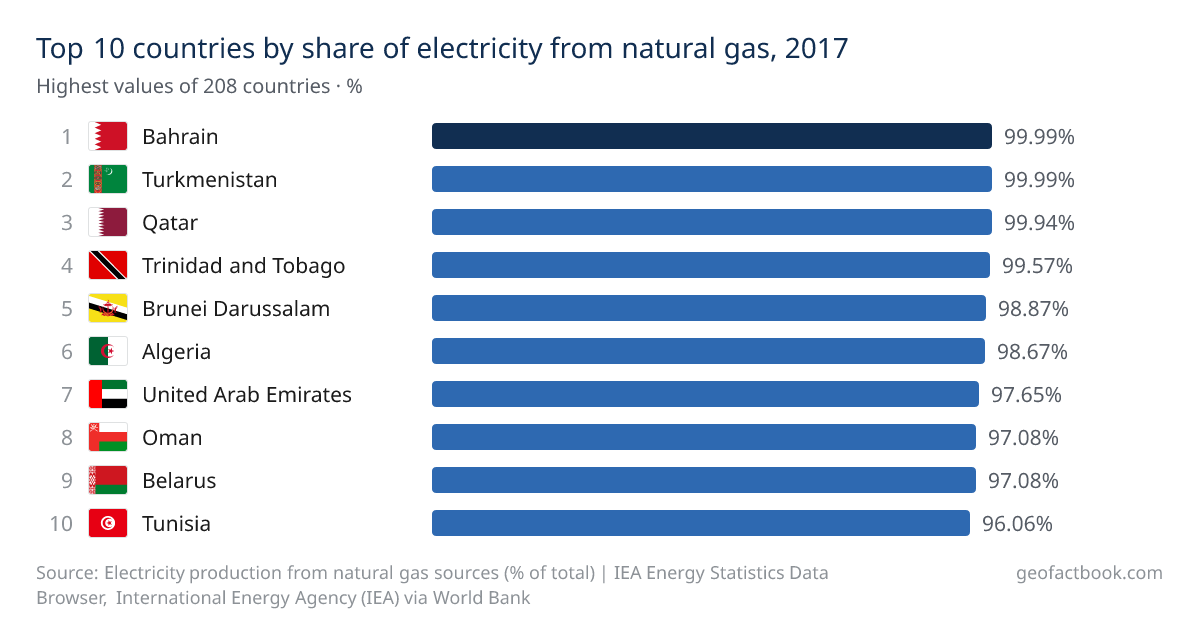
- #1
 Bahrain
- #2
 Turkmenistan
- #3
 Qatar
- #4
 Trinidad and Tobago
- #5
 Brunei Darussalam
- #6
 Algeria
- #7
 United Arab Emirates
- #8
 Oman
- #9
 Belarus
- #10
 Tunisia
Analysis: These countries represent the highest values in this dataset, showcasing significant scale and impact on global statistics.
- #208
 Zimbabwe
- #207
 Zambia
- #206
 State of Palestine
- #205
 United States Virgin Islands
- #204
 Vanuatu
- #203
 Uganda
- #202
 Tuvalu
- #201
 Turks and Caicos Islands
- #200
 Tonga
- #199
 Timor-Leste
Context: These countries or territories have the lowest values, often due to geographic size, administrative status, or specific characteristics.
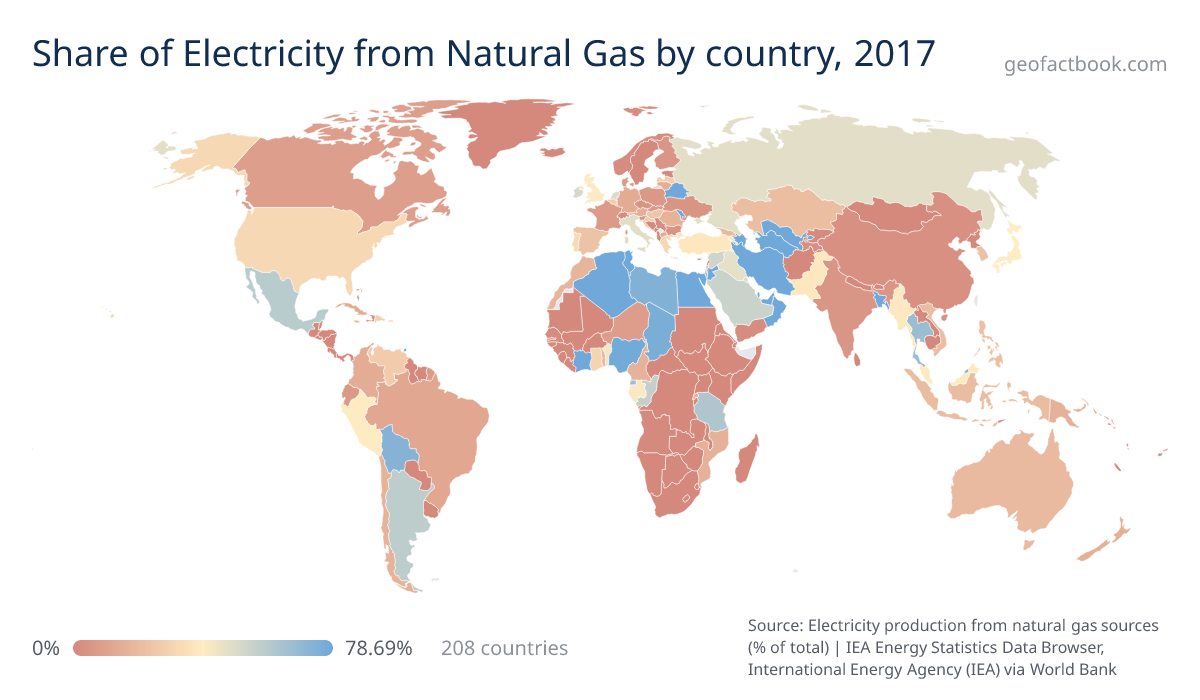
Share of Electricity from Natural Gas by country, 2017: map image
Top 10 countries by share of electricity from natural gas, 2017: chart
Insights by country
Austria
In 2017, Austria ranked #80 globally with a Share of Electricity from Natural Gas of 15.3006000785149%. This figure is relatively low compared to its neighbor Germany, which has a higher reliance on natural gas for electricity generation. Austria's energy policy emphasizes renewable sources, particularly hydropower, which accounts for a significant portion of its electricity supply, thereby limiting the role of natural gas in its energy mix.
Colombia
In 2017, Colombia ranked #83 globally with a Share of Electricity from Natural Gas of 13.8799192734611 %. This figure is relatively low compared to regional leaders like Brazil, which has a more diversified energy mix. Colombia's reliance on hydroelectric power, which accounts for a significant portion of its electricity generation, limits the share of natural gas in its energy portfolio.
British Virgin Islands
In 2017, the British Virgin Islands ranked #126 globally with a Share of Electricity from Natural Gas of 0%. This is significantly lower than many neighboring Caribbean nations that rely more on natural gas for energy production. The absence of natural gas infrastructure and the reliance on renewable sources and imported diesel fuel primarily drive this statistic in the British Virgin Islands.
Algeria
In 2017, Algeria ranked #6 globally with a Share of Electricity from Natural Gas of 98.6658078763342 %. This figure is notably higher than the global average, reflecting Algeria's significant reliance on natural gas for electricity generation compared to many countries that diversify their energy sources. The country's abundant natural gas reserves, combined with a strong domestic energy policy focused on maximizing these resources, drive this high percentage, underscoring Algeria's position as a major player in the energy sector.
Cuba
Cuba ranked #84 globally for its Share of Electricity from Natural Gas in 2017, with a value of 13.6248662321237 %. This percentage is notably lower than the global average, reflecting the country's reliance on a diverse energy mix that includes a significant portion of renewable sources. The limited infrastructure and economic constraints have hindered the expansion of natural gas usage, despite its potential to provide a cleaner energy alternative for Cuba's electricity generation.
Bahamas
In 2017, the Bahamas ranked #120 globally with a 0 % share of electricity from natural gas. This figure is notably lower than the global average, where many countries rely heavily on natural gas for electricity generation. The Bahamas' lack of natural gas utilization is primarily due to its reliance on imported oil for energy and the limited domestic energy infrastructure. Additionally, the country's small population and geographic dispersion make large-scale energy projects challenging.
Cabo Verde
Cabo Verde ranked #129 globally with a Share of Electricity from Natural Gas of 0 % in 2017. In comparison, many countries in the region rely more heavily on natural gas for electricity generation, highlighting Cabo Verde's unique energy profile. The archipelago's reliance on imported fossil fuels and limited natural resources has driven a focus on renewable energy sources, particularly wind and solar power, to meet its energy needs.
Costa Rica
Costa Rica ranked #134 globally in 2017, with a Share of Electricity from Natural Gas of 0 %. This figure is notably lower than many countries in Central America, where reliance on natural gas is more common. The country's commitment to renewable energy sources, particularly hydroelectric power, has significantly reduced its dependence on fossil fuels, reflecting its strong environmental policies and abundant natural resources.
Liberia
In 2017, Liberia ranked #162 globally with a Share of Electricity from Natural Gas of 0%. This figure is significantly lower than many neighboring countries in West Africa, where natural gas is increasingly utilized for electricity generation. The lack of infrastructure, limited investment in energy resources, and reliance on hydroelectric power and biomass are key factors contributing to this statistic in Liberia.
Jamaica
In 2017, Jamaica ranked #70 globally with a Share of Electricity from Natural Gas of 18.7300137048881 %. This figure is notably lower than the global average for natural gas electricity generation, reflecting Jamaica's reliance on a mix of energy sources, including renewable energy and imported oil. The country's energy policy has been shifting towards diversification, aiming to enhance energy security and reduce costs, influenced by its geographic location and limited domestic fossil fuel resources.
Analysis & Context
Bahrain led the world in the Share of Electricity from Natural Gas in 2017, achieving nearly 100%, while the global range spanned from 0.00% to 99.99%. The average share globally was 21.12%, highlighting diverse energy reliance patterns across countries.
Economic and Geographic Influences on Natural Gas Dependency
The reliance on natural gas for electricity generation is often driven by economic and geographic factors. In the Middle East, countries like Bahrain (99.99%), Qatar (99.94%), and United Arab Emirates (97.65%) demonstrate high percentages due to their abundant natural gas reserves and infrastructure investments. These nations prioritize gas as a cost-effective and locally abundant energy source.
Conversely, countries without natural gas reserves, such as Tonga and Timor-Leste, report a 0% share, indicating reliance on alternative energy sources or imports. The absence of indigenous natural gas production and the high costs of importing gas can significantly affect a country's energy strategy.
Policy and Infrastructure: Key Drivers of High Shares
For some nations, government policy plays a crucial role in shaping the energy landscape. In Algeria (98.67%) and Turkmenistan (99.99%), state policies support domestic natural gas utilization to reduce dependency on oil and coal, aligning with global trends towards cleaner energy sources. Additionally, infrastructure development for natural gas extraction and distribution has facilitated high shares in these countries.
In Belarus (97.08%) and Tunisia (96.06%), investments in gas-fired power plants have been pivotal. These countries have strategically developed their natural gas infrastructure to ensure energy security and meet growing electricity demand, reflecting a long-term commitment to natural gas.
Year-over-Year Changes: Significant Movers
Analyzing year-over-year changes reveals notable shifts in natural gas reliance. Benin saw a remarkable increase of 39.46 percentage points, a 1555.8% rise, driven by recent investments in natural gas infrastructure and policy shifts towards gas as a primary energy source. Similarly, Jamaica experienced a 15.92-point increase (566.1%), likely due to recent energy diversification efforts aimed at reducing oil dependence.
Conversely, Yemen experienced a significant decrease of 31.38 percentage points (-95.2%), reflecting geopolitical instability and disruptions in gas supply. In Latvia, a decrease of 18.37 points (-40.1%) suggests a strategic shift towards other energy sources, possibly in response to European Union energy policies promoting diversification.
Global Implications and Future Trends
The data from 2017 illustrates a complex global energy landscape where the Share of Electricity from Natural Gas varies widely. Countries with high shares demonstrate the advantages of resource abundance and strategic policy alignment, while those with low or zero shares often face challenges related to resource availability and economic constraints.
Looking forward, the transition towards renewable energy sources is expected to influence these patterns. Nations heavily reliant on natural gas may increasingly integrate renewables into their energy mix to enhance sustainability and meet international climate commitments. As technology advances and global energy policies evolve, the role of natural gas will likely adjust, impacting future energy statistics.
Frequently Asked Questions About Share of Electricity from Natural Gas in 2017
Which country had the highest share of electricity from natural gas in 2017?
Bahrain had the highest share of electricity from natural gas in 2017, with 99.99%.
What was the average share of electricity from natural gas across all countries in 2017?
The average share of electricity from natural gas across all countries in 2017 was 20.31%.
Which country had the lowest share of electricity from natural gas in 2017?
Afghanistan had the lowest share of electricity from natural gas in 2017, with 0%.
What was the median share of electricity from natural gas in 2017?
The median share of electricity from natural gas in 2017 was 1.53%.
How many countries had a 0% share of electricity from natural gas in 2017?
There were 10 countries with a 0% share of electricity from natural gas in 2017.
Which countries were among the top 10 for the highest share of electricity from natural gas in 2017?
The top 10 countries for the highest share of electricity from natural gas in 2017 included Bahrain, Turkmenistan, and Qatar, among others.
Data Source
Electricity production from natural gas sources (% of total) | IEA Energy Statistics Data Browser, International Energy Agency (IEA) via World Bank
Data produced by IEA Energy Statistics Data Browser, International Energy Agency (IEA), compiled and published by World Bank as "Electricity production from natural gas sources (% of total)".
Visit Data SourceCite this page
Geo Factbook. (n.d.). Share of Electricity from Natural Gas by Country, 2017. Retrieved November 28, 2026, from https://geofactbook.com/fact/share-of-electricity-from-natural-gas/2017
The figures on this page come from Electricity production from natural gas sources (% of total) | IEA Energy Statistics Data Browser, International Energy Agency (IEA) via World Bank. For academic work, cite the original source as well.
›Embed this ranking on your site
Free to embed with attribution. Shows the top 10 countries and links back to the full ranking.
Historical Data by Year
Explore Share of Electricity from Natural Gas data across different years. Compare trends and see how statistics have changed over time.
More Energy Facts
See all Energy facts →Electricity from Fossil Fuels
Electricity from fossil fuels measures energy generation trends. Compare countries, explore rankings, and analyze historical data with interactive maps.
Highest: Timor-Leste100 % of electricity generationRefined Petroleum Products Exports
Refined petroleum products exports reflect a country's economic strength. Compare nations, explore rankings, and view interactive maps.
 Highest: China848,400
Electricity Consumption
Electricity consumption data reveals energy usage trends across countries. Explore rankings and interactive maps for deeper insights.
Highest: China10,069.88 TWhYou might also like
Rule of Law Index by Country
FeaturedCompare countries by Rule of Law percentile rank, reflecting confidence in laws, courts, police, property rights, and protection from crime and violence.
 Highest: Finland100%
Currently married (Percent)
FeaturedThe percentage of currently married individuals by country highlights societal trends in family structure and relationships. Understanding these statistics can provide insights into cultural norms and demographic shifts, influencing policies and social programs.
 Highest: Bangladesh81.95%
Population Change
FeaturedThis statistic measures population change across countries, highlighting shifts in demographics. Understanding these changes is crucial for planning resources, economic growth, and social services.
 Highest: India14.13M persons