
Share of Electricity from Natural Gas 2023
Share of electricity generated from natural gas highlights energy reliance patterns globally.
Newer data is available: Share of Electricity from Natural Gas by country 2024 →
Where does your country rank? Pick it to see its position.
Related Energy statistics
More ↓Interactive Map
Complete Data Rankings
Rank | Actions | ||
|---|---|---|---|
1 |  Turkmenistan | 99.982 % | |
2 |  Bahrain | 99.707 % | |
3 |  Trinidad and Tobago | 99.558 % | |
4 |  Algeria | 98.904 % | |
5 |  Qatar | 96.606 % | |
6 |  Tunisia | 95.093 % | |
7 |  Singapore | 93.723 % | |
8 |  Oman | 92.537 % | |
9 |  Azerbaijan | 92.394 % | |
10 |  Malta | 85.708 % | |
11 |  Republic of Moldova | 84.7 % | |
12 |  Gibraltar | 80.952 % | |
13 |  Brunei Darussalam | 78.756 % | |
14 |  Iran | 78.744 % | |
15 |  Egypt | 77.9 % | |
16 |  Nigeria | 77.121 % | |
17 |  Uzbekistan | 75.858 % | |
18 |  Togo | 72.841 % | |
19 |  United Arab Emirates | 71.084 % | |
20 |  Israel | 70.855 % | |
21 |  Tanzania | 69.79 % | |
22 |  Côte d'Ivoire | 69.126 % | |
23 |  Benin | 68.582 % | |
24 |  Bolivia | 68.329 % | |
25 |  Equatorial Guinea | 67.643 % | |
26 |  Libya | 67.031 % | |
27 |  Bangladesh | 65.821 % | |
28 |  Belarus | 64.71 % | |
29 |  China, Hong Kong SAR | 64.391 % | |
30 |  Thailand | 64.135 % | |
31 |  Congo | 62.688 % | |
32 |  Kuwait | 62.555 % | |
33 |  Jordan | 61.647 % | |
34 |  Mexico | 60.867 % | |
35 |  Jamaica | 60.09 % | |
36 |  Ghana | 59.28 % | |
37 |  Saudi Arabia | 58.07 % | |
38 |  Iraq | 52.305 % | |
39 |  Syrian Arab Republic | 50.188 % | |
40 |  Ireland | 48.192 % | |
41 |  Myanmar | 47.497 % | |
42 |  Argentina | 45.615 % | |
43 |  Russia | 45.08 % | |
44 |  Italy | 44.949 % | |
45 |  Peru | 44.538 % | |
46 |  Armenia | 42.187 % | |
47 |  United States | 41.893 % | |
48 |  Gabon | 39.116 % | |
49 |  Dominican Republic | 38.134 % | |
50 |  Netherlands | 37.89 % | |
51 |  Malaysia | 37.138 % | |
52 |  United Kingdom | 34.609 % | |
53 |  Japan | 32.879 % | |
54 |  Greece | 32.012 % | |
55 |  Pakistan | 29.859 % | |
56 |  El Salvador | 29.58 % | |
57 |  Kazakhstan | 28.462 % | |
58 |  South Korea | 26.351 % | |
59 |  Rwanda | 25.168 % | |
60 |  Georgia | 23.939 % | |
61 |  Spain | 22.482 % | |
62 |  Latvia | 22.248 % | |
63 |  Croatia | 22.028 % | |
64 |  Belgium | 21.864 % | |
65 |  Portugal | 21.239 % | |
66 |  Turkey | 20.973 % | |
67 |  Hungary | 20.478 % | |
68 |  North Macedonia | 20.058 % | |
69 |  Panama | 18.919 % | |
70 |  Chile | 18.557 % | |
71 |  Australia | 17.837 % | |
72 |  Colombia | 16.438 % | |
73 |  Germany | 16.166 % | |
74 |  Cameroon | 15.889 % | |
75 |  Romania | 15.782 % | |
76 |  Canada | 15.727 % | |
77 |  Mozambique | 15.658 % | |
78 |  Philippines | 14.122 % | |
79 |  Indonesia | 12.623 % | |
80 |  Cuba | 12.601 % | |
81 |  Ukraine | 10.335 % | |
82 |  Austria | 10 % | |
83 |  Poland | 9.855 % | |
84 |  New Zealand | 9.839 % | |
85 |  Vietnam | 9.835 % | |
86 |  Lithuania | 9.769 % | |
87 |  Morocco | 9.744 % | |
88 |  Angola | 8.821 % | |
89 |  Slovakia | 7.635 % | |
90 |  France | 5.718 % | |
91 |  Brazil | 5.453 % | |
92 |  Venezuela | 5.401 % | |
93 |  Serbia | 4.912 % | |
94 |  Bulgaria | 4.824 % | |
95 |  Czech Republic | 4.758 % | |
96 |  Niger | 4.362 % | |
97 |  Luxembourg | 3.34 % | |
98 |  Slovenia | 3.136 % | |
99 |  India | 3.005 % | |
100 |  China | 2.967 % | |
101 |  Denmark | 2.932 % | |
102 |  Ecuador | 2.692 % | |
103 |  Kyrgyzstan | 1.449 % | |
104 |  Yemen | 1.182 % | |
105 |  Tajikistan | 1.02 % | |
106 |  Norway | 0.987 % | |
107 |  Finland | 0.809 % | |
108 |  Switzerland | 0.372 % | |
109 |  Estonia | 0.366 % | |
110 |  Senegal | 0.169 % | |
111 |  Sweden | 0.093 % | |
112 |  Bosnia and Herzegovina | 0.052 % | |
113 |  Guatemala | 0 % |
- #1Turkmenistan
- #2Bahrain
- #3Trinidad and Tobago
- #4Algeria
- #5Qatar
- #6Tunisia
- #7Singapore
- #8Oman
- #9Azerbaijan
- #10Malta
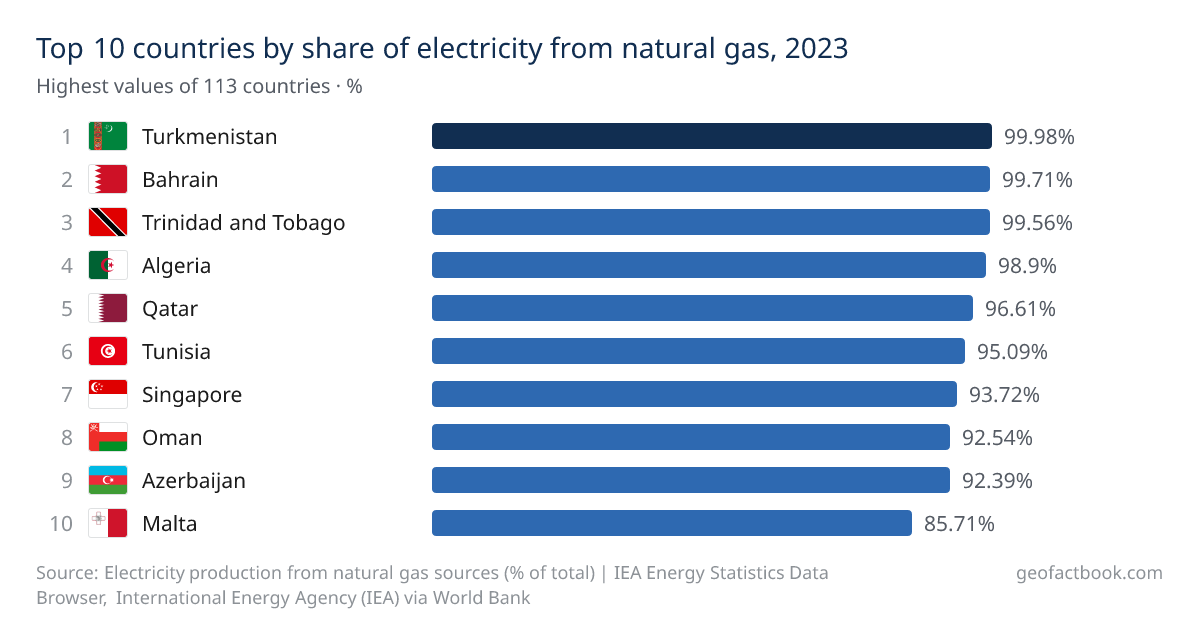
Analysis: These countries represent the highest values in this dataset, showcasing significant scale and impact on global statistics.
- #113Guatemala
- #112Bosnia and Herzegovina
- #111Sweden
- #110Senegal
- #109Estonia
- #108Switzerland
- #107Finland
- #106Norway
- #105Tajikistan
- #104Yemen
Context: These countries or territories have the lowest values, often due to geographic size, administrative status, or specific characteristics.
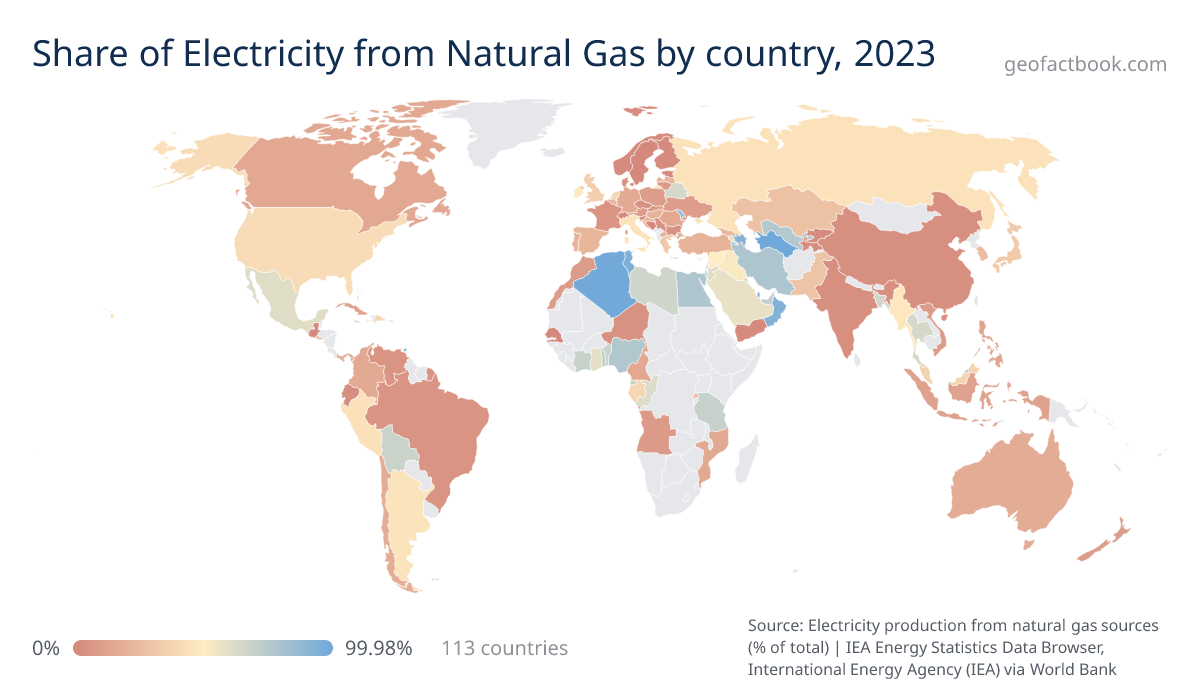
Share of Electricity from Natural Gas by country, 2023: map image
Top 10 countries by share of electricity from natural gas, 2023: chart
Insights by country
Netherlands
The Netherlands ranks #50 globally with a Share of Electricity from Natural Gas of 37.8904965471884% in 2023. This figure is notably higher than the European Union average, reflecting the country's reliance on natural gas for energy production. The Netherlands benefits from significant natural gas reserves, particularly from the Groningen field, which has historically influenced its energy policy and economic landscape.
China, Hong Kong SAR
In 2023, China, Hong Kong SAR ranked #29 globally with a Share of Electricity from Natural Gas of 64.3907590759076 %. This figure is notably higher than many regional peers, reflecting a significant reliance on natural gas for electricity generation. The region's energy policy has increasingly favored cleaner energy sources in response to air quality concerns and climate commitments, driving the shift towards natural gas over coal.
Bulgaria
Bulgaria ranks #94 globally in 2023, with a Share of Electricity from Natural Gas of 4.82424543534965 %. This figure is notably lower than the European Union average, reflecting the country's reliance on coal and nuclear energy sources. The limited use of natural gas in electricity generation can be attributed to Bulgaria's established energy infrastructure and ongoing efforts to transition towards renewable energy, which are still in the early stages of development.
Canada
In 2023, Canada ranks #76 globally with a Share of Electricity from Natural Gas of 15.7274512766279 %. This figure is notably lower than the global average, reflecting Canada's significant reliance on hydroelectric power, which constitutes a major portion of its electricity generation. The country's vast water resources and favorable geography enable it to harness hydroelectric energy effectively, while policies aimed at reducing greenhouse gas emissions further influence its energy mix.
Switzerland
In 2023, Switzerland ranks #108 globally with a Share of Electricity from Natural Gas of 0.371682130977551 %. This figure is notably lower than many European neighbors, reflecting Switzerland's strong reliance on hydroelectric power and nuclear energy for electricity generation. The country's commitment to sustainability and renewable energy sources significantly limits its dependence on natural gas, aligning with its environmental policies and energy strategy.
Congo
Congo ranks #31 globally with a Share of Electricity from Natural Gas of 62.6883308714919 % in 2023. This figure is notable compared to the global average, highlighting Congo's significant reliance on natural gas for electricity generation. The country's abundant natural gas reserves, coupled with ongoing investments in energy infrastructure, have driven this high percentage, positioning it as a key player in the region's energy landscape.
Algeria
In 2023, Algeria ranks #4 globally with a Share of Electricity from Natural Gas of 98.9036944139625 %. This high percentage is significantly above the global average, reflecting the country's heavy reliance on natural gas for energy production compared to many other nations. Algeria's vast natural gas reserves and government policies favoring gas utilization for electricity generation are primary drivers of this statistic.
Greece
In 2023, Greece ranks #54 globally with a Share of Electricity from Natural Gas of 32.0117797900473 %. This figure is notable as it is higher than many European neighbors, reflecting the country's reliance on natural gas amidst a transition to cleaner energy sources. Greece's geographic position and energy policies have led to increased investments in natural gas infrastructure, aiming to reduce dependence on more polluting fossil fuels while enhancing energy security.
Russia
In 2023, Russia ranks #43 globally with a Share of Electricity from Natural Gas of 45.0800033071071 %. This figure is notable compared to the global average, reflecting a significant reliance on natural gas for electricity generation, particularly when contrasted with countries that prioritize renewable energy sources. Russia's vast natural gas reserves and established infrastructure facilitate this dependency, making it a key player in the global energy market.
United Kingdom
The United Kingdom ranks #52 globally, with a Share of Electricity from Natural Gas of 34.6093203118098 % in 2023. This figure is notable as it is higher than many European neighbors, reflecting the UK's reliance on natural gas amid a shift from coal. The UK's energy policy has increasingly favored natural gas as a transitional fuel, driven by commitments to reduce carbon emissions while ensuring energy security.
Analysis & Context
In 2023, the country with the highest Share of Electricity from Natural Gas is Turkmenistan, boasting a remarkable 99.98%. Globally, the share ranges from a minimum of 0.00% to a maximum of 99.98%. The global average stands at 37.19%, providing a clear picture of energy reliance patterns worldwide.
Natural Gas Dominance in Energy Production
The predominance of natural gas in electricity generation is particularly evident in the Middle East and North Africa (MENA) region. Countries like Bahrain (99.71%), Qatar (96.61%), and Oman (92.54%) exemplify this trend. The abundance of natural gas reserves in these regions, coupled with established extraction and distribution infrastructures, has facilitated their heavy reliance on this resource for electricity generation. Additionally, the strategic choice to use domestically available natural gas helps these countries reduce dependence on imported energy sources, thus ensuring energy security.
Minimal Reliance on Natural Gas
On the opposite end of the spectrum, several nations demonstrate minimal reliance on natural gas for their electricity needs. For instance, Guatemala and Sweden report shares as low as 0% and 0.09%, respectively. This pattern often correlates with alternative energy strategies, such as Sweden's investment in renewable energy sources like hydroelectric and nuclear power. Similarly, countries with negligible natural gas resources or those emphasizing sustainability may opt for diverse energy portfolios, minimizing their dependence on fossil fuels.
Economic and Policy Drivers
The share of electricity from natural gas is not solely determined by resource availability; economic and policy factors play significant roles. In Trinidad and Tobago (99.56%) and Algeria (98.90%), government policies have historically favored the development of natural gas sectors to capitalize on their natural endowments. Conversely, countries like Portugal and Jordan, which saw significant decreases of -14.40% and -11.42% respectively over the past year, may be shifting towards renewable energies as part of broader environmental commitments or due to economic pressures to diversify energy sources.
Year-Over-Year Changes and Their Implications
The year-over-year changes in the share of electricity from natural gas reveal intriguing trends. El Salvador experienced a substantial increase of 15.68%, representing a 112.8% surge, suggesting a strategic pivot towards natural gas, possibly due to new infrastructure investments or policy shifts. In contrast, Portugal's significant decrease could reflect a conscious move towards reducing carbon emissions in line with EU energy policies. Meanwhile, other countries like the Dominican Republic and Kuwait also recorded notable increases, potentially driven by economic growth necessitating rapid expansion of energy capacity using readily available natural gas.
Global Energy Transition and Natural Gas
As the world progresses towards a more sustainable energy future, the role of natural gas remains pivotal yet transitional. While countries like Singapore (93.72%) and Malta (85.71%) continue to rely heavily on natural gas, the global average of 37.19% indicates a varied adoption rate. This diversity reflects both the ongoing transition to renewable energy sources and the pragmatic utilization of natural gas as a bridge fuel. The shifts observed in countries' shares signify both strategic economic decisions and responses to global pressures for cleaner energy solutions.
Frequently Asked Questions About Share of Electricity from Natural Gas in 2023
Which country had the highest share of electricity from natural gas in 2023?
Turkmenistan had the highest share of electricity from natural gas in 2023, with 99.98%.
Which country had the lowest share of electricity from natural gas in 2023?
Guatemala had the lowest share of electricity from natural gas in 2023, with 0%.
What was the average share of electricity from natural gas across countries in 2023?
The average share of electricity from natural gas across countries in 2023 was 37.19%.
What was the median share of electricity from natural gas in 2023?
The median share of electricity from natural gas in 2023 was 28.46%.
Which countries were in the top 3 for the share of electricity from natural gas in 2023?
The top 3 countries for the share of electricity from natural gas in 2023 were Turkmenistan, Bahrain, and Trinidad and Tobago.
How many countries had a share of electricity from natural gas below 1% in 2023?
There were nine countries with a share of electricity from natural gas below 1% in 2023.
Data Source
Electricity production from natural gas sources (% of total) | IEA Energy Statistics Data Browser, International Energy Agency (IEA) via World Bank
Data produced by IEA Energy Statistics Data Browser, International Energy Agency (IEA), compiled and published by World Bank as "Electricity production from natural gas sources (% of total)".
Visit Data SourceCite this page
Geo Factbook. (n.d.). Share of Electricity from Natural Gas by Country, 2023. Retrieved November 28, 2026, from https://geofactbook.com/fact/share-of-electricity-from-natural-gas/2023
The figures on this page come from Electricity production from natural gas sources (% of total) | IEA Energy Statistics Data Browser, International Energy Agency (IEA) via World Bank. For academic work, cite the original source as well.
›Embed this ranking on your site
Free to embed with attribution. Shows the top 10 countries and links back to the full ranking.
Historical Data by Year
Explore Share of Electricity from Natural Gas data across different years. Compare trends and see how statistics have changed over time.
More Energy Facts
See all Energy facts →Electricity from Fossil Fuels
Electricity from fossil fuels measures energy generation trends. Compare countries, explore rankings, and analyze historical data with interactive maps.
 Highest: Timor-Leste100 % of electricity generation
Refined Petroleum Products Exports
Refined petroleum products exports reflect a country's economic strength. Compare nations, explore rankings, and view interactive maps.
Highest: China848,400Electricity Consumption
Electricity consumption data reveals energy usage trends across countries. Explore rankings and interactive maps for deeper insights.
Highest: China10,069.88 TWhYou might also like
Rule of Law Index by Country
FeaturedCompare countries by Rule of Law percentile rank, reflecting confidence in laws, courts, police, property rights, and protection from crime and violence.
Highest: Finland100%Currently married (Percent)
FeaturedThe percentage of currently married individuals by country highlights societal trends in family structure and relationships. Understanding these statistics can provide insights into cultural norms and demographic shifts, influencing policies and social programs.
Highest: Bangladesh81.95%Population Change
FeaturedThis statistic measures population change across countries, highlighting shifts in demographics. Understanding these changes is crucial for planning resources, economic growth, and social services.
Highest: India14.13M persons