
Share of Electricity from Natural Gas 2021
Share of electricity generated from natural gas highlights energy reliance patterns globally.
Newer data is available: Share of Electricity from Natural Gas by country 2024 →
Where does your country rank? Pick it to see its position.
Related Energy statistics
More ↓

Interactive Map
Complete Data Rankings












































































































































































- #1
 Turkmenistan
- #2
 Qatar
- #3
 Bahrain
- #4
 Trinidad and Tobago
- #5
 Algeria
- #6
 Tunisia
- #7
 Oman
- #8
 Singapore
- #9
 Republic of Moldova
- #10
 Azerbaijan
Analysis: These countries represent the highest values in this dataset, showcasing significant scale and impact on global statistics.
- #208
 Zimbabwe
- #207
 Zambia
- #206
 State of Palestine
- #205
 United States Virgin Islands
- #204
 Vanuatu
- #203
 Uganda
- #202
 Tuvalu
- #201
 Turks and Caicos Islands
- #200
 Tonga
- #199
 Timor-Leste
Context: These countries or territories have the lowest values, often due to geographic size, administrative status, or specific characteristics.
Share of Electricity from Natural Gas by country, 2021: map image
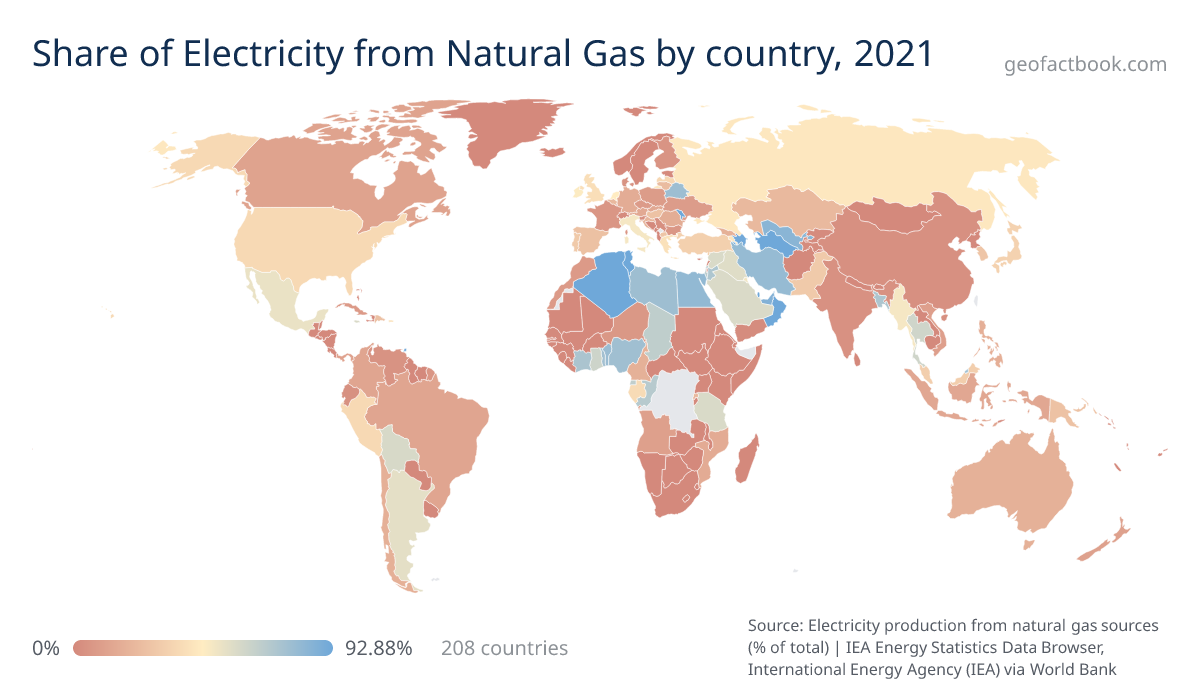
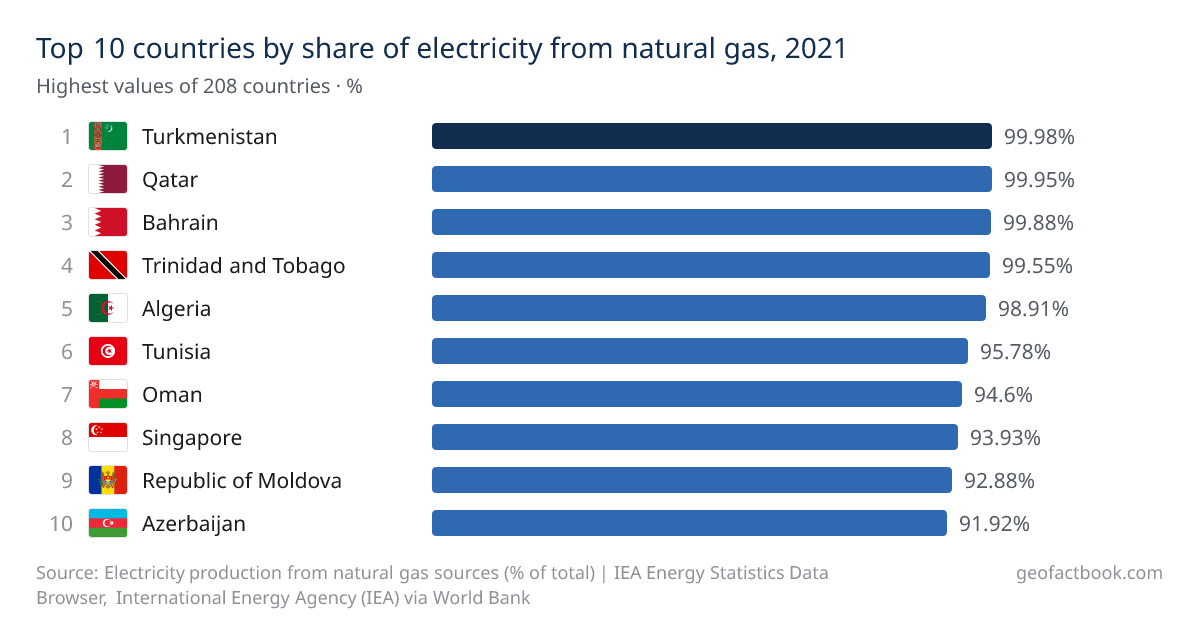
Top 10 countries by share of electricity from natural gas, 2021: chart
Insights by country
Micronesia (Fed. States of)
In 2021, Micronesia (Fed. States of) ranked #181 globally with a Share of Electricity from Natural Gas of 0 %. This places Micronesia among the lowest in the world, with many neighboring Pacific island nations relying more heavily on imported fossil fuels for energy. The country's lack of natural gas infrastructure and reliance on renewable energy sources, such as solar and biomass, significantly contribute to this statistic.
South Africa
In 2021, South Africa ranked #195 globally with a Share of Electricity from Natural Gas of 0%. This is significantly lower than many neighboring countries, which have begun to incorporate natural gas into their energy mix. The lack of natural gas infrastructure and reliance on coal for electricity generation are key factors contributing to this statistic, as South Africa continues to face challenges in transitioning to more diverse energy sources.
Montenegro
In 2021, Montenegro ranked #171 globally with a Share of Electricity from Natural Gas of 0 %. This figure is significantly lower than many European countries, reflecting a reliance on alternative energy sources. Montenegro's energy landscape is primarily shaped by its abundant hydropower resources and limited natural gas infrastructure, which has hindered the development of gas-fired power generation.
Spain
In 2021, Spain ranked #65 globally with a Share of Electricity from Natural Gas of 26.0659395141299 %. This figure is notably higher than the European Union average, reflecting Spain's significant reliance on natural gas for electricity generation. The country's geographic position and infrastructure investments have facilitated a growing natural gas market, while its energy policies aim to balance renewable energy integration with existing fossil fuel sources.
Liberia
In 2021, Liberia ranked #163 globally with a Share of Electricity from Natural Gas of 0%. This figure is significantly lower than many neighboring countries, indicating a reliance on alternative energy sources. The lack of natural gas infrastructure and limited investment in energy development are key factors contributing to this statistic in Liberia.
Marshall Islands
In 2021, the Marshall Islands ranked #182 globally with a Share of Electricity from Natural Gas of 0 %. This is significantly lower than many neighboring Pacific nations that utilize natural gas as an energy source. The absence of natural gas infrastructure and reliance on imported fossil fuels hinder the country's energy diversification efforts, while its small population and geographic isolation limit the feasibility of developing such resources.
Norway
In 2021, Norway ranked #114 globally with a Share of Electricity from Natural Gas of 0.193133318980256 %. This is significantly lower than the global average, reflecting Norway's reliance on renewable energy sources such as hydropower, which accounts for the majority of its electricity generation. The country’s abundant water resources and strong environmental policies prioritize sustainability, resulting in minimal dependence on fossil fuels for electricity production.
Vietnam
In 2021, Vietnam ranked #88 globally with a Share of Electricity from Natural Gas of 10.3878466300297 %. This figure is relatively low compared to regional leaders like Thailand, which has a significantly higher reliance on natural gas for electricity generation. The country's energy mix is shaped by its growing economy and increasing electricity demand, alongside a government push for renewable energy sources and a gradual transition from coal dependency.
Malaysia
In 2021, Malaysia ranked #57 globally with a Share of Electricity from Natural Gas of 32.4640112897043 %. This figure is notable when compared to the global average, reflecting Malaysia's reliance on natural gas as a primary energy source. The country's abundant natural gas reserves and infrastructure investments have positioned it as a key player in the energy sector, driving economic growth while meeting domestic energy needs.
Malta
In 2021, Malta ranked #12 globally with a Share of Electricity from Natural Gas of 86.0885275519422%. This figure is significantly higher than the global average, reflecting Malta's reliance on natural gas for electricity generation compared to countries with more diverse energy portfolios. The high percentage is driven by Malta's limited natural resources and its strategic investments in natural gas infrastructure to ensure energy security and reduce dependence on imported oil.
Analysis & Context
In 2021, the country with the highest Share of Electricity from Natural Gas was Turkmenistan, reaching an astounding 99.98%. Globally, the share of electricity from natural gas varied significantly, with a range from 0.00% to 99.98%. The average share worldwide was 22.45%, while the median was notably lower at 4.64%, reflecting the skewed distribution toward countries with minimal reliance on natural gas for electricity generation.
Geopolitical and Economic Drivers of High Natural Gas Dependency
The significant reliance on natural gas for electricity generation in countries like Turkmenistan (99.98%), Qatar (99.95%), and Bahrain (99.88%) can largely be attributed to their abundant natural gas reserves and strategic energy policies. These nations possess substantial natural gas fields, enabling them to utilize this resource extensively for domestic energy needs. For example, Qatar is known for its vast North Field, one of the largest natural gas reserves globally, which supports its near-total reliance on this resource for electricity.
Furthermore, these countries have developed infrastructure and investments focused on maximizing the utilization of natural gas, driven by both economic incentives and the need to diversify energy portfolios away from oil. The high dependency also reflects their strategic export markets, where natural gas serves as a critical economic lever.
Minimal Usage and Its Implications
At the other end of the spectrum, several countries reported a 0% share of electricity from natural gas, such as Tonga, Timor-Leste, and Suriname. This absence can often be explained by geographical and infrastructural limitations, as well as the availability of alternative energy sources. For island nations like Tonga, reliance on imported fuels and renewable energy sources like solar and wind is more feasible due to the high costs and logistical challenges associated with natural gas infrastructure.
These nations often prioritize renewable energy development as part of sustainable energy policies, minimizing reliance on fossil fuels. Countries like Saint Vincent and the Grenadines and Saint Lucia are investing in solar projects to reduce dependency on imported energy sources, aligning with global sustainability goals.
Year-over-Year Changes and Emerging Trends
The average change in the share of electricity from natural gas was a decrease of 0.32% (6.2%), indicating a gradual shift in energy strategies. Notably, the Syrian Arab Republic experienced a significant increase of 21.76% (59.2%), reflecting geopolitical shifts and reconstruction efforts focusing on accessible energy sources amid ongoing conflict. Similarly, Puerto Rico saw a 12.36% (41.9%) increase as it adapted its energy infrastructure post-natural disasters, emphasizing natural gas as a transitional fuel.
Conversely, countries like the Netherlands and Belarus saw notable decreases of 12.43% and 11.92%, respectively. This reduction aligns with broader European Union efforts to decrease fossil fuel dependency and increase renewable energy integration, driven by environmental policies and climate commitments.
Implications for Global Energy Policy
The diverse range in the Share of Electricity from Natural Gas across countries underscores the complexity of global energy dynamics. For regions heavily reliant on natural gas, such as the Middle East, the focus remains on leveraging this resource for economic growth while gradually integrating renewables to meet international climate targets. Meanwhile, countries with negligible natural gas usage are often at the forefront of renewable energy adoption, setting benchmarks for sustainable energy transitions.
The data from 2021 highlights the ongoing global shift towards cleaner energy sources, influenced by technological advancements, policy changes, and environmental considerations. As countries reassess their energy strategies, the role of natural gas as a transitional energy source will be pivotal in balancing economic growth with sustainability goals.
Frequently Asked Questions About Share of Electricity from Natural Gas in 2021
Which country had the highest share of electricity from natural gas in 2021?
Turkmenistan had the highest share of electricity from natural gas in 2021, with 99.98%.
What was the average share of electricity from natural gas across all countries in 2021?
The average share of electricity from natural gas across all countries in 2021 was 21.59%.
Which country had the lowest share of electricity from natural gas in 2021?
Afghanistan had the lowest share of electricity from natural gas in 2021, with 0%.
What was the median share of electricity from natural gas in 2021?
The median share of electricity from natural gas in 2021 was 3.2%.
How many countries had a 0% share of electricity from natural gas in 2021?
In 2021, 10 countries had a 0% share of electricity from natural gas, including Afghanistan, Zambia, and the State of Palestine.
Which countries were in the top 3 for the share of electricity from natural gas in 2021?
The top 3 countries for the share of electricity from natural gas in 2021 were Turkmenistan (99.98%), Qatar (99.95%), and Bahrain (99.88%).
Data Source
Electricity production from natural gas sources (% of total) | IEA Energy Statistics Data Browser, International Energy Agency (IEA) via World Bank
Data produced by IEA Energy Statistics Data Browser, International Energy Agency (IEA), compiled and published by World Bank as "Electricity production from natural gas sources (% of total)".
Visit Data SourceCite this page
Geo Factbook. (n.d.). Share of Electricity from Natural Gas by Country, 2021. Retrieved November 28, 2026, from https://geofactbook.com/fact/share-of-electricity-from-natural-gas/2021
The figures on this page come from Electricity production from natural gas sources (% of total) | IEA Energy Statistics Data Browser, International Energy Agency (IEA) via World Bank. For academic work, cite the original source as well.
›Embed this ranking on your site
Free to embed with attribution. Shows the top 10 countries and links back to the full ranking.
Historical Data by Year
Explore Share of Electricity from Natural Gas data across different years. Compare trends and see how statistics have changed over time.
More Energy Facts
See all Energy facts →Electricity from Fossil Fuels
Electricity from fossil fuels measures energy generation trends. Compare countries, explore rankings, and analyze historical data with interactive maps.
Highest: Timor-Leste100 % of electricity generationRefined Petroleum Products Exports
Refined petroleum products exports reflect a country's economic strength. Compare nations, explore rankings, and view interactive maps.
 Highest: China848,400
Electricity Consumption
Electricity consumption data reveals energy usage trends across countries. Explore rankings and interactive maps for deeper insights.
Highest: China10,069.88 TWhYou might also like
Rule of Law Index by Country
FeaturedCompare countries by Rule of Law percentile rank, reflecting confidence in laws, courts, police, property rights, and protection from crime and violence.
 Highest: Finland100%
Currently married (Percent)
FeaturedThe percentage of currently married individuals by country highlights societal trends in family structure and relationships. Understanding these statistics can provide insights into cultural norms and demographic shifts, influencing policies and social programs.
 Highest: Bangladesh81.95%
Population Change
FeaturedThis statistic measures population change across countries, highlighting shifts in demographics. Understanding these changes is crucial for planning resources, economic growth, and social services.
 Highest: India14.13M persons