
Military Spending 2018
Military spending data reveals a country's budget priorities and defense investment. Analyze how nations allocate their resources.
Newer data is available: Military Spending by country 2025 →
Where does your country rank? Pick it to see its position.
Related Military and Security statistics
More ↓
Interactive Map
Complete Data Rankings
Rank | Actions | ||
|---|---|---|---|
1 |  United States | 682,491,400,000 USD | |
2 |  China | 232,542,136,545.424 USD | |
3 |  Saudi Arabia | 74,612,266,666.667 USD | |
4 |  India | 66,228,148,024.679 USD | |
5 |  Russia | 61,649,658,199.489 USD | |
6 |  United Kingdom | 55,832,916,405.249 USD | |
7 |  France | 51,349,083,040.783 USD | |
8 |  Japan | 48,518,345,803.578 USD | |
9 |  Germany | 46,522,788,854.934 USD | |
10 |  South Korea | 43,069,973,342.875 USD | |
11 |  Brazil | 28,177,406,872.264 USD | |
12 |  Italy | 27,705,227,624.14 USD | |
13 |  Australia | 26,839,820,914.402 USD | |
14 |  Canada | 21,586,500,490.545 USD | |
15 |  Turkey | 19,646,381,099.184 USD | |
16 |  Israel | 19,262,765,541.054 USD | |
17 |  Spain | 17,823,271,130.626 USD | |
18 |  Poland | 12,039,371,859.181 USD | |
19 |  Iran | 11,795,842,412.295 USD | |
20 |  Pakistan | 11,538,963,629.869 USD | |
21 |  Netherlands | 11,114,927,469.518 USD | |
22 |  Singapore | 10,582,246,495.45 USD | |
23 |  Colombia | 10,134,719,590.551 USD | |
24 |  Algeria | 9,583,724,288.37 USD | |
25 |  Oman | 7,565,344,603.381 USD | |
26 |  Norway | 7,541,055,169.177 USD | |
27 |  Indonesia | 7,493,183,871.712 USD | |
28 |  Kuwait | 7,165,279,059.536 USD | |
29 |  Vietnam | 6,893,976,431.341 USD | |
30 |  Thailand | 6,662,163,295.026 USD | |
31 |  Iraq | 6,330,162,756.288 USD | |
32 |  Mexico | 5,839,521,271.02 USD | |
33 |  Greece | 5,760,223,717.02 USD | |
34 |  Sweden | 5,733,666,365.578 USD | |
35 |  Chile | 5,545,831,932.779 USD | |
36 |  Belgium | 4,842,740,158.353 USD | |
37 |  Ukraine | 4,758,108,384.987 USD | |
38 |  Switzerland | 4,736,844,967.477 USD | |
39 |  Denmark | 4,558,690,186.912 USD | |
40 |  Romania | 4,358,871,359.89 USD | |
41 |  Philippines | 4,107,465,372.457 USD | |
42 |  Argentina | 3,842,852,365.318 USD | |
43 |  Finland | 3,756,616,295.686 USD | |
44 |  Morocco | 3,696,571,637.943 USD | |
45 |  Bangladesh | 3,648,878,144.762 USD | |
46 |  South Africa | 3,626,098,807.715 USD | |
47 |  Malaysia | 3,445,043,719.6 USD | |
48 |  Austria | 3,387,982,011.968 USD | |
49 |  Portugal | 3,361,542,910.426 USD | |
50 |  Egypt | 3,119,587,363.842 USD | |
51 |  Lebanon | 2,775,557,816.207 USD | |
52 |  Czech Republic | 2,751,920,355.577 USD | |
53 |  Peru | 2,648,439,810.155 USD | |
54 |  Ecuador | 2,549,400,000 USD | |
55 |  New Zealand | 2,302,338,733.475 USD | |
56 |  Nigeria | 2,137,974,106.858 USD | |
57 |  Angola | 1,982,252,744.884 USD | |
58 |  Jordan | 1,957,746,478.873 USD | |
59 |  Azerbaijan | 1,672,176,470.588 USD | |
60 |  Sri Lanka | 1,639,179,094.302 USD | |
61 |  Hungary | 1,615,400,272.626 USD | |
62 |  North Korea | 1,604,444,444.444 USD | |
63 |  Myanmar | 1,531,411,936.412 USD | |
64 |  Bahrain | 1,527,659,574.468 USD | |
65 |  Kazakhstan | 1,498,611,134.615 USD | |
66 |  Uzbekistan | 1,440,466,815.758 USD | |
67 |  Slovakia | 1,285,365,249.106 USD | |
68 |  Uruguay | 1,271,768,639.862 USD | |
69 |  Kenya | 1,113,648,361.645 USD | |
70 |  Ireland | 1,107,137,377.099 USD | |
71 |  Serbia | 1,064,842,242.364 USD | |
72 |  Lithuania | 1,056,383,744.674 USD | |
73 |  Sudan | 995,839,891.797 USD | |
74 |  Bulgaria | 961,297,274.594 USD | |
75 |  Croatia | 950,582,488.179 USD | |
76 |  Belarus | 923,273,609.174 USD | |
77 |  Tunisia | 843,676,800.242 USD | |
78 |  Latvia | 709,370,536.926 USD | |
79 |  Estonia | 615,277,299.608 USD | |
80 |  Côte d'Ivoire | 607,848,217.884 USD | |
81 |  Bolivia | 603,066,852.133 USD | |
82 |  Tanzania | 603,017,517.149 USD | |
83 |  Dominican Republic | 593,678,722.09 USD | |
84 |  Cambodia | 542,653,031.611 USD | |
85 |  Slovenia | 529,496,122.659 USD | |
86 |  Armenia | 513,252,026.482 USD | |
87 |  Ethiopia | 507,010,973.514 USD | |
88 |  Botswana | 498,087,432.355 USD | |
89 |  Mali | 481,728,184.478 USD | |
90 |  Namibia | 455,979,605.472 USD | |
91 |  Cyprus | 450,408,979.852 USD | |
92 |  Cameroon | 429,892,180.572 USD | |
93 |  Nepal | 428,299,298.275 USD | |
94 |  Zimbabwe | 420,364,000 USD | |
95 |  Uganda | 408,436,536.084 USD | |
96 |  Paraguay | 386,629,374.683 USD | |
97 |  Senegal | 385,132,363.102 USD | |
98 |  Zambia | 378,227,569.721 USD | |
99 |  Honduras | 358,497,584.489 USD | |
100 |  Brunei Darussalam | 357,708,767.504 USD | |
101 |  Georgia | 333,912,381.841 USD | |
102 |  Burkina Faso | 305,781,079.058 USD | |
103 |  Congo, Democratic Republic of the | 295,348,364.635 USD | |
104 |  El Salvador | 294,610,000 USD | |
105 |  Congo | 292,260,465.25 USD | |
106 |  Luxembourg | 291,063,819.742 USD | |
107 |  Guatemala | 273,114,976.844 USD | |
108 |  Gabon | 261,217,395.06 USD | |
109 |  Chad | 253,174,123.337 USD | |
110 |  Kyrgyzstan | 250,494,252.349 USD | |
111 |  Niger | 229,639,906.144 USD | |
112 |  Ghana | 219,311,172.054 USD | |
113 |  Jamaica | 209,667,350.832 USD | |
114 |  Afghanistan | 198,074,728.574 USD | |
115 |  Guinea | 197,079,526.352 USD | |
116 |  Mozambique | 196,518,237.482 USD | |
117 |  Albania | 175,897,273.646 USD | |
118 |  Bosnia and Herzegovina | 172,073,317.815 USD | |
119 |  Trinidad and Tobago | 165,967,559.121 USD | |
120 |  Mauritania | 159,282,460.935 USD | |
121 |  Equatorial Guinea | 149,498,690.044 USD | |
122 |  South Sudan | 136,984,353.697 USD | |
123 |  Cuba | 128,609,126.956 USD | |
124 |  Rwanda | 119,025,994.801 USD | |
125 |  North Macedonia | 117,392,812.529 USD | |
126 |  Togo | 104,378,994.645 USD | |
127 |  Eswatini | 95,863,380.323 USD | |
128 |  Benin | 90,260,724.939 USD | |
129 |  Mongolia | 88,155,189.474 USD | |
130 |  Nicaragua | 81,690,573.141 USD | |
131 |  Tajikistan | 81,420,867.535 USD | |
132 |  Fiji | 81,378,313.571 USD | |
133 |  Papua New Guinea | 79,612,248.12 USD | |
134 |  Somalia | 76,562,000 USD | |
135 |  Montenegro | 75,365,603.201 USD | |
136 |  Madagascar | 73,217,433.062 USD | |
137 |  Malta | 66,869,091.038 USD | |
138 |  Burundi | 65,436,595.263 USD | |
139 |  Kosovo | 63,344,074.218 USD | |
140 |  Guyana | 61,799,566.717 USD | |
141 |  Malawi | 58,246,665.908 USD | |
142 |  Lesotho | 51,064,347.755 USD | |
143 |  Republic of Moldova | 37,394,242.702 USD | |
144 |  Central African Republic | 30,517,648.414 USD | |
145 |  Sierra Leone | 29,759,324.115 USD | |
146 |  Belize | 23,341,162.5 USD | |
147 |  Mauritius | 23,044,428.302 USD | |
148 |  Seychelles | 21,507,978.631 USD | |
149 |  Timor-Leste | 20,610,000 USD | |
150 |  Liberia | 13,229,000 USD | |
151 |  Gambia | 11,477,457.171 USD | |
152 |  Cabo Verde | 10,714,071.127 USD | |
153 |  Guinea-Bissau | 10,630,254.218 USD | |
154 |  Haiti | 9,682,978.337 USD | |
155 |  Costa Rica | 0 USD | |
156 |  Iceland | 0 USD | |
157 |  Panama | 0 USD |
- #1United States
- #2China
- #3Saudi Arabia
- #4India
- #5Russia
- #6United Kingdom
- #7France
- #8Japan
- #9Germany
- #10South Korea
Analysis: These countries represent the highest values in this dataset, showcasing significant scale and impact on global statistics.
- #157Panama
- #156Iceland
- #155Costa Rica
- #154Haiti
- #153Guinea-Bissau
- #152Cabo Verde
- #151Gambia
- #150Liberia
- #149Timor-Leste
- #148Seychelles
Context: These countries or territories have the lowest values, often due to geographic size, administrative status, or specific characteristics.
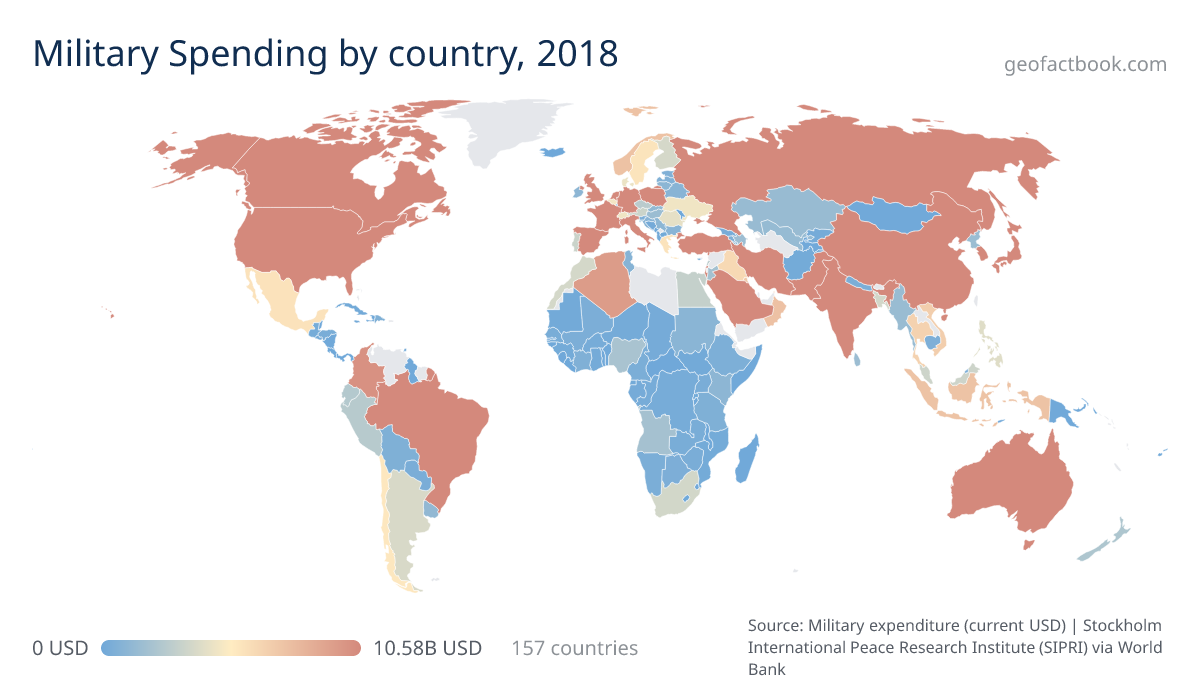
Military Spending by country, 2018: map image
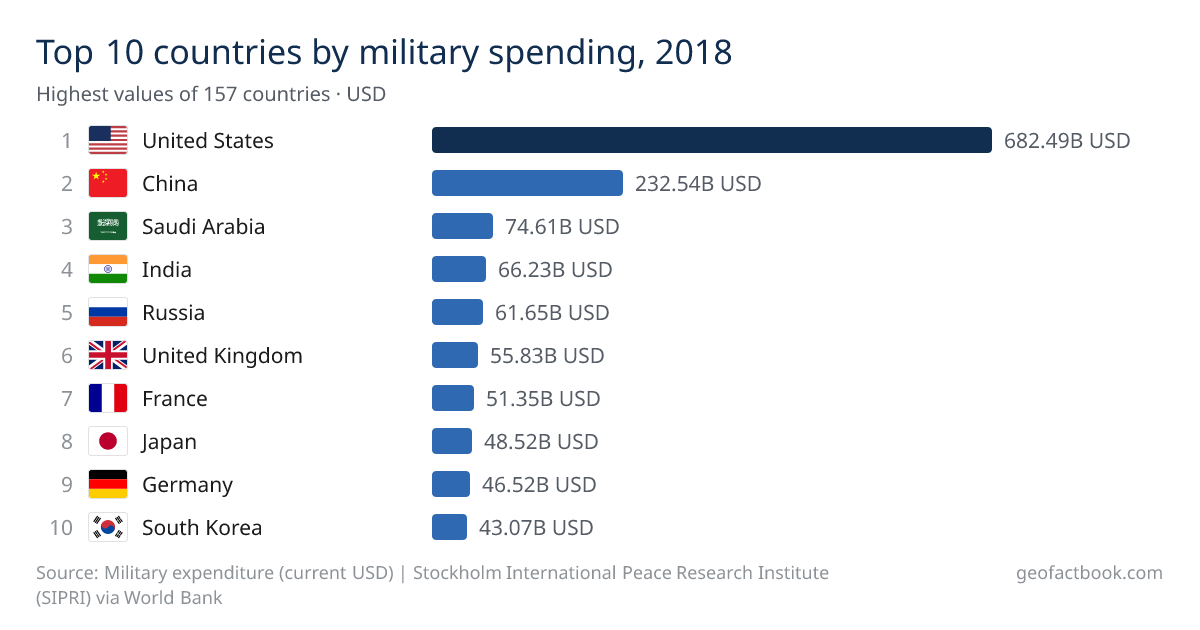
Top 10 countries by military spending, 2018: chart
Insights by country
Lebanon
In 2018, Lebanon ranked #51 globally in military spending, with a total of 2,775,557,816.21 USD. This figure is notable when compared to regional neighbors, as Lebanon's military expenditure reflects ongoing security challenges amidst a complex geopolitical landscape. The high spending is driven by the need to maintain stability in a country that hosts a significant number of refugees and faces threats from various non-state actors.
Kyrgyzstan
Kyrgyzstan ranked #110 globally in military spending with a total of 250494252.349231 USD in 2018. This figure is notably lower than many of its Central Asian neighbors, reflecting a regional trend where military budgets are often constrained by economic factors.
The country's military spending is influenced by its strategic location, bordering major powers such as China and Russia, which necessitates a focus on defense despite limited financial resources. Additionally, Kyrgyzstan's economic challenges and reliance on remittances shape its defense priorities and spending capabilities.
Liberia
In 2018, Liberia ranked #150 in military spending with a total of 13,229,000 USD. This amount is significantly lower than many of its regional neighbors, reflecting Liberia's ongoing recovery from years of civil conflict. The country's limited military budget is primarily driven by its focus on rebuilding infrastructure and addressing pressing social needs, alongside a relatively small population and economic constraints.
Mozambique
In 2018, Mozambique ranked #116 globally in military spending, with a total of 196518237.481747 USD. This figure is relatively low compared to regional peers, reflecting the country's ongoing economic challenges and prioritization of social spending over military investment. Key drivers of Mozambique's military budget include its strategic location along the Indian Ocean, which necessitates a focus on maritime security, and the need to address internal security issues stemming from political instability and insurgency in certain regions.
Argentina
In 2018, Argentina ranked #42 globally for Military Spending, with a total expenditure of 3842852365.3176 USD. This figure is notable when compared to neighboring Brazil, which spends significantly more on its military, reflecting regional defense priorities.
Key drivers of Argentina's military spending include its historical context of military governance and ongoing territorial disputes, particularly concerning the Falkland Islands. Additionally, economic constraints have led to budgetary limitations, influencing the overall military investment strategy.
Haiti
In 2018, Haiti ranked #154 globally for Military Spending, with a total expenditure of 9,682,978.34 USD. This figure is significantly lower than many of its Caribbean neighbors, reflecting a regional trend of limited military investment. The low spending can be attributed to Haiti's ongoing economic challenges, political instability, and a focus on humanitarian needs rather than military capabilities.
Russia
In 2018, Russia's military spending was $61,649,658,199.489, ranking it #5 out of 157 countries. This figure is significantly higher than many of its neighbors, reflecting the country's focus on military modernization and expansion amidst geopolitical tensions. Key drivers of this spending include Russia's strategic emphasis on national defense, ongoing conflicts in neighboring regions, and a desire to assert its influence on the global stage.
Equatorial Guinea
In 2018, Equatorial Guinea ranked #121 globally in military spending, with a total expenditure of 149498690.044337 USD. This figure is notably lower than many of its regional neighbors, reflecting a focus on economic diversification rather than military expansion. The country's military budget is influenced by its relatively small population and the need to maintain internal stability amid its oil-driven economy.
Denmark
In 2018, Denmark's military spending was $4,558,690,186.91, ranking #39 out of 157 countries. This figure is relatively modest compared to NATO allies, as Denmark has historically focused on maintaining a balanced defense budget while prioritizing social welfare. The country's commitment to collective security and its strategic location in Northern Europe drive its defense policies, alongside a small population that influences overall military expenditure.
Norway
In 2018, Norway ranked #26 globally for Military Spending, with an expenditure of 7541055169.17745 USD. This figure is notable when compared to its Nordic neighbor Sweden, which spent less on defense during the same period. Key drivers of Norway's military budget include its strategic location in the Arctic and a commitment to NATO obligations, reflecting its focus on national security and regional stability.
Analysis & Context
In 2018, the United States led the world in Military Spending with an expenditure of USD 682,491,400,000, while the global range of military budgets spanned from USD 0.00 to this maximum value. The global average for Military Spending in 2018 was approximately USD 11,425,870,195.47, offering a glimpse into how countries prioritize defense within their budgets.
Global Military Spending Patterns
The distribution of military spending across the globe in 2018 reveals significant disparities driven by economic strength, geopolitical concerns, and policy priorities. The United States and China were the two largest spenders, accounting for a substantial portion of the world's military expenditure. The United States allocated a staggering USD 682.5 billion, reflecting its global military commitments and advanced defense capabilities. Meanwhile, China invested USD 232.5 billion, indicative of its growing economic power and regional ambitions.
In contrast, several countries, including Costa Rica, Iceland, and Panama, reported zero military spending. These nations typically rely on regional alliances or other forms of diplomacy for security, emphasizing non-military means of conflict resolution.
Economic Strength and Defense Budgets
The correlation between a country's economic size and its military budget is evident in the data. Nations like Saudi Arabia and India rank among the top spenders, with expenditures of USD 74.6 billion and USD 66.2 billion, respectively. These figures reflect their economic capabilities and strategic needs. Saudi Arabia, with its vast oil wealth, prioritizes defense to maintain regional influence and security. Similarly, India focuses on modernizing its military in response to regional security challenges.
Conversely, smaller economies such as Haiti and Guinea-Bissau have minimal military spending, at USD 9.7 million and USD 10.6 million respectively, highlighting their limited financial resources and different security strategies.
Year-over-Year Spending Changes
The year-over-year changes in military spending reveal dynamic shifts driven by geopolitical tensions and economic conditions. Notably, the United States increased its military budget by USD 35.7 billion, a 5.5% rise, as part of a broader strategy to enhance its defense capabilities. China also saw a significant increase of USD 21.9 billion, reflecting its ongoing military modernization efforts.
On the other hand, Russia reduced its spending by USD 5.2 billion, or 7.8%, likely influenced by economic constraints and shifting strategic priorities. Sudan experienced the most dramatic reduction, cutting its military budget by 77.1%, indicative of internal economic challenges and possible shifts towards non-military governance approaches.
Geopolitical Tensions and Military Investments
Military spending often mirrors geopolitical tensions and the strategic imperatives of nations. For instance, South Korea, situated in a volatile region, increased its spending by USD 3.9 billion, a 10% uptick, to bolster its defense in the face of persistent regional threats. Similarly, Japan allocated USD 48.5 billion to its military, reflecting concerns over regional security dynamics and the need to maintain a robust defensive posture.
Conversely, countries with relatively stable geopolitical environments, such as Germany and France, maintain substantial but stable military budgets. Germany's expenditure of USD 46.5 billion and France's USD 51.3 billion signify their roles as key NATO members and their commitment to collective security rather than unilateral military expansion.
Overall, the 2018 military spending data underscores the complex interplay between economic capacity, geopolitical strategy, and national policy priorities. While some countries expand their military budgets in response to perceived threats, others prioritize diplomatic and economic strategies, reflecting a diverse range of approaches to national security.
Frequently Asked Questions About Military Spending in 2018
Which country had the highest military spending in 2018?
The United States had the highest military spending in 2018, with 682,491,400,000 USD.
Which country had the lowest military spending in 2018?
Costa Rica had the lowest military spending in 2018, with 0 USD.
What was the average military spending by country in 2018?
The average military spending by country in 2018 was 11,425,870,195 USD.
What was the median military spending by country in 2018?
The median military spending by country in 2018 was 615,277,300 USD.
How many countries are included in the 2018 military spending dataset?
The 2018 military spending dataset includes 157 countries.
What is the range of military spending among the top 10 countries in 2018?
The range of military spending among the top 10 countries in 2018 spans from 43,069,973,343 USD in South Korea to 682,491,400,000 USD in the United States.
Data Source
Military expenditure (current USD) | Stockholm International Peace Research Institute (SIPRI) via World Bank
Data produced by SIPRI Military Expenditure Database, Stockholm International Peace Research Institute (SIPRI), compiled and published by World Bank as "Military expenditure (current USD)".
Visit Data SourceCite this page
Geo Factbook. (n.d.). Military Spending by Country, 2018. Retrieved November 29, 2026, from https://geofactbook.com/fact/military-spending/2018
The figures on this page come from Military expenditure (current USD) | Stockholm International Peace Research Institute (SIPRI) via World Bank. For academic work, cite the original source as well.
›Embed this ranking on your site
Free to embed with attribution. Shows the top 10 countries and links back to the full ranking.
Historical Data by Year
Explore Military Spending data across different years. Compare trends and see how statistics have changed over time.
More Military and Security Facts
See all Military and Security facts →Total Armed Forces Personnel (PPP)
Explore total armed forces personnel across 266+ countries. Compare military size, view rankings, and analyze historical trends on our interactive map.
Highest: India3.07MMilitary Service Age and Obligation
Military service age and obligation details for 266+ countries. Compare requirements, explore rankings, and view interactive maps.
Highest: Angola20You might also like
Gross Domestic Product (GDP) by Country in Current US Dollars
FeaturedDiscover the Gross Domestic Product (GDP) by country in current US dollars, a key indicator of economic performance. This statistic reveals the financial health and growth potential of nations, making it essential for investors and policymakers.
Highest: United States32.95T $Population Change
FeaturedThis statistic measures population change across countries, highlighting shifts in demographics. Understanding these changes is crucial for planning resources, economic growth, and social services.
Highest: India14.13M personsLife expectancy at birth
FeaturedLife expectancy at birth measures the average years a newborn is expected to live, reflecting a country's health standards and quality of life. This vital statistic highlights disparities in healthcare and living conditions across nations, making it essential for global health assessments.
 Highest: Monaco89.29 years