
Malawi Military Spending 2025: $162.82 Million
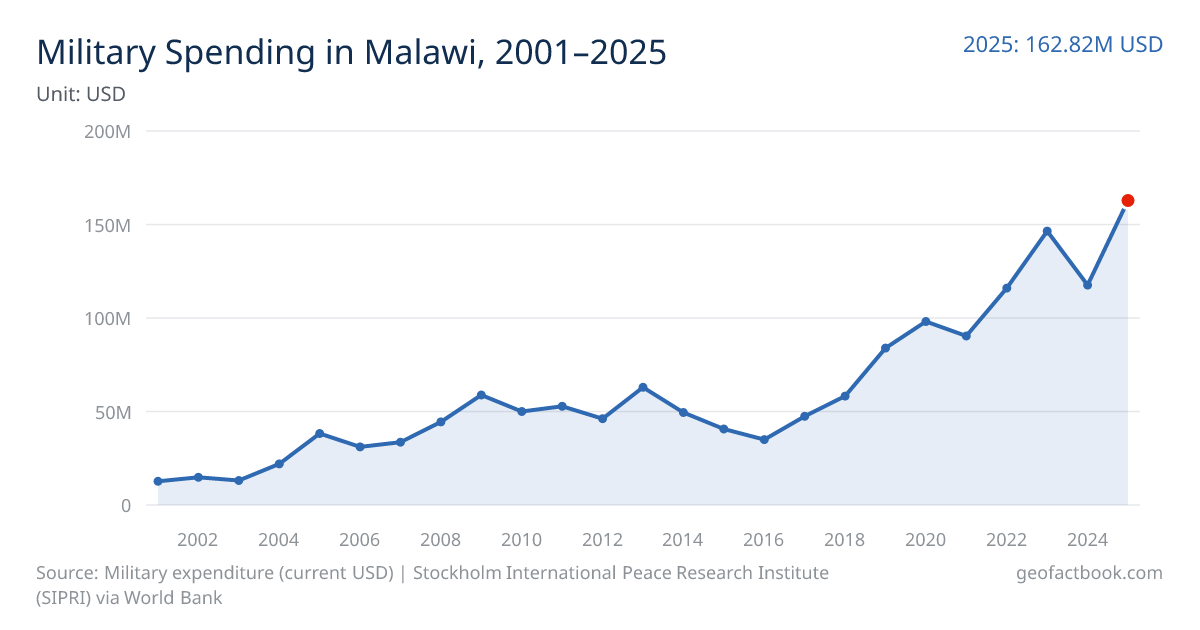
Malawi's military spending in 2025 is $162.82 Million, up 38.5% from 2024. It ranks #126 of 150 countries.
Military spending data reveals a country's budget priorities and defense investment. Analyze how nations allocate their resources.
Source (2025): Military spending
Where Malawi ranks (2025)
#126 of 150- #124
 South Sudan178.42M USD
- #125
 Montenegro176.54M USD
- #126
 Malawi162.82M USD
- #127
 Zimbabwe159.64M USD
- #128
 Malta124.66M USD
Military Spending over time
| Year | Value | Change | % Change | Actions |
|---|---|---|---|---|
| 2025 | 162.82M USD | +45.23M USD | +38.46% | |
| 2024 | 117.59M USD | 28.89M USD | -19.72% | |
| 2023 | 146.48M USD | +30.48M USD | +26.28% | |
| 2022 | 115.99M USD | +25.59M USD | +28.31% | |
| 2021 | 90.40M USD | 7.72M USD | -7.87% | |
| 2020 | 98.12M USD | +14.24M USD | +16.98% | |
| 2019 | 83.88M USD | +25.63M USD | +44.01% | |
| 2018 | 58.25M USD | +10.84M USD | +22.86% | |
| 2017 | 47.41M USD | +12.45M USD | +35.63% | |
| 2016 | 34.96M USD | 5.68M USD | -13.99% | |
| 2015 | 40.64M USD | 8.82M USD | -17.83% | |
| 2014 | 49.45M USD | 13.47M USD | -21.41% | |
| 2013 | 62.93M USD | +16.77M USD | +36.33% | |
| 2012 | 46.16M USD | 6.65M USD | -12.59% | |
| 2011 | 52.80M USD | +2.82M USD | +5.64% | |
| 2010 | 49.98M USD | 8.81M USD | -14.99% | |
| 2009 | 58.80M USD | +14.33M USD | +32.24% | |
| 2008 | 44.46M USD | +10.86M USD | +32.34% | |
| 2007 | 33.60M USD | +2.51M USD | +8.07% | |
| 2006 | 31.09M USD | 7.12M USD | -18.64% | |
| 2005 | 38.21M USD | +16.25M USD | +73.97% | |
| 2004 | 21.97M USD | +8.85M USD | +67.44% | |
| 2003 | 13.12M USD | 1.70M USD | -11.45% | |
| 2002 | 14.82M USD | +2.13M USD | +16.82% | |
| 2001 | 12.68M USD | — | — |
Military Spending in Malawi, 2001–2025: chart
Cite this page
Geo Factbook. (n.d.). Malawi: Military Spending. Retrieved November 29, 2026, from https://geofactbook.com/countries/malawi/military-spending
The figures on this page come from Military expenditure (current USD) | Stockholm International Peace Research Institute (SIPRI) via World Bank. For academic work, cite the original source as well.
Frequently Asked Questions About Malawi Military Spending
What is Malawi's military spending in 2025?▾
Malawi's military spending is $162.82 Million in 2025, according to Military expenditure (current USD) | Stockholm International Peace Research Institute (SIPRI) via World Bank.
Is Malawi's military spending increasing or decreasing?▾
Malawi's military spending rose by 38.5% from 2024 ($117.59 Million) to 2025 ($162.82 Million). Over the past decade (2015–2025) it rose by 300.7%.
How does Malawi rank for military spending?▾
In 2025, Malawi has the 126th highest military spending out of 150 countries with data.
What was Malawi's military spending in 2001?▾
In 2001, Malawi's military spending was $12.68 Million. By 2025 it rose by 1183.9%.
Explore additional statistical insights
Deaths in Armed Conflicts in Malawi
Deaths in armed conflicts highlight the human cost of wars. Track fatalities in countries with ongoing conflicts.
Military Expenditure (% of GDP) in Malawi
Military expenditure as a percentage of GDP reflects a country's military focus relative to its economy.
AI Preparedness Index in Malawi
The IMF's AI Preparedness Index scores how ready a country is to adopt artificial intelligence, on a scale from 0 to 1 (higher is better prepared). It combines four areas: digital infrastructure, human capital and labour market policies, innovation and economic integration, and regulation and ethics. It measures readiness, not how many jobs AI has replaced or could affect.
Trade as a Share of GDP in Malawi
Trade as a share of GDP measures the economic activity of countries. A higher share indicates a more open economy.
Bank Account Ownership Rate in Malawi
Bank account ownership rate indicates financial inclusion levels among adults globally, highlighting economic access.
Top FDI Inflows (% of GDP) in Malawi
Top FDI inflows as a percentage of GDP highlight countries attracting significant foreign investments relative to their economy size.