
Papua New Guinea Military Spending 2025: $106.48 Million
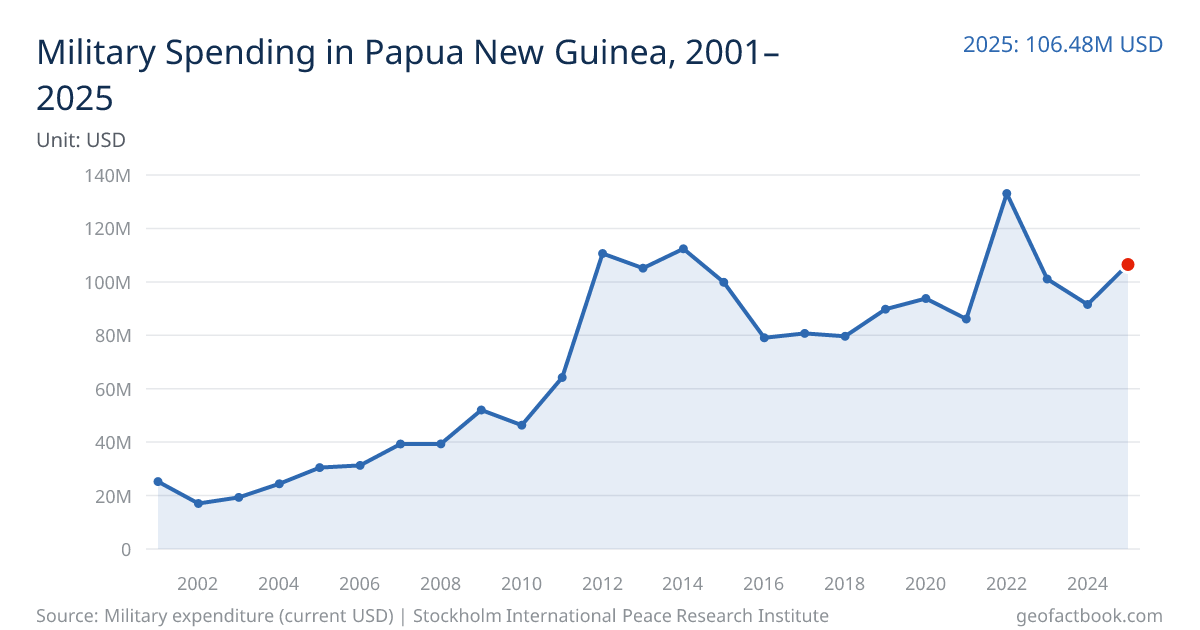
Papua New Guinea's military spending in 2025 is $106.48 Million, up 16.4% from 2024. It ranks #133 of 150 countries.
Military spending data reveals a country's budget priorities and defense investment. Analyze how nations allocate their resources.
Source (2025): Military spending
Where Papua New Guinea ranks (2025)
#133 of 150- #131
 Nicaragua116.37M USD
- #132
 Republic of Moldova113.29M USD
- #133
 Papua New Guinea106.48M USD
- #134
 Eswatini93.36M USD
- #135
 Fiji81.16M USD
Military Spending over time
| Year | Value | Change | % Change | Actions |
|---|---|---|---|---|
| 2025 | 106.48M USD | +14.96M USD | +16.35% | |
| 2024 | 91.52M USD | 9.54M USD | -9.44% | |
| 2023 | 101.06M USD | 32.01M USD | -24.06% | |
| 2022 | 133.07M USD | +46.98M USD | +54.57% | |
| 2021 | 86.09M USD | 7.70M USD | -8.21% | |
| 2020 | 93.79M USD | +4.02M USD | +4.47% | |
| 2019 | 89.77M USD | +10.16M USD | +12.76% | |
| 2018 | 79.61M USD | 1.11M USD | -1.37% | |
| 2017 | 80.72M USD | +1.67M USD | +2.11% | |
| 2016 | 79.05M USD | 20.79M USD | -20.82% | |
| 2015 | 99.84M USD | 12.54M USD | -11.15% | |
| 2014 | 112.38M USD | +7.27M USD | +6.92% | |
| 2013 | 105.10M USD | 5.52M USD | -4.99% | |
| 2012 | 110.62M USD | +46.43M USD | +72.33% | |
| 2011 | 64.19M USD | +17.86M USD | +38.54% | |
| 2010 | 46.34M USD | 5.71M USD | -10.98% | |
| 2009 | 52.05M USD | +12.72M USD | +32.33% | |
| 2008 | 39.33M USD | +44.92K USD | +0.11% | |
| 2007 | 39.29M USD | +7.98M USD | +25.49% | |
| 2006 | 31.31M USD | +843.26K USD | +2.77% | |
| 2005 | 30.46M USD | +6.04M USD | +24.74% | |
| 2004 | 24.42M USD | +5.11M USD | +26.49% | |
| 2003 | 19.31M USD | +2.29M USD | +13.43% | |
| 2002 | 17.02M USD | 8.21M USD | -32.54% | |
| 2001 | 25.23M USD | — | — |
Military Spending in Papua New Guinea, 2001–2025: chart
Cite this page
Geo Factbook. (n.d.). Papua New Guinea: Military Spending. Retrieved November 29, 2026, from https://geofactbook.com/countries/papua-new-guinea/military-spending
The figures on this page come from Military expenditure (current USD) | Stockholm International Peace Research Institute (SIPRI) via World Bank. For academic work, cite the original source as well.
Frequently Asked Questions About Papua New Guinea Military Spending
What is Papua New Guinea's military spending in 2025?▾
Papua New Guinea's military spending is $106.48 Million in 2025, according to Military expenditure (current USD) | Stockholm International Peace Research Institute (SIPRI) via World Bank.
Is Papua New Guinea's military spending increasing or decreasing?▾
Papua New Guinea's military spending rose by 16.4% from 2024 ($91.52 Million) to 2025 ($106.48 Million). Over the past decade (2015–2025) it rose by 6.7%.
How does Papua New Guinea rank for military spending?▾
In 2025, Papua New Guinea has the 133rd highest military spending out of 150 countries with data.
What was Papua New Guinea's military spending in 2001?▾
In 2001, Papua New Guinea's military spending was $25.23 Million. By 2025 it rose by 322.0%.
Explore additional statistical insights
Military Expenditures (% of GDP) in Papua New Guinea
Military Expenditures as a percentage of GDP highlights national defense spending. Compare countries, explore rankings, and view trends.
Deaths in Armed Conflicts in Papua New Guinea
Deaths in armed conflicts highlight the human cost of wars. Track fatalities in countries with ongoing conflicts.
Top Exporting Countries in Papua New Guinea
Top exporting countries drive global trade; measure export volume and its impact on international markets.
Inflation Rate (Consumer Prices) in Papua New Guinea
Inflation Rate (Consumer Prices) reveals how price changes affect economies. Compare countries and explore interactive rankings and trends.
Tourism Revenue (% of GDP) in Papua New Guinea
Tourism revenue as a percentage of GDP shows the economic importance of tourism in a country. Higher values indicate greater reliance.
Lifetime Risk of Maternal Death in Papua New Guinea
Lifetime risk of maternal death indicates the probability a woman will die from maternal causes. High values signal poor maternal health.