
Philippines Military Spending 2025: $6.38 Billion
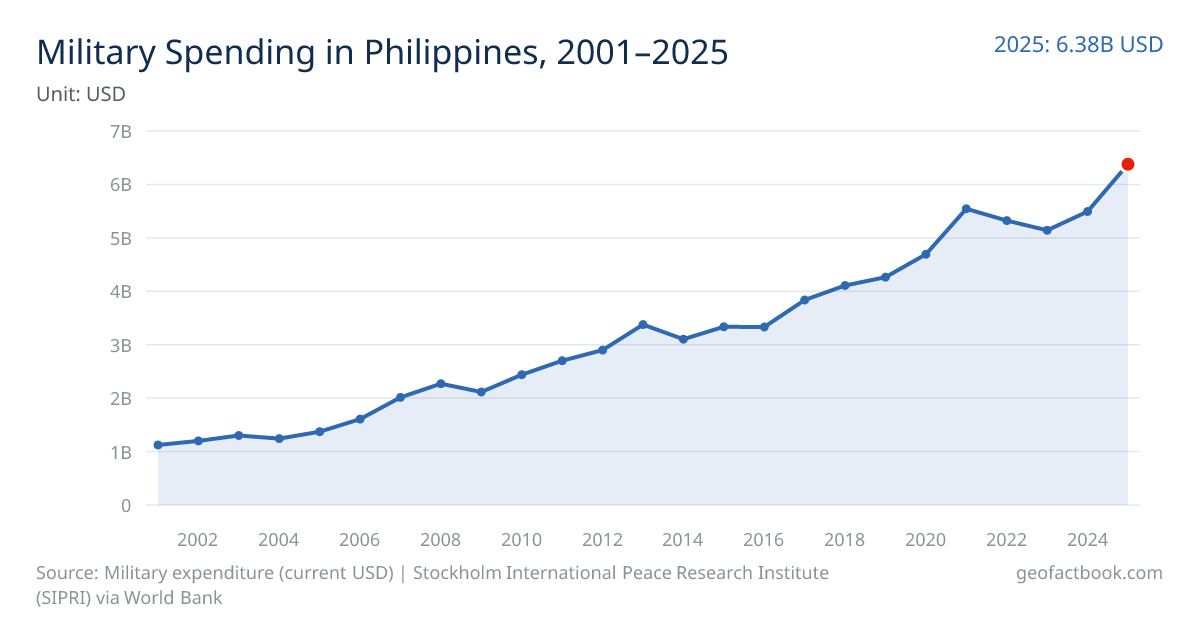
Philippines's military spending in 2025 is $6.38 Billion, up 16.1% from 2024. It ranks #40 of 150 countries.
Military spending data reveals a country's budget priorities and defense investment. Analyze how nations allocate their resources.
Source (2025): Military spending
Where Philippines ranks (2025)
#40 of 150- #38
 Czech Republic7.05B USD
- #39
 Iraq6.45B USD
- #40
 Philippines6.38B USD
- #41
 Austria6.35B USD
- #42
 Morocco6.33B USD
Military Spending over time
| Year | Value | Change | % Change | Actions |
|---|---|---|---|---|
| 2025 | 6.38B USD | +885.34M USD | +16.12% | |
| 2024 | 5.49B USD | +351.26M USD | +6.83% | |
| 2023 | 5.14B USD | 180.34M USD | -3.39% | |
| 2022 | 5.32B USD | 221.60M USD | -4.00% | |
| 2021 | 5.54B USD | +851.33M USD | +18.14% | |
| 2020 | 4.69B USD | +429.66M USD | +10.08% | |
| 2019 | 4.26B USD | +155.66M USD | +3.79% | |
| 2018 | 4.11B USD | +270.94M USD | +7.06% | |
| 2017 | 3.84B USD | +505.01M USD | +15.16% | |
| 2016 | 3.33B USD | 4.03M USD | -0.12% | |
| 2015 | 3.34B USD | +232.42M USD | +7.49% | |
| 2014 | 3.10B USD | 273.90M USD | -8.11% | |
| 2013 | 3.38B USD | +478.34M USD | +16.50% | |
| 2012 | 2.90B USD | +197.19M USD | +7.30% | |
| 2011 | 2.70B USD | +263.30M USD | +10.80% | |
| 2010 | 2.44B USD | +322.40M USD | +15.24% | |
| 2009 | 2.12B USD | 155.12M USD | -6.83% | |
| 2008 | 2.27B USD | +256.53M USD | +12.74% | |
| 2007 | 2.01B USD | +407.10M USD | +25.33% | |
| 2006 | 1.61B USD | +234.57M USD | +17.09% | |
| 2005 | 1.37B USD | +129.48M USD | +10.41% | |
| 2004 | 1.24B USD | 58.06M USD | -4.46% | |
| 2003 | 1.30B USD | +102.16M USD | +8.52% | |
| 2002 | 1.20B USD | +77.02M USD | +6.86% | |
| 2001 | 1.12B USD | — | — |
Military Spending in Philippines, 2001–2025: chart
Cite this page
Geo Factbook. (n.d.). Philippines: Military Spending. Retrieved November 29, 2026, from https://geofactbook.com/countries/philippines/military-spending
The figures on this page come from Military expenditure (current USD) | Stockholm International Peace Research Institute (SIPRI) via World Bank. For academic work, cite the original source as well.
Frequently Asked Questions About Philippines Military Spending
What is Philippines's military spending in 2025?▾
Philippines's military spending is $6.38 Billion in 2025, according to Military expenditure (current USD) | Stockholm International Peace Research Institute (SIPRI) via World Bank.
Is Philippines's military spending increasing or decreasing?▾
Philippines's military spending rose by 16.1% from 2024 ($5.49 Billion) to 2025 ($6.38 Billion). Over the past decade (2015–2025) it rose by 91.2%.
How does Philippines rank for military spending?▾
In 2025, Philippines has the 40th highest military spending out of 150 countries with data.
What was Philippines's military spending in 2001?▾
In 2001, Philippines's military spending was $1.12 Billion. By 2025 it rose by 468.5%.
Explore additional statistical insights
Deaths in Armed Conflicts in Philippines
Deaths in armed conflicts highlight the human cost of wars. Track fatalities in countries with ongoing conflicts.
Total Armed Forces Personnel (PPP) in Philippines
Explore total armed forces personnel across 266+ countries. Compare military size, view rankings, and analyze historical trends on our interactive map.
Cotton Yield Per Hectare in Philippines
Cotton yield per hectare varies widely. Explore top countries excelling in efficient cotton farming practices.
Total population in Philippines
Discover the latest total population statistics for every country and region worldwide. Explore accurate, up-to-date data on global population growth, density, and demographic trends — sourced from trusted international databases like the UN and World Bank. Perfect for researchers, students, and data enthusiasts looking to understand how the world’s population is changing.
Air Freight Volume in Philippines
Air freight volume measures the total cargo transported by air in metric tons, a key indicator of a country's trade activity.
Banana Yield Per Hectare in Philippines
Compare the efficiency of banana production by examining yield per hectare across different countries.