
Military Spending 2008
Military spending data reveals a country's budget priorities and defense investment. Analyze how nations allocate their resources.
Newer data is available: Military Spending by country 2025 →
Where does your country rank? Pick it to see its position.
Related Military and Security statistics
More ↓
Interactive Map
Complete Data Rankings
Rank | Actions | ||
|---|---|---|---|
1 |  United States | 656,756,000,000 USD | |
2 |  China | 78,840,802,819.863 USD | |
3 |  United Kingdom | 72,915,407,669.74 USD | |
4 |  Russia | 56,183,785,393.254 USD | |
5 |  France | 55,590,086,700.365 USD | |
6 |  Japan | 46,361,468,280.459 USD | |
7 |  Germany | 45,281,516,418.992 USD | |
8 |  Saudi Arabia | 38,222,933,333.333 USD | |
9 |  Italy | 36,839,989,746.219 USD | |
10 |  India | 33,002,376,727.38 USD | |
11 |  South Korea | 26,072,410,507.69 USD | |
12 |  Brazil | 24,452,903,035.822 USD | |
13 |  Spain | 22,227,721,829.568 USD | |
14 |  Canada | 19,342,058,404.558 USD | |
15 |  Australia | 18,633,092,318.274 USD | |
16 |  Turkey | 16,809,576,495.175 USD | |
17 |  Israel | 13,643,372,417.099 USD | |
18 |  Netherlands | 12,374,848,939.832 USD | |
19 |  United Arab Emirates | 11,571,681,415.929 USD | |
20 |  Iran | 11,081,950,208.569 USD | |
21 |  Greece | 10,616,942,502.266 USD | |
22 |  Poland | 9,349,421,394.299 USD | |
23 |  Colombia | 9,051,130,501.954 USD | |
24 |  Singapore | 7,454,324,102.738 USD | |
25 |  Norway | 6,370,921,985.816 USD | |
26 |  Belgium | 6,321,307,004.688 USD | |
27 |  Sweden | 6,024,791,006.054 USD | |
28 |  Venezuela | 5,660,456,450.862 USD | |
29 |  Pakistan | 5,226,678,786.502 USD | |
30 |  Algeria | 5,172,336,907.04 USD | |
31 |  Ukraine | 4,811,038,840.223 USD | |
32 |  Denmark | 4,788,030,120.848 USD | |
33 |  Chile | 4,641,877,575.551 USD | |
34 |  Kuwait | 4,430,342,077.462 USD | |
35 |  Malaysia | 4,411,795,565.122 USD | |
36 |  Mexico | 4,334,654,123.651 USD | |
37 |  Switzerland | 4,098,459,038.492 USD | |
38 |  Finland | 3,974,140,756.071 USD | |
39 |  Egypt | 3,779,880,349.747 USD | |
40 |  Austria | 3,746,731,607.28 USD | |
41 |  Portugal | 3,714,798,403.34 USD | |
42 |  Thailand | 3,650,043,676.249 USD | |
43 |  Oman | 3,462,483,745.124 USD | |
44 |  South Africa | 3,285,925,081.283 USD | |
45 |  Indonesia | 3,232,201,382.364 USD | |
46 |  Sudan | 3,228,000,000 USD | |
47 |  Angola | 3,163,591,147.409 USD | |
48 |  Iraq | 3,116,304,019.848 USD | |
49 |  Romania | 3,000,404,945.094 USD | |
50 |  Morocco | 2,944,958,472.736 USD | |
51 |  Czech Republic | 2,918,701,552.28 USD | |
52 |  Argentina | 2,788,980,204.57 USD | |
53 |  Qatar | 2,317,500,000 USD | |
54 |  Philippines | 2,270,904,919.083 USD | |
55 |  Vietnam | 2,052,177,006.784 USD | |
56 |  Hungary | 1,867,877,499.085 USD | |
57 |  Syrian Arab Republic | 1,732,416,847.902 USD | |
58 |  Ecuador | 1,646,000,000 USD | |
59 |  Nigeria | 1,615,533,210.737 USD | |
60 |  Azerbaijan | 1,607,799,225.92 USD | |
61 |  Ireland | 1,582,890,833.852 USD | |
62 |  Kazakhstan | 1,540,810,813.057 USD | |
63 |  New Zealand | 1,534,982,791.094 USD | |
64 |  Sri Lanka | 1,511,363,006.997 USD | |
65 |  Peru | 1,503,663,891.381 USD | |
66 |  Slovakia | 1,411,710,284.895 USD | |
67 |  Jordan | 1,358,383,579.904 USD | |
68 |  Croatia | 1,243,402,599.966 USD | |
69 |  Yemen | 1,196,411,765.884 USD | |
70 |  Lebanon | 1,169,485,903.814 USD | |
71 |  Bulgaria | 1,161,451,477.803 USD | |
72 |  Serbia | 1,111,631,537.861 USD | |
73 |  Libya | 1,100,068,652.13 USD | |
74 |  Georgia | 1,090,160,250.605 USD | |
75 |  Bangladesh | 1,030,020,018.239 USD | |
76 |  South Sudan | 896,390,706.932 USD | |
77 |  Belarus | 883,028,556.249 USD | |
78 |  Slovenia | 829,384,406.929 USD | |
79 |  Bahrain | 719,946,808.511 USD | |
80 |  Chad | 611,426,848.74 USD | |
81 |  Latvia | 581,752,272.927 USD | |
82 |  Kenya | 580,011,940.678 USD | |
83 |  Tunisia | 578,911,487.331 USD | |
84 |  Uruguay | 567,703,932.828 USD | |
85 |  Lithuania | 541,390,194.648 USD | |
86 |  Cyprus | 453,803,054.162 USD | |
87 |  Estonia | 431,922,678.339 USD | |
88 |  Armenia | 395,994,365.442 USD | |
89 |  Ethiopia | 390,635,511.893 USD | |
90 |  Côte d'Ivoire | 368,910,574.915 USD | |
91 |  Bolivia | 365,826,318.09 USD | |
92 |  Brunei Darussalam | 361,989,034.484 USD | |
93 |  Cameroon | 346,586,125.657 USD | |
94 |  Dominican Republic | 333,538,881.607 USD | |
95 |  Botswana | 332,400,254.29 USD | |
96 |  Uganda | 311,856,269.326 USD | |
97 |  Equatorial Guinea | 292,754,658.836 USD | |
98 |  Zambia | 278,055,135.811 USD | |
99 |  Namibia | 266,555,848.311 USD | |
100 |  Albania | 255,677,957.819 USD | |
101 |  Afghanistan | 240,532,594.621 USD | |
102 |  Bosnia and Herzegovina | 233,292,390.653 USD | |
103 |  Senegal | 216,870,289.523 USD | |
104 |  Congo | 207,724,344.302 USD | |
105 |  Tanzania | 194,000,300.925 USD | |
106 |  Nepal | 187,069,695.836 USD | |
107 |  Luxembourg | 175,683,890.578 USD | |
108 |  El Salvador | 173,000,000 USD | |
109 |  North Macedonia | 172,658,158.915 USD | |
110 |  Paraguay | 168,154,857.4 USD | |
111 |  Guatemala | 166,494,048.304 USD | |
112 |  Congo, Democratic Republic of the | 159,998,426.585 USD | |
113 |  Kyrgyzstan | 149,309,214.592 USD | |
114 |  Mali | 142,919,351.057 USD | |
115 |  Trinidad and Tobago | 139,098,455.663 USD | |
116 |  Honduras | 132,428,400.639 USD | |
117 |  Jamaica | 130,699,170.655 USD | |
118 |  Mauritania | 123,323,383.836 USD | |
119 |  Burkina Faso | 116,999,586.874 USD | |
120 |  Ghana | 114,271,459.457 USD | |
121 |  Madagascar | 103,271,539.538 USD | |
122 |  Cuba | 89,057,268.722 USD | |
123 |  Montenegro | 85,106,382.979 USD | |
124 |  Mozambique | 83,709,455.734 USD | |
125 |  Cambodia | 82,630,723.428 USD | |
126 |  Rwanda | 67,660,359.624 USD | |
127 |  Mongolia | 66,749,871.333 USD | |
128 |  Eswatini | 66,657,830.199 USD | |
129 |  Benin | 64,986,541.048 USD | |
130 |  Togo | 57,009,189.268 USD | |
131 |  Malta | 56,032,519.134 USD | |
132 |  Niger | 53,630,486.484 USD | |
133 |  Fiji | 53,585,658.62 USD | |
134 |  Tajikistan | 52,467,120.604 USD | |
135 |  Malawi | 44,464,251.404 USD | |
136 |  Burundi | 43,856,319.949 USD | |
137 |  Nicaragua | 42,659,728.782 USD | |
138 |  Papua New Guinea | 39,332,022.266 USD | |
139 |  Republic of Moldova | 36,845,650.5 USD | |
140 |  Djibouti | 36,274,835.276 USD | |
141 |  Central African Republic | 31,511,483.793 USD | |
142 |  Guyana | 30,520,593.421 USD | |
143 |  Lesotho | 27,350,681.861 USD | |
144 |  Timor-Leste | 23,651,000 USD | |
145 |  Sierra Leone | 23,645,736.556 USD | |
146 |  Belize | 18,717,737.5 USD | |
147 |  Gambia | 17,163,572.132 USD | |
148 |  Laos | 16,275,405.903 USD | |
149 |  Mauritius | 15,580,188.944 USD | |
150 |  Seychelles | 11,124,810.198 USD | |
151 |  Cabo Verde | 10,758,715.968 USD | |
152 |  Liberia | 3,907,000 USD | |
153 |  Kosovo | 927,234.775 USD | |
154 |  Costa Rica | 0 USD | |
155 |  Iceland | 0 USD | |
156 |  Panama | 0 USD |
Analysis: These countries represent the highest values in this dataset, showcasing significant scale and impact on global statistics.
- #156Panama
- #155Iceland
- #154Costa Rica
- #153Kosovo
- #152Liberia
- #151Cabo Verde
- #150Seychelles
- #149Mauritius
- #148Laos
- #147Gambia
Context: These countries or territories have the lowest values, often due to geographic size, administrative status, or specific characteristics.
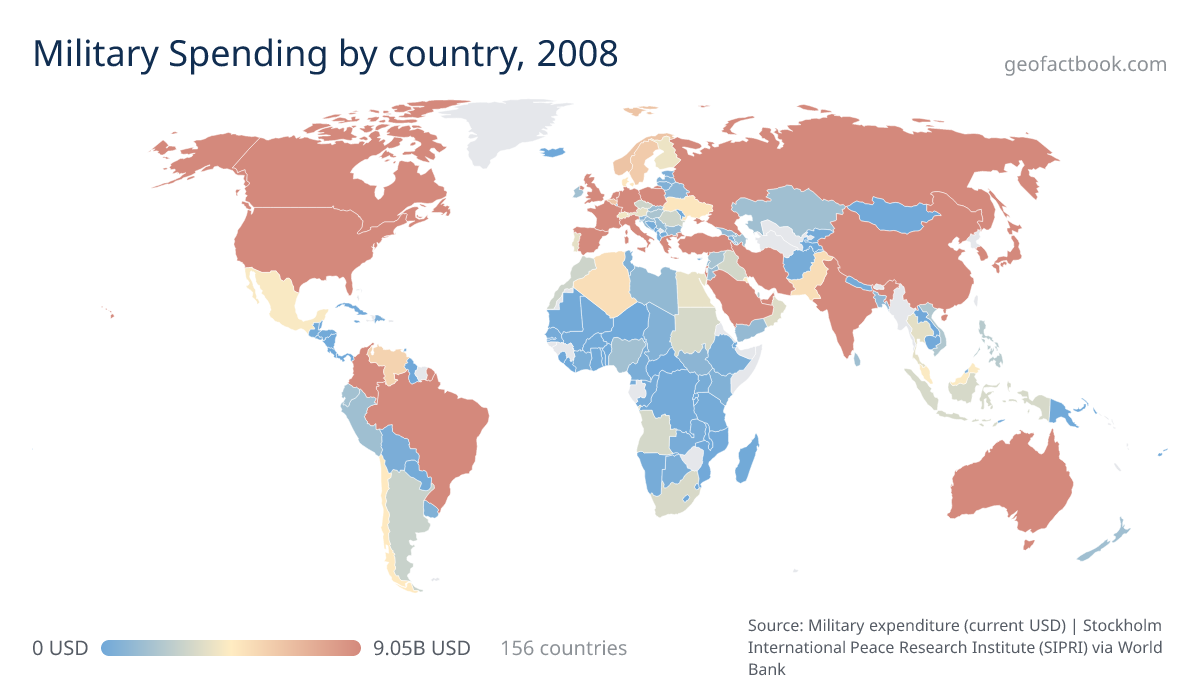
Military Spending by country, 2008: map image
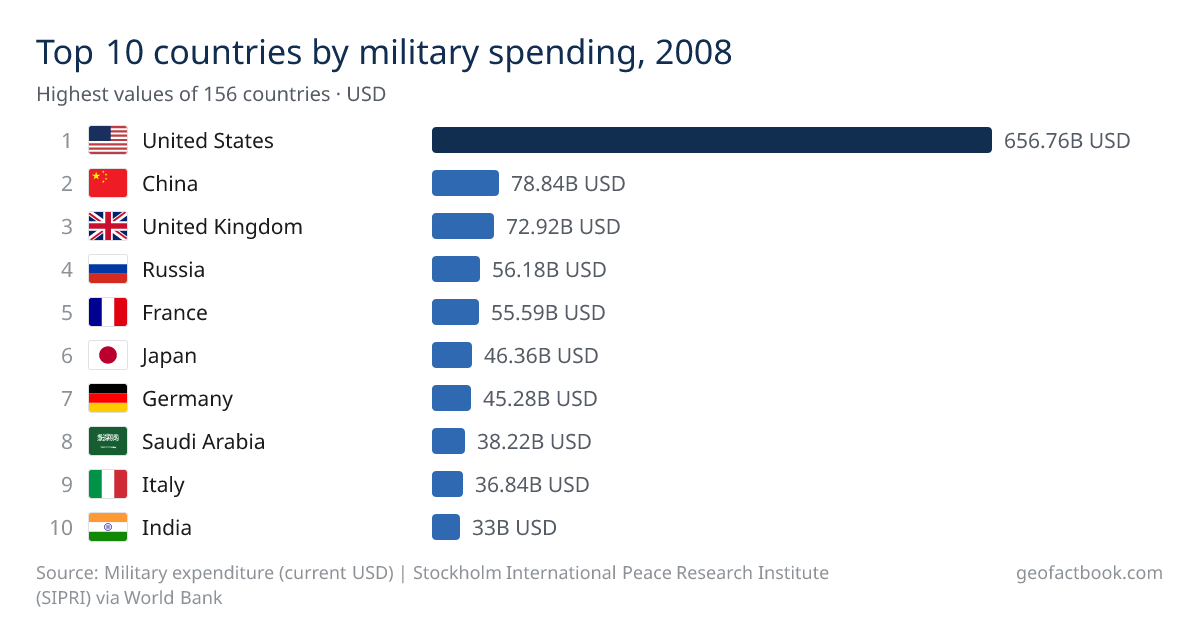
Top 10 countries by military spending, 2008: chart
Insights by country
Laos
In 2008, Laos ranked #148 globally in military spending, with a total expenditure of 16,275,405.90 USD. This figure is relatively low compared to its regional neighbors, reflecting a focus on economic development rather than military expansion. The country's military budget is influenced by its limited economic resources and a commitment to maintaining peace and stability in a region marked by historical conflicts.
Kenya
In 2008, Kenya's military spending was $580,011,940.68, ranking #82 out of 156 countries. This expenditure is notably lower than that of regional neighbors like Uganda, which has prioritized military modernization. Factors influencing Kenya's military budget include its strategic location in East Africa, ongoing security challenges such as terrorism, and a commitment to regional stability through peacekeeping efforts.
Iceland
In 2008, Iceland ranked #155 out of 156 countries for Military Spending, with a total of 0 USD. This significantly lower spending compared to many nations reflects Iceland's unique position as a NATO member without a standing army, relying instead on cooperative defense arrangements. The country's geographical isolation and small population further contribute to its minimal military expenditure, focusing resources on other sectors such as social welfare and environmental protection.
Djibouti
In 2008, Djibouti ranked #140 globally for Military Spending with a total of 36,274,835.2755161 USD. This figure is notably low compared to many of its regional neighbors, reflecting the country's limited economic resources and strategic military priorities. Djibouti's military expenditure is influenced by its strategic location near key maritime routes and its role as a host for foreign military bases, which impacts its defense policy and spending decisions.
Cambodia
In 2008, Cambodia ranked #125 globally in military spending, with an expenditure of 82,630,723.43 USD. This figure is notably lower than many of its Southeast Asian neighbors, reflecting the region's diverse military investment levels. The country's military budget is influenced by its historical context, including the aftermath of the Khmer Rouge regime and ongoing efforts to stabilize and modernize its armed forces.
Angola
In 2008, Angola ranked #47 globally in military spending, allocating 3,163,591,147.41 USD to its defense budget. This expenditure is significant compared to many regional neighbors, as Angola's military budget reflects its efforts to stabilize and secure its territory following years of civil conflict. The country's rich natural resources, particularly oil, have fueled economic growth, enabling increased military investment aimed at maintaining internal security and regional influence.
Fiji
In 2008, Fiji ranked #133 globally in military spending, with a total of 53,585,658.62 USD. This figure is notably lower than many Pacific neighbors, reflecting the region's generally modest defense budgets. Economic challenges and a focus on development rather than military expansion are key drivers behind Fiji's spending priorities.
Cabo Verde
Cabo Verde's military spending in 2008 was $10,758,715.97, ranking #151 out of 156 countries. This figure is significantly lower than many regional counterparts, reflecting the nation's limited military needs due to its small size and population. The primary drivers of this low military expenditure include Cabo Verde's strategic focus on tourism and economic development, which prioritize civilian over military investment.
China
In 2008, China ranked #2 globally in military spending, with an expenditure of 78840802819.8629 USD. This figure significantly surpassed many of its regional neighbors, reflecting China's ambition to enhance its military capabilities amidst rising geopolitical tensions. Key drivers of this spending include China's rapid economic growth, which has allowed for increased defense budgets, and its strategic focus on modernizing its armed forces to assert its influence in Asia and beyond.
Austria
In 2008, Austria's Military Spending was $3,746,731,607.28, ranking it #40 out of 156 countries. This spending is notably lower than that of neighboring countries like Germany, which invests significantly more in its military capabilities. Austria's military expenditure is influenced by its neutral status and commitment to peacekeeping, reflecting a policy focus on diplomacy over military engagement.
Analysis & Context
In 2008, the United States led the world in Military Spending with a staggering USD 656,756,000,000, while the global range spanned from USD 0.00 to this peak amount. The global median Military Spending was USD 829,384,406.93, providing a benchmark for evaluating national priorities in defense investments.
Military Spending Concentration Among Major Powers
The distribution of Military Spending in 2008 was heavily skewed towards a few major powers. The United States, with its expenditure of USD 656,756,000,000, accounted for a significant portion of global defense budgets, reflecting its strategic military commitments worldwide and its role as a global superpower. China, the second-highest spender, allocated USD 78,840,802,819.86, indicative of its rapid economic growth and increasing military ambitions. Similarly, the United Kingdom and Russia followed with expenditures of USD 72,915,407,669.74 and USD 56,183,785,393.25 respectively, underscoring their historical and strategic defense priorities.
These figures highlight the concentration of military resources among a few countries, which is often driven by geopolitical objectives, historical alliances, and the necessity to maintain or expand global influence. The disparities in spending also reflect differing national priorities and economic capacities.
Minimal Military Expenditure in Smaller Nations
Contrastingly, several countries reported minimal or no Military Spending. Iceland, Costa Rica, and Panama each reported USD 0 in military expenses, aligning with their policies of neutrality or lack of standing armies. For instance, Costa Rica abolished its military in 1949, channeling funds towards education and healthcare instead.
Other nations like Kosovo and Liberia had minimal expenditures of USD 927,234.77 and USD 3,907,000 respectively, often due to limited economic resources or reliance on international peacekeeping forces for defense. These examples illustrate how smaller and less economically developed countries may prioritize domestic development over military expansion.
Year-over-Year Changes in Military Spending
The year 2008 saw significant year-over-year changes in Military Spending for several countries. The United States experienced an increase of USD 67,170,000,000 (11.4%), driven by ongoing military engagements in the Middle East. China and Russia saw increases of USD 16,704,212,065.27 (26.9%) and USD 12,648,790,397.01 (29.1%) respectively, reflecting their strategic military expansions.
Conversely, countries like South Korea and Sweden reduced their spending by USD 1,653,719,077.56 (-6.0%) and USD 361,430,155.49 (-5.7%) respectively. These reductions could be attributed to shifts in defense policy or economic constraints. Such fluctuations underscore the dynamic nature of military budgets, influenced by both internal policy decisions and external geopolitical pressures.
Economic Factors Influencing Military Budgets
Economic capacity plays a crucial role in determining a nation's Military Spending. Countries with robust economies like the United States, China, and Japan can sustain higher defense budgets without compromising other areas of public spending. For instance, Japan allocated USD 46,361,468,280.46 to its military, balancing its pacifist constitution with regional security concerns.
In contrast, nations with smaller economies often face trade-offs between military and social expenditures. For example, India spent USD 33,002,376,727.38, reflecting its need to address both defense requirements and pressing socio-economic challenges. Similarly, Saudi Arabia, with its reliance on oil revenues, allocated substantial funds of USD 38,222,933,333.33, driven by regional security dynamics and oil wealth.
Overall, Military Spending in 2008 provides a window into how countries prioritize defense in relation to their economic capabilities and geopolitical objectives. The data highlights stark contrasts in spending patterns, influenced by historical contexts, strategic needs, and economic realities.
Frequently Asked Questions About Military Spending in 2008
Which country had the highest military spending in 2008?
The United States had the highest military spending in 2008, with 656,756,000,000 USD.
What was the average military spending by country in 2008?
The average military spending by country in 2008 was 9,618,015,294 USD.
Which country had the lowest military spending in 2008?
Iceland had the lowest military spending in 2008, with 0 USD.
What was the median military spending by country in 2008?
The median military spending by country in 2008 was 774,665,608 USD.
How many countries are included in the 2008 military spending dataset?
The dataset includes military spending data for 156 countries in 2008.
Which countries were in the top 10 for military spending in 2008?
The top 10 countries for military spending in 2008 were the United States, China, United Kingdom, Russia, France, Japan, Germany, Saudi Arabia, Italy, and India.
Data Source
Military expenditure (current USD) | Stockholm International Peace Research Institute (SIPRI) via World Bank
Data produced by SIPRI Military Expenditure Database, Stockholm International Peace Research Institute (SIPRI), compiled and published by World Bank as "Military expenditure (current USD)".
Visit Data SourceCite this page
Geo Factbook. (n.d.). Military Spending by Country, 2008. Retrieved November 29, 2026, from https://geofactbook.com/fact/military-spending/2008
The figures on this page come from Military expenditure (current USD) | Stockholm International Peace Research Institute (SIPRI) via World Bank. For academic work, cite the original source as well.
›Embed this ranking on your site
Free to embed with attribution. Shows the top 10 countries and links back to the full ranking.
Historical Data by Year
Explore Military Spending data across different years. Compare trends and see how statistics have changed over time.
More Military and Security Facts
See all Military and Security facts →Total Armed Forces Personnel (PPP)
Explore total armed forces personnel across 266+ countries. Compare military size, view rankings, and analyze historical trends on our interactive map.
Highest: India3.07MMilitary Service Age and Obligation
Military service age and obligation details for 266+ countries. Compare requirements, explore rankings, and view interactive maps.
Highest: Angola20You might also like
Gross Domestic Product (GDP) by Country in Current US Dollars
FeaturedDiscover the Gross Domestic Product (GDP) by country in current US dollars, a key indicator of economic performance. This statistic reveals the financial health and growth potential of nations, making it essential for investors and policymakers.
Highest: United States32.95T $Population Change
FeaturedThis statistic measures population change across countries, highlighting shifts in demographics. Understanding these changes is crucial for planning resources, economic growth, and social services.
Highest: India14.13M personsLife expectancy at birth
FeaturedLife expectancy at birth measures the average years a newborn is expected to live, reflecting a country's health standards and quality of life. This vital statistic highlights disparities in healthcare and living conditions across nations, making it essential for global health assessments.
 Highest: Monaco89.29 years