
Algeria Military Spending 2025: $25.44 Billion
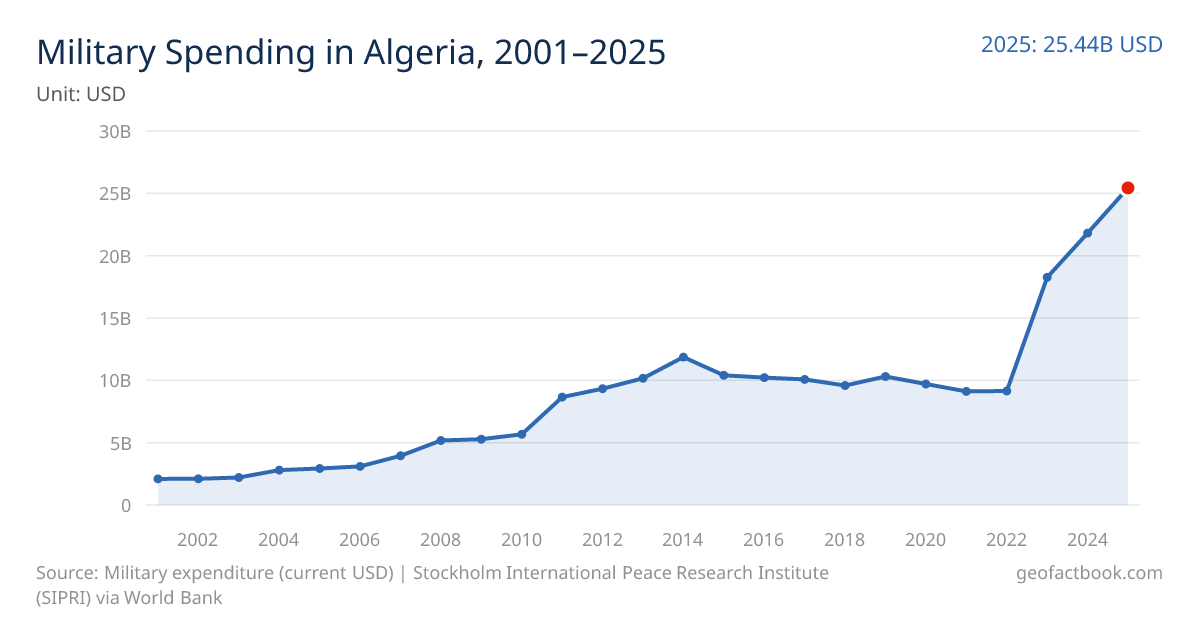
Algeria's military spending in 2025 is $25.44 Billion, up 16.6% from 2024. It ranks #20 of 150 countries.
Military spending data reveals a country's budget priorities and defense investment. Analyze how nations allocate their resources.
Source (2025): Military spending
Where Algeria ranks (2025)
#20 of 150- #18
 Turkey29.99B USD
- #19
 Netherlands28.94B USD
- #20
 Algeria25.44B USD
- #21
 Brazil23.95B USD
- #22
 Singapore17.44B USD
Military Spending over time
| Year | Value | Change | % Change | Actions |
|---|---|---|---|---|
| 2025 | 25.44B USD | +3.63B USD | +16.63% | |
| 2024 | 21.81B USD | +3.55B USD | +19.42% | |
| 2023 | 18.26B USD | +9.12B USD | +99.70% | |
| 2022 | 9.15B USD | +33.35M USD | +0.37% | |
| 2021 | 9.11B USD | 595.82M USD | -6.14% | |
| 2020 | 9.71B USD | 595.32M USD | -5.78% | |
| 2019 | 10.30B USD | +719.88M USD | +7.51% | |
| 2018 | 9.58B USD | 489.64M USD | -4.86% | |
| 2017 | 10.07B USD | 143.72M USD | -1.41% | |
| 2016 | 10.22B USD | 190.26M USD | -1.83% | |
| 2015 | 10.41B USD | 1.46B USD | -12.27% | |
| 2014 | 11.86B USD | +1.70B USD | +16.75% | |
| 2013 | 10.16B USD | +835.30M USD | +8.96% | |
| 2012 | 9.33B USD | +674.05M USD | +7.79% | |
| 2011 | 8.65B USD | +2.98B USD | +52.56% | |
| 2010 | 5.67B USD | +390.72M USD | +7.40% | |
| 2009 | 5.28B USD | +108.25M USD | +2.09% | |
| 2008 | 5.17B USD | +1.23B USD | +31.08% | |
| 2007 | 3.95B USD | +851.84M USD | +27.53% | |
| 2006 | 3.09B USD | +169.16M USD | +5.78% | |
| 2005 | 2.92B USD | +122.60M USD | +4.37% | |
| 2004 | 2.80B USD | +595.83M USD | +27.00% | |
| 2003 | 2.21B USD | +105.79M USD | +5.04% | |
| 2002 | 2.10B USD | +8.98M USD | +0.43% | |
| 2001 | 2.09B USD | — | — |
Military Spending in Algeria, 2001–2025: chart
Cite this page
Geo Factbook. (n.d.). Algeria: Military Spending. Retrieved November 29, 2026, from https://geofactbook.com/countries/algeria/military-spending
The figures on this page come from Military expenditure (current USD) | Stockholm International Peace Research Institute (SIPRI) via World Bank. For academic work, cite the original source as well.
Frequently Asked Questions About Algeria Military Spending
What is Algeria's military spending in 2025?▾
Algeria's military spending is $25.44 Billion in 2025, according to Military expenditure (current USD) | Stockholm International Peace Research Institute (SIPRI) via World Bank.
Is Algeria's military spending increasing or decreasing?▾
Algeria's military spending rose by 16.6% from 2024 ($21.81 Billion) to 2025 ($25.44 Billion). Over the past decade (2015–2025) it rose by 144.4%.
How does Algeria rank for military spending?▾
In 2025, Algeria has the 20th highest military spending out of 150 countries with data.
What was Algeria's military spending in 2001?▾
In 2001, Algeria's military spending was $2.09 Billion. By 2025 it rose by 1116.2%.
Explore additional statistical insights
Deaths in Armed Conflicts in Algeria
Deaths in armed conflicts highlight the human cost of wars. Track fatalities in countries with ongoing conflicts.
Total Armed Forces Personnel (PPP) in Algeria
Explore total armed forces personnel across 266+ countries. Compare military size, view rankings, and analyze historical trends on our interactive map.
Total Meat Production Volume in Algeria
Explore total meat production volume in tons across countries, highlighting key producers and trends in the global market.
Length of paid parental leave for mother in Algeria
Discover how the length of paid parental leave for mothers varies by country, impacting family well-being and workforce participation. Explore the statistics that highlight this critical social issue.
Independence in Algeria
Independence measures a country's self-governance. Compare global rankings, explore interactive maps, and analyze historical trends.
Currently married (Percent) in Algeria
The percentage of currently married individuals by country highlights societal trends in family structure and relationships. Understanding these statistics can provide insights into cultural norms and demographic shifts, influencing policies and social programs.