
Argentina Military Spending 2025: $3.88 Billion
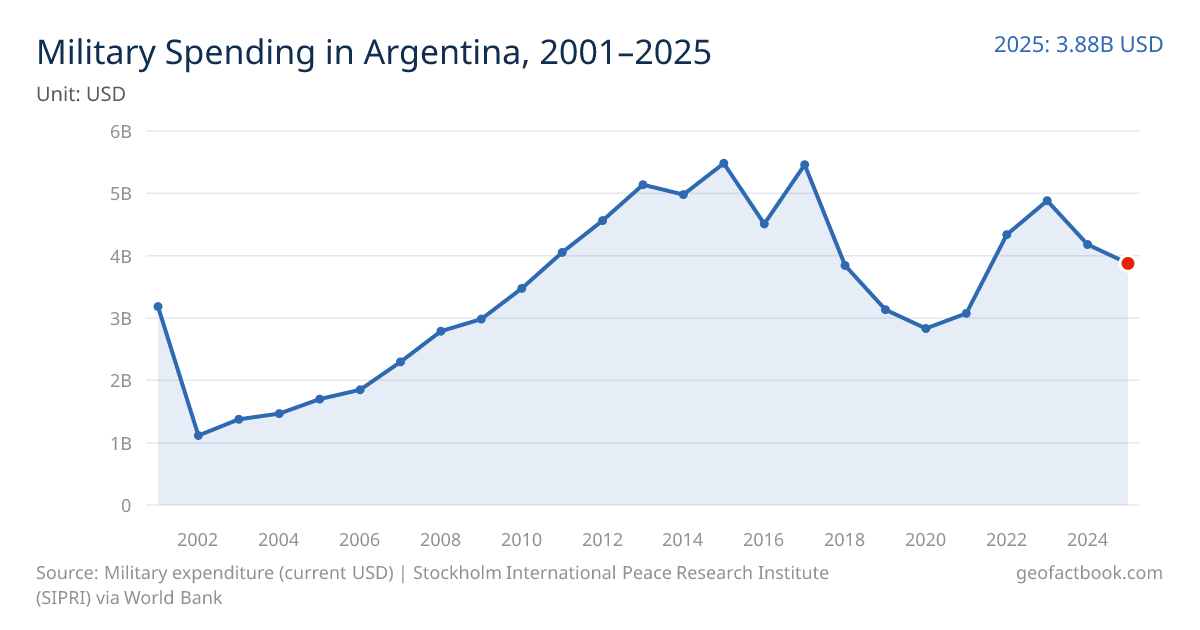
Argentina's military spending in 2025 is $3.88 Billion, down 7.3% from 2024. It ranks #50 of 150 countries.
Military spending data reveals a country's budget priorities and defense investment. Analyze how nations allocate their resources.
Source (2025): Military spending
Where Argentina ranks (2025)
#50 of 150- #48
 Azerbaijan4.94B USD
- #49
 Malaysia4.93B USD
- #50
 Argentina3.88B USD
- #51
 Bangladesh3.83B USD
- #52
 South Africa3.17B USD
Military Spending over time
| Year | Value | Change | % Change | Actions |
|---|---|---|---|---|
| 2025 | 3.88B USD | 304.09M USD | -7.28% | |
| 2024 | 4.18B USD | 702.51M USD | -14.39% | |
| 2023 | 4.88B USD | +544.09M USD | +12.54% | |
| 2022 | 4.34B USD | +1.26B USD | +41.15% | |
| 2021 | 3.07B USD | +242.50M USD | +8.57% | |
| 2020 | 2.83B USD | 301.73M USD | -9.63% | |
| 2019 | 3.13B USD | 710.20M USD | -18.48% | |
| 2018 | 3.84B USD | 1.62B USD | -29.61% | |
| 2017 | 5.46B USD | +950.00M USD | +21.07% | |
| 2016 | 4.51B USD | 972.97M USD | -17.75% | |
| 2015 | 5.48B USD | +503.17M USD | +10.11% | |
| 2014 | 4.98B USD | 158.53M USD | -3.09% | |
| 2013 | 5.14B USD | +574.76M USD | +12.60% | |
| 2012 | 4.56B USD | +511.29M USD | +12.62% | |
| 2011 | 4.05B USD | +576.58M USD | +16.59% | |
| 2010 | 3.48B USD | +493.50M USD | +16.55% | |
| 2009 | 2.98B USD | +192.87M USD | +6.92% | |
| 2008 | 2.79B USD | +492.53M USD | +21.45% | |
| 2007 | 2.30B USD | +448.90M USD | +24.30% | |
| 2006 | 1.85B USD | +147.97M USD | +8.71% | |
| 2005 | 1.70B USD | +233.77M USD | +15.95% | |
| 2004 | 1.47B USD | +90.94M USD | +6.61% | |
| 2003 | 1.37B USD | +260.70M USD | +23.40% | |
| 2002 | 1.11B USD | 2.07B USD | -65.00% | |
| 2001 | 3.18B USD | — | — |
Military Spending in Argentina, 2001–2025: chart
Cite this page
Geo Factbook. (n.d.). Argentina: Military Spending. Retrieved November 29, 2026, from https://geofactbook.com/countries/argentina/military-spending
The figures on this page come from Military expenditure (current USD) | Stockholm International Peace Research Institute (SIPRI) via World Bank. For academic work, cite the original source as well.
Frequently Asked Questions About Argentina Military Spending
What is Argentina's military spending in 2025?▾
Argentina's military spending is $3.88 Billion in 2025, according to Military expenditure (current USD) | Stockholm International Peace Research Institute (SIPRI) via World Bank.
Is Argentina's military spending increasing or decreasing?▾
Argentina's military spending fell by 7.3% from 2024 ($4.18 Billion) to 2025 ($3.88 Billion). Over the past decade (2015–2025) it fell by 29.3%.
How does Argentina rank for military spending?▾
In 2025, Argentina has the 50th highest military spending out of 150 countries with data.
What was Argentina's military spending in 2001?▾
In 2001, Argentina's military spending was $3.18 Billion. By 2025 it rose by 21.7%.
Explore additional statistical insights
Military Service Age and Obligation in Argentina
Military service age and obligation details for 266+ countries. Compare requirements, explore rankings, and view interactive maps.
Total Armed Forces Personnel (PPP) in Argentina
Explore total armed forces personnel across 266+ countries. Compare military size, view rankings, and analyze historical trends on our interactive map.
Total demand for family planning (Percent) in Argentina
Total demand for family planning measures the percentage of individuals seeking access to reproductive health services. Understanding this statistic is crucial for addressing global population growth and improving health outcomes.
Youth Labor Force Participation Rate in Argentina
Youth labor force participation measures the percentage of young people actively engaged in the labor market, employed or seeking work.
Corn Yield per Hectare in Argentina
Analyze the efficiency of corn production with yield per hectare metrics. Efficiency impacts pricing and supply chain.
Nurses and Midwives Density in Argentina
Nurses and midwives density measures healthcare accessibility. Learn about countries with the highest and lowest density per 1,000 people.