
Military Spending 2013
Military spending data reveals a country's budget priorities and defense investment. Analyze how nations allocate their resources.
Newer data is available: Military Spending by country 2025 →
Where does your country rank? Pick it to see its position.
Related Military and Security statistics
More ↓
Interactive Map
Complete Data Rankings
Rank | Actions | ||
|---|---|---|---|
1 |  United States | 679,229,000,000 USD | |
2 |  China | 164,070,469,321.744 USD | |
3 |  Russia | 88,352,896,463.56 USD | |
4 |  Saudi Arabia | 67,020,000,000 USD | |
5 |  United Kingdom | 63,837,724,855.431 USD | |
6 |  France | 52,016,233,686.557 USD | |
7 |  Japan | 49,023,932,406.858 USD | |
8 |  India | 47,403,528,801.423 USD | |
9 |  Germany | 44,255,214,617 USD | |
10 |  South Korea | 34,311,220,715.167 USD | |
11 |  Brazil | 32,874,787,230.589 USD | |
12 |  Italy | 29,957,445,904.517 USD | |
13 |  Australia | 24,825,262,588.817 USD | |
14 |  United Arab Emirates | 23,561,061,946.903 USD | |
15 |  Canada | 18,515,731,209.944 USD | |
16 |  Turkey | 18,427,646,196.757 USD | |
17 |  Spain | 17,242,959,322.002 USD | |
18 |  Israel | 15,737,015,503.661 USD | |
19 |  Colombia | 12,503,812,627.422 USD | |
20 |  Iran | 11,997,186,984.099 USD | |
21 |  Netherlands | 10,226,260,324.845 USD | |
22 |  Algeria | 10,161,588,239.148 USD | |
23 |  Singapore | 9,345,680,492.288 USD | |
24 |  Poland | 9,275,711,727.446 USD | |
25 |  Oman | 8,766,319,895.969 USD | |
26 |  Indonesia | 8,383,996,543.431 USD | |
27 |  Iraq | 7,780,188,679.245 USD | |
28 |  Pakistan | 7,655,678,989.265 USD | |
29 |  Norway | 7,391,829,787.234 USD | |
30 |  Sweden | 6,528,737,467.32 USD | |
31 |  Mexico | 6,473,144,378.328 USD | |
32 |  Venezuela | 6,199,698,500.155 USD | |
33 |  Angola | 6,090,751,702.009 USD | |
34 |  Kuwait | 5,697,937,802.28 USD | |
35 |  Greece | 5,656,789,414.766 USD | |
36 |  Thailand | 5,555,742,693.484 USD | |
37 |  Chile | 5,529,879,480.61 USD | |
38 |  Vietnam | 5,522,036,554.024 USD | |
39 |  Belgium | 5,264,659,907.451 USD | |
40 |  Argentina | 5,137,974,300.97 USD | |
41 |  Switzerland | 5,032,883,664.328 USD | |
42 |  Malaysia | 4,915,722,759.457 USD | |
43 |  Ukraine | 4,386,419,892.406 USD | |
44 |  Egypt | 4,359,834,243.77 USD | |
45 |  Denmark | 4,216,647,585.336 USD | |
46 |  Finland | 4,162,321,934.902 USD | |
47 |  South Africa | 4,118,208,483.427 USD | |
48 |  Morocco | 4,065,552,316.935 USD | |
49 |  Libya | 3,964,690,154.137 USD | |
50 |  Portugal | 3,806,367,579.754 USD | |
51 |  Philippines | 3,377,027,861.151 USD | |
52 |  Azerbaijan | 3,367,574,161.197 USD | |
53 |  Peru | 3,305,451,871.318 USD | |
54 |  Austria | 3,229,065,841.343 USD | |
55 |  Ecuador | 2,735,825,000 USD | |
56 |  Kazakhstan | 2,551,124,374.708 USD | |
57 |  Romania | 2,452,512,981.081 USD | |
58 |  Nigeria | 2,418,760,170.871 USD | |
59 |  Myanmar | 2,366,989,084.911 USD | |
60 |  Czech Republic | 2,148,786,231.036 USD | |
61 |  Bangladesh | 2,047,989,070.87 USD | |
62 |  New Zealand | 1,952,413,462.248 USD | |
63 |  Lebanon | 1,935,718,241.372 USD | |
64 |  Yemen | 1,648,750,523.524 USD | |
65 |  Sri Lanka | 1,600,841,410.408 USD | |
66 |  Jordan | 1,444,929,577.465 USD | |
67 |  Bahrain | 1,347,606,382.979 USD | |
68 |  Hungary | 1,280,050,962.248 USD | |
69 |  Ireland | 1,195,763,444.372 USD | |
70 |  Uruguay | 1,045,084,368.409 USD | |
71 |  South Sudan | 981,983,050.847 USD | |
72 |  Slovakia | 967,923,107.87 USD | |
73 |  Croatia | 962,051,495.614 USD | |
74 |  Belarus | 959,801,420.093 USD | |
75 |  Serbia | 932,203,595.302 USD | |
76 |  Kenya | 860,560,896.115 USD | |
77 |  Bulgaria | 811,634,330.232 USD | |
78 |  Tunisia | 759,358,881.243 USD | |
79 |  Chad | 726,459,396 USD | |
80 |  Bolivia | 564,512,107.577 USD | |
81 |  Slovenia | 506,742,932.103 USD | |
82 |  Estonia | 479,450,612.157 USD | |
83 |  Armenia | 444,551,859.501 USD | |
84 |  Tanzania | 443,379,945.515 USD | |
85 |  Georgia | 441,878,926.977 USD | |
86 |  Côte d'Ivoire | 430,003,610.836 USD | |
87 |  Brunei Darussalam | 412,094,279.754 USD | |
88 |  Cameroon | 392,840,630.899 USD | |
89 |  Namibia | 386,158,568.011 USD | |
90 |  Cyprus | 384,925,361.046 USD | |
91 |  Dominican Republic | 383,380,254.066 USD | |
92 |  Zambia | 381,345,802.083 USD | |
93 |  Ethiopia | 375,510,781.685 USD | |
94 |  Congo, Democratic Republic of the | 374,475,653.352 USD | |
95 |  Paraguay | 371,215,575.362 USD | |
96 |  Congo | 367,057,295.472 USD | |
97 |  Zimbabwe | 356,700,000 USD | |
98 |  Lithuania | 354,862,149.703 USD | |
99 |  Botswana | 306,438,573.577 USD | |
100 |  Uganda | 300,075,573.372 USD | |
101 |  Latvia | 283,568,932.74 USD | |
102 |  Gabon | 282,163,387.58 USD | |
103 |  Nepal | 281,038,425.694 USD | |
104 |  Honduras | 254,071,606.75 USD | |
105 |  Ghana | 251,483,584.425 USD | |
106 |  Guatemala | 249,757,853.378 USD | |
107 |  Cambodia | 243,470,109.876 USD | |
108 |  El Salvador | 237,500,000 USD | |
109 |  Senegal | 236,737,915.958 USD | |
110 |  Kyrgyzstan | 234,442,449.229 USD | |
111 |  Afghanistan | 217,194,107.113 USD | |
112 |  Trinidad and Tobago | 211,176,025.94 USD | |
113 |  Bosnia and Herzegovina | 197,617,188.826 USD | |
114 |  Luxembourg | 196,854,847.383 USD | |
115 |  Guinea | 196,818,705.594 USD | |
116 |  Albania | 180,015,508.821 USD | |
117 |  Burkina Faso | 166,136,345.235 USD | |
118 |  Mozambique | 157,892,114.363 USD | |
119 |  Mali | 153,833,697.676 USD | |
120 |  Mauritania | 144,215,483.468 USD | |
121 |  Jamaica | 128,230,634.344 USD | |
122 |  North Macedonia | 126,506,348.703 USD | |
123 |  Cuba | 119,383,259.912 USD | |
124 |  Niger | 106,064,286.293 USD | |
125 |  Papua New Guinea | 105,100,890.618 USD | |
126 |  Mongolia | 103,464,069.872 USD | |
127 |  Eswatini | 86,040,376.756 USD | |
128 |  Benin | 86,027,601.456 USD | |
129 |  Rwanda | 82,480,715.58 USD | |
130 |  Nicaragua | 74,532,010.937 USD | |
131 |  Togo | 72,419,237.309 USD | |
132 |  Madagascar | 71,877,874.494 USD | |
133 |  Montenegro | 64,836,243.077 USD | |
134 |  Malawi | 62,925,520.092 USD | |
135 |  Burundi | 60,859,500.093 USD | |
136 |  Fiji | 58,108,276.9 USD | |
137 |  Malta | 53,789,438.883 USD | |
138 |  Kosovo | 48,597,681.233 USD | |
139 |  Lesotho | 47,941,183.172 USD | |
140 |  Central African Republic | 47,923,241.449 USD | |
141 |  Guyana | 35,163,485.788 USD | |
142 |  Sierra Leone | 31,684,939.411 USD | |
143 |  Timor-Leste | 31,683,000 USD | |
144 |  Republic of Moldova | 26,710,522.134 USD | |
145 |  Somalia | 26,050,000 USD | |
146 |  Mauritius | 23,200,896.376 USD | |
147 |  Laos | 22,755,619.359 USD | |
148 |  Guinea-Bissau | 21,710,792.648 USD | |
149 |  Belize | 17,778,875 USD | |
150 |  Liberia | 15,111,500 USD | |
151 |  Seychelles | 13,766,451.324 USD | |
152 |  Gambia | 10,378,894.494 USD | |
153 |  Cabo Verde | 9,815,671.635 USD | |
154 |  Haiti | 4,480,843.388 USD | |
155 |  Costa Rica | 0 USD | |
156 |  Iceland | 0 USD | |
157 |  Panama | 0 USD |
- #1United States
- #2China
- #3Russia
- #4Saudi Arabia
- #5United Kingdom
- #6France
- #7Japan
- #8India
- #9Germany
- #10South Korea
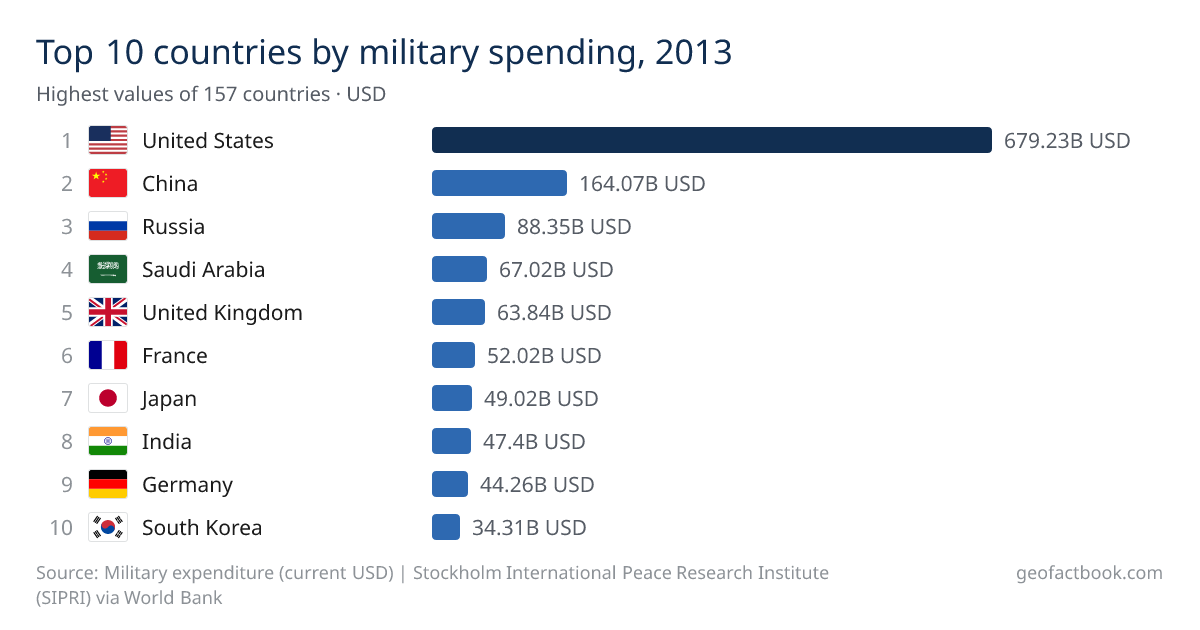
Analysis: These countries represent the highest values in this dataset, showcasing significant scale and impact on global statistics.
- #157Panama
- #156Iceland
- #155Costa Rica
- #154Haiti
- #153Cabo Verde
- #152Gambia
- #151Seychelles
- #150Liberia
- #149Belize
- #148Guinea-Bissau
Context: These countries or territories have the lowest values, often due to geographic size, administrative status, or specific characteristics.
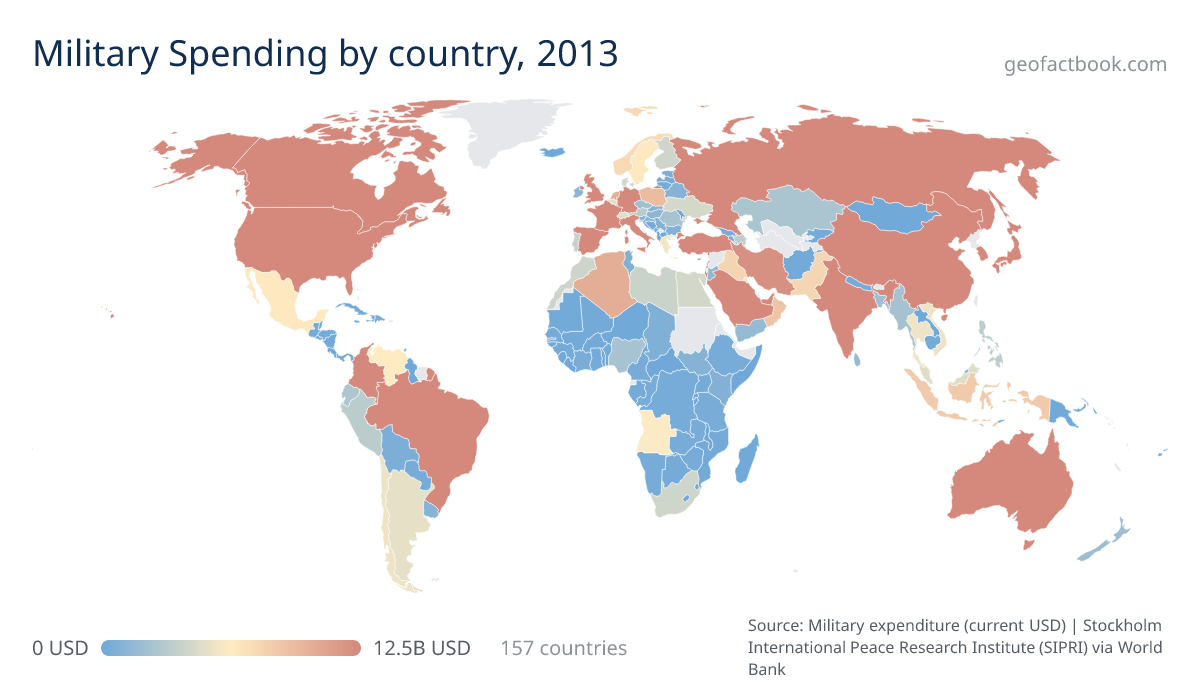
Military Spending by country, 2013: map image
Top 10 countries by military spending, 2013: chart
Insights by country
Chile
In 2013, Chile ranked #37 globally in military spending, with a total of 5529879480.60968 USD. This amount reflects a commitment to maintaining a capable military force in a region characterized by historical tensions and territorial disputes, particularly with neighboring Peru and Bolivia. Additionally, Chile's robust economy, underpinned by its mining sector, provides the financial resources necessary to support such spending levels.
Saudi Arabia
In 2013, Saudi Arabia ranked #4 globally in military spending, allocating 67020000000 USD to its defense budget. This figure is significantly higher than many of its regional neighbors, reflecting the country's strategic focus on military modernization and regional security. Key drivers of this substantial spending include Saudi Arabia's geopolitical position in the Middle East and its ongoing efforts to counteract regional threats, particularly from Iran.
Somalia
In 2013, Somalia ranked #145 globally in military spending with a total of 26,050,000 USD. This figure is notably low compared to many countries in the region, reflecting the ongoing challenges faced by the nation in terms of security and governance. The primary drivers of this limited military expenditure include a protracted history of conflict, a fragile state structure, and reliance on international aid for basic needs rather than military capabilities.
Burkina Faso
In 2013, Burkina Faso's military spending was $166,136,345.235204 USD, ranking it #117 out of 157 countries. This spending level is relatively low compared to regional neighbors, reflecting a focus on development rather than military expansion. The country faces ongoing security challenges from extremist groups, which has led to increased calls for military investment, though economic constraints limit substantial growth in defense budgets.
Slovenia
In 2013, Slovenia ranked #81 globally in military spending, allocating 506742932.103314 USD to its defense budget. This figure is notably lower than the NATO average, reflecting Slovenia's smaller military footprint compared to larger regional players like Germany. The country's military spending is influenced by its strategic focus on peacekeeping missions and a commitment to international security, alongside budget constraints stemming from its post-economic crisis recovery.
Sierra Leone
Sierra Leone's military spending in 2013 was $31,684,939.41 USD, ranking it #142 out of 157 countries. This expenditure is significantly lower than many of its West African neighbors, reflecting the region's varied security priorities and economic capabilities. The country's military budget has been shaped by its post-civil war recovery, with a focus on rebuilding infrastructure and stabilizing governance rather than extensive military expansion.
Timor-Leste
In 2013, Timor-Leste ranked #143 globally in military spending, with a total of 31,683,000 USD. This figure is notably low compared to regional neighbors, reflecting a focus on development rather than military capacity. The country's military budget is influenced by its recent history of conflict and ongoing efforts to build a stable democratic state, prioritizing social and economic reconstruction over military expansion.
China
In 2013, China ranked #2 globally in military spending, with a total of 164070469321.744 USD. This figure is significantly higher than many regional neighbors, reflecting China's strategic emphasis on military modernization and regional influence.
The key drivers behind this spending include China's rapid economic growth, which has enabled increased defense budgets, and ongoing territorial disputes in the South China Sea, necessitating a robust military presence. Additionally, China's focus on becoming a global superpower has led to substantial investments in advanced military technology and capabilities.
Venezuela
In 2013, Venezuela ranked #32 globally for Military Spending, with a total expenditure of 6199698500.15542 USD. This spending level was notable in the context of Latin America, where many neighboring countries had lower military budgets, reflecting Venezuela's focus on military modernization amid regional tensions.
The country's military spending was driven by a combination of factors, including its strategic geopolitical position and ongoing domestic challenges, which prompted the government to prioritize defense capabilities as a means of asserting sovereignty and stability.
Bahrain
In 2013, Bahrain's military spending was $1,347,606,382.98, placing the country at rank 67 out of 157 countries. This expenditure is notable given that it is higher than the regional average for Gulf Cooperation Council (GCC) nations, reflecting Bahrain's strategic focus on defense amid regional tensions. The key drivers of this spending include Bahrain's geopolitical position and its reliance on military capabilities to ensure national security, particularly in light of its proximity to Iran and ongoing regional instability.
Analysis & Context
In 2013, the United States led the world in Military Spending with a staggering USD 679.2 billion, while the global range varied from USD 0 to this maximum. The global average military expenditure was approximately USD 11.1 billion, highlighting the significant disparities in defense investment among countries.
Global Disparities in Military Spending
The vast disparities in Military Spending in 2013 can be attributed to a combination of economic capacity, geopolitical considerations, and policy priorities. China, with a military budget of USD 164.1 billion, and Russia, at USD 88.4 billion, followed the United States, reflecting their strategic goals and economic strength. These countries prioritize military expenditure to enhance their global influence and ensure national security. In contrast, nations like Costa Rica, Iceland, and Panama reported USD 0 in military spending, underscoring their strategic neutrality or reliance on international security arrangements.
Economic Capacity and Military Expenditure
The economic capacity of a nation significantly influences its military budget. For instance, Saudi Arabia allocated USD 67 billion to defense, ranking fourth globally. This reflects its substantial oil revenues and strategic need to secure its borders in a volatile region. Similarly, Japan and Germany, with expenditures of USD 49 billion and USD 44.3 billion respectively, demonstrate how economic powerhouses invest in defense to maintain regional stability and fulfill international obligations. Conversely, smaller economies like Haiti and Cabo Verde spent merely USD 4.5 million and USD 9.8 million, illustrating the limited fiscal space available for defense spending.
Geopolitical Tensions and Defense Budgets
Geopolitical tensions often drive nations to allocate significant portions of their budgets to military expenditure. The Middle East, characterized by ongoing conflicts and regional rivalries, saw countries like Saudi Arabia and the United Arab Emirates significantly increase their defense budgets. The UAE's military spending rose by 23.8%, a reflection of its strategic interests in the region. Similarly, Russia increased its expenditure by 8.4%, likely in response to its geopolitical ambitions and regional security dynamics.
Year-over-Year Changes and Strategic Shifts
Analyzing year-over-year changes reveals strategic shifts in national priorities. While China increased its spending by USD 18.9 billion (a 13.1% rise), reflecting its growing international assertiveness, the United States reduced its expenditure by USD 45.9 billion (a 6.3% decline), aligning with its strategic pivot and budgetary constraints. Notably, Iraq witnessed an 87.9% increase, underscoring post-conflict reconstruction and security needs.
On the other hand, countries like Japan and Iran saw significant declines in military spending, with reductions of USD 10.9 billion and USD 4.5 billion respectively. Japan's decrease of 18.3% may be linked to its pacifist constitution and economic challenges, while Iran's 27.3% cut likely correlates with international sanctions affecting its economy.
In conclusion, the 2013 military spending landscape illustrates how economic strength, geopolitical dynamics, and strategic priorities shape national defense budgets. Countries like the United States, China, and Russia dominate due to their economic capabilities and global ambitions, while others allocate resources based on regional security needs and economic constraints. Understanding these patterns provides valuable insights into the global distribution of military power and the underlying factors driving defense expenditures.
Frequently Asked Questions About Military Spending in 2013
Which country had the highest military spending in 2013?
The United States had the highest military spending in 2013, with 679,229,000,000 USD.
Which country had the lowest military spending in 2013?
Costa Rica had the lowest military spending in 2013, with 0 USD.
What was the average military spending by country in 2013?
The average military spending by country in 2013 was 11,127,271,438 USD.
What was the median military spending by country in 2013?
The median military spending by country in 2013 was 726,459,396 USD.
How many countries are included in the 2013 military spending dataset?
The 2013 military spending dataset includes 157 countries.
Which countries were in the top 10 for military spending in 2013?
The top 10 countries for military spending in 2013 were the United States, China, Russia, Saudi Arabia, United Kingdom, France, Japan, India, Germany, and South Korea.
Data Source
Military expenditure (current USD) | Stockholm International Peace Research Institute (SIPRI) via World Bank
Data produced by SIPRI Military Expenditure Database, Stockholm International Peace Research Institute (SIPRI), compiled and published by World Bank as "Military expenditure (current USD)".
Visit Data SourceCite this page
Geo Factbook. (n.d.). Military Spending by Country, 2013. Retrieved November 29, 2026, from https://geofactbook.com/fact/military-spending/2013
The figures on this page come from Military expenditure (current USD) | Stockholm International Peace Research Institute (SIPRI) via World Bank. For academic work, cite the original source as well.
›Embed this ranking on your site
Free to embed with attribution. Shows the top 10 countries and links back to the full ranking.
Historical Data by Year
Explore Military Spending data across different years. Compare trends and see how statistics have changed over time.
More Military and Security Facts
See all Military and Security facts →Total Armed Forces Personnel (PPP)
Explore total armed forces personnel across 266+ countries. Compare military size, view rankings, and analyze historical trends on our interactive map.
Highest: India3.07MMilitary Service Age and Obligation
Military service age and obligation details for 266+ countries. Compare requirements, explore rankings, and view interactive maps.
Highest: Angola20You might also like
Gross Domestic Product (GDP) by Country in Current US Dollars
FeaturedDiscover the Gross Domestic Product (GDP) by country in current US dollars, a key indicator of economic performance. This statistic reveals the financial health and growth potential of nations, making it essential for investors and policymakers.
Highest: United States32.95T $Population Change
FeaturedThis statistic measures population change across countries, highlighting shifts in demographics. Understanding these changes is crucial for planning resources, economic growth, and social services.
Highest: India14.13M personsLife expectancy at birth
FeaturedLife expectancy at birth measures the average years a newborn is expected to live, reflecting a country's health standards and quality of life. This vital statistic highlights disparities in healthcare and living conditions across nations, making it essential for global health assessments.
 Highest: Monaco89.29 years