
Hepatitis B Immunization Rate in Children 2025
Tracks the vaccination rate for hepatitis B in children, crucial for preventing liver disease.
Where does your country rank? Pick it to see its position.
Related Health statistics
More ↓
Interactive Map
Complete Data Rankings




































































































































































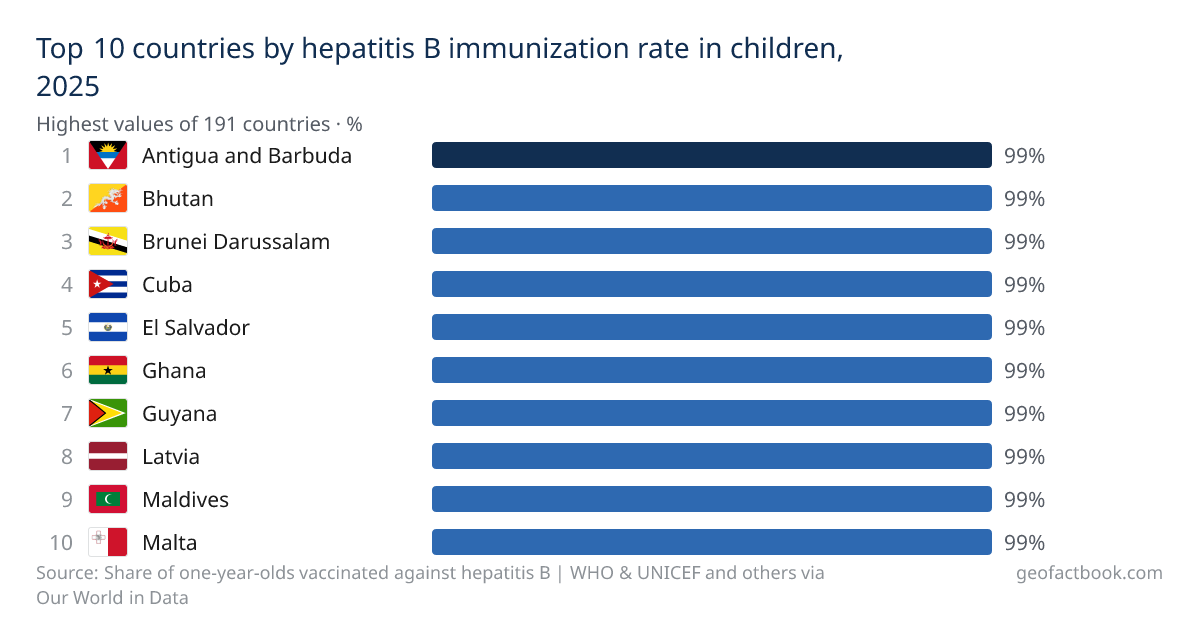
- #1
 Antigua and Barbuda
- #2
 Bhutan
- #3
 Brunei Darussalam
- #4
 Cuba
- #5
 El Salvador
- #6
 Ghana
- #7
 Guyana
- #8
 Latvia
- #9
 Maldives
- #10
 Malta
Analysis: These countries represent the highest values in this dataset, showcasing significant scale and impact on global statistics.
- #191
 Yemen
- #190
 Montenegro
- #189
 Papua New Guinea
- #188
 Central African Republic
- #187
 Venezuela
- #186
 Azerbaijan
- #185
 Lebanon
- #184
 Angola
- #183
 Kazakhstan
- #182
 Haiti
Context: These countries or territories have the lowest values, often due to geographic size, administrative status, or specific characteristics.
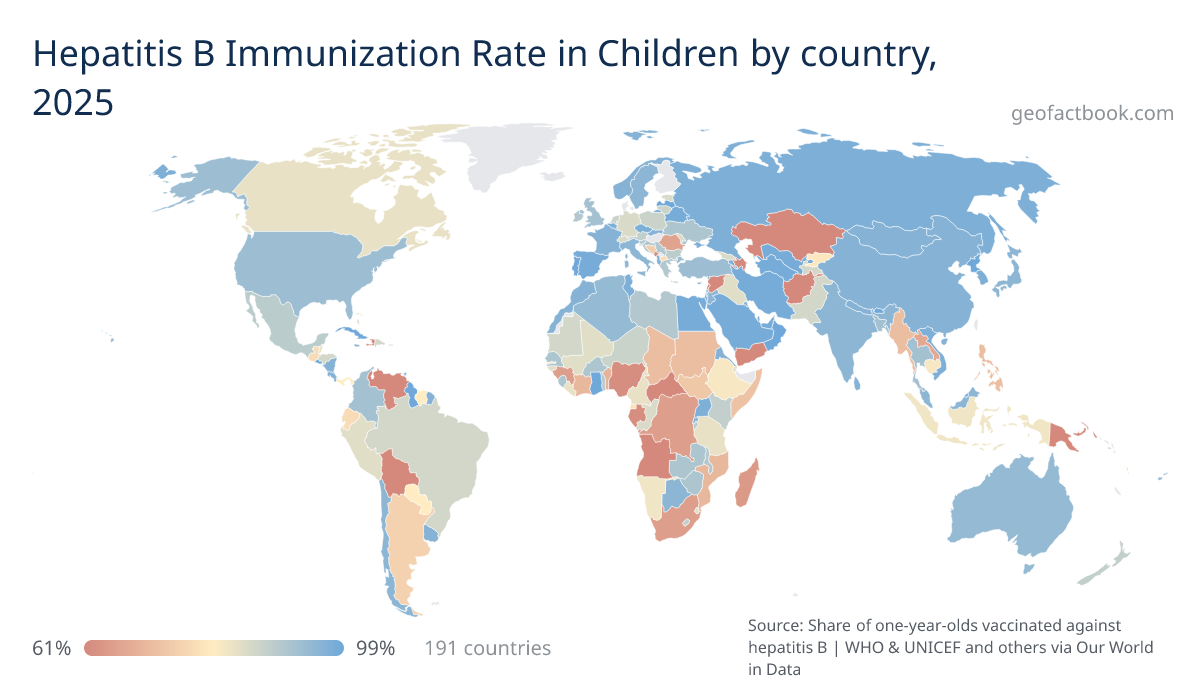
Hepatitis B Immunization Rate in Children by country, 2025: map image
Top 10 countries by hepatitis B immunization rate in children, 2025: chart
Insights by country
Malta
In 2025, Malta ranks #12 globally for Hepatitis B Immunization Rate in Children with a value of 99 %. This rate is significantly higher than the global average, reflecting Malta's strong healthcare policies and effective immunization programs. The country's commitment to public health, supported by a robust healthcare system and high government investment in healthcare services, has facilitated widespread vaccination coverage among children.
France
In 2025, France ranks #45 globally with a Hepatitis B Immunization Rate in Children of 96 %. This rate is above the global average but lower than several neighboring countries, indicating a strong commitment to childhood vaccination. Key drivers for this high immunization rate include France's robust healthcare system, which offers free vaccinations, and public health campaigns that emphasize the importance of immunization for preventing infectious diseases.
Togo
Togo ranks #97 globally with a Hepatitis B Immunization Rate in Children of 90 % in 2025. This rate is above the global average but lower than some of its West African neighbors, indicating room for improvement in public health initiatives.
The country's relatively high immunization rate can be attributed to government efforts to enhance healthcare access and vaccination programs, particularly in rural areas. Additionally, international partnerships and funding have bolstered Togo's ability to implement effective immunization campaigns.
Slovenia
In 2025, Slovenia's Hepatitis B Immunization Rate in Children is 90 %, ranking #96 out of 191 countries. This rate is below the global average, indicating room for improvement in childhood vaccination efforts compared to higher-ranked nations. Factors influencing this statistic include Slovenia's robust healthcare system and government initiatives aimed at increasing vaccination coverage, although challenges remain in reaching all demographics effectively.
Mauritius
Mauritius ranks #47 globally with a Hepatitis B Immunization Rate in Children of 96 % for the year 2025. This rate is notably higher than the global average, reflecting the country's strong healthcare policies. The high immunization rate can be attributed to Mauritius's robust public health infrastructure and government initiatives aimed at increasing vaccination coverage among children.
Trinidad and Tobago
In 2025, Trinidad and Tobago ranks #37 globally with a Hepatitis B Immunization Rate in Children of 97 %. This rate is notably higher than the global average, indicating strong health initiatives in the country. The high immunization coverage can be attributed to effective public health policies and a robust healthcare system that prioritizes childhood vaccinations.
Senegal
In 2025, Senegal ranks #83 globally with a Hepatitis B Immunization Rate in Children of 91%. This rate is above the average for many countries in the West African region, indicating effective immunization strategies. Key drivers for this achievement include the government's commitment to expanding healthcare access and increasing public awareness about vaccination benefits.
Malawi
In 2025, Malawi's Hepatitis B Immunization Rate in Children stands at 90 %, ranking #94 out of 191 countries. This rate is slightly below the global average, reflecting challenges faced in healthcare delivery compared to top-ranked nations. Factors contributing to this statistic include Malawi's ongoing efforts to enhance healthcare infrastructure and increase access to immunization programs, particularly in rural areas where healthcare resources are limited.
Mozambique
Mozambique ranks #168 globally with a Hepatitis B Immunization Rate in Children of 70% in 2025. This rate is notably below the global average, highlighting significant public health challenges. Contributing factors include limited healthcare infrastructure and ongoing economic difficulties, which hinder access to vaccinations in rural areas. Additionally, Mozambique's high population growth places increased demand on healthcare resources, complicating immunization efforts.
Micronesia (Fed. States of)
In 2025, Micronesia (Fed. States of) has a Hepatitis B Immunization Rate in Children of 85 %, ranking #128 out of 191 countries. This rate is below the global average, highlighting a significant gap in immunization coverage compared to higher-ranked nations. Factors contributing to this statistic include limited healthcare infrastructure and challenges in reaching remote island populations, which hinder vaccination efforts.
Analysis & Context
In 2025, the Hepatitis B Immunization Rate in Children is led by Oman, Maldives, Bhutan, Ghana, State of Palestine, Portugal, Guyana, Brunei Darussalam, El Salvador, and Latvia, all achieving a maximum rate of 99%. The global range spans from 39% in Yemen to 99% in these leading nations. The median global immunization rate stands at a robust 90%, while the average is slightly lower at 86.03%.
Global Leaders and Immunization Success
The top performers in the Hepatitis B Immunization Rate in Children, such as Oman, Maldives, and Portugal, exhibit near-universal coverage. These countries benefit from well-established healthcare systems and strong governmental support for vaccination programs. For instance, Portugal has integrated vaccination into its primary healthcare services, ensuring easy access and high compliance rates.
Moreover, the commitment to public health in countries like Bhutan and Ghana is reflected in their comprehensive vaccination schedules and community outreach initiatives. These strategies are pivotal in maintaining high immunization rates and preventing liver disease outbreaks among children.
Challenges in Low-Performing Regions
Conversely, the bottom performers, including Yemen (39%) and Montenegro (41%), face significant obstacles. Political instability, economic constraints, and limited healthcare infrastructure contribute to these low rates. For example, ongoing conflicts in Yemen disrupt health services, hindering vaccine distribution and accessibility.
In the Central African Republic (46%) and Papua New Guinea (43%), geographical barriers and a lack of healthcare resources further exacerbate the challenge of reaching remote populations. These factors collectively impede efforts to improve immunization coverage.
Year-over-Year Trends and Notable Changes
Analyzing the year-over-year changes, Sudan experienced the most significant improvement, with a remarkable 32% increase, reaching an immunization rate of 82.1%. This surge can be attributed to enhanced international support and investment in health infrastructure. Likewise, the Cook Islands saw a 20% rise, reflecting successful health policy implementations.
Conversely, Montenegro witnessed a drastic decline of -20%, highlighting potential disruptions in healthcare services or vaccine hesitancy. Similarly, Saint Lucia and North Macedonia experienced declines of -15% and -14%, respectively, which may prompt investigations into systemic healthcare issues or shifts in public health priorities.
Economic and Policy Influences on Immunization Rates
Economic stability and effective policy frameworks are crucial determinants of high immunization rates. Countries like Latvia and El Salvador, which boast strong economic structures, ensure consistent funding for public health initiatives, leading to sustained high vaccination rates.
In contrast, nations with economic hardships or inconsistent policy implementations, such as Venezuela (50%) and Angola (52%), struggle to maintain adequate immunization coverage. These countries often face challenges in securing vaccine supplies and managing distribution networks, impacting overall vaccination success.
In summary, the Hepatitis B Immunization Rate in Children for 2025 highlights significant disparities driven by economic, political, and infrastructural factors. Understanding these dynamics is crucial for global health organizations and governments aiming to enhance vaccination efforts and protect children worldwide from preventable diseases.
Frequently Asked Questions About Hepatitis B Immunization Rate in Children in 2025
Which country has the highest hepatitis B immunization rate in children in 2025?
Oman has the highest hepatitis B immunization rate in children in 2025, with a rate of 99%.
What is the average hepatitis B immunization rate in children across all countries in 2025?
The average hepatitis B immunization rate in children across all countries in 2025 is 86.03%.
Which country has the lowest hepatitis B immunization rate in children in 2025?
Yemen has the lowest hepatitis B immunization rate in children in 2025, with a rate of 39%.
What is the median hepatitis B immunization rate in children in 2025?
The median hepatitis B immunization rate in children in 2025 is 90%.
How many countries are included in the hepatitis B immunization rate dataset for 2025?
The dataset includes 191 countries for the hepatitis B immunization rate in children in 2025.
What is the range of hepatitis B immunization rates in children in 2025 among the listed countries?
The range of hepatitis B immunization rates in children in 2025 spans from 39% in Yemen to 99% in Oman.
Data Source
Share of one-year-olds vaccinated against hepatitis B | WHO & UNICEF and others via Our World in Data
Data produced by WHO & UNICEF; UN, World Population Prospects, compiled and published by Our World in Data as "Share of one-year-olds vaccinated against hepatitis B".
Visit Data SourceCite this page
Geo Factbook. (n.d.). Hepatitis B Immunization Rate in Children by Country, 2025. Retrieved November 28, 2026, from https://geofactbook.com/fact/hepatitis-b-immunization-rate-in-children/2025
The figures on this page come from Share of one-year-olds vaccinated against hepatitis B | WHO & UNICEF and others via Our World in Data. For academic work, cite the original source as well.
›Embed this ranking on your site
Free to embed with attribution. Shows the top 10 countries and links back to the full ranking.
Historical Data by Year
Explore Hepatitis B Immunization Rate in Children data across different years. Compare trends and see how statistics have changed over time.
More Health Facts
See all Health facts →Global Stillbirth Rate Trends
Explore global trends in stillbirth rates, highlighting improvements or setbacks over time across different countries.
 Highest: Somalia3.49 per 1,000 births
Public Health Spending (% of GDP)
Public health spending as a percentage of GDP measures how much countries allocate to health relative to their economic output.
 Highest: United States14.3%
Mean Age at First Birth
Mean age at first birth indicates maternal age trends. Compare countries, explore rankings, and see historical shifts with interactive maps.
 Highest: Andorra32.8
You might also like
Gross Domestic Product (GDP) by Country in Current US Dollars
FeaturedDiscover the Gross Domestic Product (GDP) by country in current US dollars, a key indicator of economic performance. This statistic reveals the financial health and growth potential of nations, making it essential for investors and policymakers.
Highest: United States32.95T $Total population
FeaturedDiscover the latest total population statistics for every country and region worldwide. Explore accurate, up-to-date data on global population growth, density, and demographic trends — sourced from trusted international databases like the UN and World Bank. Perfect for researchers, students, and data enthusiasts looking to understand how the world’s population is changing.
 Highest: India1.48B persons
Life expectancy at birth
FeaturedLife expectancy at birth measures the average years a newborn is expected to live, reflecting a country's health standards and quality of life. This vital statistic highlights disparities in healthcare and living conditions across nations, making it essential for global health assessments.
 Highest: Monaco89.29 years