
Hepatitis B Immunization Rate in Children 2007
Tracks the vaccination rate for hepatitis B in children, crucial for preventing liver disease.
Newer data is available: Hepatitis B Immunization Rate in Children by country 2025 →

Where does your country rank? Pick it to see its position.
Related Health statistics
More ↓
Interactive Map
Complete Data Rankings



























































































































































Analysis: These countries represent the highest values in this dataset, showcasing significant scale and impact on global statistics.
- #171
 India
- #170
 Canada
- #169
 Djibouti
- #168
 Nigeria
- #167
 France
- #166
 Angola
- #165
 Ethiopia
- #164
 Laos
- #163
 Pakistan
- #162
 Iraq
Context: These countries or territories have the lowest values, often due to geographic size, administrative status, or specific characteristics.
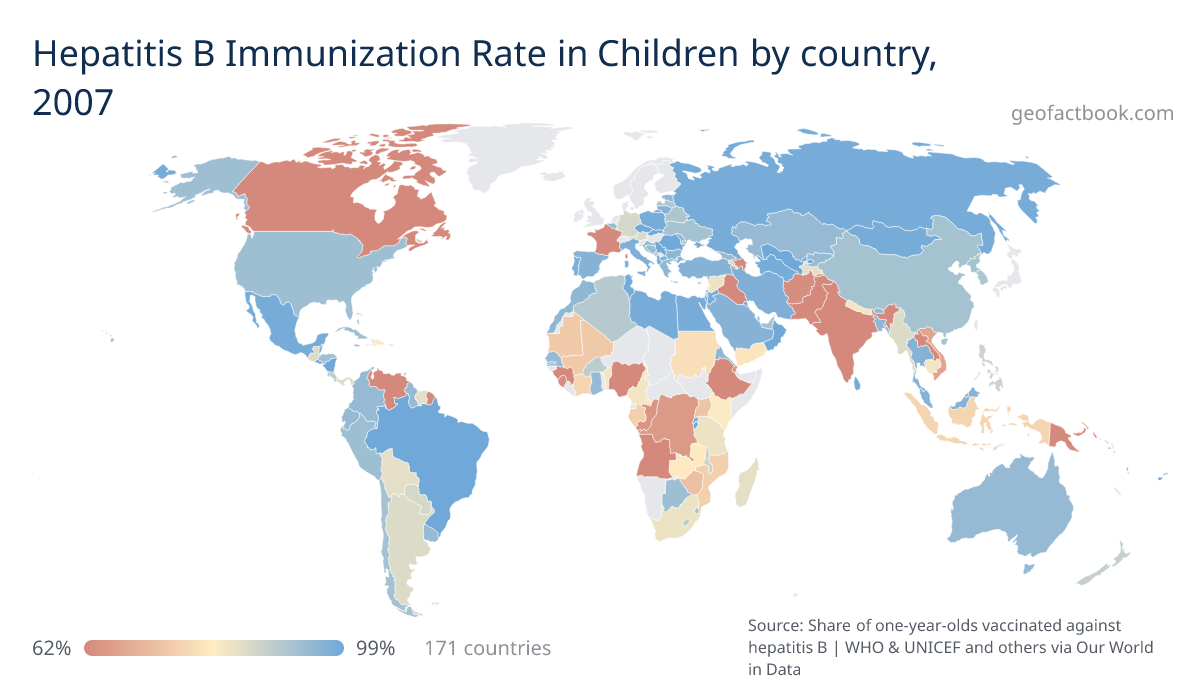
Hepatitis B Immunization Rate in Children by country, 2007: map image
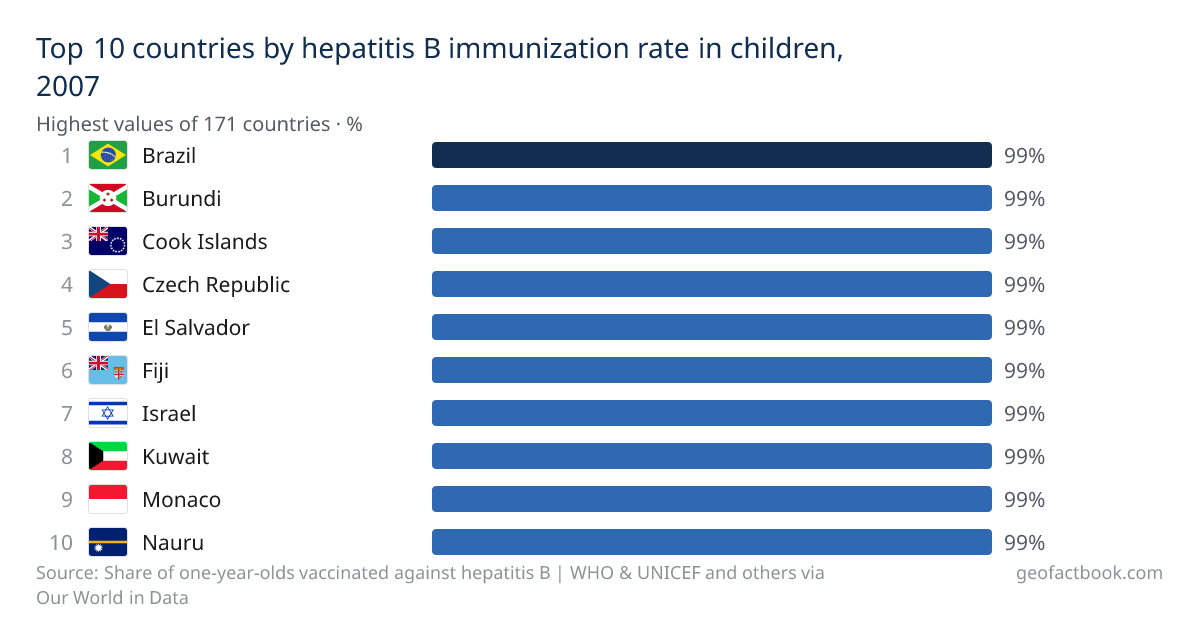
Top 10 countries by hepatitis B immunization rate in children, 2007: chart
Insights by country
Guinea
In 2007, Guinea ranked #161 globally with a Hepatitis B Immunization Rate in Children of 57%. This rate is significantly lower than the global average, highlighting critical public health challenges in the country. Contributing factors include limited healthcare infrastructure and ongoing political instability, which hinder vaccination efforts and outreach programs.
Malaysia
In 2007, Malaysia achieved a Hepatitis B Immunization Rate in Children of 96 %, ranking #51 out of 171 countries. This rate is significantly higher than the global average, indicating strong healthcare initiatives in the region. Key drivers of this success include Malaysia's robust public health policies and extensive vaccination programs that have prioritized childhood immunization.
North Macedonia
In 2007, North Macedonia achieved a Hepatitis B Immunization Rate in Children of 96 %, ranking #57 out of 171 countries. This rate is notably higher than the global average, reflecting strong health policies and effective vaccination programs. The country’s commitment to immunization has been supported by international partnerships and initiatives aimed at improving child health outcomes.
Djibouti
In 2007, Djibouti had a Hepatitis B Immunization Rate in Children of 25%, ranking #169 out of 171 countries. This rate is significantly lower than the global average, which highlights the challenges faced by the nation in healthcare access. Limited healthcare infrastructure, economic constraints, and ongoing political instability have hindered effective immunization programs in Djibouti.
Iran
In 2007, Iran achieved a Hepatitis B Immunization Rate in Children of 97 %, ranking #40 out of 171 countries. This rate is significantly higher than the global average, reflecting Iran's robust public health initiatives. The country's commitment to vaccination programs, supported by government policies and healthcare infrastructure, has played a crucial role in achieving this high immunization rate.
Bosnia and Herzegovina
In 2007, Bosnia and Herzegovina achieved a Hepatitis B Immunization Rate in Children of 94 %, ranking #68 out of 171 countries. This rate is notably higher than the global average, reflecting the country's commitment to childhood vaccination programs. Contributing factors include a relatively stable healthcare infrastructure and government initiatives aimed at improving public health, despite the challenges posed by its post-war recovery and economic conditions.
Nauru
Nauru achieved a Hepatitis B Immunization Rate in Children of 99 % in 2007, ranking #11 out of 171 countries. This rate is significantly higher than the global average, reflecting the country's commitment to public health initiatives. Factors contributing to this high immunization rate include Nauru's small population, which allows for more efficient healthcare delivery, and government policies prioritizing childhood vaccinations as part of their healthcare strategy.
Laos
In 2007, Laos ranked #164 globally with a Hepatitis B immunization rate in children of 50 %. This rate is significantly lower than the global average, reflecting challenges in healthcare access and infrastructure. Contributing factors include Laos's economic constraints and a rural population that faces difficulties in receiving consistent medical services, which hinder widespread vaccination efforts.
Syrian Arab Republic
In 2007, the Syrian Arab Republic had a Hepatitis B Immunization Rate in Children of 83 %, ranking #129 out of 171 countries. This rate is below the global average, indicating challenges in healthcare access and vaccination programs compared to higher-ranking nations. Factors contributing to this statistic include the country's ongoing conflict, which has disrupted healthcare services, and a relatively underfunded public health infrastructure that limits immunization outreach.
Serbia
In 2007, Serbia achieved a Hepatitis B Immunization Rate in Children of 99 %, ranking #18 out of 171 countries. This rate is significantly higher than the global average, reflecting Serbia's commitment to child health and preventive care. The country's robust healthcare system and effective vaccination campaigns have been key drivers in achieving this high immunization rate, ensuring widespread access to essential vaccines for children.
Analysis & Context
In 2007, the Hepatitis B Immunization Rate in Children was highest in countries like Serbia, Brazil, and Seychelles, all achieving an impressive rate of 99%. The global range for this year spanned from a low of 6% in India to the maximum of 99% in several top-ranking countries. The global average immunization rate was 86.61%, with a median value of 93%, highlighting significant disparities across different regions.
Economic Influence on Immunization Rates
Economic factors are a major determinant of Hepatitis B Immunization Rate in Children. Countries like Serbia and Brazil, both with a rate of 99%, benefit from relatively stable economies that can support comprehensive healthcare initiatives. In contrast, India, with the lowest rate at 6%, faces challenges such as vast population size and varied economic conditions across its regions, which complicate vaccine distribution and accessibility.
Meanwhile, Nigeria and Angola have rates of 42% and 43% respectively, reflecting the economic struggles these countries face. Despite being Africa’s largest economy, Nigeria's healthcare system is under pressure from rapid population growth and limited healthcare funding, which impacts vaccination efforts.
Policy and Healthcare Infrastructure
Strong healthcare policies and infrastructure play crucial roles in achieving high immunization rates. Countries like Oman and Israel, both at 99%, benefit from government-backed healthcare systems that prioritize immunization. These countries have implemented successful public health campaigns and maintained robust healthcare infrastructure, ensuring widespread vaccine availability and public awareness.
Conversely, Canada and France show surprisingly low rates of 14% and 42%, respectively. These figures may be influenced by different healthcare policies, where vaccinations might not be mandatory or are subject to public debate, affecting uptake rates.
Geopolitical Factors and Immunization Challenges
Geopolitical stability often correlates with higher immunization rates. Countries such as Monaco and Slovakia enjoy high rates of 99% due to stable governance and effective public health policies. In contrast, regions experiencing conflict or political instability, like Iraq with a rate of 56%, face significant hurdles in implementing consistent immunization programs.
In Djibouti, with a rate of 25%, limited infrastructure and government capacity contribute to low immunization rates. The geopolitical landscape can hinder vaccine distribution and access, particularly in regions with ongoing conflict or governance challenges.
Year-over-Year Trends and Significant Changes
The year-over-year trends reveal significant changes in immunization rates across several countries. Dominica saw a remarkable increase of 86.00%, representing a 1228.6% growth, likely due to intensified public health efforts and international support. Similarly, Gabon and Sudan experienced substantial increases of 23.00% and 18.00% respectively, reflecting successful health policy implementations and improved healthcare delivery systems.
Conversely, Vietnam experienced a significant decrease of 26.00% in its immunization rate, a 28.0% reduction, possibly due to shifts in policy or funding priorities. Mali and Malawi also faced declines of 16.00% and 12.00% respectively, which may indicate challenges in sustaining immunization initiatives amidst other pressing health concerns.
These variations highlight the dynamic nature of global health efforts and the myriad factors influencing Hepatitis B Immunization Rate in Children, from economic and policy drivers to geopolitical influences.
Frequently Asked Questions About Hepatitis B Immunization Rate in Children in 2007
Which country had the highest hepatitis B immunization rate in children in 2007?
Serbia had the highest hepatitis B immunization rate in children in 2007, with a rate of 99%.
What was the lowest hepatitis B immunization rate in children in 2007 and which country had it?
India had the lowest hepatitis B immunization rate in children in 2007, with a rate of 6%.
What was the average hepatitis B immunization rate in children across all countries in 2007?
The average hepatitis B immunization rate in children across all countries in 2007 was 86.61%.
What was the median hepatitis B immunization rate in children in 2007?
The median hepatitis B immunization rate in children in 2007 was 93%.
Which countries were in the top 10 for hepatitis B immunization rates in children in 2007?
The top 10 countries for hepatitis B immunization rates in children in 2007, all with a rate of 99%, were Serbia, Brazil, Seychelles, Burundi, Slovakia, Nicaragua, Monaco, Niue, Oman, and Israel.
Which countries were in the bottom 10 for hepatitis B immunization rates in children in 2007?
The bottom 10 countries for hepatitis B immunization rates in children in 2007 were India, Canada, Djibouti, Nigeria, France, Angola, Ethiopia, Laos, Pakistan, and Iraq.
Data Source
Share of one-year-olds vaccinated against hepatitis B | WHO & UNICEF and others via Our World in Data
Data produced by WHO & UNICEF; UN, World Population Prospects, compiled and published by Our World in Data as "Share of one-year-olds vaccinated against hepatitis B".
Visit Data SourceCite this page
Geo Factbook. (n.d.). Hepatitis B Immunization Rate in Children by Country, 2007. Retrieved November 28, 2026, from https://geofactbook.com/fact/hepatitis-b-immunization-rate-in-children/2007
The figures on this page come from Share of one-year-olds vaccinated against hepatitis B | WHO & UNICEF and others via Our World in Data. For academic work, cite the original source as well.
›Embed this ranking on your site
Free to embed with attribution. Shows the top 10 countries and links back to the full ranking.
Historical Data by Year
Explore Hepatitis B Immunization Rate in Children data across different years. Compare trends and see how statistics have changed over time.
More Health Facts
See all Health facts →Global Stillbirth Rate Trends
Explore global trends in stillbirth rates, highlighting improvements or setbacks over time across different countries.
 Highest: Somalia3.49 per 1,000 births
Public Health Spending (% of GDP)
Public health spending as a percentage of GDP measures how much countries allocate to health relative to their economic output.
 Highest: United States14.3%
Mean Age at First Birth
Mean age at first birth indicates maternal age trends. Compare countries, explore rankings, and see historical shifts with interactive maps.
 Highest: Andorra32.8
You might also like
Gross Domestic Product (GDP) by Country in Current US Dollars
FeaturedDiscover the Gross Domestic Product (GDP) by country in current US dollars, a key indicator of economic performance. This statistic reveals the financial health and growth potential of nations, making it essential for investors and policymakers.
Highest: United States32.95T $Total population
FeaturedDiscover the latest total population statistics for every country and region worldwide. Explore accurate, up-to-date data on global population growth, density, and demographic trends — sourced from trusted international databases like the UN and World Bank. Perfect for researchers, students, and data enthusiasts looking to understand how the world’s population is changing.
Highest: India1.48B personsLife expectancy at birth
FeaturedLife expectancy at birth measures the average years a newborn is expected to live, reflecting a country's health standards and quality of life. This vital statistic highlights disparities in healthcare and living conditions across nations, making it essential for global health assessments.
 Highest: Monaco89.29 years