
Hepatitis B Immunization Rate in Children 2016
Tracks the vaccination rate for hepatitis B in children, crucial for preventing liver disease.
Newer data is available: Hepatitis B Immunization Rate in Children by country 2025 →

Where does your country rank? Pick it to see its position.
Related Health statistics
More ↓
Interactive Map
Complete Data Rankings









































































































































































Analysis: These countries represent the highest values in this dataset, showcasing significant scale and impact on global statistics.
- #186
 Ukraine
- #185
 Chad
- #184
 Central African Republic
- #183
 South Sudan
- #182
 Papua New Guinea
- #181
 Guinea
- #180
 Somalia
- #179
 Nigeria
- #178
 Equatorial Guinea
- #177
 Angola
Context: These countries or territories have the lowest values, often due to geographic size, administrative status, or specific characteristics.
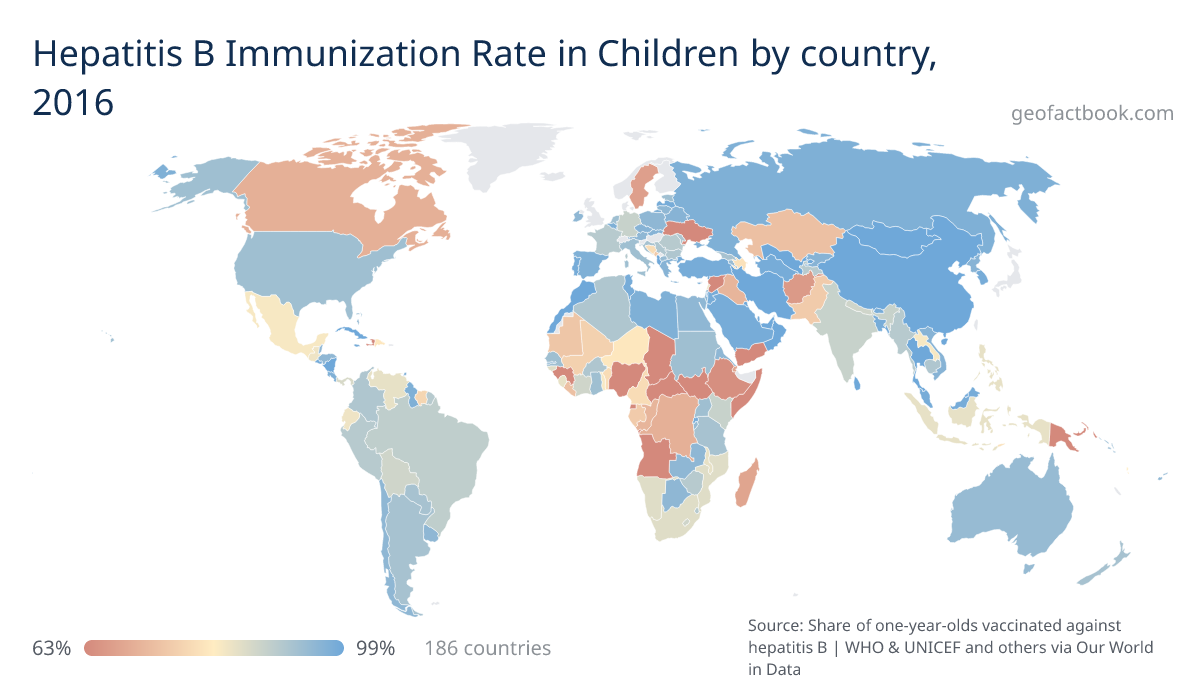
Hepatitis B Immunization Rate in Children by country, 2016: map image
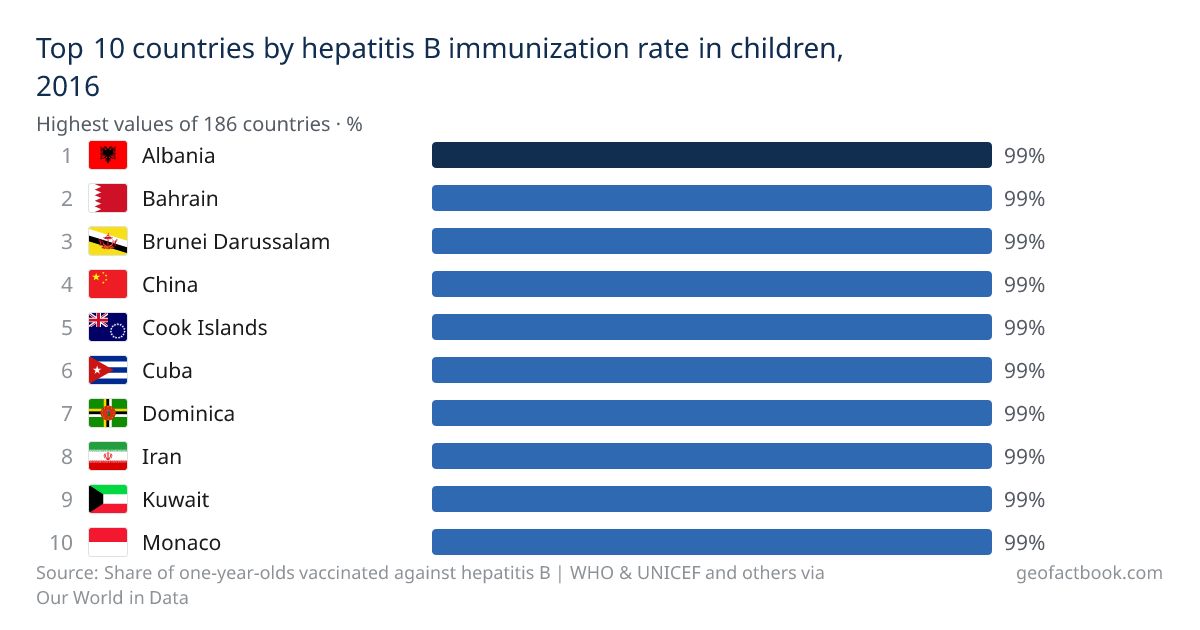
Top 10 countries by hepatitis B immunization rate in children, 2016: chart
Insights by country
Nigeria
Nigeria's Hepatitis B Immunization Rate in Children was 53 % in 2016, ranking it #179 out of 186 countries. This rate is significantly lower than the global average, reflecting ongoing challenges in healthcare access and infrastructure. Factors such as economic instability, high population density, and inadequate healthcare policy implementation have hindered immunization efforts in Nigeria, leaving many children vulnerable to preventable diseases.
Niger
Niger ranked #146 globally with a Hepatitis B Immunization Rate in Children of 80 % in 2016. This rate is below the global average, reflecting challenges in healthcare access and infrastructure compared to higher-ranked countries. Contributing factors include Niger's economic constraints and a high prevalence of poverty, which hinder the delivery of essential health services and vaccination programs.
Tunisia
Tunisia achieved a Hepatitis B Immunization Rate in Children of 98 % in 2016, ranking #37 out of 186 countries. This rate is significantly higher than the global average, reflecting the country’s effective public health policies and commitment to vaccination programs. Tunisia's strong healthcare infrastructure and government initiatives aimed at improving child health have been pivotal in achieving this high immunization rate.
Suriname
In 2016, Suriname ranked #152 globally with a Hepatitis B Immunization Rate in Children of 77%. This rate is below the global average, highlighting a significant public health challenge compared to higher-performing countries. Contributing factors include limited healthcare access in rural areas and economic constraints that impact vaccination programs. Additionally, public awareness and healthcare infrastructure may require further development to improve immunization rates effectively.
Saudi Arabia
In 2016, Saudi Arabia achieved a Hepatitis B Immunization Rate in Children of 98 %, ranking #36 out of 186 countries. This rate is significantly higher than the global average, reflecting the country's strong healthcare infrastructure. The high immunization rate can be attributed to the government's commitment to public health initiatives and widespread vaccination programs, supported by substantial financial resources and a focus on preventative healthcare.
Somalia
In 2016, Somalia had a Hepatitis B Immunization Rate in Children of 49 %, ranking #180 out of 186 countries. This rate is significantly lower than the global average, indicating substantial gaps in childhood vaccination coverage. Contributing factors include ongoing conflict, limited healthcare infrastructure, and widespread poverty, which hinder access to essential medical services and immunization programs.
Mongolia
Mongolia achieved a Hepatitis B Immunization Rate in Children of 99 % in 2016, ranking #13 out of 186 countries. This rate is significantly higher than the global average, reflecting the country's strong commitment to child health initiatives. Key drivers of this success include government policies focused on universal healthcare access and effective vaccination programs, supported by international partnerships and funding. Furthermore, Mongolia's relatively low population density facilitates outreach efforts in rural areas, ensuring high immunization coverage.
Singapore
In 2016, Singapore achieved a Hepatitis B Immunization Rate in Children of 96 %, ranking #60 out of 186 countries. This rate is higher than the global average, reflecting Singapore's robust healthcare system and commitment to preventive medicine. The country's comprehensive immunization programs and strong public health policies, supported by significant government investment in healthcare infrastructure, contribute to this high vaccination coverage.
Peru
In 2016, Peru achieved a Hepatitis B Immunization Rate in Children of 90 %, ranking #113 out of 186 countries. This rate is slightly below the global average, highlighting potential gaps in healthcare access compared to higher-ranking nations. Key drivers of this statistic include Peru's ongoing efforts to improve healthcare infrastructure and vaccination programs, particularly in rural areas where access to medical services can be limited.
Lithuania
In 2016, Lithuania achieved a Hepatitis B Immunization Rate in Children of 95 %, ranking #74 out of 186 countries. This rate is notably higher than the global average, reflecting the country's commitment to child health and preventive care. Lithuania's robust healthcare system, supported by government policies prioritizing vaccination programs, plays a crucial role in maintaining high immunization coverage among children.
Analysis & Context
In 2016, the Hepatitis B Immunization Rate in Children was highest in Uzbekistan, Mongolia, and several other nations, all achieving a rate of 99%. Globally, the immunization rate varied significantly, with the lowest recorded at 26% in Ukraine. The global average for this crucial health metric stood at 87.33%, providing a benchmark for evaluating countries' performance in preventing liver disease through vaccination.
Economic Stability and Immunization Rates
Economic factors play a pivotal role in determining a country's ability to administer widespread immunization. High immunization rates, such as the 99% seen in Brunei Darussalam and Monaco, are often associated with countries that have robust healthcare infrastructures and substantial public health funding. These nations can efficiently distribute vaccines and ensure high coverage among children.
Conversely, countries like Chad with a low immunization rate of 41% often face economic constraints that hinder healthcare services. Limited resources can lead to inadequate vaccine supply chains and insufficient healthcare personnel, impacting their ability to achieve higher immunization coverage.
Geopolitical and Social Influences
Geopolitical stability and social factors also significantly influence immunization rates. For instance, Somalia, with an immunization rate of 49%, faces ongoing conflict and political instability that disrupt healthcare services and vaccine distribution. In contrast, countries like Thailand and China, with rates of 99%, benefit from stable governance that supports comprehensive public health initiatives.
Social factors, including public awareness and cultural attitudes towards vaccination, can also affect immunization rates. Regions with strong public health campaigns and community engagement, such as Bahrain, achieve near-universal coverage, highlighting the importance of societal support for vaccination programs.
Trends and Year-over-Year Changes
Analyzing year-over-year changes offers insights into dynamic shifts in immunization strategies. Sweden experienced a remarkable increase of 14%, reaching a rate of 99%, attributed to intensified public health campaigns and improved vaccine accessibility. Similarly, Guatemala and Equatorial Guinea saw significant increases of 13%, reflecting successful governmental efforts to enhance healthcare delivery.
Conversely, some countries faced declines in immunization rates. Mauritius experienced a notable decrease of 25%, dropping its rate to 74%. Such declines may result from budget cuts, logistical challenges, or shifts in public policy that deprioritize vaccination efforts.
Policy Interventions and Future Prospects
Effective policy interventions are crucial for improving immunization rates. Countries with top-tier rates, like Uzbekistan and Mongolia, often implement comprehensive vaccination policies, including mandatory immunization and free vaccine distribution. These policies ensure high coverage and are models for countries seeking to improve their rates.
Looking ahead, international collaboration and investment in healthcare infrastructures are essential for countries lagging behind, such as Ukraine and Chad. By addressing economic and logistical barriers, these nations can enhance their immunization programs, ultimately improving public health outcomes and reducing the burden of hepatitis B globally.
Frequently Asked Questions About Hepatitis B Immunization Rate in Children in 2016
Which country had the highest hepatitis B immunization rate in children in 2016?
Uzbekistan had the highest hepatitis B immunization rate in children in 2016, with a rate of 99%.
What was the lowest hepatitis B immunization rate in children in 2016?
The lowest hepatitis B immunization rate in children in 2016 was in Ukraine, with a rate of 26%.
What was the average hepatitis B immunization rate in children across all countries in 2016?
The average hepatitis B immunization rate in children across all countries in 2016 was 87.33%.
What was the median hepatitis B immunization rate in children in 2016?
The median hepatitis B immunization rate in children in 2016 was 93%.
Which countries were in the top 10 for hepatitis B immunization rates in children in 2016?
The top 10 countries for hepatitis B immunization rates in children in 2016, all with a rate of 99%, were Uzbekistan, Mongolia, State of Palestine, Brunei Darussalam, Monaco, Thailand, Dominica, Saint Vincent and the Grenadines, China, and Bahrain.
What was the range of hepatitis B immunization rates in children in 2016?
The range of hepatitis B immunization rates in children in 2016 was from 26% in Ukraine to 99% in several countries, including Uzbekistan and Mongolia.
Data Source
Share of one-year-olds vaccinated against hepatitis B | WHO & UNICEF and others via Our World in Data
Data produced by WHO & UNICEF; UN, World Population Prospects, compiled and published by Our World in Data as "Share of one-year-olds vaccinated against hepatitis B".
Visit Data SourceCite this page
Geo Factbook. (n.d.). Hepatitis B Immunization Rate in Children by Country, 2016. Retrieved November 28, 2026, from https://geofactbook.com/fact/hepatitis-b-immunization-rate-in-children/2016
The figures on this page come from Share of one-year-olds vaccinated against hepatitis B | WHO & UNICEF and others via Our World in Data. For academic work, cite the original source as well.
›Embed this ranking on your site
Free to embed with attribution. Shows the top 10 countries and links back to the full ranking.
Historical Data by Year
Explore Hepatitis B Immunization Rate in Children data across different years. Compare trends and see how statistics have changed over time.
More Health Facts
See all Health facts →Global Stillbirth Rate Trends
Explore global trends in stillbirth rates, highlighting improvements or setbacks over time across different countries.
Highest: Somalia3.49 per 1,000 birthsPublic Health Spending (% of GDP)
Public health spending as a percentage of GDP measures how much countries allocate to health relative to their economic output.
 Highest: United States14.3%
Mean Age at First Birth
Mean age at first birth indicates maternal age trends. Compare countries, explore rankings, and see historical shifts with interactive maps.
 Highest: Andorra32.8
You might also like
Gross Domestic Product (GDP) by Country in Current US Dollars
FeaturedDiscover the Gross Domestic Product (GDP) by country in current US dollars, a key indicator of economic performance. This statistic reveals the financial health and growth potential of nations, making it essential for investors and policymakers.
Highest: United States32.95T $Total population
FeaturedDiscover the latest total population statistics for every country and region worldwide. Explore accurate, up-to-date data on global population growth, density, and demographic trends — sourced from trusted international databases like the UN and World Bank. Perfect for researchers, students, and data enthusiasts looking to understand how the world’s population is changing.
 Highest: India1.48B persons
Life expectancy at birth
FeaturedLife expectancy at birth measures the average years a newborn is expected to live, reflecting a country's health standards and quality of life. This vital statistic highlights disparities in healthcare and living conditions across nations, making it essential for global health assessments.
 Highest: Monaco89.29 years