
Hepatitis B Immunization Rate in Children 2001
Tracks the vaccination rate for hepatitis B in children, crucial for preventing liver disease.
Newer data is available: Hepatitis B Immunization Rate in Children by country 2025 →
Where does your country rank? Pick it to see its position.
Related Health statistics
More ↓
Interactive Map
Complete Data Rankings


















































































- #1
 Bahrain
- #2
 Brunei Darussalam
- #3
 Egypt
- #4
 Kuwait
- #5
 Monaco
- #6
 Niue
- #7
 Oman
- #8
 Saint Kitts and Nevis
- #9
 Slovakia
- #10
 Tuvalu
Analysis: These countries represent the highest values in this dataset, showcasing significant scale and impact on global statistics.
- #105
 Ukraine
- #104
 Côte d'Ivoire
- #103
 Barbados
- #102
 Yemen
- #101
 Bahamas
- #100
 Mozambique
- #99
 France
- #98
 Russia
- #97
 Austria
- #96
 Philippines
Context: These countries or territories have the lowest values, often due to geographic size, administrative status, or specific characteristics.
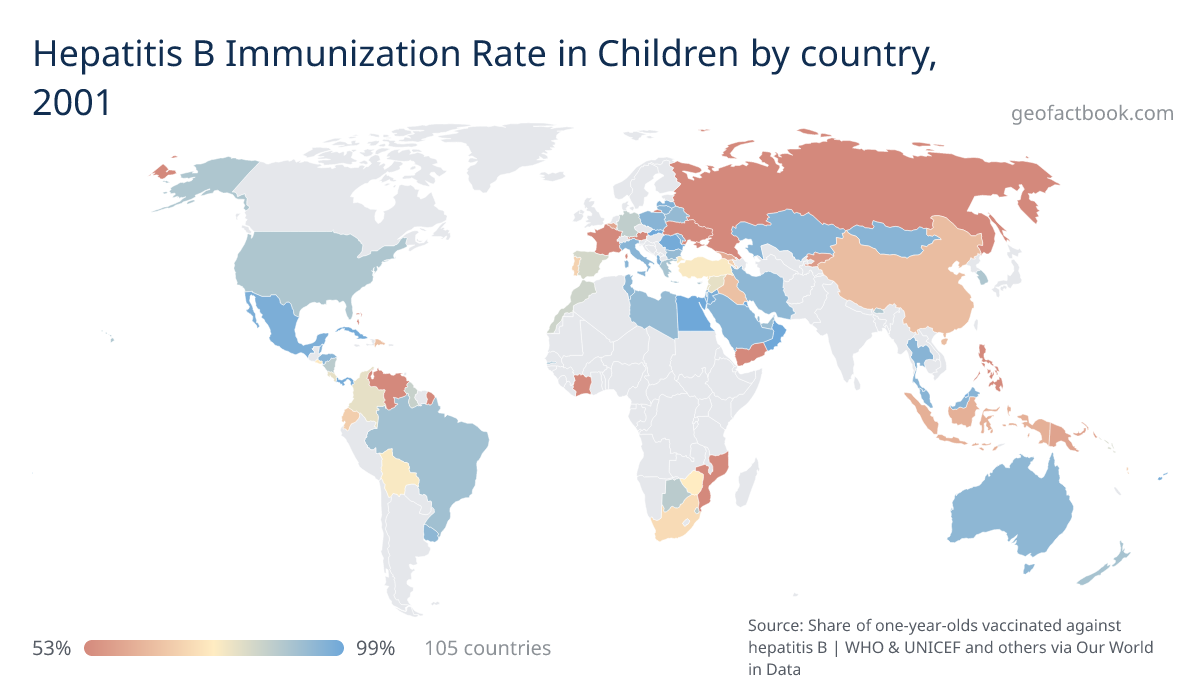
Hepatitis B Immunization Rate in Children by country, 2001: map image
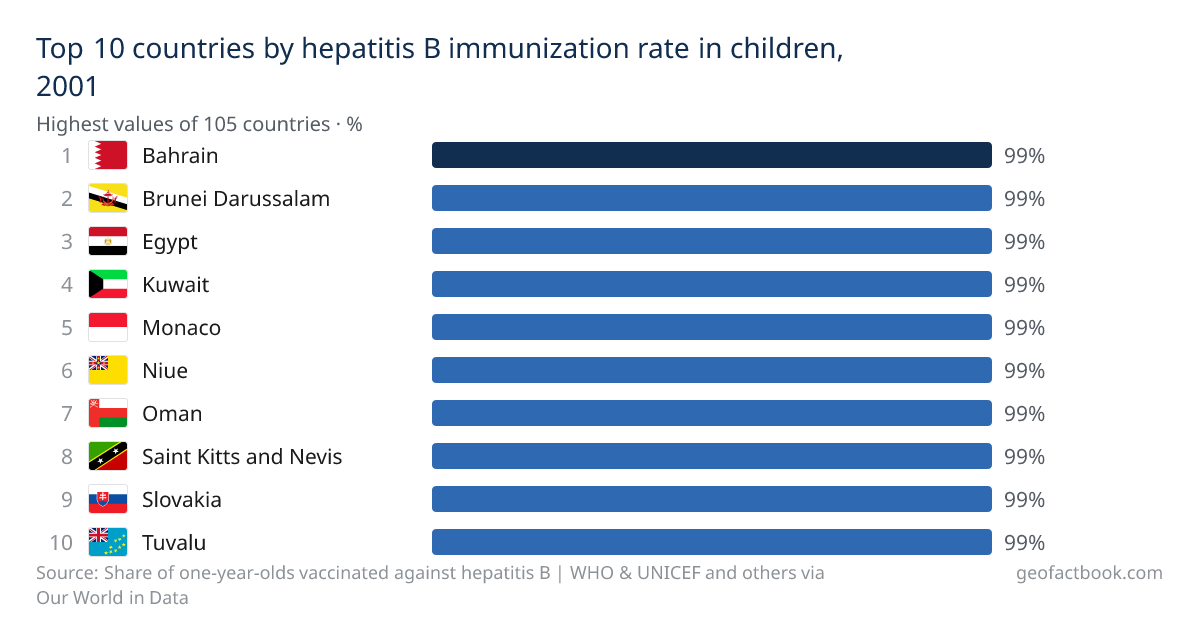
Top 10 countries by hepatitis B immunization rate in children, 2001: chart
Insights by country
Kuwait
In 2001, Kuwait achieved a Hepatitis B Immunization Rate in Children of 99 %, ranking #3 out of 105 countries. This rate is significantly higher than the global average, reflecting Kuwait's strong healthcare infrastructure and commitment to public health. The country's wealth, driven by oil revenues, allows for substantial investment in healthcare services and immunization programs, ensuring high coverage rates among children.
Grenada
In 2001, Grenada achieved a Hepatitis B Immunization Rate in Children of 96 %, ranking #22 out of 105 countries. This rate is notably higher than the global average, reflecting the country's effective public health initiatives. Grenada's strong healthcare system, supported by government policies prioritizing childhood vaccinations, has played a crucial role in achieving this high immunization rate.
Antigua and Barbuda
In 2001, Antigua and Barbuda achieved a Hepatitis B Immunization Rate in Children of 96 %, ranking #20 out of 105 countries. This rate is significantly higher than the global average, reflecting the country's commitment to child health. Key drivers of this high immunization rate include robust healthcare policies and access to vaccination programs, supported by a relatively high GDP per capita compared to many other nations in the Caribbean.
Venezuela
In 2001, Venezuela had a Hepatitis B Immunization Rate in Children of 53%, ranking #95 out of 105 countries. This rate is significantly lower than many Latin American neighbors, reflecting broader public health challenges in the region. Contributing factors include economic instability and political turmoil, which have hindered access to healthcare and vaccination programs.
Libya
In 2001, Libya achieved a Hepatitis B Immunization Rate in Children of 93 %, ranking #47 out of 105 countries. This rate is notably higher than the global average, reflecting Libya's strong public health initiatives during that period. Key drivers of this success include government investment in healthcare infrastructure and widespread vaccination campaigns aimed at reducing preventable diseases among children.
Barbados
In 2001, Barbados had a Hepatitis B Immunization Rate in Children of 18 %, ranking #103 out of 105 countries. This rate is significantly lower than many of its Caribbean neighbors, which often exceed 90% immunization coverage. Contributing factors include limited healthcare resources and public health initiatives that struggled to reach all populations effectively.
Andorra
In 2001, Andorra achieved a Hepatitis B Immunization Rate in Children of 84%, ranking #68 out of 105 countries. This rate is notably lower than the global average, reflecting challenges in healthcare access and public health initiatives. Factors influencing this statistic include Andorra's small population size, which can limit the scale of immunization programs, and its unique geographical location that may affect healthcare resource distribution.
Tunisia
Tunisia ranked #42 globally with a Hepatitis B Immunization Rate in Children of 94 % in 2001. This rate is notably higher than the global average, reflecting the country's strong commitment to childhood vaccination programs. Key drivers of this achievement include Tunisia's investment in public health initiatives and a relatively stable healthcare infrastructure that prioritizes preventive care.
Lebanon
In 2001, Lebanon ranked #75 globally with a Hepatitis B Immunization Rate in Children of 80%. This rate is notably lower than the global average, indicating challenges in public health outreach compared to higher-ranked countries. Contributing factors include Lebanon's ongoing economic instability and fragmented healthcare system, which can hinder consistent immunization efforts across the population.
San Marino
In 2001, San Marino achieved a Hepatitis B Immunization Rate in Children of 96 %, ranking #25 out of 105 countries. This rate is notably higher than the global average, reflecting the country's strong healthcare infrastructure and commitment to preventive medicine. San Marino's robust immunization programs are supported by its small population, which allows for effective outreach and healthcare delivery.
Analysis & Context
In 2001, the countries with the highest Hepatitis B Immunization Rate in Children were Slovakia, Kuwait, Egypt, and several others, all with a rate of 99%. The global range for this metric spanned from 7% in Ukraine to 99% in the leading countries. The average global immunization rate was 81.69%, with a median of 91%, indicating a skew towards higher immunization rates among the countries surveyed.
Policy Influence on Immunization Rates
Countries achieving a 99% immunization rate, such as Slovakia, Kuwait, and Oman, typically have robust public health policies that prioritize preventive healthcare. These nations often offer universal healthcare systems or have significant government subsidies for vaccinations, ensuring widespread access. For instance, Slovakia benefits from an integrated healthcare system that mandates vaccinations, which is a common characteristic among high-performing countries in this metric.
Conversely, countries with lower rates like Ukraine (7%) and Côte d'Ivoire (10%) may face challenges such as limited healthcare infrastructure, political instability, or insufficient public health funding. These barriers can significantly impede the ability to implement and sustain effective immunization programs.
Economic Factors and Immunization Rates
Economic stability is a critical factor influencing Hepatitis B Immunization Rate in Children. Wealthier nations with higher GDP per capita, such as Monaco and Bahrain (both at 99%), tend to have better healthcare infrastructure and funding for public health initiatives. These resources allow for comprehensive vaccination campaigns and education programs that ensure high coverage rates.
In contrast, nations like Mozambique (25%) and Yemen (19%) may struggle with economic constraints that limit their healthcare capabilities. Economic hardships can lead to lower government spending on health services, affecting the availability and distribution of vaccines.
Geopolitical and Cultural Influences
Geopolitical stability and cultural factors also play roles in immunization rates. France and Russia, with rates of 28% and 43% respectively, illustrate how cultural attitudes towards vaccination can impact immunization rates. In these countries, vaccine hesitancy or skepticism may be more prevalent, affecting overall vaccination uptake despite available resources.
Additionally, geopolitical stability can influence health outcomes. Regions experiencing conflict or political unrest, such as parts of Yemen and Ukraine, often face disruptions in healthcare services, which can severely impact vaccination rates.
Strategies for Improvement
Improving Hepatitis B Immunization Rate in Children requires multifaceted strategies. Countries with lower rates could benefit from international aid focused on strengthening healthcare infrastructure and training healthcare personnel. Moreover, public health campaigns that address vaccine hesitancy and promote the benefits of immunization could enhance uptake.
For countries like Austria and Philippines, with rates of 44% and 45% respectively, targeted interventions such as school-based vaccination programs and community outreach could prove effective. Tailoring strategies to address specific barriers and leveraging technology for tracking and reminders may also increase vaccination rates.
Frequently Asked Questions About Hepatitis B Immunization Rate in Children in 2001
Which country had the highest hepatitis B immunization rate in children in 2001?
Slovakia had the highest hepatitis B immunization rate in children in 2001, with a rate of 99%.
What was the lowest hepatitis B immunization rate in children by country in 2001?
Ukraine had the lowest hepatitis B immunization rate in children in 2001, with a rate of 7%.
What was the average hepatitis B immunization rate in children across countries in 2001?
The average hepatitis B immunization rate in children across countries in 2001 was 81.69%.
What was the median hepatitis B immunization rate in children in 2001?
The median hepatitis B immunization rate in children in 2001 was 91%.
Which countries were in the top 10 for hepatitis B immunization rates in children in 2001?
The top 10 countries for hepatitis B immunization rates in children in 2001 were Slovakia, Kuwait, Egypt, Brunei Darussalam, Oman, Niue, Saint Kitts and Nevis, Bahrain, Tuvalu, and Monaco, all with a rate of 99%.
What was the range of hepatitis B immunization rates in children across countries in 2001?
The range of hepatitis B immunization rates in children in 2001 spanned from a low of 7% in Ukraine to a high of 99% in several countries, including Slovakia and Kuwait.
Data Source
Share of one-year-olds vaccinated against hepatitis B | WHO & UNICEF and others via Our World in Data
Data produced by WHO & UNICEF; UN, World Population Prospects, compiled and published by Our World in Data as "Share of one-year-olds vaccinated against hepatitis B".
Visit Data SourceCite this page
Geo Factbook. (n.d.). Hepatitis B Immunization Rate in Children by Country, 2001. Retrieved November 28, 2026, from https://geofactbook.com/fact/hepatitis-b-immunization-rate-in-children/2001
The figures on this page come from Share of one-year-olds vaccinated against hepatitis B | WHO & UNICEF and others via Our World in Data. For academic work, cite the original source as well.
›Embed this ranking on your site
Free to embed with attribution. Shows the top 10 countries and links back to the full ranking.
Historical Data by Year
Explore Hepatitis B Immunization Rate in Children data across different years. Compare trends and see how statistics have changed over time.
More Health Facts
See all Health facts →Global Stillbirth Rate Trends
Explore global trends in stillbirth rates, highlighting improvements or setbacks over time across different countries.
 Highest: Somalia3.49 per 1,000 births
Public Health Spending (% of GDP)
Public health spending as a percentage of GDP measures how much countries allocate to health relative to their economic output.
 Highest: United States14.3%
Mean Age at First Birth
Mean age at first birth indicates maternal age trends. Compare countries, explore rankings, and see historical shifts with interactive maps.
 Highest: Andorra32.8
You might also like
Gross Domestic Product (GDP) by Country in Current US Dollars
FeaturedDiscover the Gross Domestic Product (GDP) by country in current US dollars, a key indicator of economic performance. This statistic reveals the financial health and growth potential of nations, making it essential for investors and policymakers.
Highest: United States32.95T $Total population
FeaturedDiscover the latest total population statistics for every country and region worldwide. Explore accurate, up-to-date data on global population growth, density, and demographic trends — sourced from trusted international databases like the UN and World Bank. Perfect for researchers, students, and data enthusiasts looking to understand how the world’s population is changing.
 Highest: India1.48B persons
Life expectancy at birth
FeaturedLife expectancy at birth measures the average years a newborn is expected to live, reflecting a country's health standards and quality of life. This vital statistic highlights disparities in healthcare and living conditions across nations, making it essential for global health assessments.
Highest: Monaco89.29 years