
Hepatitis B Immunization Rate in Children 2011
Tracks the vaccination rate for hepatitis B in children, crucial for preventing liver disease.
Newer data is available: Hepatitis B Immunization Rate in Children by country 2025 →
Where does your country rank? Pick it to see its position.
Related Health statistics
More ↓
Interactive Map
Complete Data Rankings





























































































































































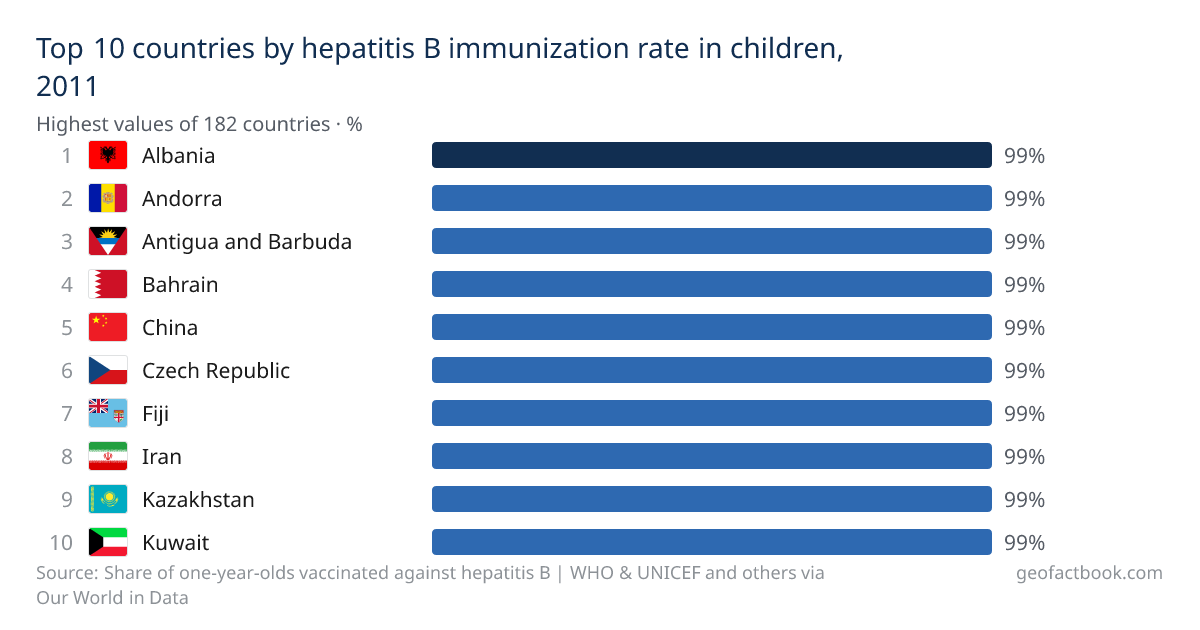
- #1
 Albania
- #2
 Andorra
- #3
 Antigua and Barbuda
- #4
 Bahrain
- #5
 China
- #6
 Czech Republic
- #7
 Fiji
- #8
 Iran
- #9
 Kazakhstan
- #10
 Kuwait
Analysis: These countries represent the highest values in this dataset, showcasing significant scale and impact on global statistics.
- #182
 Netherlands
- #181
 Ukraine
- #180
 Sweden
- #179
 Chad
- #178
 Myanmar
- #177
 India
- #176
 Nigeria
- #175
 Central African Republic
- #174
 Angola
- #173
 Papua New Guinea
Context: These countries or territories have the lowest values, often due to geographic size, administrative status, or specific characteristics.
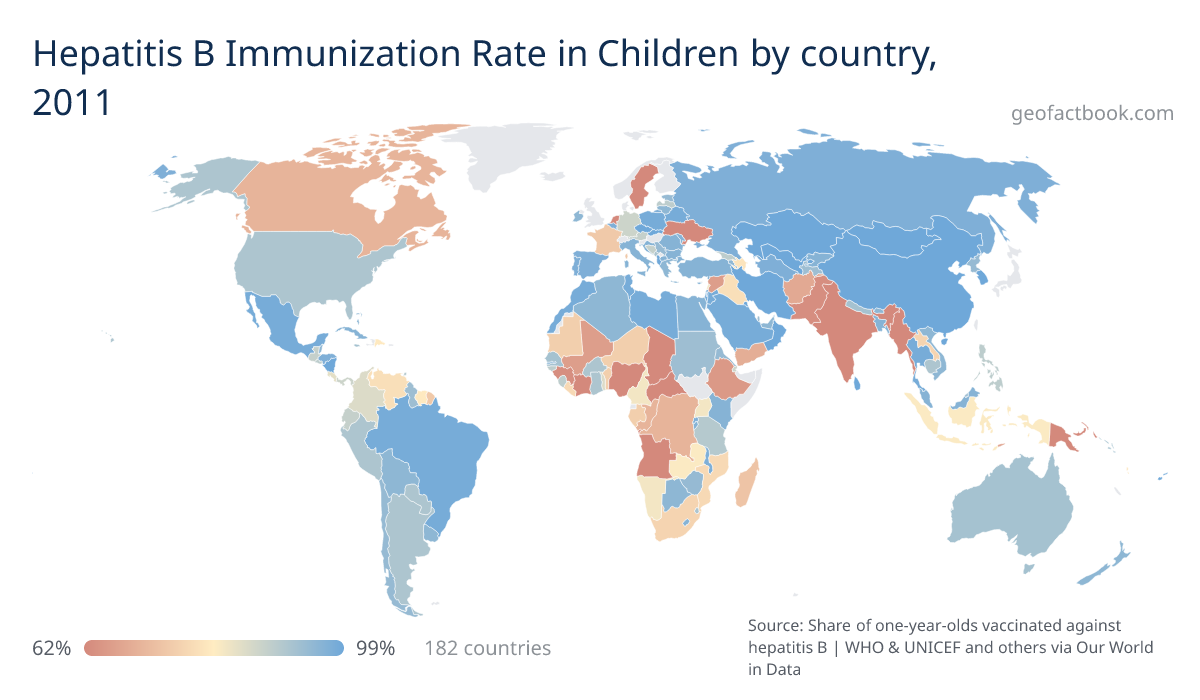
Hepatitis B Immunization Rate in Children by country, 2011: map image
Top 10 countries by hepatitis B immunization rate in children, 2011: chart
Insights by country
Palau
In 2011, Palau ranked #109 globally with a Hepatitis B Immunization Rate in Children of 91%. This rate is slightly below the global average, reflecting challenges in healthcare access compared to higher-ranked countries. Factors contributing to this statistic include Palau's small population size, which can limit healthcare resources and outreach efforts, as well as its geographic isolation in the Pacific, impacting logistics for vaccine distribution.
South Africa
In 2011, South Africa had a Hepatitis B Immunization Rate in Children of 76 %, ranking #153 out of 182 countries. This rate is below the global average, indicating challenges in achieving widespread immunization compared to higher-ranked nations. Factors contributing to this statistic include socioeconomic disparities and access to healthcare services, which can hinder vaccination efforts, especially in rural areas.
Vietnam
In 2011, Vietnam achieved a Hepatitis B Immunization Rate in Children of 95 %, ranking #82 out of 182 countries. This rate is notably higher than the global average, reflecting Vietnam's commitment to improving child health through vaccination programs. Key drivers of this success include government policies prioritizing immunization and increased access to healthcare services in urban and rural areas.
Ethiopia
Ethiopia ranked #169 globally with a Hepatitis B Immunization Rate in Children of 65% in 2011. This rate is significantly lower than the global average, reflecting challenges in healthcare access compared to higher-ranked countries. Contributing factors include economic constraints, limited healthcare infrastructure, and ongoing conflicts that hinder immunization efforts across the country.
Turkmenistan
In 2011, Turkmenistan achieved a Hepatitis B Immunization Rate in Children of 97 %, ranking #46 out of 182 countries. This rate is notably higher than the global average, reflecting the country's commitment to improving child health. The robust immunization program in Turkmenistan is supported by government policies prioritizing healthcare access, alongside efforts to enhance public awareness about vaccination benefits.
Burkina Faso
Burkina Faso achieved a Hepatitis B Immunization Rate in Children of 91 % in 2011, ranking #114 out of 182 countries. This rate is relatively high compared to some neighboring countries, indicating a focused effort in child vaccination programs. The government's commitment to improving healthcare access, alongside international support for immunization initiatives, has played a crucial role in achieving this rate despite challenges such as limited resources and infrastructural issues.
Belarus
In 2011, Belarus achieved a Hepatitis B Immunization Rate in Children of 98 %, ranking #26 out of 182 countries. This rate is significantly higher than the global average, reflecting the country's strong public health policies. Belarus has prioritized immunization programs, supported by government funding and a robust healthcare system, which has effectively increased vaccination coverage among children.
Belgium
In 2011, Belgium achieved a Hepatitis B Immunization Rate in Children of 97 %, ranking #39 out of 182 countries. This rate is significantly higher than the global average, reflecting the country's robust healthcare system and commitment to preventive measures. Belgium's strong immunization programs, supported by comprehensive public health policies and accessible healthcare services, are key drivers behind this high vaccination rate.
Egypt
In 2011, Egypt achieved a Hepatitis B Immunization Rate in Children of 96 %, ranking #68 out of 182 countries. This rate is notably higher than the global average, reflecting Egypt's commitment to improving child health through vaccination programs. The country's robust public health initiatives, bolstered by international support and a focus on preventive care, have significantly contributed to this achievement.
Trinidad and Tobago
In 2011, Trinidad and Tobago had a Hepatitis B Immunization Rate in Children of 90 %, ranking #116 out of 182 countries. This rate is below the global average, indicating room for improvement in childhood vaccination coverage. Contributing factors include the country's healthcare policies and access to medical services, which can vary significantly between urban and rural areas.
Analysis & Context
In 2011, the Hepatitis B Immunization Rate in Children reached its peak in several countries, with South Korea, the Czech Republic, Slovakia, the State of Palestine, China, Seychelles, Kazakhstan, Saint Lucia, Monaco, and Mongolia all achieving a remarkable coverage of 99%. The global range for this crucial health metric spanned from as low as 20% in the Netherlands to the near-universal coverage in the aforementioned countries. The global average immunization rate stood at 87.42%, with a median value of 94%, indicating a generally high level of coverage worldwide.
Policy Success in Leading Nations
The countries achieving a 99% immunization rate share common features that contribute to their success. South Korea and China, for instance, have robust national immunization programs supported by government policies that prioritize public health. In these countries, the integration of hepatitis B vaccination into routine childhood immunization schedules ensures widespread coverage. Additionally, the economic capabilities of these nations allow for substantial investment in healthcare infrastructure and public awareness campaigns, crucial for maintaining high vaccination rates.
Furthermore, countries like the Czech Republic and Slovakia benefit from comprehensive healthcare systems with strong governmental oversight, ensuring that vaccinations are accessible and affordable. The success in these regions underscores the importance of policy-driven healthcare initiatives and economic stability in achieving high immunization rates.
Challenges in Countries with Low Coverage
At the other end of the spectrum, countries such as the Netherlands and Ukraine reported significantly lower immunization rates of 20% and 21%, respectively. These low figures can be attributed to several factors, including vaccine hesitancy and logistical challenges. In the Netherlands, for instance, skepticism about vaccinations in certain communities has historically affected immunization rates. Meanwhile, Ukraine faced political and economic instability, which likely disrupted healthcare services and vaccine distribution.
In Chad and Myanmar, where rates were 33% and 40%, infrastructural challenges and limited healthcare resources play a critical role. These countries often struggle with inadequate healthcare funding and accessibility issues, which hinder the implementation of effective vaccination programs.
Year-over-Year Trends and Significant Changes
Examining year-over-year changes, several countries experienced notable shifts in their immunization rates. Ireland saw a dramatic increase of 49%, reflecting a successful public health intervention and improved healthcare delivery. Similarly, Sudan and Canada reported increases of 18% and 14%, respectively, demonstrating effective policy adjustments and increased healthcare funding.
Conversely, Myanmar experienced a significant decline of 52%, highlighting the impact of political turmoil and resource shortages on healthcare services. Ukraine also saw a decrease of 27%, further emphasizing the challenges faced due to instability. These trends underscore the dynamic nature of healthcare interventions and the impact of external factors on immunization rates.
Economic and Demographic Influences
The disparity in hepatitis B immunization rates often correlates with economic status and demographic factors. High-income countries typically have the resources to support comprehensive healthcare systems, which include routine childhood vaccinations. This is evident in countries like Monaco and Seychelles, where economic stability contributes to high immunization coverage.
In contrast, countries with lower economic indicators, such as the Central African Republic and Nigeria, face more significant challenges in healthcare delivery. These nations often rely on international aid and support to implement vaccination programs, which can be inconsistent and affected by global economic conditions.
Demographic factors also play a role, as densely populated areas may experience greater logistical challenges in vaccine distribution. However, they also offer opportunities for more efficient mass vaccination campaigns, as seen in urban centers of countries with higher coverage rates.
In conclusion, the Hepatitis B Immunization Rate in Children in 2011 highlights the critical role of government policy, economic stability, and healthcare infrastructure in achieving high vaccination coverage. While many countries have made significant strides, ongoing challenges remain, particularly in regions facing economic and political instability. Understanding these factors is essential for improving global immunization efforts and preventing liver disease worldwide.
Frequently Asked Questions About Hepatitis B Immunization Rate in Children in 2011
Which country had the highest hepatitis B immunization rate in children in 2011?
South Korea had the highest hepatitis B immunization rate in children in 2011, with a rate of 99%.
What was the lowest hepatitis B immunization rate in children by country in 2011?
The Netherlands had the lowest hepatitis B immunization rate in children in 2011, with a rate of 20%.
What was the average hepatitis B immunization rate in children across countries in 2011?
The average hepatitis B immunization rate in children across the 182 countries in 2011 was 87.42%.
What was the median hepatitis B immunization rate in children by country in 2011?
The median hepatitis B immunization rate in children by country in 2011 was 93.5%.
Which countries were in the top 10 for hepatitis B immunization rates in children in 2011?
The top 10 countries for hepatitis B immunization rates in children in 2011, all with a rate of 99%, were South Korea, Czech Republic, Slovakia, State of Palestine, China, Seychelles, Kazakhstan, Saint Lucia, Monaco, and Mongolia.
How many countries were tracked for hepatitis B immunization rates in children in 2011?
A total of 182 countries were tracked for hepatitis B immunization rates in children in 2011.
Data Source
Share of one-year-olds vaccinated against hepatitis B | WHO & UNICEF and others via Our World in Data
Data produced by WHO & UNICEF; UN, World Population Prospects, compiled and published by Our World in Data as "Share of one-year-olds vaccinated against hepatitis B".
Visit Data SourceCite this page
Geo Factbook. (n.d.). Hepatitis B Immunization Rate in Children by Country, 2011. Retrieved November 28, 2026, from https://geofactbook.com/fact/hepatitis-b-immunization-rate-in-children/2011
The figures on this page come from Share of one-year-olds vaccinated against hepatitis B | WHO & UNICEF and others via Our World in Data. For academic work, cite the original source as well.
›Embed this ranking on your site
Free to embed with attribution. Shows the top 10 countries and links back to the full ranking.
Historical Data by Year
Explore Hepatitis B Immunization Rate in Children data across different years. Compare trends and see how statistics have changed over time.
More Health Facts
See all Health facts →Global Stillbirth Rate Trends
Explore global trends in stillbirth rates, highlighting improvements or setbacks over time across different countries.
 Highest: Somalia3.49 per 1,000 births
Public Health Spending (% of GDP)
Public health spending as a percentage of GDP measures how much countries allocate to health relative to their economic output.
 Highest: United States14.3%
Mean Age at First Birth
Mean age at first birth indicates maternal age trends. Compare countries, explore rankings, and see historical shifts with interactive maps.
Highest: Andorra32.8You might also like
Gross Domestic Product (GDP) by Country in Current US Dollars
FeaturedDiscover the Gross Domestic Product (GDP) by country in current US dollars, a key indicator of economic performance. This statistic reveals the financial health and growth potential of nations, making it essential for investors and policymakers.
Highest: United States32.95T $Total population
FeaturedDiscover the latest total population statistics for every country and region worldwide. Explore accurate, up-to-date data on global population growth, density, and demographic trends — sourced from trusted international databases like the UN and World Bank. Perfect for researchers, students, and data enthusiasts looking to understand how the world’s population is changing.
Highest: India1.48B personsLife expectancy at birth
FeaturedLife expectancy at birth measures the average years a newborn is expected to live, reflecting a country's health standards and quality of life. This vital statistic highlights disparities in healthcare and living conditions across nations, making it essential for global health assessments.
 Highest: Monaco89.29 years