
Hepatitis B Immunization Rate in Children 2019
Tracks the vaccination rate for hepatitis B in children, crucial for preventing liver disease.
Newer data is available: Hepatitis B Immunization Rate in Children by country 2025 →
Where does your country rank? Pick it to see its position.
Related Health statistics
More ↓
Interactive Map
Complete Data Rankings



































































































































































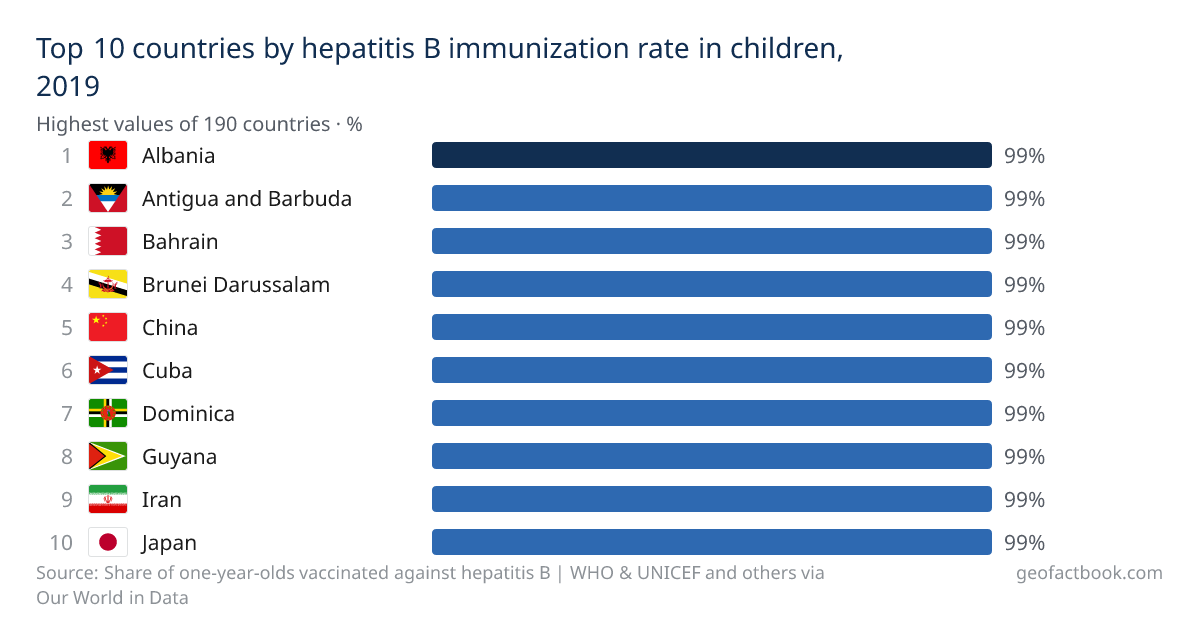
- #1
 Albania
- #2
 Antigua and Barbuda
- #3
 Bahrain
- #4
 Brunei Darussalam
- #5
 China
- #6
 Cuba
- #7
 Dominica
- #8
 Guyana
- #9
 Iran
- #10
 Japan
Analysis: These countries represent the highest values in this dataset, showcasing significant scale and impact on global statistics.
- #190
 Papua New Guinea
- #189
 Central African Republic
- #188
 Guinea
- #187
 Chad
- #186
 Haiti
- #185
 Mexico
- #184
 Somalia
- #183
 Yemen
- #182
 South Sudan
- #181
 Angola
Context: These countries or territories have the lowest values, often due to geographic size, administrative status, or specific characteristics.
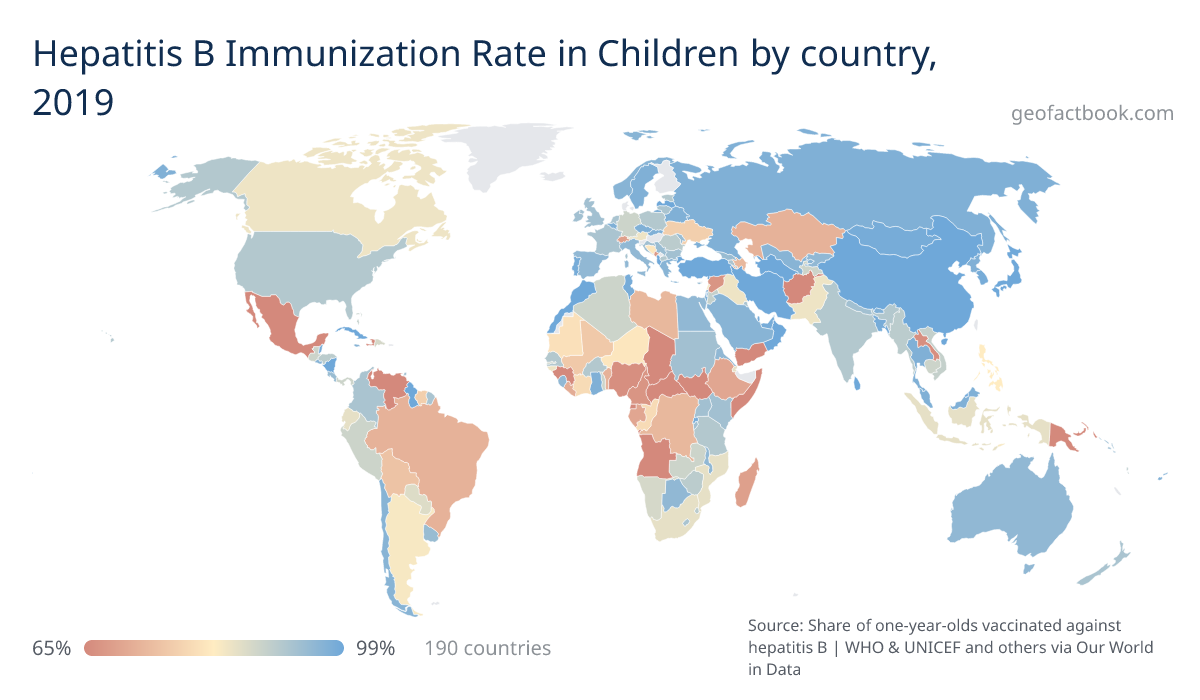
Hepatitis B Immunization Rate in Children by country, 2019: map image
Top 10 countries by hepatitis B immunization rate in children, 2019: chart
Insights by country
India
In 2019, India achieved a Hepatitis B Immunization Rate in Children of 91%, ranking #104 out of 190 countries. This rate is below the global average, indicating room for improvement in child immunization efforts compared to higher-ranking nations. Contributing factors include India's vast population and diverse healthcare access, which can complicate the delivery of consistent immunization programs across urban and rural areas.
Latvia
In 2019, Latvia achieved a Hepatitis B Immunization Rate in Children of 99 %, ranking #13 out of 190 countries. This rate is notably higher than the global average, reflecting Latvia's strong commitment to public health initiatives. The country's robust healthcare system, combined with effective vaccination programs and policies, has ensured high coverage rates among children, contributing to the prevention of Hepatitis B.
Kuwait
Kuwait ranked #96 globally for Hepatitis B Immunization Rate in Children in 2019, with a rate of 92 %. This rate is slightly below the global average, indicating room for improvement in childhood vaccination initiatives. The country's robust healthcare system and government policies aimed at public health have contributed to this relatively high immunization rate, although challenges remain in reaching all demographics effectively.
Gambia
In 2019, Gambia's Hepatitis B Immunization Rate in Children was 88 %, ranking #123 out of 190 countries. This rate is relatively high compared to some neighboring countries, but it still falls short of the global average for immunization rates. Key drivers of this statistic include Gambia's commitment to immunization programs and international support for healthcare initiatives, despite challenges such as limited healthcare infrastructure and resources.
Peru
In 2019, Peru ranked #127 globally with a Hepatitis B Immunization Rate in Children of 88 %. This rate is below the global average, reflecting challenges in healthcare access compared to higher-ranked countries. Factors contributing to this statistic include Peru's diverse geography, which can hinder healthcare delivery, and ongoing efforts to improve vaccination coverage in rural areas, where access to medical services remains limited.
Honduras
In 2019, Honduras ranked #113 globally with a Hepatitis B Immunization Rate in Children of 90%. This rate is relatively high compared to some neighboring countries, which struggle with lower immunization coverage. The strong performance can be attributed to ongoing public health initiatives and support from international organizations aimed at increasing vaccination rates among children in rural and underserved areas.
Italy
In 2019, Italy achieved a Hepatitis B Immunization Rate in Children of 95 %, ranking #68 out of 190 countries. This rate is slightly above the European average, reflecting the country's robust healthcare system and effective vaccination programs. Key drivers include Italy's universal healthcare policy, which ensures access to vaccinations, and strong public health campaigns that emphasize the importance of immunization.
Dominican Republic
In 2019, the Dominican Republic achieved a Hepatitis B Immunization Rate in Children of 87 %, ranking #131 out of 190 countries. This rate is below the global average, highlighting a significant public health challenge in the region. Contributing factors include limited access to healthcare services in rural areas and economic constraints that affect vaccination programs. Additionally, ongoing efforts to improve healthcare infrastructure and increase awareness are crucial for enhancing immunization coverage.
Kazakhstan
Kazakhstan ranked #166 globally in 2019 with a Hepatitis B Immunization Rate in Children of 72 %. This rate is significantly lower than the global average, indicating challenges in healthcare access compared to higher-ranking countries. Contributing factors include the vast geography of Kazakhstan, which complicates healthcare delivery, and economic disparities that affect public health funding and vaccination outreach efforts.
Lebanon
In 2019, Lebanon achieved a Hepatitis B Immunization Rate in Children of 83 %, ranking #147 out of 190 countries. This rate is below the global average, indicating challenges in public health outreach compared to higher-performing nations. Contributing factors include ongoing economic instability and disruptions in healthcare infrastructure, which can hinder vaccination campaigns and access to medical services for families.
Analysis & Context
In 2019, the Hepatitis B Immunization Rate in Children saw Sri Lanka, Niue, Brunei Darussalam, China, Tonga, Antigua and Barbuda, Oman, Latvia, State of Palestine, and Japan leading the world with a rate of 99%. Globally, the immunization rates ranged from a minimum of 35% in Papua New Guinea to a maximum of 99%, with an average rate of 87.85% and a median of 92%. These figures highlight significant disparities in healthcare access and policy effectiveness across different regions.
Global Disparities in Immunization Rates
The wide range in the Hepatitis B Immunization Rate in Children in 2019 underscores stark differences in public health infrastructure and policy implementation across the globe. While Japan and others achieved near-universal coverage at 99%, countries like Papua New Guinea and the Central African Republic lagged significantly behind, with rates of 35% and 38%, respectively. These lower rates can often be attributed to factors such as limited healthcare access, insufficient funding, and political instability, which hinder vaccination efforts.
In regions with higher immunization rates, robust healthcare systems and comprehensive national immunization programs play a crucial role. For instance, China's successful vaccination campaigns are supported by strong governmental policies and widespread public health initiatives. Conversely, in countries like Guinea and Chad, where rates are at 53%, challenges such as rural healthcare delivery and resource allocation make achieving higher coverage more difficult.
Economic and Policy Influences
Economic stability and government policy are key drivers of immunization rates. Wealthier nations, like Japan and Latvia, which both reached a 99% immunization rate, typically have the resources to implement effective vaccination strategies and ensure widespread public health education. In contrast, countries with lower GDPs often struggle to prioritize healthcare, as seen in Haiti and Yemen, where rates were 54% and 60%, respectively.
Policy frameworks also significantly impact immunization outcomes. Countries that mandate vaccinations and provide them free of charge tend to have higher uptake rates. For example, Oman and Antigua and Barbuda achieved high coverage by integrating hepatitis B vaccines into their national immunization schedules and ensuring government-subsidized access.
Year-over-Year Changes and Trends
From the data, notable year-over-year increases in the Hepatitis B Immunization Rate in Children were observed in countries like Samoa (+24.00 points, 54.5% increase) and Vietnam (+14.00 points, 18.7% increase). These improvements may be attributed to enhanced public health campaigns and international aid, which help bolster local healthcare systems.
Conversely, some countries experienced declines in immunization rates, with Brazil seeing a decrease of 15.00 points (17.2% decline). This drop could result from political changes affecting healthcare funding and policy continuity. Similarly, Liberia and Laos experienced decreases of 10.00 and 9.00 points, respectively, highlighting the vulnerability of immunization programs to economic and political shifts.
Implications for Global Health
The disparities in the Hepatitis B Immunization Rate in Children reflect broader challenges in global health equity. Countries with high immunization rates demonstrate that comprehensive healthcare policies and economic stability are essential for achieving public health goals. However, for nations with lower rates, international cooperation and targeted interventions remain crucial to overcoming barriers to immunization.
Efforts to increase vaccination rates must consider local contexts, addressing both logistical challenges and societal factors. As global health initiatives continue to evolve, understanding these dynamics is vital for ensuring that all children receive the protection they need against hepatitis B, ultimately contributing to healthier populations worldwide.
Frequently Asked Questions About Hepatitis B Immunization Rate in Children in 2019
Which country had the highest hepatitis B immunization rate in children in 2019?
Sri Lanka had the highest hepatitis B immunization rate in children in 2019, with a rate of 99%.
What was the lowest hepatitis B immunization rate in children by country in 2019?
Papua New Guinea had the lowest hepatitis B immunization rate in children in 2019, with a rate of 35%.
What was the average hepatitis B immunization rate in children across countries in 2019?
The average hepatitis B immunization rate in children across countries in 2019 was 87.85%.
What was the median hepatitis B immunization rate in children by country in 2019?
The median hepatitis B immunization rate in children by country in 2019 was 92%.
Which countries were in the top 10 for hepatitis B immunization rates in children in 2019?
The top 10 countries for hepatitis B immunization rates in children in 2019, all with a rate of 99%, were Sri Lanka, Niue, Brunei Darussalam, China, Tonga, Antigua and Barbuda, Oman, Latvia, State of Palestine, and Japan.
What was the range of hepatitis B immunization rates in children by country in 2019?
The range of hepatitis B immunization rates in children by country in 2019 was from 35% in Papua New Guinea to 99% in several top countries.
Data Source
Share of one-year-olds vaccinated against hepatitis B | WHO & UNICEF and others via Our World in Data
Data produced by WHO & UNICEF; UN, World Population Prospects, compiled and published by Our World in Data as "Share of one-year-olds vaccinated against hepatitis B".
Visit Data SourceCite this page
Geo Factbook. (n.d.). Hepatitis B Immunization Rate in Children by Country, 2019. Retrieved November 28, 2026, from https://geofactbook.com/fact/hepatitis-b-immunization-rate-in-children/2019
The figures on this page come from Share of one-year-olds vaccinated against hepatitis B | WHO & UNICEF and others via Our World in Data. For academic work, cite the original source as well.
›Embed this ranking on your site
Free to embed with attribution. Shows the top 10 countries and links back to the full ranking.
Historical Data by Year
Explore Hepatitis B Immunization Rate in Children data across different years. Compare trends and see how statistics have changed over time.
More Health Facts
See all Health facts →Global Stillbirth Rate Trends
Explore global trends in stillbirth rates, highlighting improvements or setbacks over time across different countries.
Highest: Somalia3.49 per 1,000 birthsPublic Health Spending (% of GDP)
Public health spending as a percentage of GDP measures how much countries allocate to health relative to their economic output.
 Highest: United States14.3%
Mean Age at First Birth
Mean age at first birth indicates maternal age trends. Compare countries, explore rankings, and see historical shifts with interactive maps.
 Highest: Andorra32.8
You might also like
Gross Domestic Product (GDP) by Country in Current US Dollars
FeaturedDiscover the Gross Domestic Product (GDP) by country in current US dollars, a key indicator of economic performance. This statistic reveals the financial health and growth potential of nations, making it essential for investors and policymakers.
Highest: United States32.95T $Total population
FeaturedDiscover the latest total population statistics for every country and region worldwide. Explore accurate, up-to-date data on global population growth, density, and demographic trends — sourced from trusted international databases like the UN and World Bank. Perfect for researchers, students, and data enthusiasts looking to understand how the world’s population is changing.
 Highest: India1.48B persons
Life expectancy at birth
FeaturedLife expectancy at birth measures the average years a newborn is expected to live, reflecting a country's health standards and quality of life. This vital statistic highlights disparities in healthcare and living conditions across nations, making it essential for global health assessments.
 Highest: Monaco89.29 years