
Hepatitis B Immunization Rate in Children 2002
Tracks the vaccination rate for hepatitis B in children, crucial for preventing liver disease.
Newer data is available: Hepatitis B Immunization Rate in Children by country 2025 →
Where does your country rank? Pick it to see its position.
Related Health statistics
More ↓
Interactive Map
Complete Data Rankings



































































































- #1
 Antigua and Barbuda
- #2
 Belarus
- #3
 Brunei Darussalam
- #4
 Fiji
- #5
 Iran
- #6
 Kuwait
- #7
 Kyrgyzstan
- #8
 Republic of Moldova
- #9
 Monaco
- #10
 Niue
Analysis: These countries represent the highest values in this dataset, showcasing significant scale and impact on global statistics.
- #123
 Trinidad and Tobago
- #122
 Saint Lucia
- #121
 Benin
- #120
 Uganda
- #119
 France
- #118
 Yemen
- #117
 Tajikistan
- #116
 Cabo Verde
- #115
 Philippines
- #114
 Ukraine
Context: These countries or territories have the lowest values, often due to geographic size, administrative status, or specific characteristics.
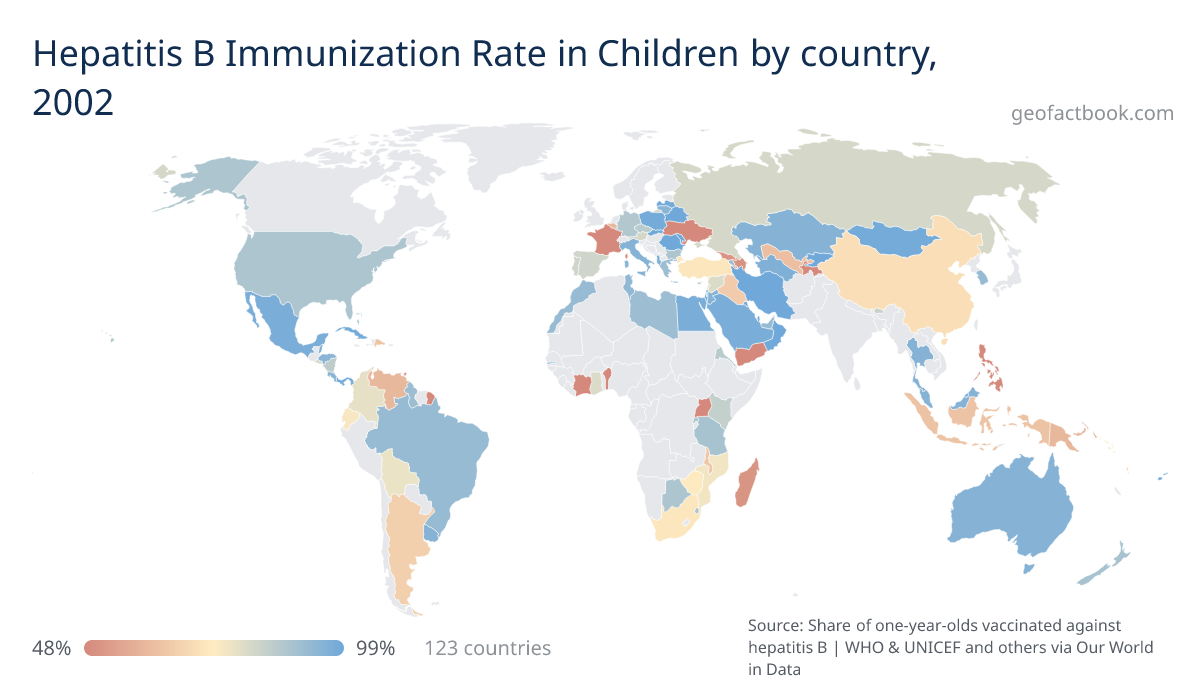
Hepatitis B Immunization Rate in Children by country, 2002: map image
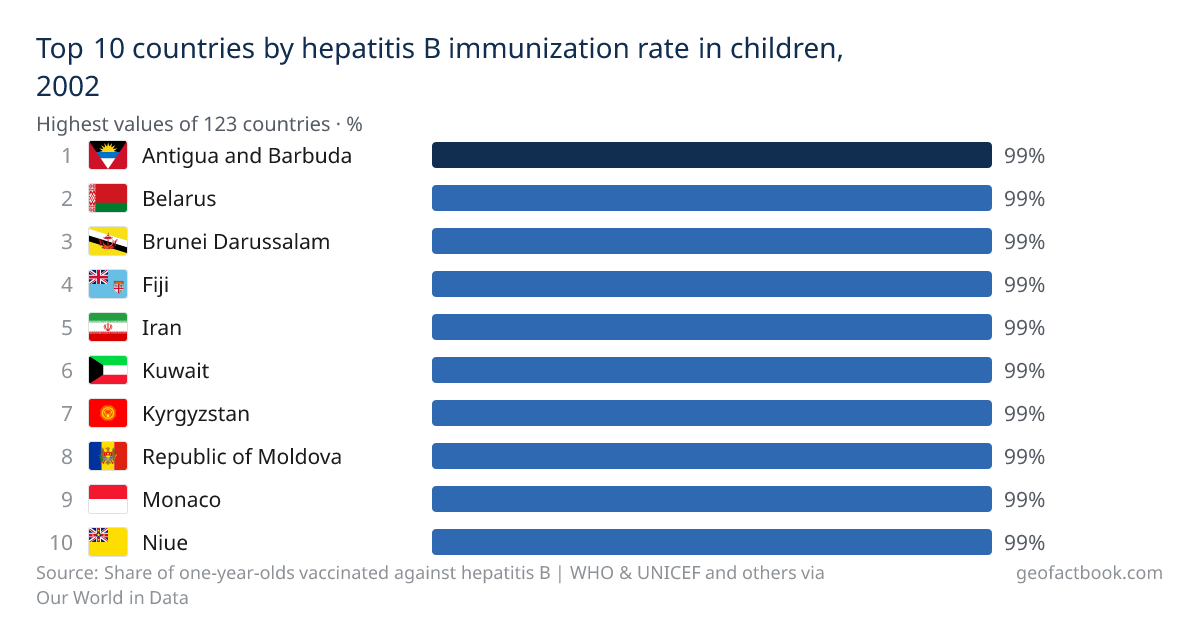
Top 10 countries by hepatitis B immunization rate in children, 2002: chart
Insights by country
Armenia
In 2002, Armenia achieved a Hepatitis B Immunization Rate in Children of 91 %, ranking #56 out of 123 countries. This rate is competitive compared to regional averages, reflecting Armenia's commitment to childhood vaccinations amidst a backdrop of economic challenges. Key drivers of this immunization success include government initiatives focused on public health and the availability of vaccines through international partnerships, which have strengthened healthcare access in the country.
El Salvador
In 2002, El Salvador achieved a Hepatitis B Immunization Rate in Children of 81 %, ranking #82 out of 123 countries. This rate is slightly below the regional average for Latin America, which often exceeds 85%. The immunization efforts in El Salvador have been influenced by government health initiatives aimed at reducing infectious diseases, alongside challenges such as economic constraints and healthcare access in rural areas.
Nauru
Nauru ranked #94 globally with a Hepatitis B Immunization Rate in Children of 75 % in 2002. This rate is notably lower than the global average, indicating challenges in immunization coverage compared to higher-ranked countries. Contributing factors include Nauru's small population size and limited healthcare infrastructure, which can hinder widespread vaccination efforts.
Kazakhstan
In 2002, Kazakhstan achieved a Hepatitis B Immunization Rate in Children of 95 %, ranking #37 out of 123 countries. This rate is notably higher than the global average, reflecting the country's strong commitment to childhood vaccination programs. Key drivers include Kazakhstan's investment in healthcare infrastructure and public health initiatives aimed at reducing infectious diseases.
Lebanon
In 2002, Lebanon ranked #90 globally with a Hepatitis B Immunization Rate in Children of 77 %. This rate is below the global average, indicating challenges in healthcare access compared to higher-ranked countries. Factors contributing to this statistic include Lebanon's ongoing economic difficulties and political instability, which have impacted the healthcare system's effectiveness and vaccination outreach efforts.
Kiribati
In 2002, Kiribati ranked #87 globally with a Hepatitis B Immunization Rate in Children of 79 %. This rate is below the global average, indicating challenges in healthcare accessibility compared to higher-ranked nations. Factors contributing to this statistic include Kiribati's remote geographic location, which complicates the distribution of medical resources, and limited healthcare infrastructure that affects immunization outreach efforts.
Belgium
In 2002, Belgium ranked #107 globally with a Hepatitis B Immunization Rate in Children of 60 %. This rate is notably lower than many of its European neighbors, reflecting a broader regional challenge in childhood vaccination uptake at that time. Contributing factors include varying public health policies and the need for improved healthcare outreach in certain demographics, which may have hindered access to vaccinations.
Dominican Republic
In 2002, the Dominican Republic ranked #104 globally with a Hepatitis B Immunization Rate in Children of 63%. This rate is significantly lower than the global average, highlighting a gap in childhood vaccination efforts. Contributing factors include limited healthcare access in rural areas and economic challenges that affect public health initiatives.
Italy
In 2002, Italy achieved a Hepatitis B Immunization Rate in Children of 95 %, ranking #36 out of 123 countries. This rate is notably higher than the global average, reflecting Italy's strong public health initiatives. Factors contributing to this success include a well-established healthcare system and government policies focused on preventive care, ensuring widespread access to vaccinations for children.
Cuba
Cuba achieved a Hepatitis B Immunization Rate in Children of 98 % in 2002, ranking #17 out of 123 countries. This rate is significantly higher than the global average, reflecting Cuba's robust public health policies and commitment to childhood vaccinations. The country's extensive healthcare system, characterized by universal access and a focus on preventive care, has been a key driver behind this impressive immunization coverage.
Analysis & Context
In 2002, Antigua and Barbuda, along with nine other countries, led the world with a Hepatitis B Immunization Rate in Children of 99%, while Trinidad and Tobago had the lowest rate at 5%. The global range highlights significant disparities in vaccination efforts. The average immunization rate globally was 81.76%, with a median of 89%, indicating that while many countries have high coverage, several fall significantly below this threshold.
Economic Development and Immunization Rates
The high Hepatitis B Immunization Rate in Children in countries like Monaco and Kuwait can be attributed to their robust healthcare systems and substantial government investment in public health. Both countries reported a vaccination rate of 99%. These nations have the economic resources to ensure widespread vaccine availability and public health campaigns. In contrast, countries with lower economic development, such as Benin (15%) and Uganda (29%), struggle with limited healthcare infrastructure and funding, which can hinder vaccine distribution and access.
Geopolitical Influences and Immunization
Geopolitical stability also plays a crucial role in determining immunization rates. For example, Iran achieved a high immunization rate of 99% despite regional tensions, likely due to strong government prioritization of healthcare. On the other hand, Yemen, with a rate of 31%, faces challenges such as political instability and conflict, which disrupt healthcare services and impede vaccination efforts.
Year-over-Year Trends and Changes
Analyzing year-over-year changes reveals significant shifts in immunization rates. The Bahamas experienced the most substantial increase, with a rise of 68% (an impressive 323.8% increase), reflecting successful public health initiatives and improved vaccine outreach programs. Similarly, Mozambique and Barbados saw increases of 51% and 48%, respectively. Conversely, Nauru faced a notable decrease of 20% in its immunization rate, indicating possible challenges in vaccine supply chains or public health policies.
Policy and Public Health Initiatives
Countries with the highest immunization rates typically benefit from comprehensive public health policies that prioritize vaccination. Brunei Darussalam and Republic of Moldova, both reporting a 99% rate, have likely implemented effective vaccination programs and public awareness campaigns. In contrast, countries like France, with a surprisingly low rate of 29%, might face public skepticism about vaccines or logistical challenges in reaching rural populations. The data suggests that government commitment to healthcare and public trust in vaccination are pivotal in achieving high immunization rates.
Overall, the data from 2002 highlights the complex interplay between economic capacity, geopolitical stability, and public health policy in determining Hepatitis B Immunization Rates in Children across different countries. These factors collectively influence how effectively countries can protect their populations from hepatitis B, underscoring the need for targeted strategies to improve vaccination coverage where it lags.
Frequently Asked Questions About Hepatitis B Immunization Rate in Children in 2002
Which country had the highest hepatitis B immunization rate in children in 2002?
Antigua and Barbuda had the highest hepatitis B immunization rate in children in 2002, with a rate of 99%.
What was the lowest hepatitis B immunization rate in children in 2002?
Trinidad and Tobago had the lowest hepatitis B immunization rate in children in 2002, with a rate of 5%.
What was the average hepatitis B immunization rate in children across countries in 2002?
The average hepatitis B immunization rate in children across the dataset of 123 countries in 2002 was 81.76%.
What was the median hepatitis B immunization rate in children in 2002?
The median hepatitis B immunization rate in children in 2002 was 89%.
Which countries were in the top 10 for hepatitis B immunization rates in children in 2002?
The top 10 countries for hepatitis B immunization rates in children in 2002, all with a rate of 99%, were Antigua and Barbuda, Palau, Republic of Moldova, Brunei Darussalam, Romania, Kyrgyzstan, Iran, Niue, Monaco, and Kuwait.
What is the range of hepatitis B immunization rates in children in 2002?
The range of hepatitis B immunization rates in children in 2002 spans from 5% in Trinidad and Tobago to 99% in several countries, including Antigua and Barbuda.
Data Source
Share of one-year-olds vaccinated against hepatitis B | WHO & UNICEF and others via Our World in Data
Data produced by WHO & UNICEF; UN, World Population Prospects, compiled and published by Our World in Data as "Share of one-year-olds vaccinated against hepatitis B".
Visit Data SourceCite this page
Geo Factbook. (n.d.). Hepatitis B Immunization Rate in Children by Country, 2002. Retrieved November 28, 2026, from https://geofactbook.com/fact/hepatitis-b-immunization-rate-in-children/2002
The figures on this page come from Share of one-year-olds vaccinated against hepatitis B | WHO & UNICEF and others via Our World in Data. For academic work, cite the original source as well.
›Embed this ranking on your site
Free to embed with attribution. Shows the top 10 countries and links back to the full ranking.
Historical Data by Year
Explore Hepatitis B Immunization Rate in Children data across different years. Compare trends and see how statistics have changed over time.
More Health Facts
See all Health facts →Global Stillbirth Rate Trends
Explore global trends in stillbirth rates, highlighting improvements or setbacks over time across different countries.
 Highest: Somalia3.49 per 1,000 births
Public Health Spending (% of GDP)
Public health spending as a percentage of GDP measures how much countries allocate to health relative to their economic output.
 Highest: United States14.3%
Mean Age at First Birth
Mean age at first birth indicates maternal age trends. Compare countries, explore rankings, and see historical shifts with interactive maps.
 Highest: Andorra32.8
You might also like
Gross Domestic Product (GDP) by Country in Current US Dollars
FeaturedDiscover the Gross Domestic Product (GDP) by country in current US dollars, a key indicator of economic performance. This statistic reveals the financial health and growth potential of nations, making it essential for investors and policymakers.
Highest: United States32.95T $Total population
FeaturedDiscover the latest total population statistics for every country and region worldwide. Explore accurate, up-to-date data on global population growth, density, and demographic trends — sourced from trusted international databases like the UN and World Bank. Perfect for researchers, students, and data enthusiasts looking to understand how the world’s population is changing.
 Highest: India1.48B persons
Life expectancy at birth
FeaturedLife expectancy at birth measures the average years a newborn is expected to live, reflecting a country's health standards and quality of life. This vital statistic highlights disparities in healthcare and living conditions across nations, making it essential for global health assessments.
Highest: Monaco89.29 years