
Share of Electricity from Coal 2019
Share of electricity from coal measures the percentage of a country's electricity generated using coal.
Newer data is available: Share of Electricity from Coal by country 2024 →

Where does your country rank? Pick it to see its position.
Related Energy statistics
More ↓

Interactive Map
Complete Data Rankings



















































































































































































Analysis: These countries represent the highest values in this dataset, showcasing significant scale and impact on global statistics.
- #207
 Yemen
- #206
 State of Palestine
- #205
 United States Virgin Islands
- #204
 Venezuela
- #203
 Vanuatu
- #202
 Uruguay
- #201
 United Arab Emirates
- #200
 Uganda
- #199
 Tuvalu
- #198
 Turks and Caicos Islands
Context: These countries or territories have the lowest values, often due to geographic size, administrative status, or specific characteristics.
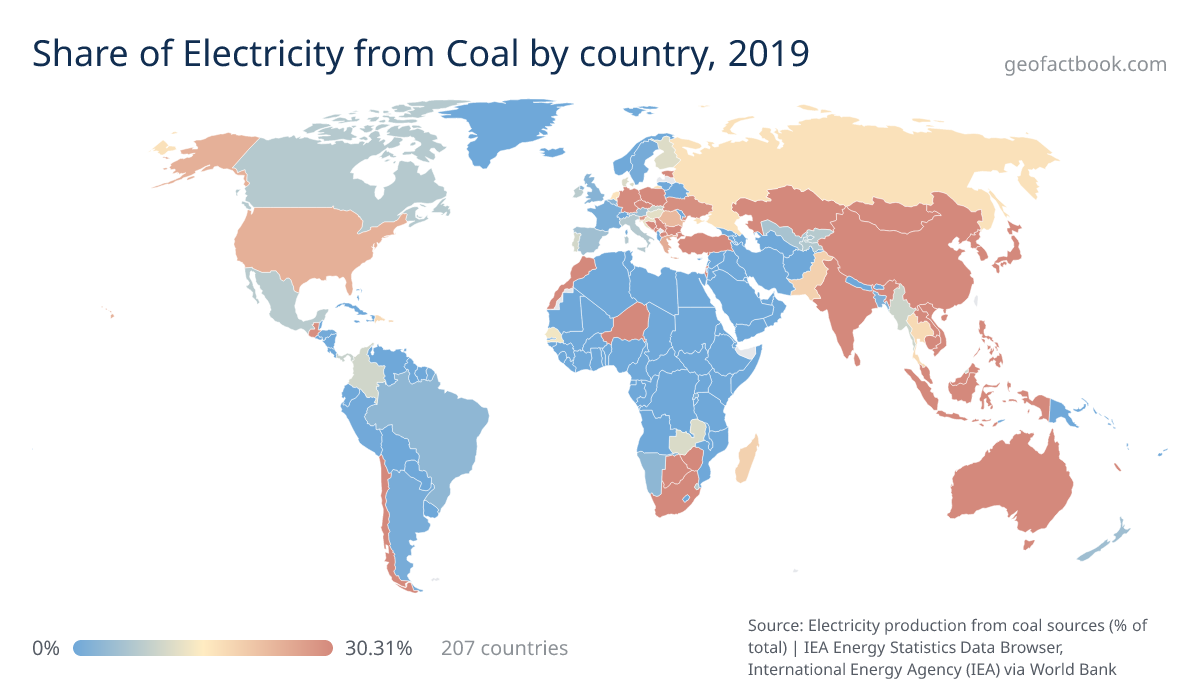
Share of Electricity from Coal by country, 2019: map image
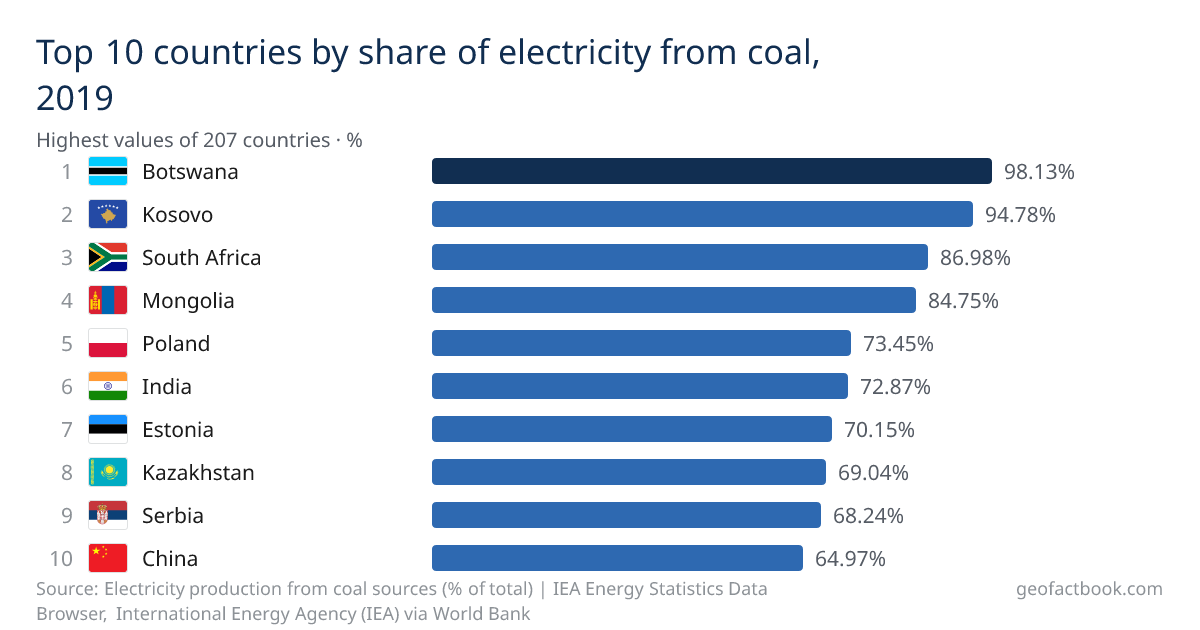
Top 10 countries by share of electricity from coal, 2019: chart
Insights by country
Malaysia
In 2019, Malaysia ranked #25 globally with a Share of Electricity from Coal of 42.8396023839025 %. This figure is higher than the global average, reflecting Malaysia's reliance on coal as a primary energy source compared to many neighboring Southeast Asian countries. The country's energy policy has historically favored coal due to its abundance and cost-effectiveness, driving significant investment in coal-fired power plants to meet growing electricity demand.
Indonesia
In 2019, Indonesia ranked #12 globally with a Share of Electricity from Coal of 62.9651857068496 %. This figure is significantly higher than the global average, reflecting the country's heavy reliance on coal compared to many of its Southeast Asian neighbors. Indonesia's abundant coal reserves and the rapid growth of its economy drive this reliance, as coal remains a cost-effective source of energy to support industrialization and meet rising electricity demands.
Angola
In 2019, Angola ranked #94 globally with a Share of Electricity from Coal of 0 %. This figure is significantly lower than many of its African neighbors, where coal is a major energy source. The absence of coal in Angola's energy mix can be attributed to its reliance on hydropower, driven by the country's abundant water resources and government policies aimed at promoting renewable energy development.
Tunisia
Tunisia ranked #195 globally in 2019 with a Share of Electricity from Coal of 0%. This places Tunisia among the lowest coal-dependent countries, contrasting sharply with global leaders in coal usage. The country’s energy strategy emphasizes renewable sources, particularly solar and wind, reflecting its geographic advantages and commitment to sustainable development.
Saint Martin (French part)
In 2019, Saint Martin (French part) ranked #179 globally with a Share of Electricity from Coal: 0 %. This figure places it significantly below many of its Caribbean neighbors, where coal usage is more prevalent for electricity generation. The absence of coal in its energy mix can be attributed to a strong focus on renewable energy sources and the island's commitment to sustainable development, driven by both local policies and environmental considerations.
Saint Lucia
In 2019, Saint Lucia ranked #178 globally with a Share of Electricity from Coal of 0 %. This is significantly lower than many countries in the Caribbean, where coal usage is more prevalent for energy generation. The absence of coal in Saint Lucia's energy mix is largely due to the government's commitment to renewable energy sources, aiming to reduce carbon emissions and reliance on fossil fuels.
South Sudan
In 2019, South Sudan ranked #186 with a Share of Electricity from Coal of 0%. This figure is significantly lower than many countries in the region, reflecting a lack of coal-based energy infrastructure. The absence of coal usage is primarily due to South Sudan's ongoing conflict, which has hindered investment in energy production, combined with its reliance on renewable sources and limited access to electricity overall.
North Macedonia
In 2019, North Macedonia ranked #15 globally, with a Share of Electricity from Coal of 59.7546430397001 %. This figure is significantly higher than the European Union average, reflecting the country's reliance on coal for energy production. North Macedonia's energy landscape is largely shaped by its domestic coal reserves and the historical development of its energy infrastructure, which has prioritized coal-fired power plants to meet growing electricity demands.
Romania
In 2019, Romania ranked #42 globally with a Share of Electricity from Coal of 23.0267350977827 %. This figure is notably higher than the European Union average, reflecting the country's reliance on coal for energy production compared to its neighbors. The primary drivers of this statistic include Romania's abundant coal reserves and the economic necessity to maintain energy independence, despite ongoing pressures to transition to more sustainable energy sources.
Brunei Darussalam
In 2019, Brunei Darussalam ranked #58 globally with a Share of Electricity from Coal of 9.80948520470207 %. This percentage is notably lower than the global average, reflecting the country's reliance on natural gas for electricity generation. Brunei's abundant natural gas reserves and government policies prioritizing cleaner energy sources contribute to its limited coal usage in the energy mix.
Analysis & Context
In 2019, Botswana led the world in the Share of Electricity from Coal, with a staggering 98.13% of its electricity generated from coal. Globally, this metric ranged from a minimum of 0.00% to a maximum of 98.13%. The global average share of electricity from coal stood at 12.34%, while the median was 0.00%, highlighting a significant skew in coal dependence among countries.
Economic Dependencies and Coal Utilization
The high reliance on coal for electricity in countries like Botswana (98.13%), Kosovo (94.78%), and South Africa (86.98%) can be attributed to economic dependencies and resource availability. These nations possess abundant coal reserves, making coal an economically viable energy source. For instance, South Africa is one of the world's largest coal producers, which naturally supports its heavy reliance on coal for electricity generation.
In contrast, countries with minimal or zero coal reliance, such as Guyana, Guinea-Bissau, and Guinea, often rely on alternative energy sources. This could be due to the lack of domestic coal reserves or a strategic shift towards renewable energy sources. These patterns reflect not only resource endowments but also policy decisions influenced by economic and environmental considerations.
Policy Shifts and Environmental Concerns
Countries like Estonia and Denmark demonstrate significant reductions in coal reliance, with Estonia's share decreasing by 11.84% and Denmark's by 10.42%. These reductions are aligned with broader policy shifts towards sustainable energy sources. Denmark, for example, has been a leader in wind energy, which has helped reduce its dependency on coal. Such transitions are often driven by environmental concerns and international commitments to reduce carbon emissions.
Similarly, Netherlands and Portugal have also seen substantial decreases in their coal shares, by 10.05% and 9.72% respectively, further underscoring the impact of proactive energy policies and investments in renewable energy infrastructure.
Rising Coal Dependence: A Regional Perspective
Conversely, some countries have experienced an increase in coal usage for electricity. North Macedonia saw the largest increase of 8.96%, while Vietnam and Pakistan reported increases of 8.41% and 7.07% respectively. This rise can be linked to rapid industrialization and growing energy demands in these regions. In the case of Vietnam, the country's burgeoning manufacturing sector has driven a higher energy consumption rate, with coal being a readily available and historically cheaper option.
These increases also reflect the challenges faced by developing nations in balancing economic growth with sustainable energy practices. The reliance on coal, despite its environmental impact, often stems from its cost-effectiveness and existing infrastructure.
Global Trends and Future Outlook
The global average change in the share of electricity from coal in 2019 was a decrease of 0.46 percentage points, equivalent to a 2.7% reduction. This trend suggests a gradual transition away from coal, driven by environmental policies and technological advancements in renewable energy. However, the variance between countries underscores a complex landscape where economic, geographic, and policy factors interact.
As countries continue to develop and expand their energy infrastructures, the balance between coal and alternative energy sources will be critical. The future of coal in electricity generation will likely be influenced by advancements in technology, shifts in policy, and the global commitment to reducing carbon emissions.
Frequently Asked Questions About Share of Electricity from Coal in 2019
Which country had the highest share of electricity from coal in 2019?
Botswana had the highest share of electricity from coal in 2019, with 98.13%.
What was the average share of electricity from coal across all countries in 2019?
The average share of electricity from coal across all countries in 2019 was 11.92%.
Which country had the lowest share of electricity from coal in 2019?
Iraq had the lowest share of electricity from coal in 2019, with 0%.
What is the median share of electricity from coal among countries in 2019?
The median share of electricity from coal among countries in 2019 was 0%.
How many countries had a 0% share of electricity from coal in 2019?
There were 10 countries with a 0% share of electricity from coal in 2019.
Which countries were in the top 3 for share of electricity from coal in 2019?
The top 3 countries for share of electricity from coal in 2019 were Botswana, Kosovo, and South Africa.
Data Source
Electricity production from coal sources (% of total) | IEA Energy Statistics Data Browser, International Energy Agency (IEA) via World Bank
Data produced by IEA Energy Statistics Data Browser, International Energy Agency (IEA), compiled and published by World Bank as "Electricity production from coal sources (% of total)".
Visit Data SourceCite this page
Geo Factbook. (n.d.). Share of Electricity from Coal by Country, 2019. Retrieved November 28, 2026, from https://geofactbook.com/fact/share-of-electricity-from-coal/2019
The figures on this page come from Electricity production from coal sources (% of total) | IEA Energy Statistics Data Browser, International Energy Agency (IEA) via World Bank. For academic work, cite the original source as well.
›Embed this ranking on your site
Free to embed with attribution. Shows the top 10 countries and links back to the full ranking.
Historical Data by Year
Explore Share of Electricity from Coal data across different years. Compare trends and see how statistics have changed over time.
More Energy Facts
See all Energy facts →Electricity from Hydroelectric Plants
Electricity from hydroelectric plants shows renewable energy production. Explore country rankings, compare data, and view interactive maps.
 Highest: Bhutan100 % of electricity generation
Share of Electricity from Natural Gas
Share of electricity generated from natural gas highlights energy reliance patterns globally.
 Highest: Turkmenistan100%
Natural Gas Consumption
Natural gas consumption data reveals energy usage trends across countries. Compare figures, explore rankings, and visualize with interactive maps.
 Highest: United States9,015.28 TWh
You might also like
Total population
FeaturedDiscover the latest total population statistics for every country and region worldwide. Explore accurate, up-to-date data on global population growth, density, and demographic trends — sourced from trusted international databases like the UN and World Bank. Perfect for researchers, students, and data enthusiasts looking to understand how the world’s population is changing.
 Highest: India1.48B persons
Human Capital Index
FeaturedThe Human Capital Index measures a country's investment in education and health, reflecting its potential for economic growth and productivity. This vital statistic highlights the importance of nurturing human resources for sustainable development.
 Highest: Singapore0.91
Population Change
FeaturedThis statistic measures population change across countries, highlighting shifts in demographics. Understanding these changes is crucial for planning resources, economic growth, and social services.
Highest: India14.13M persons