
Share of Electricity from Coal 2009
Share of electricity from coal measures the percentage of a country's electricity generated using coal.
Newer data is available: Share of Electricity from Coal by country 2024 →
Where does your country rank? Pick it to see its position.
Related Energy statistics
More ↓
Interactive Map
Complete Data Rankings












































































































































































- #1
 Botswana
- #2
 Kosovo
- #3
 Mongolia
- #4
 South Africa
- #5
 Estonia
- #6
 Poland
- #7
 China
- #8
 North Macedonia
- #9
 Australia
- #10
 Kazakhstan
Analysis: These countries represent the highest values in this dataset, showcasing significant scale and impact on global statistics.
- #202
 Yemen
- #201
 State of Palestine
- #200
 United States Virgin Islands
- #199
 Venezuela
- #198
 Vanuatu
- #197
 Uruguay
- #196
 United Arab Emirates
- #195
 Uganda
- #194
 Tuvalu
- #193
 Turks and Caicos Islands
Context: These countries or territories have the lowest values, often due to geographic size, administrative status, or specific characteristics.
Share of Electricity from Coal by country, 2009: map image
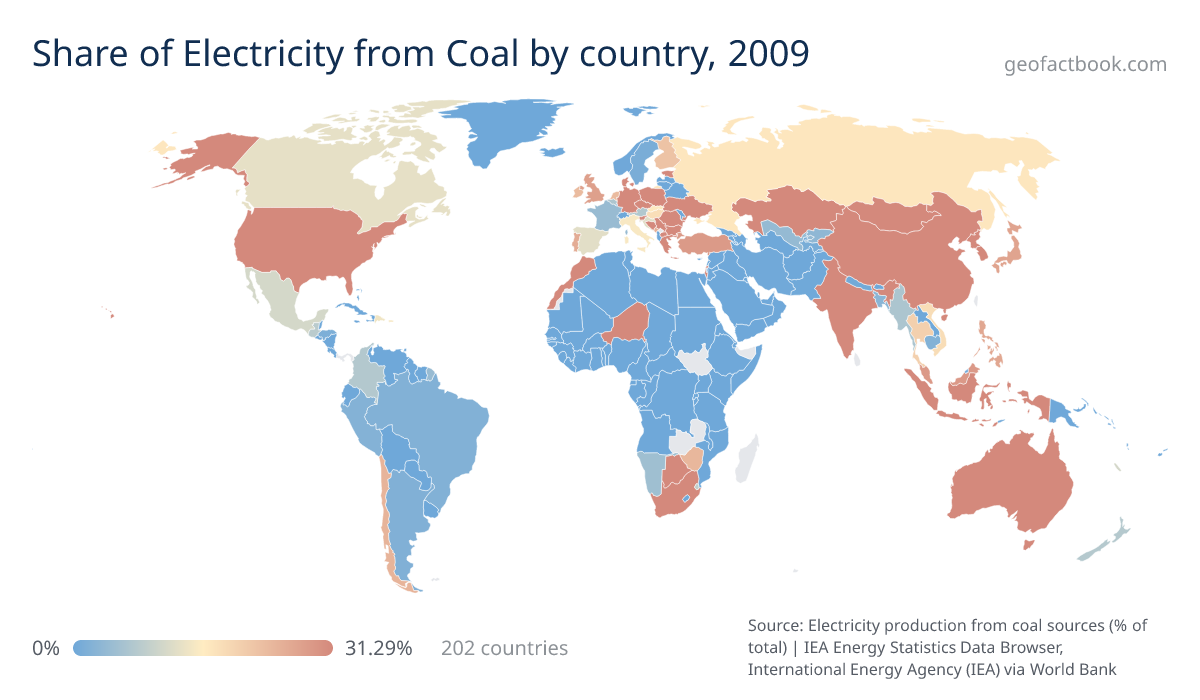
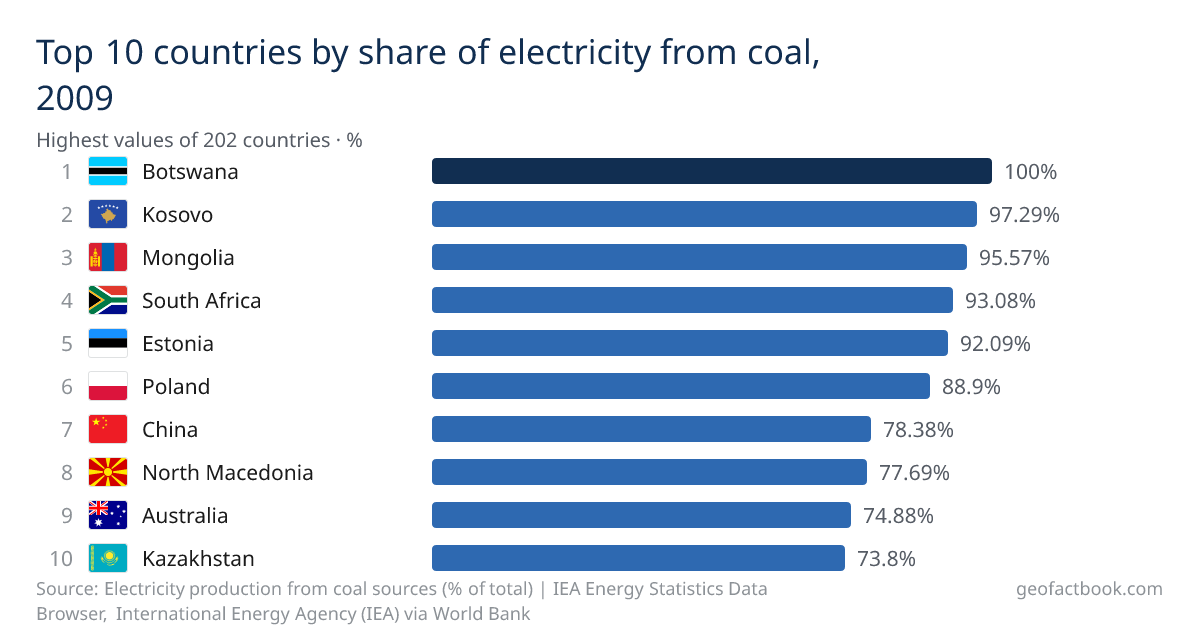
Top 10 countries by share of electricity from coal, 2009: chart
Insights by country
Austria
In 2009, Austria ranked #60 globally with a Share of Electricity from Coal of 7.28501744177631%. This figure is notably lower than the global average, reflecting Austria's commitment to renewable energy sources compared to countries heavily reliant on coal, such as China. The country's abundant hydropower resources and strong environmental policies have driven a significant shift towards cleaner energy, reducing dependence on coal-fired electricity generation.
Antigua and Barbuda
In 2009, Antigua and Barbuda ranked #87 globally with a Share of Electricity from Coal of 0 %. This figure is notably lower than many Caribbean neighbors, which often rely more heavily on fossil fuels for energy production. The country's commitment to renewable energy sources, driven by its geographic abundance of sunlight and wind, has influenced this statistic, reflecting a broader strategy to mitigate environmental impacts and promote sustainability.
Guam
In 2009, Guam ranked #131 globally with a Share of Electricity from Coal of 0 %. This figure is significantly lower than many neighboring Pacific islands, which often rely on coal for energy generation. The absence of coal in Guam's energy mix is primarily due to its commitment to renewable energy sources and the limited availability of coal resources on the island.
Bahamas
In 2009, the Bahamas ranked #89 globally with a Share of Electricity from Coal of 0 %. This figure is significantly lower than many Caribbean neighbors, reflecting a regional trend toward alternative energy sources. The Bahamas relies heavily on imported fossil fuels for electricity generation, with a strong emphasis on renewable energy initiatives driven by its geographic isolation and the need for energy security.
Solomon Islands
In 2009, the Solomon Islands ranked #96 globally, with a Share of Electricity from Coal of 0%. This figure is notably lower than many Pacific Island nations that rely on fossil fuels for energy. The absence of coal usage can be attributed to the country's abundant renewable energy resources, particularly hydropower, and a commitment to sustainable energy policies aimed at reducing carbon emissions.
Oman
In 2009, Oman ranked #156 globally with a Share of Electricity from Coal of 0 %. This figure is notably lower than many of its neighbors in the Gulf region, where coal usage is more common for electricity generation. Oman's energy policy has historically focused on natural gas as the primary source for electricity, driven by the country's abundant natural gas reserves and a commitment to sustainable energy practices.
Armenia
In 2009, Armenia ranked #91 globally with a Share of Electricity from Coal: 0 %. This figure is notably lower than the regional average for Eastern Europe, where many countries rely more heavily on coal for electricity generation. Armenia's lack of coal usage can be attributed to its limited domestic coal resources and a strong emphasis on developing renewable energy sources and nuclear power to meet its energy needs.
Guatemala
In 2009, Guatemala ranked #57 globally with a Share of Electricity from Coal of 8.10213330385763 %. This figure is relatively low compared to countries like China, which heavily relies on coal for its energy needs. The limited use of coal in Guatemala can be attributed to the country's focus on renewable energy sources, particularly hydroelectric power, which aligns with its abundant water resources and environmental policies aimed at sustainability.
Central African Republic
In 2009, the Central African Republic ranked #103 globally with a Share of Electricity from Coal of 0%. This figure is notably lower than many countries in the region, reflecting a reliance on alternative energy sources. The country's limited access to coal resources, combined with a focus on hydroelectric power due to its abundant water resources, has shaped its energy profile.
Bolivia
In 2009, Bolivia ranked #94 globally with a Share of Electricity from Coal of 0 %. This figure is notably lower than many of its regional neighbors, reflecting a broader reliance on hydropower and natural gas for electricity generation. Bolivia's unique geography, characterized by mountainous terrain and abundant water resources, has facilitated the development of hydroelectric projects, which dominate its energy mix.
Analysis & Context
In 2009, the country with the highest Share of Electricity from Coal was Botswana, with a perfect score of 100%, while the range of coal dependency for electricity generation spanned from 0% to 100% globally. The average share of electricity from coal across the 200 countries with available data was 12.46%, with a median value at 0%, indicating a significant number of countries with minimal or no reliance on coal.
Economic and Policy Drivers of Coal Dependency
The reliance on coal for electricity generation is often driven by both economic factors and energy policies. Countries with abundant coal reserves, such as Botswana (100%) and South Africa (93.08%), tend to have high shares of coal in their electricity mix. This is largely due to the economic advantage of utilizing readily available domestic resources, which reduces the need for energy imports and supports local industries.
In China (78.38%), the significant share of electricity from coal reflects its rapid industrialization and the historical prioritization of coal due to its cost-effectiveness and availability. Similarly, Poland (88.90%) maintains a high coal dependency, influenced by its extensive coal mining sector and the socio-political importance of coal in its energy policy.
Environmental and Technological Shifts
Despite coal's economic benefits, environmental concerns and technological advancements are prompting shifts in energy strategies. Countries like Estonia (92.09%) and Australia (74.88%), while still heavily reliant on coal, are increasingly investing in renewable energy sources to reduce carbon emissions and comply with international climate agreements.
Conversely, the complete absence of coal in the electricity mix of countries like Burundi, Iceland, and Grenada (all 0%) can often be attributed to limited coal resources and a strategic focus on alternative energy forms like hydroelectricity and geothermal energy, particularly in regions with abundant natural resources.
Significant Year-over-Year Changes
Analyzing the year-over-year data reveals notable shifts in coal dependency. North Korea saw the largest increase, with a +8.28% rise (23.0%), likely due to a lack of alternative energy resources and geopolitical isolation, which limits energy imports. On the other hand, Montenegro experienced the most significant decrease, with a -20.62% change (-45.2%), possibly driven by efforts to diversify its energy sources and reduce environmental impact.
Other countries like Eswatini (-12.23%, -57.9%) and Kyrgyzstan (-7.84%, -69.2%) have also reduced their reliance on coal, reflecting broader global trends towards renewable energy adoption and energy efficiency improvements.
Implications of Coal Dependency
The varied reliance on coal for electricity generation has profound implications for environmental sustainability, energy security, and economic stability. High coal dependency, as seen in Mongolia (95.57%) and Kosovo (97.29%), poses challenges for reducing greenhouse gas emissions and achieving sustainable energy transitions.
Conversely, countries with low or zero coal dependency, such as Guinea and Guam (both 0%), may benefit from cleaner energy profiles but also face challenges in maintaining energy reliability and affordability without coal's baseload capabilities.
Ultimately, the global trend towards reducing coal dependency is driven by the need to balance economic growth, environmental protection, and energy security. As countries continue to innovate and invest in more sustainable energy solutions, the landscape of electricity generation is poised for significant transformation.
Frequently Asked Questions About Share of Electricity from Coal in 2009
Which country had the highest share of electricity from coal in 2009?
Botswana had the highest share of electricity from coal in 2009, with 100%.
Which country had the lowest share of electricity from coal in 2009?
Brunei Darussalam had the lowest share of electricity from coal in 2009, with 0%.
What was the average share of electricity from coal across all countries in 2009?
The average share of electricity from coal across all countries in 2009 was 12.33%.
What was the median share of electricity from coal in 2009?
The median share of electricity from coal in 2009 was 0%.
How many countries had a 0% share of electricity from coal in 2009?
There were 10 countries with a 0% share of electricity from coal in 2009.
Which country had the second-highest share of electricity from coal in 2009?
Kosovo had the second-highest share of electricity from coal in 2009, with 97.29%.
Data Source
Electricity production from coal sources (% of total) | IEA Energy Statistics Data Browser, International Energy Agency (IEA) via World Bank
Data produced by IEA Energy Statistics Data Browser, International Energy Agency (IEA), compiled and published by World Bank as "Electricity production from coal sources (% of total)".
Visit Data SourceCite this page
Geo Factbook. (n.d.). Share of Electricity from Coal by Country, 2009. Retrieved November 28, 2026, from https://geofactbook.com/fact/share-of-electricity-from-coal/2009
The figures on this page come from Electricity production from coal sources (% of total) | IEA Energy Statistics Data Browser, International Energy Agency (IEA) via World Bank. For academic work, cite the original source as well.
›Embed this ranking on your site
Free to embed with attribution. Shows the top 10 countries and links back to the full ranking.
Historical Data by Year
Explore Share of Electricity from Coal data across different years. Compare trends and see how statistics have changed over time.
More Energy Facts
See all Energy facts →Electricity from Hydroelectric Plants
Electricity from hydroelectric plants shows renewable energy production. Explore country rankings, compare data, and view interactive maps.
 Highest: Bhutan100 % of electricity generation
Share of Electricity from Natural Gas
Share of electricity generated from natural gas highlights energy reliance patterns globally.
 Highest: Turkmenistan100%
Natural Gas Consumption
Natural gas consumption data reveals energy usage trends across countries. Compare figures, explore rankings, and visualize with interactive maps.
 Highest: United States9,015.28 TWh
You might also like
Total population
FeaturedDiscover the latest total population statistics for every country and region worldwide. Explore accurate, up-to-date data on global population growth, density, and demographic trends — sourced from trusted international databases like the UN and World Bank. Perfect for researchers, students, and data enthusiasts looking to understand how the world’s population is changing.
 Highest: India1.48B persons
Human Capital Index
FeaturedThe Human Capital Index measures a country's investment in education and health, reflecting its potential for economic growth and productivity. This vital statistic highlights the importance of nurturing human resources for sustainable development.
 Highest: Singapore0.91
Population Change
FeaturedThis statistic measures population change across countries, highlighting shifts in demographics. Understanding these changes is crucial for planning resources, economic growth, and social services.
Highest: India14.13M persons