
Share of Electricity from Coal 2011
Share of electricity from coal measures the percentage of a country's electricity generated using coal.
Newer data is available: Share of Electricity from Coal by country 2024 →
Where does your country rank? Pick it to see its position.
Related Energy statistics
More ↓
Interactive Map
Complete Data Rankings








































































































































































- #1
 Kosovo
- #2
 Mongolia
- #3
 South Africa
- #4
 Estonia
- #5
 Poland
- #6
 Botswana
- #7
 Kazakhstan
- #8
 China
- #9
 North Macedonia
- #10
 Serbia
Analysis: These countries represent the highest values in this dataset, showcasing significant scale and impact on global statistics.
- #205
 Yemen
- #204
 State of Palestine
- #203
 United States Virgin Islands
- #202
 Venezuela
- #201
 Vanuatu
- #200
 Uruguay
- #199
 United Arab Emirates
- #198
 Uganda
- #197
 Tuvalu
- #196
 Turks and Caicos Islands
Context: These countries or territories have the lowest values, often due to geographic size, administrative status, or specific characteristics.
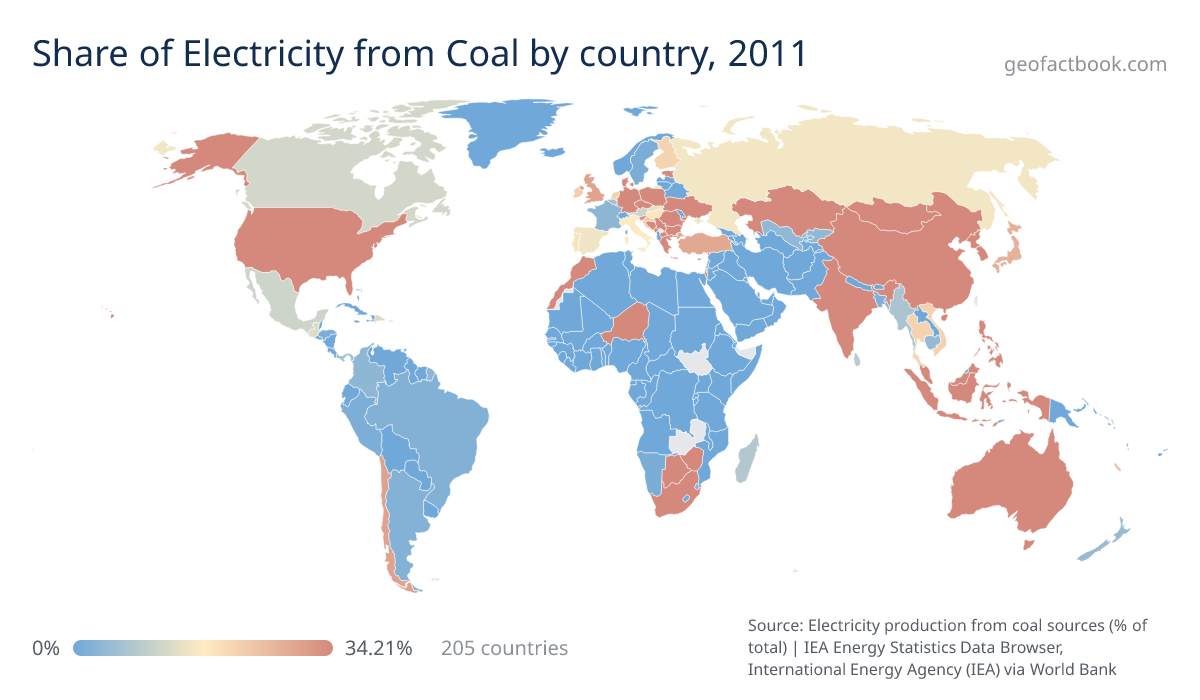
Share of Electricity from Coal by country, 2011: map image
Top 10 countries by share of electricity from coal, 2011: chart
Insights by country
Panama
In 2011, Panama ranked #62 globally with a Share of Electricity from Coal of 5.77857325492201 %. This figure is notably lower than the global average, reflecting Panama's reliance on renewable energy sources, particularly hydropower, which constitutes a significant portion of its electricity generation. The country's geographic landscape, with abundant water resources, has shaped its energy policy, prioritizing sustainability over fossil fuel dependency.
Timor-Leste
In 2011, Timor-Leste ranked #172 globally with a Share of Electricity from Coal of 0 %. This figure is notably lower than many countries in the region, reflecting a reliance on alternative energy sources. The absence of coal usage can be attributed to Timor-Leste's limited natural resources and a focus on developing renewable energy initiatives to support its nascent economy.
Saint Vincent and the Grenadines
In 2011, Saint Vincent and the Grenadines ranked #178 globally with a Share of Electricity from Coal of 0 %. This figure is significantly lower than many Caribbean neighbors that rely more heavily on fossil fuels for energy. The country's focus on renewable energy sources, such as hydroelectric power, reflects its commitment to sustainable development and environmental preservation.
Eritrea
Eritrea ranked #121 globally in 2011 with a Share of Electricity from Coal of 0%. This figure is significantly lower than the global average, indicating a minimal reliance on coal for electricity generation compared to many other countries. The absence of coal usage can be attributed to Eritrea's limited industrial base and a focus on developing renewable energy sources, primarily due to its geographic conditions and policy priorities aimed at sustainable development.
Bosnia and Herzegovina
In 2011, Bosnia and Herzegovina ranked #13 globally with a Share of Electricity from Coal: 70.7198952879581 %. This high percentage is significantly above the European Union average, where coal has been declining due to environmental policies. The reliance on coal is driven by the country's abundant coal reserves and the historical development of its energy sector, which has prioritized coal-fired power generation to meet domestic energy needs.
Bahamas
In 2011, the Bahamas ranked #93 globally with a Share of Electricity from Coal of 0 %. This is notably lower than many countries in the Caribbean region, where reliance on coal for electricity generation is more common. The Bahamas primarily utilizes renewable energy sources and imported fuels, driven by its commitment to sustainability and the geographic limitations of the islands, which affect the feasibility of coal infrastructure.
Aruba
In 2011, Aruba ranked #162 globally with a Share of Electricity from Coal of 0 %. This figure is notably low compared to many countries that rely heavily on coal, reflecting Aruba's commitment to sustainable energy sources. The island's geographic constraints and small size have led to a focus on renewable energy initiatives, particularly solar and wind power, to meet its electricity needs.
Malta
In 2011, Malta ranked #155 globally, with a Share of Electricity from Coal of 0 %. This figure is notably lower than many neighboring countries, reflecting Malta's commitment to alternative energy sources. The absence of coal in Malta's energy mix is driven by its geographical limitations and a strong focus on renewable energy initiatives, aiming to reduce carbon emissions and reliance on fossil fuels.
Botswana
Botswana ranked #6 globally in 2011, with a Share of Electricity from Coal of 82.9131652661064 %. This figure is significantly higher than the global average, reflecting the country's heavy reliance on coal for energy production. The dominance of coal in Botswana's energy mix is driven by abundant local coal reserves and a lack of alternative energy infrastructure, which shapes the nation's energy policy and economic development strategies.
Austria
In 2011, Austria ranked #57 globally with a Share of Electricity from Coal of 11.1452144713051 %. This figure is notably lower than the global average, reflecting Austria's commitment to renewable energy sources compared to many countries that rely heavily on coal. Austria's mountainous geography and favorable policy environment have facilitated the development of hydroelectric power, which significantly contributes to its energy mix.
Ecuador
In 2011, Ecuador ranked #117 globally with a Share of Electricity from Coal of 0 %. This figure is notably low compared to many countries, particularly those heavily reliant on coal, such as China and India. The absence of coal in Ecuador's energy mix is largely due to its abundant hydroelectric resources, which supply the majority of its electricity, along with a policy focus on renewable energy sources.
Guam
In 2011, Guam ranked #134 globally with a Share of Electricity from Coal of 0%. This figure is notably lower than many of its neighbors in the Pacific region, reflecting a commitment to alternative energy sources. Guam's energy landscape is shaped by its geographic isolation and a strong push towards renewable energy initiatives, driven by both environmental policies and the high cost of fossil fuel imports.
Bulgaria
Bulgaria ranked #19 globally with a Share of Electricity from Coal of 54.2098942850956 % in 2011. This figure is significantly higher than the European Union average, reflecting Bulgaria's reliance on coal for energy production compared to many of its neighbors. The country's energy strategy has historically favored coal due to its domestic reserves and the economic importance of coal-fired power plants in providing employment and energy security.
Sri Lanka
In 2011, Sri Lanka ranked #58 globally with a Share of Electricity from Coal of 8.90375707668554 %. This figure is notably lower than the global average, reflecting the country's reliance on renewable energy sources compared to many of its neighbors. The limited use of coal can be attributed to Sri Lanka's commitment to sustainable energy policies and the abundant availability of hydropower resources, which significantly influence its energy mix.
Iceland
Iceland ranked #138 globally in 2011 for its Share of Electricity from Coal, with a value of 0 %. This is significantly lower than many countries that rely heavily on coal for energy production, illustrating Iceland's commitment to renewable energy sources. The country primarily utilizes geothermal and hydroelectric power due to its unique geological features and abundant natural resources, resulting in minimal coal dependency.
Analysis & Context
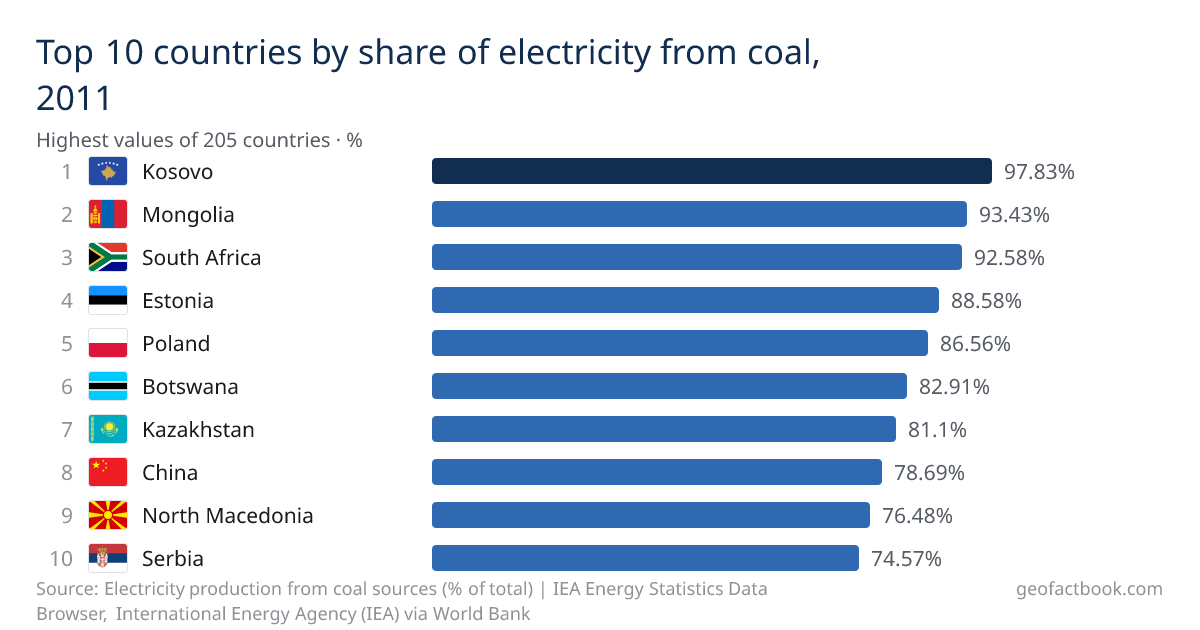
In 2011, Kosovo led the world in the "Share of Electricity from Coal" with a staggering 97.83%, while the global range spanned from 0.00% to 97.83%. The global average share of electricity generated from coal during this year was 12.86%, highlighting a significant reliance on coal in specific regions compared to others.
Coal Dependency in Top-Producing Nations
The top contributors to electricity from coal in 2011 were predominantly countries with abundant coal reserves or limited access to alternative energy sources. Kosovo, with its near-total reliance on coal, reflects its substantial lignite reserves, which are among the largest in Europe. Similarly, Mongolia (93.43%) and South Africa (92.58%) also boast significant coal deposits, which are critical for their energy production. In South Africa, coal is integral to its economy, providing a cost-effective energy source that supports its industrial sector.
Poland (86.56%) and China (78.69%) further illustrate the trend of coal dependency. Poland's energy sector is heavily reliant on coal due to its domestic reserves and the historical development of its energy infrastructure around coal. Meanwhile, China, despite its significant investments in renewable energy, continues to depend heavily on coal to meet its vast energy needs due to its rapid industrialization and urbanization.
Zero Dependency: Countries with No Coal Usage
In stark contrast, several countries recorded a 0% share of electricity from coal in 2011. These include the Democratic Republic of the Congo, Haiti, and Guyana. These nations typically rely on alternative energy sources such as hydroelectric power, which is abundant in regions like the Democratic Republic of the Congo due to the Congo River. Furthermore, economic constraints and infrastructure limitations in these countries often prevent the development of coal-based energy systems.
Year-over-Year Trends: Significant Movers
The year-over-year changes in coal usage for electricity generation reveal notable shifts. Montenegro experienced the largest increase, rising by 23.04% (72.9%), likely due to increased domestic coal production and a shift from imported energy. Similarly, Bosnia and Herzegovina saw an increase of 18.19% (34.6%), reflecting efforts to boost energy independence through local coal resources.
Conversely, Botswana recorded the most significant decrease at -13.33% (-13.8%). This reduction might be attributed to efforts to diversify energy sources and reduce carbon emissions. North Korea and Finland also decreased their coal usage by -6.85% (-16.7%) and -5.12% (-19.3%), respectively, with Finland's reduction aligning with its long-term strategy to transition towards renewable energy sources.
Economic and Policy Factors Influencing Coal Use
The reliance on coal for electricity generation is often influenced by economic and policy factors. In many high coal-usage countries, such as China and South Africa, coal remains a cheap and locally available resource, essential for supporting economic growth and industrial activities. Conversely, countries with lower or zero coal usage often have policies promoting renewable energy or lack the infrastructure for coal-based power generation.
In Europe, environmental policies and commitments to reduce carbon emissions have led countries like Finland and Denmark to decrease their reliance on coal. These countries are investing heavily in wind and solar power, which are becoming increasingly cost-competitive with traditional fossil fuels.
Overall, the data from 2011 highlights a diverse global landscape in the share of electricity from coal, driven by a complex interplay of resource availability, economic development, and policy decisions. This diversity underscores the ongoing global energy transition and the challenges and opportunities it presents for different countries.
Frequently Asked Questions About Share of Electricity from Coal in 2011
Which country had the highest share of electricity from coal in 2011?
Kosovo had the highest share of electricity from coal in 2011, with 97.83%.
What was the lowest share of electricity from coal by any country in 2011?
The Central African Republic had the lowest share of electricity from coal in 2011, with 0%.
What was the average share of electricity from coal across all countries in 2011?
The average share of electricity from coal across all countries in 2011 was 12.55%.
Which countries were in the top 3 for share of electricity from coal in 2011?
The top 3 countries for share of electricity from coal in 2011 were Kosovo (97.83%), Mongolia (93.43%), and South Africa (92.58%).
What was the median share of electricity from coal in 2011?
The median share of electricity from coal in 2011 was 0%, indicating that at least half of the countries had no electricity generated from coal.
How many countries had a 0% share of electricity from coal in 2011?
There were 10 countries with a 0% share of electricity from coal in 2011.
Data Source
Electricity production from coal sources (% of total) | IEA Energy Statistics Data Browser, International Energy Agency (IEA) via World Bank
Data produced by IEA Energy Statistics Data Browser, International Energy Agency (IEA), compiled and published by World Bank as "Electricity production from coal sources (% of total)".
Visit Data SourceCite this page
Geo Factbook. (n.d.). Share of Electricity from Coal by Country, 2011. Retrieved November 28, 2026, from https://geofactbook.com/fact/share-of-electricity-from-coal/2011
The figures on this page come from Electricity production from coal sources (% of total) | IEA Energy Statistics Data Browser, International Energy Agency (IEA) via World Bank. For academic work, cite the original source as well.
›Embed this ranking on your site
Free to embed with attribution. Shows the top 10 countries and links back to the full ranking.
Historical Data by Year
Explore Share of Electricity from Coal data across different years. Compare trends and see how statistics have changed over time.
More Energy Facts
See all Energy facts →Electricity from Hydroelectric Plants
Electricity from hydroelectric plants shows renewable energy production. Explore country rankings, compare data, and view interactive maps.
 Highest: Bhutan100 % of electricity generation
Share of Electricity from Natural Gas
Share of electricity generated from natural gas highlights energy reliance patterns globally.
 Highest: Turkmenistan100%
Natural Gas Consumption
Natural gas consumption data reveals energy usage trends across countries. Compare figures, explore rankings, and visualize with interactive maps.
 Highest: United States9,015.28 TWh
You might also like
Total population
FeaturedDiscover the latest total population statistics for every country and region worldwide. Explore accurate, up-to-date data on global population growth, density, and demographic trends — sourced from trusted international databases like the UN and World Bank. Perfect for researchers, students, and data enthusiasts looking to understand how the world’s population is changing.
 Highest: India1.48B persons
Human Capital Index
FeaturedThe Human Capital Index measures a country's investment in education and health, reflecting its potential for economic growth and productivity. This vital statistic highlights the importance of nurturing human resources for sustainable development.
 Highest: Singapore0.91
Population Change
FeaturedThis statistic measures population change across countries, highlighting shifts in demographics. Understanding these changes is crucial for planning resources, economic growth, and social services.
Highest: India14.13M persons