
Share of Electricity from Coal 2015
Share of electricity from coal measures the percentage of a country's electricity generated using coal.
Newer data is available: Share of Electricity from Coal by country 2024 →
Where does your country rank? Pick it to see its position.
Related Energy statistics
More ↓

Interactive Map
Complete Data Rankings























































































































































































Analysis: These countries represent the highest values in this dataset, showcasing significant scale and impact on global statistics.
- #207
 Yemen
- #206
 State of Palestine
- #205
 United States Virgin Islands
- #204
 Venezuela
- #203
 Vanuatu
- #202
 Uruguay
- #201
 United Arab Emirates
- #200
 Uganda
- #199
 Tuvalu
- #198
 Turks and Caicos Islands
Context: These countries or territories have the lowest values, often due to geographic size, administrative status, or specific characteristics.
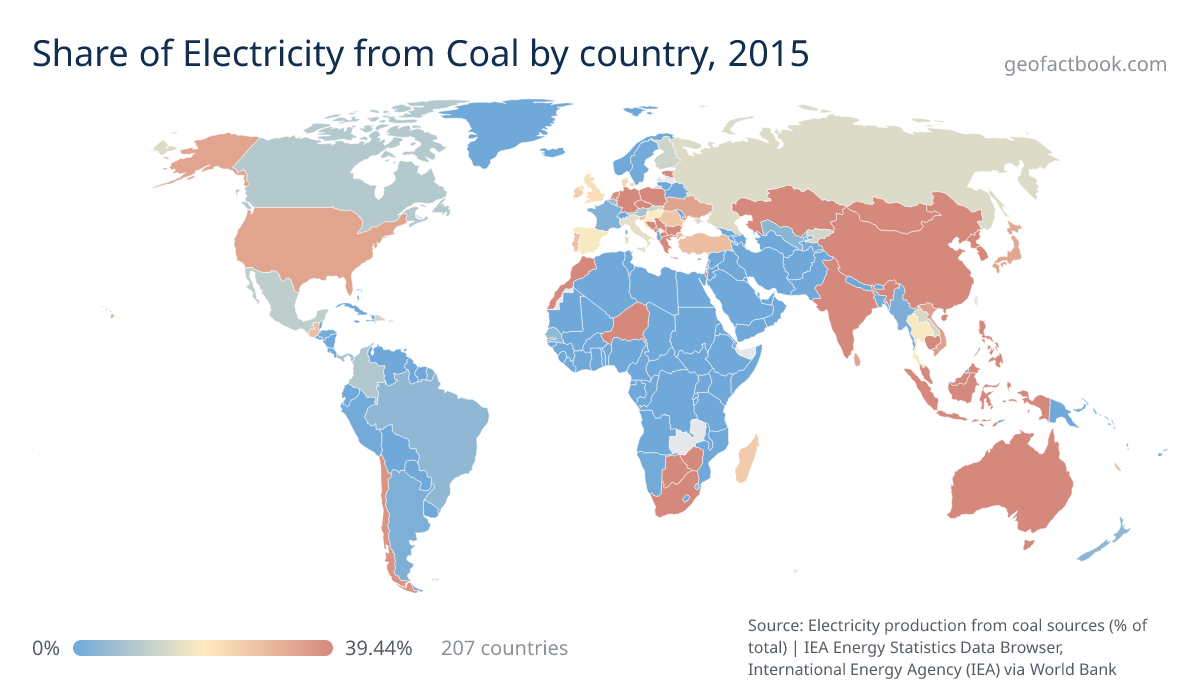
Share of Electricity from Coal by country, 2015: map image
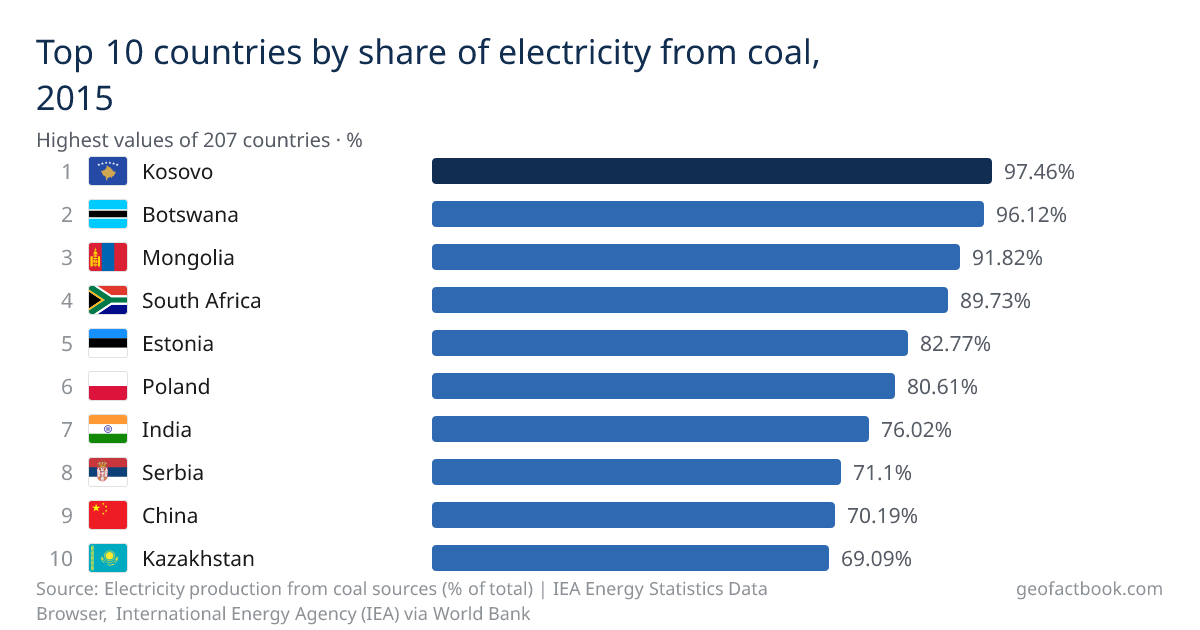
Top 10 countries by share of electricity from coal, 2015: chart
Insights by country
Slovakia
In 2015, Slovakia ranked #59 globally with a Share of Electricity from Coal of 12.3852358473033%. This figure is notably lower than the European Union average, reflecting a regional trend towards cleaner energy sources. Slovakia's reliance on coal has been influenced by its historical industrial base and energy policies, although ongoing commitments to reduce carbon emissions are shaping a shift towards renewable energy investments.
New Caledonia
In 2015, New Caledonia ranked #41 globally with a Share of Electricity from Coal of 28.3766884734237 %. This figure is notably higher than the global average, reflecting the country's reliance on coal for energy production. The island's geographical isolation and limited access to alternative energy sources contribute to this dependency, alongside a historical focus on coal mining as a key economic activity.
Nicaragua
Nicaragua ranked #166 globally in 2015, with a Share of Electricity from Coal at 0 %. This figure is significantly lower than many countries in Central America, where coal is more commonly used for electricity generation. Nicaragua's reliance on renewable energy sources, particularly hydroelectric power, and government policies promoting sustainability have contributed to this low percentage of coal usage.
Nauru
In 2015, Nauru had a global rank of #161 with a Share of Electricity from Coal of 0%. This figure is notably lower than many countries that rely heavily on coal for electricity generation, such as Australia, which has a significant coal dependency. Nauru's lack of coal usage is largely due to its limited natural resources and a focus on renewable energy sources, particularly solar power, which aligns with its goal to enhance energy sustainability.
Liberia
In 2015, Liberia ranked #149 globally with a Share of Electricity from Coal of 0%. This is significantly lower than many countries, particularly compared to the global average, where coal contributes to a substantial portion of electricity generation. The lack of coal-based electricity in Liberia is primarily due to the country's limited access to fossil fuel resources and a reliance on hydroelectric power, driven by its abundant river systems.
Vanuatu
In 2015, Vanuatu ranked #165 globally with a Share of Electricity from Coal of 0 %. This is significantly lower than many countries that rely heavily on coal for energy, including its regional neighbor Australia, which has a much higher share. The absence of coal in Vanuatu's energy mix is primarily due to its commitment to renewable energy sources, driven by both environmental policies and the country's limited natural resources to extract fossil fuels.
Papua New Guinea
Papua New Guinea ranked #171 globally with a Share of Electricity from Coal of 0 % in 2015. This figure is significantly lower than the global average, as many countries rely heavily on coal for electricity generation. The absence of coal in Papua New Guinea's energy mix can be attributed to its abundant renewable energy resources, particularly hydropower, and a commitment to sustainable energy policies aimed at reducing carbon emissions.
Malawi
In 2015, Malawi ranked #153 globally with a Share of Electricity from Coal of 0 %. This figure is significantly lower than many countries in the region, where coal is a more common energy source. Malawi's reliance on renewable energy sources, particularly hydroelectric power, is driven by its abundant water resources and government policies aimed at promoting sustainable energy solutions.
Mauritius
In 2015, Mauritius ranked #30 globally with a Share of Electricity from Coal of 39.4394394394394%. This figure is notably higher than the global average, reflecting the country's reliance on coal for energy generation compared to many other nations. The heavy dependence on coal is driven by Mauritius's limited access to alternative energy resources and its ongoing efforts to balance energy security with economic growth.
Lesotho
In 2015, Lesotho had a global rank of #148 with a Share of Electricity from Coal of 0%. This figure is notably lower than many neighboring countries, reflecting Lesotho's reliance on hydropower, which accounts for the majority of its electricity generation. The country's mountainous geography and abundant water resources facilitate this renewable energy source, while limited coal deposits and environmental policies discourage coal usage.
Analysis & Context
In 2015, Kosovo led the world with a Share of Electricity from Coal of 97.46%, marking the highest reliance on coal for electricity production globally. This year saw a wide range in coal dependency, with the minimum share recorded at 0.00% in several countries. The global average for the Share of Electricity from Coal was 13.05%, while the median stood at 0.00%, indicating a significant skew towards lower coal dependency.
Economic and Geographic Drivers of Coal Dependency
The high reliance on coal for electricity in certain countries, such as Kosovo (97.46%), Botswana (96.11%), and Mongolia (91.82%), can often be attributed to economic and geographic factors. These countries typically have abundant coal reserves, which makes coal a cost-effective energy source. For instance, South Africa, with its extensive coal deposits, generated 89.73% of its electricity from coal in 2015. This pattern is common in nations where coal mining is a significant industry, providing both energy security and economic benefits. Conversely, countries with limited or no coal reserves, like Albania and Ghana, showed a 0.00% share, often relying on alternative energy sources such as hydropower or imports.
Policy and Environmental Considerations
Policy decisions and environmental considerations also play a crucial role in shaping a country's reliance on coal. In Poland, where coal accounted for 80.61% of electricity generation, the government's energy policy has historically supported coal to protect domestic jobs and energy independence. However, such policies are increasingly challenged by the global shift towards greener energy sources. Meanwhile, countries like Denmark, which saw a significant reduction in coal usage (-9.81%), are actively transitioning towards renewable energy to meet environmental goals and reduce carbon footprints.
Year-over-Year Trends and Significant Changes
The year-over-year trends in coal dependency reveal significant shifts in certain countries. Cambodia experienced the largest increase in coal usage, with a jump of 21.57%, increasing its share by 75.5%. This surge can be linked to rapid industrialization and the consequent rise in energy demands. Similarly, Vietnam and Sri Lanka also saw considerable increases, reflecting their growing energy needs and economic development. On the other hand, Niger reduced its share by 14.14%, a decrease of 25.4%, likely due to a shift towards more sustainable energy practices or changes in energy policy. These trends highlight the dynamic nature of global energy landscapes and the varying pace at which countries are adapting to new energy paradigms.
The Global Context of Coal in Energy Production
Globally, the reliance on coal for electricity generation is influenced by a complex interplay of economic, environmental, and policy factors. While the global average share of 13.05% suggests a moderate reliance on coal, the median value of 0.00% reflects a significant number of countries opting for alternative energy sources. This dichotomy underscores the transition many nations are undergoing, as they balance economic growth with environmental sustainability. As countries like China (70.19%) and India (76.02%) continue to grow, their energy policies will significantly impact global coal dependency trends. The data from 2015 provides a snapshot of this transition, highlighting the varying strategies employed by nations to meet their energy needs in a rapidly changing world.
Frequently Asked Questions About Share of Electricity from Coal in 2015
Which country had the highest share of electricity from coal in 2015?
Kosovo had the highest share of electricity from coal in 2015, with 97.46%.
Which country had the lowest share of electricity from coal in 2015?
Gabon had the lowest share of electricity from coal in 2015, with 0%.
What was the average share of electricity from coal across all countries in 2015?
The average share of electricity from coal across all countries in 2015 was 12.61%.
What was the median share of electricity from coal in 2015?
The median share of electricity from coal in 2015 was 0%.
How many countries had a 0% share of electricity from coal in 2015?
Ten countries had a 0% share of electricity from coal in 2015.
Which countries were in the top 3 for the share of electricity from coal in 2015?
The top 3 countries for the share of electricity from coal in 2015 were Kosovo (97.46%), Botswana (96.12%), and Mongolia (91.82%).
Data Source
Electricity production from coal sources (% of total) | IEA Energy Statistics Data Browser, International Energy Agency (IEA) via World Bank
Data produced by IEA Energy Statistics Data Browser, International Energy Agency (IEA), compiled and published by World Bank as "Electricity production from coal sources (% of total)".
Visit Data SourceCite this page
Geo Factbook. (n.d.). Share of Electricity from Coal by Country, 2015. Retrieved November 28, 2026, from https://geofactbook.com/fact/share-of-electricity-from-coal/2015
The figures on this page come from Electricity production from coal sources (% of total) | IEA Energy Statistics Data Browser, International Energy Agency (IEA) via World Bank. For academic work, cite the original source as well.
›Embed this ranking on your site
Free to embed with attribution. Shows the top 10 countries and links back to the full ranking.
Historical Data by Year
Explore Share of Electricity from Coal data across different years. Compare trends and see how statistics have changed over time.
More Energy Facts
See all Energy facts →Electricity from Hydroelectric Plants
Electricity from hydroelectric plants shows renewable energy production. Explore country rankings, compare data, and view interactive maps.
 Highest: Bhutan100 % of electricity generation
Share of Electricity from Natural Gas
Share of electricity generated from natural gas highlights energy reliance patterns globally.
 Highest: Turkmenistan100%
Natural Gas Consumption
Natural gas consumption data reveals energy usage trends across countries. Compare figures, explore rankings, and visualize with interactive maps.
 Highest: United States9,015.28 TWh
You might also like
Total population
FeaturedDiscover the latest total population statistics for every country and region worldwide. Explore accurate, up-to-date data on global population growth, density, and demographic trends — sourced from trusted international databases like the UN and World Bank. Perfect for researchers, students, and data enthusiasts looking to understand how the world’s population is changing.
 Highest: India1.48B persons
Human Capital Index
FeaturedThe Human Capital Index measures a country's investment in education and health, reflecting its potential for economic growth and productivity. This vital statistic highlights the importance of nurturing human resources for sustainable development.
 Highest: Singapore0.91
Population Change
FeaturedThis statistic measures population change across countries, highlighting shifts in demographics. Understanding these changes is crucial for planning resources, economic growth, and social services.
Highest: India14.13M persons