
Logistics Performance Index 2016
The Logistics Performance Index ranks countries on logistics efficiency, offering insight into global trade capabilities.
Newer data is available: Logistics Performance Index by country 2022 →
Where does your country rank? Pick it to see its position.
Related Economy statistics
More ↓


Interactive Map
Complete Data Rankings







































































































































- #1
 Germany
- #2
 Luxembourg
- #3
 Sweden
- #4
 Netherlands
- #5
 Singapore
- #6
 Belgium
- #7
 Austria
- #8
 United Kingdom
- #9
 China, Hong Kong SAR
- #10
 United States
Analysis: These countries represent the highest values in this dataset, showcasing significant scale and impact on global statistics.
- #159
 Syrian Arab Republic
- #158
 Haiti
- #157
 Somalia
- #156
 Mauritania
- #155
 Equatorial Guinea
- #154
 Sierra Leone
- #153
 Lesotho
- #152
 Tajikistan
- #151
 Laos
- #150
 Zimbabwe
Context: These countries or territories have the lowest values, often due to geographic size, administrative status, or specific characteristics.
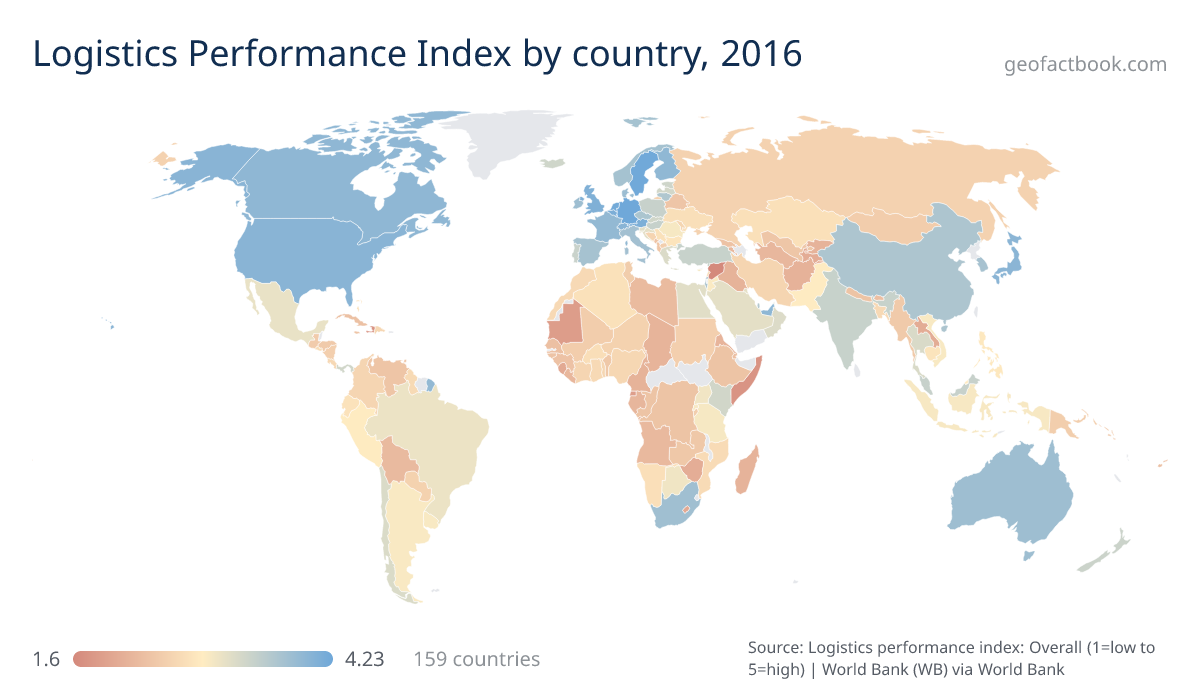
Logistics Performance Index by country, 2016: map image
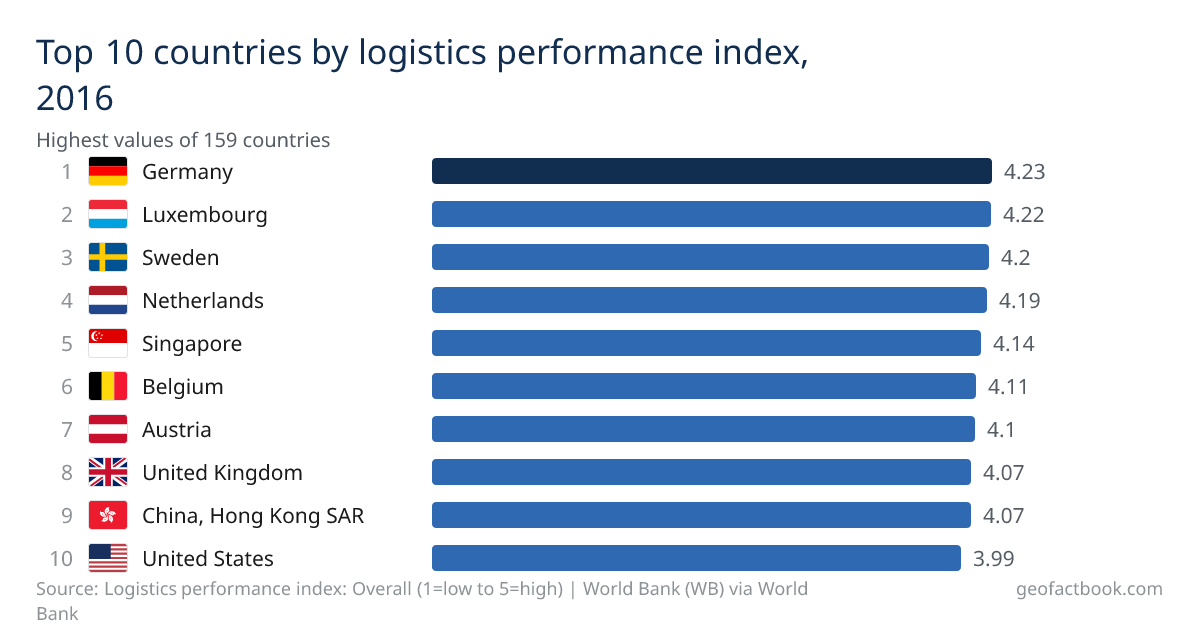
Top 10 countries by logistics performance index, 2016: chart
Insights by country
Uruguay
In 2016, Uruguay achieved a Logistics Performance Index of 2.974545, ranking #64 out of 159 countries. This performance is notably lower than regional leaders like Chile, indicating room for improvement in logistics efficiency. Key drivers of Uruguay's logistics performance include its strategic geographic location as a gateway to the Southern Cone and ongoing investments in infrastructure development, though challenges remain in supply chain coordination and regulatory processes.
South Africa
In 2016, South Africa achieved a Logistics Performance Index of 3.775321, ranking #20 out of 159 countries. This performance is notably above the regional average for Sub-Saharan Africa, highlighting its relative strength in logistics. Key drivers of this ranking include South Africa's well-developed infrastructure, particularly in transport and communications, alongside its strategic geographic position as a gateway to other African markets.
Tajikistan
Tajikistan ranked #152 with a Logistics Performance Index value of 2.062743 in 2016. This positioned the country among the lowest globally, reflecting significant challenges compared to regional neighbors. Key factors contributing to this low ranking include Tajikistan's mountainous geography, which complicates transportation infrastructure, and a reliance on remittances rather than diversified economic development. Additionally, limited investment in logistics and trade facilitation further hinders its performance in this critical area.
Somalia
In 2016, Somalia ranked #157 with a Logistics Performance Index value of 1.747098. This places Somalia near the bottom of the global rankings, only ahead of one other country, reflecting significant logistical challenges compared to regional neighbors. The country's ongoing conflict, lack of infrastructure, and limited government capacity severely hinder effective logistics and trade operations, impacting its overall economic development.
Uzbekistan
In 2016, Uzbekistan achieved a Logistics Performance Index of 2.404525, ranking #117 out of 159 countries. This score is below the global average, indicating challenges in logistics efficiency compared to top performers like Germany, which consistently ranks near the top. Key factors influencing Uzbekistan's logistics performance include its landlocked geography, which complicates trade routes, and ongoing reforms aimed at modernizing infrastructure and improving trade facilitation.
Latvia
In 2016, Latvia achieved a Logistics Performance Index of 3.327107, ranking #42 out of 159 countries. This position is notable, especially when compared to neighboring Estonia, which ranked higher in the same index. Latvia's logistics performance is influenced by its strategic geographic location as a transit hub in the Baltic region, along with ongoing investments in infrastructure and logistics services aimed at enhancing efficiency.
Portugal
In 2016, Portugal achieved a Logistics Performance Index of 3.409367, ranking #35 out of 159 countries. This places Portugal above the global average, though it trails behind its neighbor Spain, which ranks higher in logistics efficiency. Key drivers of Portugal's performance include its strategic location as a gateway to Europe and its investment in infrastructure improvements, which enhance connectivity and trade capabilities.
Laos
In 2016, Laos ranked #151 globally with a Logistics Performance Index of 2.067254. This position places Laos near the bottom of the rankings, significantly lower than its regional neighbors, reflecting challenges in its logistics infrastructure. Key drivers of this low performance include the country's limited road networks and underdeveloped transport facilities, which hinder efficient movement of goods and services.
Venezuela
In 2016, Venezuela ranked #121 globally in the Logistics Performance Index with a score of 2.39078. This performance is significantly lower than many of its regional neighbors, reflecting challenges in logistics infrastructure and efficiency. The country’s ongoing economic crisis, characterized by hyperinflation and a decline in oil revenues, has severely impacted its logistics capabilities and supply chain operations.
Norway
In 2016, Norway achieved a Logistics Performance Index of 3.732163, ranking #22 out of 159 countries. This position is notable as it reflects a strong performance relative to many of its Nordic neighbors, which typically excel in logistics but may not reach Norway's specific score. Key drivers of this performance include Norway's advanced infrastructure, efficient transport systems, and a well-regulated maritime sector, which facilitate smooth logistics operations in its challenging geography.
Analysis & Context
In 2016, the Logistics Performance Index was led by Germany with a score of 4.23, while the global range spanned from 1.60 to 4.23. The average score across the 159 countries evaluated was 2.88, providing a benchmark for global logistics efficiency.
Economic Powerhouses and Their Logistics Efficiency
Countries with robust economies often have well-developed logistics infrastructures, which is reflected in their high Logistics Performance Index scores. Germany, leading the index with a score of 4.23, is a prime example, benefiting from its central location in Europe and its advanced transportation networks. Similarly, Luxembourg and Sweden, scoring 4.22 and 4.20 respectively, leverage their strategic positions and economic stability to maintain efficient logistics systems.
These nations typically invest significantly in infrastructure, technology, and trade facilitation, which are critical components in achieving high logistics performance. The presence of major global logistics companies headquartered in these countries also contributes to their leading positions.
Geographic and Policy Influences on Logistics Performance
Geography plays a crucial role in a country's logistics performance. Singapore, for instance, with a score of 4.14, benefits from its strategic location as a key global trade hub, allowing for efficient maritime and air logistics operations. Netherlands, scoring 4.19, utilizes its position as a gateway to Europe with the Port of Rotterdam, one of the busiest ports in the world.
Policy decisions also significantly impact logistics efficiency. Countries like Belgium and Austria, with scores of 4.11 and 4.10, respectively, have implemented policies that streamline customs procedures and enhance supply chain transparency. These measures are essential for maintaining high logistics performance.
Challenges Faced by Lower-Performing Countries
At the other end of the spectrum, countries like the Syrian Arab Republic and Haiti, with scores of 1.60 and 1.72, respectively, face significant challenges in logistics performance. These challenges often stem from ongoing conflicts, political instability, and inadequate infrastructure. Such factors hinder the development of efficient logistics systems, impacting trade capabilities and economic growth.
In Somalia and Mauritania, scoring 1.75 and 1.87, the lack of investment in infrastructure and technology, along with complex regulatory environments, further exacerbates logistics inefficiencies. Addressing these issues is crucial for improving their logistics performance and fostering economic development.
Comparative Insights: Lessons from Top Performers
The disparities in the Logistics Performance Index highlight the importance of strategic investments and policy frameworks. High-performing countries like United Kingdom and China, Hong Kong SAR, with scores of 4.07 and 4.07, demonstrate that a focus on innovation, infrastructure development, and regulatory efficiency can significantly enhance logistics performance.
For countries aiming to improve their logistics capabilities, emulating the practices of top performers can be beneficial. This includes investing in state-of-the-art infrastructure, adopting advanced logistics technologies, and creating conducive policy environments that facilitate trade and transportation.
In conclusion, the 2016 Logistics Performance Index underscores the critical role of logistics in global trade and economic development. While top-performing countries set benchmarks for logistics efficiency, lower-performing nations face challenges that require targeted interventions. Understanding these dynamics is key to enhancing global logistics performance and, consequently, economic prosperity.
Frequently Asked Questions About Logistics Performance Index in 2016
Which country had the highest Logistics Performance Index in 2016?
Germany had the highest Logistics Performance Index in 2016, with a score of 4.23.
Which country had the lowest Logistics Performance Index in 2016?
The Syrian Arab Republic had the lowest Logistics Performance Index in 2016, with a score of 1.6.
What was the average Logistics Performance Index value in 2016?
The average Logistics Performance Index value in 2016 was 2.88.
What was the median Logistics Performance Index value in 2016?
The median Logistics Performance Index value in 2016 was 2.73.
How many countries were included in the Logistics Performance Index dataset for 2016?
The Logistics Performance Index dataset for 2016 included 159 countries.
Which countries were in the top 3 of the Logistics Performance Index in 2016?
The top 3 countries in the Logistics Performance Index in 2016 were Germany, Luxembourg, and Sweden.
Data Source
Logistics performance index: Overall (1=low to 5=high) | World Bank (WB) via World Bank
Data produced by Connecting to Compete - Logistics Performance Index (LPI), World Bank (WB), compiled and published by World Bank as "Logistics performance index: Overall (1=low to 5=high)".
Visit Data SourceCite this page
Geo Factbook. (n.d.). Logistics Performance Index by Country, 2016. Retrieved November 29, 2026, from https://geofactbook.com/fact/logistics-performance-index/2016
The figures on this page come from Logistics performance index: Overall (1=low to 5=high) | World Bank (WB) via World Bank. For academic work, cite the original source as well.
›Embed this ranking on your site
Free to embed with attribution. Shows the top 10 countries and links back to the full ranking.
Historical Data by Year
Explore Logistics Performance Index data across different years. Compare trends and see how statistics have changed over time.
More Economy Facts
See all Economy facts →Current Health Expenditure (% of GDP)
Current health expenditure as a percentage of GDP highlights spending trends. Compare countries, explore rankings, and view historical data.
 Highest: Tuvalu27.09 % of GDP
Share of population in poverty ($3 a day)
Share of population in poverty ($3 a day) statistics by country with historical data from Our World in Data.
 Highest: Honduras15.72
GNI Per Capita (PPP)
GNI per capita (PPP) shows the average income earned per person, adjusted for purchasing power.
Highest: Singapore135,750 USDYou might also like
Rule of Law Index by Country
FeaturedCompare countries by Rule of Law percentile rank, reflecting confidence in laws, courts, police, property rights, and protection from crime and violence.
 Highest: Finland100%
Life expectancy at birth
FeaturedLife expectancy at birth measures the average years a newborn is expected to live, reflecting a country's health standards and quality of life. This vital statistic highlights disparities in healthcare and living conditions across nations, making it essential for global health assessments.
 Highest: Monaco89.29 years
Median age of population
FeaturedThe median age of a population is a key demographic indicator, reflecting the age distribution within a country. Understanding median age helps assess economic development, healthcare needs, and social dynamics. Countries with a higher median age may face challenges related to aging populations, while younger populations often indicate growth potential.
Highest: Monaco53.17 years