
Logistics Performance Index 2014
The Logistics Performance Index ranks countries on logistics efficiency, offering insight into global trade capabilities.
Newer data is available: Logistics Performance Index by country 2022 →
Where does your country rank? Pick it to see its position.
Related Economy statistics
More ↓

Interactive Map
Complete Data Rankings








































































































































- #1
 Germany
- #2
 Netherlands
- #3
 Belgium
- #4
 United Kingdom
- #5
 Singapore
- #6
 Sweden
- #7
 Norway
- #8
 Luxembourg
- #9
 United States
- #10
 Japan
Analysis: These countries represent the highest values in this dataset, showcasing significant scale and impact on global statistics.
- #159
 Somalia
- #158
 Congo, Democratic Republic of the
- #157
 Afghanistan
- #156
 Congo
- #155
 Eritrea
- #154
 Syrian Arab Republic
- #153
 Djibouti
- #152
 Sudan
- #151
 Cuba
- #150
 Yemen
Context: These countries or territories have the lowest values, often due to geographic size, administrative status, or specific characteristics.
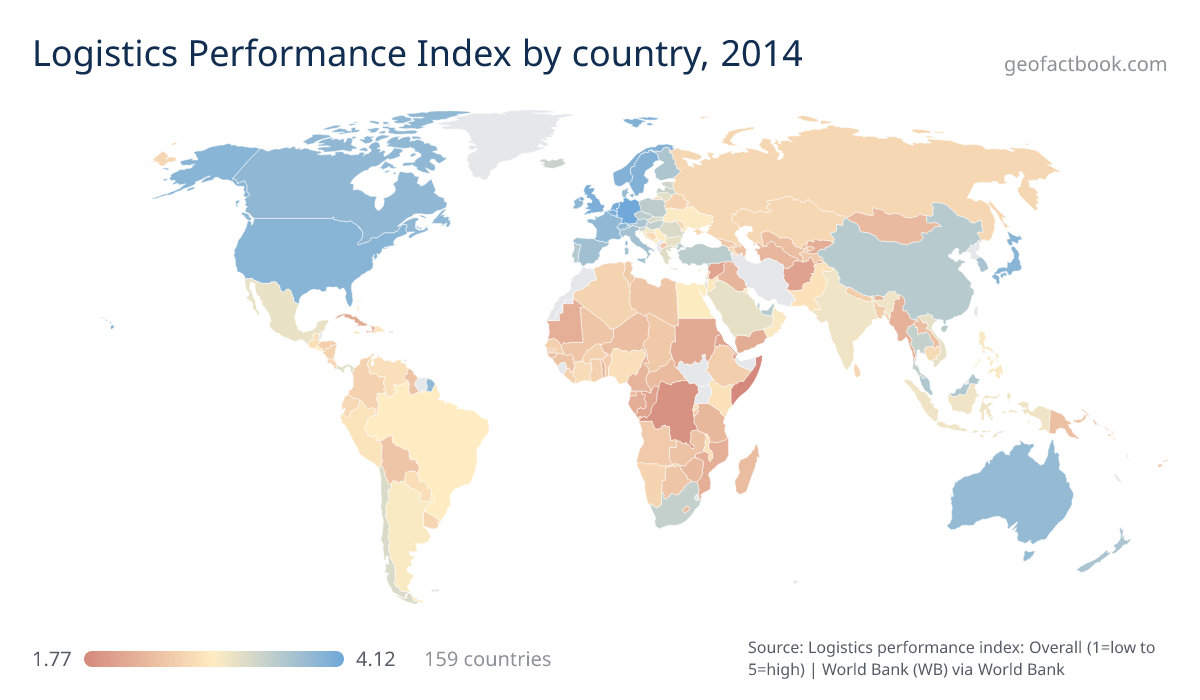
Logistics Performance Index by country, 2014: map image
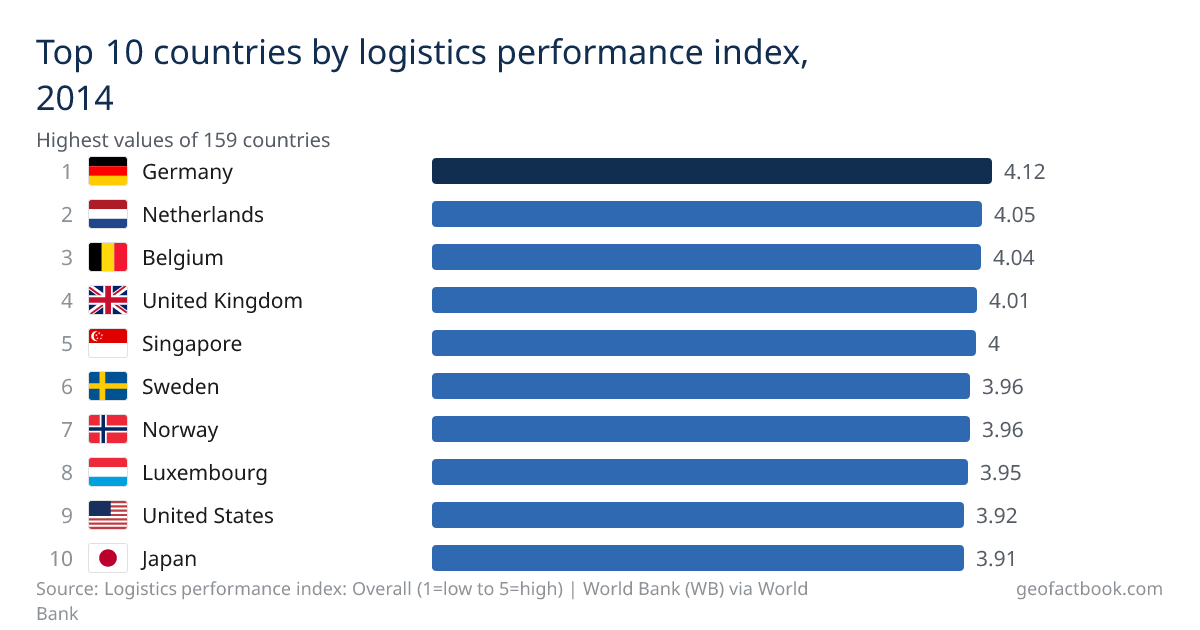
Top 10 countries by logistics performance index, 2014: chart
Insights by country
Chile
In 2014, Chile achieved a Logistics Performance Index of 3.255786, ranking #41 out of 159 countries. This places Chile above the regional average for Latin America, indicating a competitive logistics environment compared to its neighbors. Key drivers of this performance include Chile's extensive trade agreements and its well-developed infrastructure, particularly in ports and road networks, which facilitate efficient movement of goods.
Afghanistan
In 2014, Afghanistan ranked #157 with a Logistics Performance Index value of 2.069573. This position places Afghanistan near the bottom globally, significantly lower than many of its neighbors and far from the top-ranked countries like Germany. The country's challenging geography, ongoing conflict, and underdeveloped infrastructure contribute to its poor logistics performance, severely hampering trade and economic growth.
Benin
In 2014, Benin achieved a Logistics Performance Index of 2.560822, ranking #108 out of 159 countries. This score reflects challenges in logistics compared to regional leaders like South Africa, which typically ranks higher due to more developed infrastructure. Factors contributing to Benin's performance include its reliance on the Port of Cotonou for trade, which faces congestion and inefficiencies, as well as limited investment in transportation networks.
Cyprus
In 2014, Cyprus achieved a Logistics Performance Index of 3.000577, ranking #57 out of 159 countries. This performance is notable compared to its neighbor Greece, which ranked lower in the same year. Cyprus's logistics efficiency is bolstered by its strategic geographic location as a gateway between Europe, Asia, and Africa, along with a well-developed transport infrastructure that supports its trade activities.
Angola
In 2014, Angola had a Logistics Performance Index of 2.54298, ranking #111 out of 159 countries. This score reflects significant challenges compared to regional peers, as many African nations struggle with infrastructure and logistics efficiency. Factors impacting Angola's performance include its vast geography, limited transport infrastructure, and a reliance on oil exports, which can hinder broader economic logistics development.
Burundi
In 2014, Burundi had a Logistics Performance Index of 2.565735, ranking #106 out of 159 countries. This places Burundi below the global average, indicating significant challenges in its logistics infrastructure compared to higher-ranked nations. Factors contributing to this low performance include the country's limited transportation networks, political instability, and economic constraints that hinder investment in logistics capabilities.
Greece
In 2014, Greece achieved a Logistics Performance Index of 3.201602, ranking #43 out of 159 countries. This positioned Greece below the European average, indicating room for improvement in logistics efficiency compared to its EU neighbors. Key factors influencing this performance include Greece's strategic geographical location as a gateway to Europe and its challenges in infrastructure development and bureaucratic processes, which can hinder logistics operations.
Botswana
In 2014, Botswana achieved a Logistics Performance Index value of 2.492775, ranking #119 out of 159 countries. This performance is notably below the regional average for Southern Africa, reflecting challenges in infrastructure and logistics services compared to higher-ranked neighbors like South Africa. Key drivers of Botswana's logistics performance include its landlocked geography, which complicates trade routes, and ongoing efforts to improve transport infrastructure, although progress is gradual.
Costa Rica
Costa Rica achieved a Logistics Performance Index of 2.700719 in 2014, ranking #86 out of 159 countries. This score is notably lower than the global average, reflecting challenges in infrastructure and efficiency compared to top performers like Germany. Key drivers behind this performance include Costa Rica's reliance on a relatively small domestic market and ongoing investments in improving transport networks, which are essential for enhancing its logistics capabilities.
Chad
In 2014, Chad ranked #112 globally with a Logistics Performance Index value of 2.52968. This score places Chad below many of its neighbors and highlights significant logistical challenges compared to higher-ranked countries in the region. Factors contributing to this low performance include inadequate infrastructure, limited access to international trade routes, and ongoing political instability that hampers economic development.
Analysis & Context
The Logistics Performance Index in 2014 was led by Germany, with a score of 4.12, marking the highest efficiency in logistics among 159 countries. The global range spanned from 1.77 to 4.12. The average score across all countries was 2.89, while the median value stood at 2.75, highlighting a diverse performance landscape in global logistics capabilities.
Economic Powerhouses and Logistics Efficiency
The top performers in the 2014 Logistics Performance Index were predominantly economically advanced countries with robust infrastructure. Germany not only led the ranking but also exemplified how a well-developed logistics network can bolster a country's trade efficiency. Similarly, Netherlands and Belgium, with scores of 4.05 and 4.04 respectively, leveraged their strategic geographical positions and advanced port facilities to enhance their logistics performance. These countries benefit from established policies that promote efficient customs procedures, quality of logistics services, and strong international shipping connections.
Challenges in Low-Scoring Nations
At the lower end of the index, countries like Somalia and the Democratic Republic of the Congo scored 1.77 and 1.88 respectively. These scores reflect significant logistical challenges, often stemming from political instability, inadequate infrastructure, and limited access to global trade networks. For example, Afghanistan scored 2.07, where ongoing conflict and mountainous terrain complicate the development of efficient logistics systems. These factors collectively hinder the ability of such countries to participate effectively in global commerce, impacting their economic growth potential.
Geographic and Policy Influences on Logistics Performance
Geographic advantages play a critical role in logistics performance. Countries like Singapore and Sweden, with scores of 4.00 and 3.96, respectively, benefit from their strategic locations and policies that support seamless trade operations. Singapore's port is one of the busiest in the world, serving as a key transshipment hub due to its strategic location along major shipping routes. Meanwhile, Sweden leverages its advanced transport infrastructure and technology-driven logistics services to maintain high efficiency in logistics.
Implications for Global Trade and Development
The 2014 Logistics Performance Index underscores the importance of efficient logistics in enhancing a country's trade capabilities and economic development. High-scoring countries like the United States and Japan, with scores of 3.92 and 3.91, demonstrate that investments in infrastructure and technology can significantly uplift logistics performance. For developing nations, improving logistics can be a gateway to increased competitiveness on the global stage. Enhancing logistics performance requires targeted policy interventions, investment in infrastructure, and fostering public-private partnerships to overcome existing barriers.
In conclusion, the Logistics Performance Index in 2014 highlights stark contrasts in logistics efficiency across the globe, reflecting broader economic and infrastructural disparities. Understanding these dynamics is crucial for policymakers aiming to boost their country's logistical capabilities and, by extension, their participation in global trade. The index serves as a valuable tool for identifying areas that require strategic focus to drive economic growth through improved logistics performance.
Frequently Asked Questions About Logistics Performance Index in 2014
Which country had the highest Logistics Performance Index in 2014?
Germany had the highest Logistics Performance Index in 2014, with a score of 4.12.
What was the average Logistics Performance Index value in 2014?
The average Logistics Performance Index value in 2014 was 2.89.
Which country had the lowest Logistics Performance Index in 2014?
Somalia had the lowest Logistics Performance Index in 2014, with a score of 1.77.
What was the median Logistics Performance Index value in 2014?
The median Logistics Performance Index value in 2014 was 2.75.
How many countries were included in the Logistics Performance Index dataset for 2014?
The Logistics Performance Index dataset for 2014 included 159 countries.
Which countries were in the top 3 for the Logistics Performance Index in 2014?
The top 3 countries in the Logistics Performance Index for 2014 were Germany (4.12), Netherlands (4.05), and Belgium (4.04).
Data Source
Logistics performance index: Overall (1=low to 5=high) | World Bank (WB) via World Bank
Data produced by Connecting to Compete - Logistics Performance Index (LPI), World Bank (WB), compiled and published by World Bank as "Logistics performance index: Overall (1=low to 5=high)".
Visit Data SourceCite this page
Geo Factbook. (n.d.). Logistics Performance Index by Country, 2014. Retrieved November 29, 2026, from https://geofactbook.com/fact/logistics-performance-index/2014
The figures on this page come from Logistics performance index: Overall (1=low to 5=high) | World Bank (WB) via World Bank. For academic work, cite the original source as well.
›Embed this ranking on your site
Free to embed with attribution. Shows the top 10 countries and links back to the full ranking.
Historical Data by Year
Explore Logistics Performance Index data across different years. Compare trends and see how statistics have changed over time.
More Economy Facts
See all Economy facts →Current Health Expenditure (% of GDP)
Current health expenditure as a percentage of GDP highlights spending trends. Compare countries, explore rankings, and view historical data.
 Highest: Tuvalu27.09 % of GDP
Share of population in poverty ($3 a day)
Share of population in poverty ($3 a day) statistics by country with historical data from Our World in Data.
 Highest: Honduras15.72
GNI Per Capita (PPP)
GNI per capita (PPP) shows the average income earned per person, adjusted for purchasing power.
Highest: Singapore135,750 USDYou might also like
Rule of Law Index by Country
FeaturedCompare countries by Rule of Law percentile rank, reflecting confidence in laws, courts, police, property rights, and protection from crime and violence.
 Highest: Finland100%
Life expectancy at birth
FeaturedLife expectancy at birth measures the average years a newborn is expected to live, reflecting a country's health standards and quality of life. This vital statistic highlights disparities in healthcare and living conditions across nations, making it essential for global health assessments.
 Highest: Monaco89.29 years
Median age of population
FeaturedThe median age of a population is a key demographic indicator, reflecting the age distribution within a country. Understanding median age helps assess economic development, healthcare needs, and social dynamics. Countries with a higher median age may face challenges related to aging populations, while younger populations often indicate growth potential.
Highest: Monaco53.17 years