
Logistics Performance Index 2012
The Logistics Performance Index ranks countries on logistics efficiency, offering insight into global trade capabilities.
Newer data is available: Logistics Performance Index by country 2022 →
Where does your country rank? Pick it to see its position.
Related Economy statistics
More ↓

Interactive Map
Complete Data Rankings



































































































































- #1
 Singapore
- #2
 China, Hong Kong SAR
- #3
 Finland
- #4
 Germany
- #5
 Denmark
- #6
 Netherlands
- #7
 Belgium
- #8
 Japan
- #9
 United States
- #10
 United Kingdom
Analysis: These countries represent the highest values in this dataset, showcasing significant scale and impact on global statistics.
- #153
 Burundi
- #152
 Djibouti
- #151
 Haiti
- #150
 Chad
- #149
 Nepal
- #148
 Sierra Leone
- #147
 Congo
- #146
 Sudan
- #145
 Eritrea
- #144
 Comoros
Context: These countries or territories have the lowest values, often due to geographic size, administrative status, or specific characteristics.
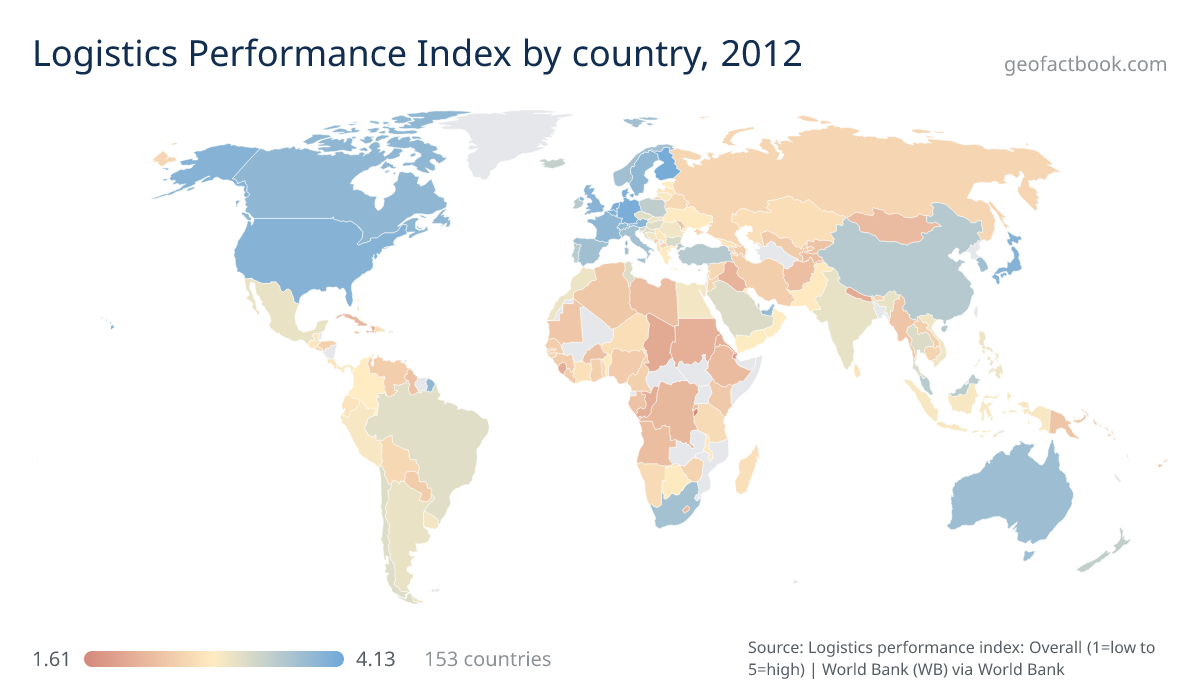
Logistics Performance Index by country, 2012: map image
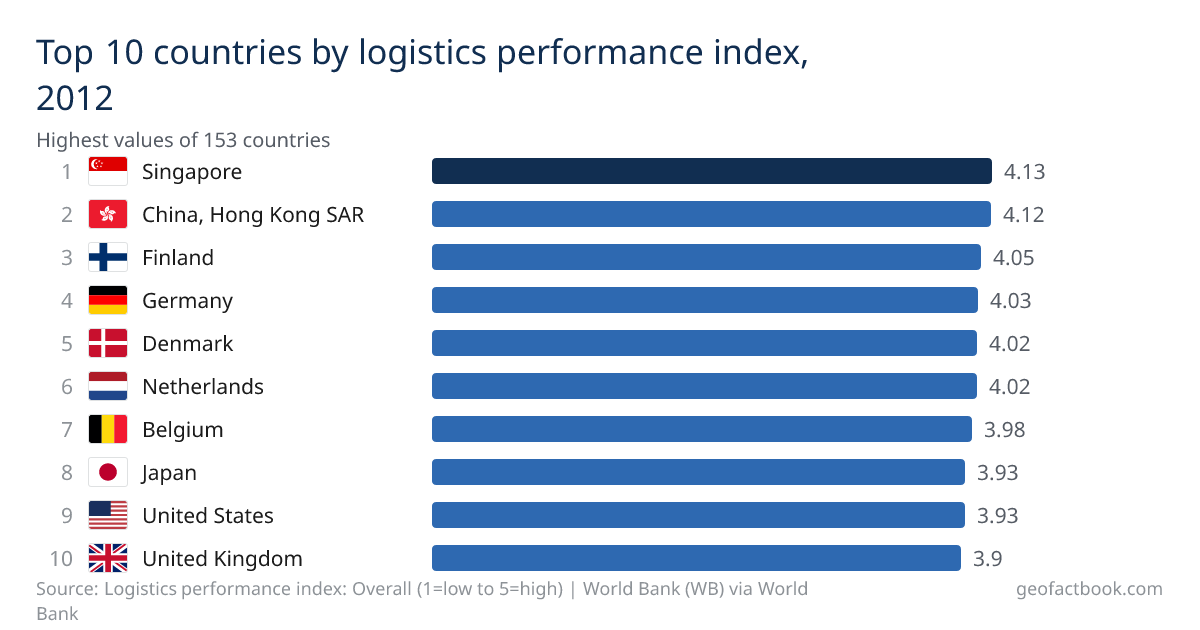
Top 10 countries by logistics performance index, 2012: chart
Insights by country
Libya
In 2012, Libya achieved a Logistics Performance Index of 2.28, placing it at #135 out of 153 countries. This performance is notably below the global average, indicating significant challenges in logistics compared to more developed nations. Factors contributing to this low ranking include ongoing political instability and inadequate infrastructure, which hinder efficient transportation and trade processes within the country.
Belarus
In 2012, Belarus achieved a Logistics Performance Index of 2.61, ranking #90 out of 153 countries. This score placed Belarus below the global average, indicating challenges in its logistics infrastructure compared to top performers like Germany. Key factors influencing this performance include Belarus's central location in Europe, which provides strategic transit routes, and ongoing economic reforms aimed at enhancing trade efficiency.
Luxembourg
In 2012, Luxembourg achieved a Logistics Performance Index score of 3.82, ranking #15 out of 153 countries. This places Luxembourg above the global average, reflecting its strong logistics infrastructure compared to many of its neighbors in Western Europe. The country's strategic location at the crossroads of major transport routes, combined with its robust economy and investment in logistics services, contributes significantly to its high performance in this metric.
Congo
In 2012, Congo achieved a Logistics Performance Index of 2.08, ranking #147 out of 153 countries. This performance places Congo significantly below the global average, indicating severe challenges in logistics compared to more efficient nations. Factors contributing to this low ranking include inadequate infrastructure, limited transportation networks, and ongoing political instability, which hinder effective supply chain management and trade facilitation.
Singapore
In 2012, Singapore achieved a remarkable Logistics Performance Index of 4.13, ranking #1 out of 153 countries. This performance significantly outpaced regional competitors, underscoring Singapore's position as a global logistics hub. Key drivers of this success include its strategic geographic location along major shipping routes and robust government policies that promote trade facilitation and infrastructure development.
Armenia
In 2012, Armenia achieved a Logistics Performance Index of 2.56, ranking #97 out of 153 countries. This score is notably lower than the global average, indicating challenges in logistics efficiency compared to top performers like Germany, which consistently ranks at the top. Key factors affecting Armenia's logistics performance include its landlocked geography, which limits access to major shipping routes, and ongoing economic constraints that impact infrastructure development.
Turkey
In 2012, Turkey achieved a Logistics Performance Index of 3.51, ranking #26 out of 153 countries. This position places Turkey above the global average, showcasing its strategic importance as a logistics hub between Europe and Asia. Key drivers of this performance include Turkey's extensive transportation infrastructure and its central geographic location, facilitating trade routes and access to major markets.
Angola
In 2012, Angola had a Logistics Performance Index of 2.28, ranking #134 out of 153 countries. This score places Angola significantly lower than many of its regional peers, reflecting challenges in logistics infrastructure and services. Key drivers of this low performance include the country's underdeveloped transport networks and a history of civil conflict, which have hindered investment and efficiency in the logistics sector.
Netherlands
In 2012, the Netherlands achieved a Logistics Performance Index value of 4.02, ranking #6 out of 153 countries. This performance places it among the top logistics hubs globally, with only countries like Germany and Singapore surpassing it. The Netherlands benefits from its strategic geographic location in Europe, a well-developed infrastructure, and a highly efficient logistics sector, which collectively enhance its trade capabilities.
Qatar
In 2012, Qatar achieved a Logistics Performance Index of 3.32, ranking #32 out of 153 countries. This performance is notably higher than many regional peers, highlighting Qatar's strategic position as a logistics hub in the Middle East. Factors contributing to this ranking include its significant investment in infrastructure, such as the Hamad International Airport and extensive road networks, which facilitate efficient trade and transport.
Analysis & Context
In 2012, the Logistics Performance Index was led by Singapore with a score of 4.13, representing the highest logistics efficiency among 153 countries. The global range of the index spanned from 1.61 to 4.13. The global average score was 2.87, while the median score was 2.77, suggesting a modest level of logistics performance worldwide.
Top Performers and Their Economic Influence
The top performers in the Logistics Performance Index, such as Singapore (4.13), China, Hong Kong SAR (4.12), and Finland (4.05), highlight the critical role of strategic geographic positioning and advanced infrastructure in logistics efficiency. Singapore's position as a global trade hub is bolstered by its world-class port facilities and connectivity, which facilitate efficient movement of goods. Similarly, Hong Kong's logistics prowess is supported by its status as a major re-export center, benefiting from proximity to mainland China and a well-developed transport infrastructure.
In Europe, Germany (4.03) and the Netherlands (4.02) exemplify how robust logistics networks can enhance trade capabilities. Germany's central location in Europe and its extensive rail and road networks contribute to its high logistics performance. The Netherlands, with its pivotal port in Rotterdam, serves as a gateway to Europe, emphasizing the importance of strategic infrastructure investment in boosting logistics efficiency.
Challenges Facing Low-Performing Countries
On the lower end of the index, countries like Burundi (1.61) and Djibouti (1.8) face significant logistical challenges. These nations often struggle with inadequate infrastructure, political instability, and limited access to global markets, which impede their logistics performance. For instance, Burundi's landlocked geography and underdeveloped transport systems limit its trade capabilities, while Djibouti's reliance on external investment for port development underscores the challenges faced by smaller economies in improving logistics efficiency.
In Haiti (2.03) and Chad (2.03), political instability and limited infrastructure development are key factors contributing to their low scores. The lack of reliable transportation networks and technology in these countries restricts efficient supply chain operations, hindering economic growth and development.
Infrastructure and Policy as Key Drivers
Infrastructure and policy frameworks are pivotal in determining logistics performance. Countries with well-established policies that support trade and investment, like Denmark (4.02) and Belgium (3.98), demonstrate higher logistics efficiency. Denmark's efficient customs procedures and Belgium's strategic location with a comprehensive road and rail network enhance their logistics performance, facilitating seamless movement of goods.
Conversely, Sudan (2.10) and Eritrea (2.11) illustrate how inadequate infrastructure and restrictive policies can impede logistics efficiency. In these countries, limited investment in transport infrastructure and regulatory barriers can stifle logistical operations, reflecting the broader economic challenges they face.
The Role of Technological Advancement
Technological advancement plays a crucial role in enhancing logistics performance. Countries like Japan (3.93) and the United States (3.93) leverage advanced technology to optimize supply chain operations. Japan's integration of cutting-edge technology in its logistics processes, such as automation and real-time tracking, enhances efficiency and reduces costs. The United States, with its vast logistics network, benefits from technological innovations that streamline operations across its extensive supply chain.
In contrast, countries like Comoros (2.14) and Nepal (2.04) face technological limitations that hinder their logistics capabilities. The lack of access to modern technology and infrastructure investment in these countries restricts their ability to compete in the global market, emphasizing the need for technological adoption to improve logistics performance.
Overall, the 2012 Logistics Performance Index underscores the significant impact of infrastructure, policy, and technology on logistics efficiency. Countries leading the index demonstrate the benefits of strategic investments and policy frameworks that support efficient logistics operations, while those at the lower end highlight the challenges and opportunities for improvement in global logistics capabilities.
Frequently Asked Questions About Logistics Performance Index in 2012
Which country had the highest Logistics Performance Index in 2012?
Singapore had the highest Logistics Performance Index in 2012, with a score of 4.13.
Which country had the lowest Logistics Performance Index in 2012?
Burundi had the lowest Logistics Performance Index in 2012, with a score of 1.61.
What was the average Logistics Performance Index score in 2012?
The average Logistics Performance Index score in 2012 was 2.87.
What was the median Logistics Performance Index score in 2012?
The median Logistics Performance Index score in 2012 was 2.77.
How many countries were included in the Logistics Performance Index dataset for 2012?
The Logistics Performance Index dataset for 2012 included 153 countries.
Which countries were in the top 3 of the Logistics Performance Index in 2012?
The top 3 countries in the Logistics Performance Index in 2012 were Singapore, China, Hong Kong SAR, and Finland.
Data Source
Logistics performance index: Overall (1=low to 5=high) | World Bank (WB) via World Bank
Data produced by Connecting to Compete - Logistics Performance Index (LPI), World Bank (WB), compiled and published by World Bank as "Logistics performance index: Overall (1=low to 5=high)".
Visit Data SourceCite this page
Geo Factbook. (n.d.). Logistics Performance Index by Country, 2012. Retrieved November 29, 2026, from https://geofactbook.com/fact/logistics-performance-index/2012
The figures on this page come from Logistics performance index: Overall (1=low to 5=high) | World Bank (WB) via World Bank. For academic work, cite the original source as well.
›Embed this ranking on your site
Free to embed with attribution. Shows the top 10 countries and links back to the full ranking.
Historical Data by Year
Explore Logistics Performance Index data across different years. Compare trends and see how statistics have changed over time.
More Economy Facts
See all Economy facts →Current Health Expenditure (% of GDP)
Current health expenditure as a percentage of GDP highlights spending trends. Compare countries, explore rankings, and view historical data.
 Highest: Tuvalu27.09 % of GDP
Share of population in poverty ($3 a day)
Share of population in poverty ($3 a day) statistics by country with historical data from Our World in Data.
 Highest: Honduras15.72
GNI Per Capita (PPP)
GNI per capita (PPP) shows the average income earned per person, adjusted for purchasing power.
Highest: Singapore135,750 USDYou might also like
Rule of Law Index by Country
FeaturedCompare countries by Rule of Law percentile rank, reflecting confidence in laws, courts, police, property rights, and protection from crime and violence.
Highest: Finland100%Life expectancy at birth
FeaturedLife expectancy at birth measures the average years a newborn is expected to live, reflecting a country's health standards and quality of life. This vital statistic highlights disparities in healthcare and living conditions across nations, making it essential for global health assessments.
 Highest: Monaco89.29 years
Median age of population
FeaturedThe median age of a population is a key demographic indicator, reflecting the age distribution within a country. Understanding median age helps assess economic development, healthcare needs, and social dynamics. Countries with a higher median age may face challenges related to aging populations, while younger populations often indicate growth potential.
Highest: Monaco53.17 years